# Base-fee controller RFC
**Author: Valardragon**
One of the most important things for app-chains to iterate on is their fee market.
A clever insight of the EIP-1559 work, is that we can abstract ~all the complexity for the end-user, and have them provide just two terms: `max_fee_amount, tip_amount`. We have the chain determine, via some mechanism, the base fee for a given tx. (The inputs into this algorithm are up to the chain) The user is then charged `base_fee + max_tip_amount`. If `base fee > max_fee_amount`, then no fee is charged and the tx reverts. Otherwise, `min(base_fee + max_tip_amount, max_fee_amount)` will be charged from the user.
The key concern is we need this base fee to be easy for wallets to reason about. How do they choose this `max_fee`, and whats a reasonable tip.
This RFP proposes an API, and a registry, with the goal that:
- Enables easy additions of new fee markets for app-chains
- Front-ends can easily determine reasonable max fee amounts
## Fee market candidate ideas
We briefly list a few anticipated fee market ideas that we need to support, so we can keep these in mind. Theres a lot to do here, so the list is mostly to point out things that could induce new complexities, and we wish to abstract so wallets don't have to think about it.
- direct EIP-1559
- EIP-1559 with features that respond to surges more directly (["AIMD"](https://hackmd.io/VoyaxCIoRoqd01U--NMV3g?both))
- So it becomes a bit harder to reason about the "max" base fee for normal users
- multi-variate EIP-1559 for each "high-level" resource
- E.g. independent base fees for bandwidth, compute, storage read/writes
- Any/All of the above, with increasing fees for repeated access to the same state
- So during an NFT mint, all txs to that NFT contract get higher fees, but all other txs remain relatively the same.
- Protocol subsidization of certain types of txs
- e.g. staking having a lower base fee
- e.g. having swap fee count towards tx fee
## (Context) Front-end side needs
We start with what information the wallet would need, as it will inform what needs to be exposed from the chain interface.
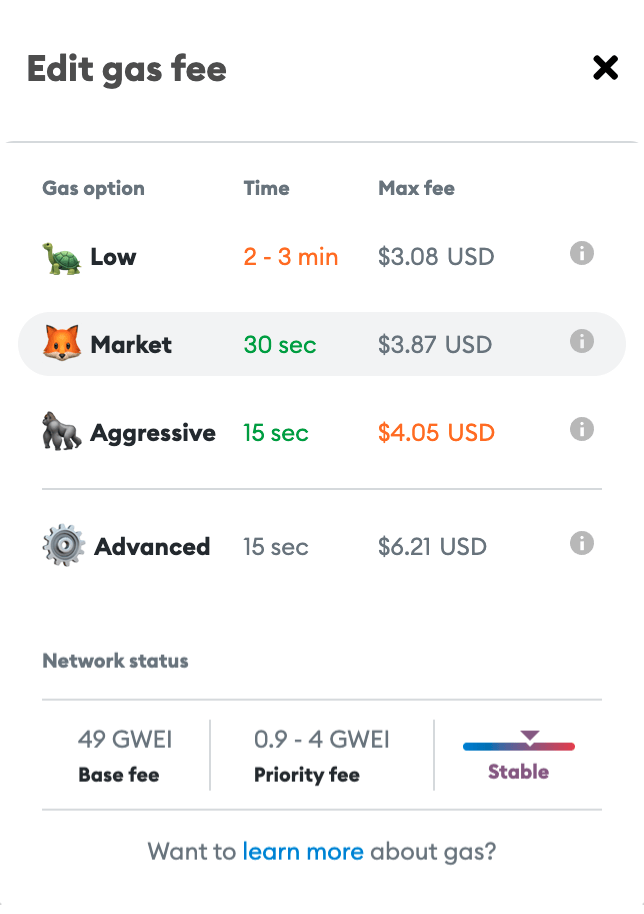
Something thats nice, is that a wallet choosing how to reason about tips is basically independent of all of this. Its relatively easy to scan the chain, and determine what the tip standard price is. This changed how [metamask displayed & reasoned](https://metamask.io/1559/) about it. Screenshots posted below. But the intuition is that "priority" is really just the tip, which doesn't require guessing. You can just read the current market rate, and choose how you pay relative to market rate.
So we see the following UX metamask switched to:
Pre-eip1559 | Post-1559
:-------------------------:|:-------------------------:
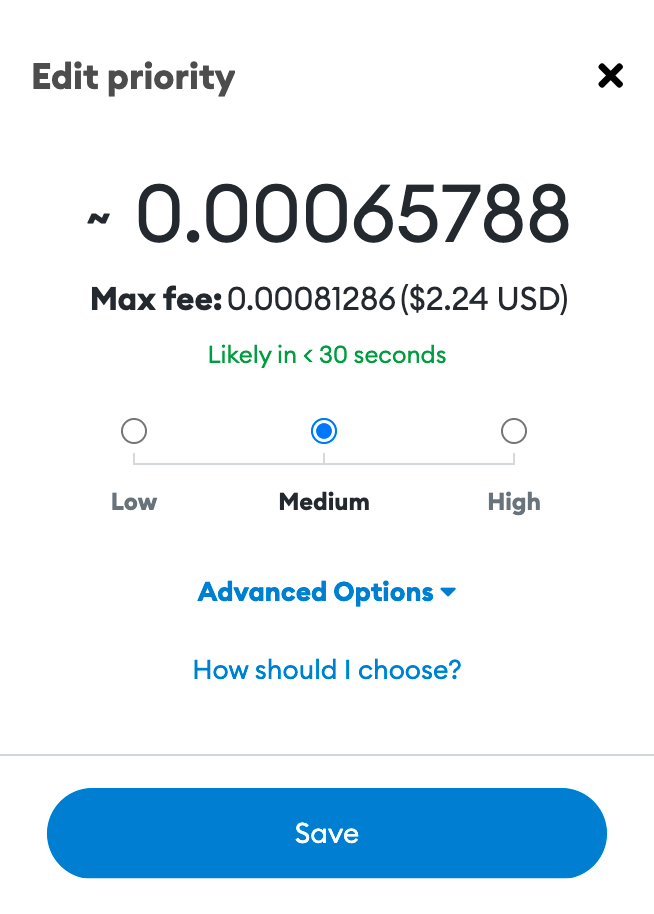 | 
To generate such a UX, they'd have to get a way to:
- Determine "market rate" of Tip's, and some quartile distribution of this
- Query current base fee that applies to a given tx
- Make some prediction around base fee volatility.
- Some of this volatility is encompassed with `max_tip` if bidding higher on that.
Today Metamask just gets this all by looking at the last block, nothing fancy. We should be designing something with ability to do a bit better than that.
We should expose on-chain queries per block for:
- 25th, 50th, 75th percentile of fee tip per unit gas in block B
- Base fee if this tx was submitted now
- Avg base fee for this type of tx in block B
And then indexers could take this data, and create this over multiple blocks.
## Typescript library interface
Any basefee algorithm in the registry should have an accompanying typescript object satisfying the following interface.
```typescript
interface BaseFeeQuerier {
// or whatever is the standard for rest is.
querier: CosmJsClient;
// does some one-time setup work, e.g. if your fee market has some parameters,
// query the chain for them and cache them
setup: () -> void;
// get base fee for this set of []sdk_Msg at this block height.
// Note that its up to the library to determine what queries it needs
// to do. It should aim to do minimal queries to the chain, and leak
// as little info about the msgs as required.
//
// So if there is nothing msg dependent for this algorithm, don't query
// anything including the msgs.
basefee: (block_number: number, msgs: sdk_Msg[]) => sdk_decimal;
// same as above, but returns a distribution.
// up to the algorithm to infer how to define low/p25/p50/p75/max
// for message dependent base-fees, w/o many of that message in the last block.
// we can work this out in more detail
basefee_distribution: (block_number: number, msgs: sdk_Msg[]) => Distribution;
// average tip for this "type" of transaction, in this block height.
// same as above, the library should leak minimal info about the message,
// depending on whats needed.
tip: (block_number: number, msgs: sdk_Msg[]) => sdk_decimal;
tip_distribution: (block_number: number, msgs: sdk_Msg[]) => Distribution;
}
interface Distribution {
num_samples: number;
low: sdk_decimal;
// p stands for percentile
p25: sdk_decimal;
p50: sdk_decimal;
p75: sdk_decimal;
max: sdk_decimal;
}
```
Then the wallet uses these queries. We expect wallets to in practice just query `basefee(last_block, msgs)` and `tip(last_block, msgs)` as is commonly done in Ethereum today. We expect the set `max_base_fee` to be some multiple of the `basefee` of the prior block. We leave these other distribution queries for people wanting more complex aggregations.
### Reasoning about base fee growth
We explicitly do not include any queries for generically reasoning about the base fee in subsequent blocks. If wallets wish to do this, they should extrapolate this via generic means from historic base fees, or white-box something for the specific algorithm.
As time goes on, and fee market experiments continue, we can maybe learn better generic methods to do this. But the "max" a base fee can grow to in (say) 5 blocks time should be large for surge-resiliency. It only grows larger as we get increasingly multi-dimensional fee markets.
The actual max will likely trend to being ludicrously large (and never getting hit), so having this in the default API will likely result in users getting over-quoted prices.
## Data provider interfaces
There should ideally be data providers who make a standard service to adapt the queries ran in the front-end, to give the distribution over block ranges. E.g. serving
```typescript
interface BatchedBaseFeeQuerier {
basefee_distribution: (start_block: number, end_block: number, msgs: sdk_Msg[]) => Distribution;
tip_distribution: (start_block: number, end_block: number, msgs: sdk_Msg[]) => Distribution;
}
```
## Chain-side interface
The interface the chain exposes really comes from the typescript library. It just has to be able to look at a block, and respond to the queries that the library makes. What we need to standardize on across all chains, is how we format the tx body, the actual queries are abstracted behind the typescript interface.
### Tx interface
I'm very amenable to change this entire section, this is just a suggestion from my end.
Its a design goal that for most chains, we support both the "old" fee format, and this new fee format of `(max_fee, max_tip)`.
For the old fee format, we can interpret their old fee F as `(max_fee=F, max_tip=F)`.
With that as context, then we can actually re-use the old tx.proto field for Fee: https://github.com/cosmos/cosmos-sdk/blob/main/proto/cosmos/tx/v1beta1/tx.proto#L207-L209
Ideally, we'd rename `amount` to `max_amount`. Also, we'd ideally add a new field directly into this, called `max_tip` for amount (thats optional), as that would be serialization compatible with old libraries.
That would be breaking, so we should eventually go to that upon SDK changes. But in the interrim, we can use the tx "critical extensions", to express `max_tip` amount until then.
### Default stack to make implementation easy
#### Goal
As we want to allow chains to change a lot of the fee market stack, its too complex to write a software stack easily write _any_ imagined base-fee controller.
Instead I propose we make a default interface to ease iteration, for any base-fee controller that is _isolated_. An _isolated_ controller is going to be one where in block N, the base-fees paid by `tx_1` and `tx_2` are fully independent. (So `tx_1` using more of one resource, can't increase the base fee of `tx_2` for the same resource) Importantly, both `tx_1` and `tx_2` will affect base fees in the _next_ block, but not for each other in the same block.
This isolation still enables different fee controllers for gas, bandwidth, i/o, and different controllers per message type. It does not enable increase of cost, for repeated access to the same state within a block. It does enable this for repeated access across blocks.
#### Proposal
##### Fee deduction side
There should be a `base-fee-controller` ante-handler, that has access to a unique portion of state just for it. (e.g. taking a prefix store that only it has access to)
The base-fee controller should take in a base-fee algorithm, and recipients for base-fee and tip. Lets define the interface for a base-fee algorithm:
```go
type BaseFeeAlgo interface {
GetRequiredBaseFee(ctx, tx sdk.Tx) sdk.Coin
GetBaseFeeReceiver(ctx) sdk.Addr
GetTipReceiver(ctx) sdk.Addr
}
```
The `base-fee-controller` ante-handler will then run as follows:
```go
func (h handler) DeductFees(ctx, tx) error {
feePayer := tx.GetFeePayer()
maxFee := tx.GetMaxFee()
baseFee := h.GetRequiredBaseFee(ctx, tx)
if maxFee < baseFee {
return errors.New("insufficient base fee, minimum is %d, got %d", baseFee, maxFee)
}
maxTip, isLegacy := tx.GetMaxTip()
if isLegacy {
maxTip = maxFee
}
remainingFee := maxFee - baseFee
tipAmt := min(remainingFee, maxTip)
err1 := h.DeductBaseFee(feepayer, baseFee)
err2 := h.DeductTip(feepayer, tipAmt)
if err1 != nil {
return err1
}
if err2 != nil {
return err2
}
}
```
##### Query serving side
We similarly run into a problem where its not obvious how to abstract the queries when different msg types can have different fees. As if your base-fee algorithm is transaction aware, then you need to different queries type-script side to make it sensible.
For now we assume there will be one standard implementation people use for base-fee algorithms that don't depend on the type of transactions, and leave simplifying the query interface for tx-type dependent base fees to future work. (Its valuable to get this out as is, and wallet side everything will gracefully work with this change)
We don't show the sample implementation in this case, since its pretty simple end block logic. (Scan all txs, read base fee & tip, save the distribution data to state)
### Mempool interface
The app-chain is already responsible for making a mempool that interoperates with its fee algorithm. So conceptually nothing changes, if you modify the fee market you should consider modifying the mempool.
We suggest two common defaults that should emerge, and then greater complexity becomes app-specific.
The choice of general mempool approach (priority vs fifo) should appear in the chain-registry. Then the typescript libraries can ensure that for fifo mempools tip is always near-zero.
#### Priority based mempools
This one is pretty simple, have a standard ethereum-like mempool, with txs satisfying base-fee requirement sorted by tip. If multiple txs have the same tip, sort FIFO (cref [this being done in geth](https://github.com/ethereum/go-ethereum/issues/21350))
#### FIFO based mempools
For chains where sandwitching is an active concern, it seems better to actually standardize around tipless txs, and have all txs sorted by first-in-first-out order. Note that you already have a "time to get on-chain" somewhat guaranteed here -- base fee price keeps going up, pricing out people ahead in queue.
So your node maintains a mempool with the main list being txs meeting base-fee, sorted by receipt time.
It also maintains a (small) list of txs not meeting base fee, with receipt times still remembered. How we resource bound this is a bit of an open question, but I'd suggest:
- reject incoming txs below last base-fee
- prune anything from this list after its been there for k minutes
- once max `active + inactive` list length is reached, new txs meeting base fee pop off lowest base fee txs from this inactive list.
This mempool should also have replace-by-fee semantics. (So if an address submits a higher fee tx w/ the same sequence, replace the old tx but keep that older receipt time)
Features can be built off this as the base.
## Registry interface
The registry should be a github repo, with a registry listing:
- enum id
- entry name
- npm package name, version, hash
- typescript github repo
With time, hopefully tooling emerges, that enables a wallet to import a wrapper repo, and just specify the enum_id's it wishes to include at compile time. (Effectively mimicking rust feature flags, with the registry)
## Anticipated questions
### How should we determine registry enums
To be honest, I'm very unopinionated here. I'm fine with it literally being PR number to whatever repo this is lol.
### What about Escalator fees?
Escalator fees can still be done, thats actually a different layer of abstraction that can be done on top of this.
Whats nice is staircase fees can be designed around _any_ base-fee market :)
### Fee distribution
This up to the chain to decide as today. They could choose to burn base-fees, follow the distribution we do today in cosmos, etc. This is something that affects the market structure, but is thankfully abstracted to not be the wallets job!
### How will tips play out?
This depends on mempool design, and fee distribution design!
In Ethereum base fee is burned, but we don't need to do the same. We can distribute across many validators (smoothening), have some collected by community pool, etc.
So this depends on details of each app :)
### How do we ensure wallets are truly able to easily extend
Inspired a bit by [this post on the extensibility of TLS](https://www.imperialviolet.org/2016/05/16/agility.html), its important to ensure were getting a wallet-side ecosystem that truly lets us move between these mechanisms.
I think ensuring as a community that we add more enums to the spec within the first year will help enforce agility of this interface.
### Anticipated initial registry enums
- Base EIP-1559
- `setup()` will indicate if the default network mempool is priority or fifo
- AIMD
 Google Drive
Gist
Clipboard
Google Drive
Gist
Clipboard
 Sign in via Google
 Sign in via Facebook
 Sign in via X(Twitter)
 Sign in via GitHub
 Sign in via Dropbox
 Sign in with Wallet






