# CRISPR Background
[BI397 at MBL Lab](https://hackmd.io/@ColbyMBL/index)
## Background
Experimental manipulations are an important tool to investigate how patterns are created during development. By disrupting specific elements of a developing system, we can infer the normal function of that element from changes in the phenotype. Lose-of-function experiments of this kind can be done by removing cells from an embryo or juvenile, but also by removing the function of genes.
Historically, genetic control of development was studied by mutagenesis. In this method, mutations are created at random throughout the genome by chemical mutagens or X-ray damage. Many individuals need to be screened for a phenotype altering the structure or developmental process under study. Then the affected gene must be mapped and characterized at the level of its DNA sequence. That process is laborious and prone to bias at levels of mutation and screening.
### CRISPR/Cas9
CRISPR/Cas9 gene editing is a method that can be used to permanently alter DNA in live cells at specific targeted sequences. It relies on Cas9, which evolved for viral defense in the bacterium *Streptococcus pyogenes*. Cas9 is an endonuclease, which can cut the phosphodiester bonds on both strands of DNA, producing a double-strand break. Unlike other endonucleases, Cas9 is directed to cut DNA by a short guide RNA. In *Strep. pyogenes* this guide consists of two separate RNAs. A tracrRNA has a sequence that is recognized and bound by Cas9. This component is generic. However, a crRNA has a 3$^\prime$ region of base complementary to the tracrRNA and a 5$^\prime$ sequence that targets the Cas9/RNA complex to a specific DNA sequence. In *Strep. pyogenes* the crRNA sequence is derived from viral genes that have previously infected the cell. In this way the bacterium is able to recognize and destroy new, invading viral DNA ([Barrangou 2015](https://www.ncbi.nlm.nih.gov/pubmed/25574773)).

> **Figure 1.** In *Streptococcus pyogenes* Cas9 uses a generic tracrRNA and a target-specific crRNA to identify and destroy viral DNA. (Image source: https://sg.idtdna.com/jp/)
The *Strep. pyogenes* immune mechanism has been modified to become a versatile tool of molecular genetics. *Cas9* has been cloned into *E. coli* were the protein can be grown and produced in large quantities. To increase its effectiveness in eukaryotic cells, most researchers use a modified version of the protein that includes a eukaryotic nuclear-localization signal (NLS) peptide at the N-terminus of the protein. While it is possible to use a crRNA and tracrRNA, many researchers use a single short guide RNA (sgRNA) to simplify the process. The guide RNA must retain a specific 80-nucleotide sequence at its 3$^\prime$ end, which is bound by Cas9: 5$^\prime$-GUUUUAGAGCUAGAAAUAGCAAGUUAAAAUAAGGCUAGUCCGUUAUCAACUUGAAAAAGUGGCACCGAGUCGGUGCUUUU-3$^\prime$. At the 5$^\prime$-end almost any 20-nucleotide sequence can be used to target Cas9 to a position in the genome. There Cas9 will cut leaving a 1-bp overhang, 17-nucleotides from the 5$^\prime$-end of the guide's sequence ([Zou & Liu 2016](https://www.nature.com/articles/srep37584)). Most animal cells will repair double-strand breaks of this kind using a mechanism called non-homologous end joining (NHEJ). However doing so produces a small deletion, at least 1 bp but sometimes 100's of bp. If the target is within the coding sequence of a gene, these mutations may cause a frame-shift that renders the gene non-functional.

> **Figure 2.** Most applications of CRISPR/Cas9 for gene editing now use a single guide RNA (usually abbreviated sgRNA, but labeled gRNA in this figure). This guide targets Cas9 to a specific target DNA sequence, where it makes a double-strand break, which can then be repaired by NHEJ, albeit with a high frequency of intel mutations. (Image source: https://www.addgene.org/crispr/guide/)
#### Short guide RNA design
With the rise of CRISPR/Cas9 gene editing, guide design has become a useful skill and a many companies charge to provide algorithms that automate the process. However, the basic rules are straight forward. The only major constraint on the selection of a target DNA sequence is necessity of a protospacer adjacent motif (PAM). Enzymes similar to Cas9 have evolved in several different bacterial species, where the PAM sequence differs. However in the most commonly used commercial versions of Cas9, derived from *Strep. pyogenes*, the PAM sequence is 5$^\prime$-NGG-3$^\prime$ (where "N" is any base followed by two guanines). This PAM sequence must appear immediately downstream of the targeted sequence in the genome. (However, the PAM sequence does not appear in the guide RNA.)

> **Figure 3.** And example of how Cas9 and an sgRNA are positioned relative to a target DNA and the PAM sequence. (Image source: https://web.science.uu.nl/developmentalbiology/)
People working with CRISPR in diverse organisms have also developed a set of other suggestions for designing sgRNAs (e.g. [Zhang & Reed 2017](https://www.researchgate.net/publication/319369908_A_Practical_Guide_to_CRISPRCas9_Genome_Editing_in_Lepidoptera/fulltext/59a74da3a6fdcc61fcfbd675/A-Practical-Guide-to-CRISPR-Cas9-Genome-Editing-in-Lepidoptera.pdf); [Addgene 2017](https://blog.addgene.org/how-to-design-your-grna-for-crispr-genome-editing); Martin & O'Connell in press).
- Avoid target sites close to start codon of a gene. In some cells, some genes may be able to use alternative ATG start codons downstream of the annotated start codon.
- Similarly, avoid target sites close to the stop codon of a gene to maximize the chances of creating a non-functional allele.
- If you are working from transcript sequence, there is a risk that the designed target sequence will span an exon-exon junction. If so, the guide RNA is unlikely to bind the genome.
- A guide sequence can be 17-27 nucleotides, on either strand. But 20 nt may be optimal.
- Watch out for N's in your sequence. Do not choose sequences that include N's.
- Never use a guide with 3 or more U’s in a row. This sequence can act as an RNA polymerase III terminator.
- The GC content of the target sequence should be between ~ 30-80%. Higher GC content, especially at the 3$^\prime$ end may increase editing efficiency, since it increases the binding strength of the sgRNA with the DNA. However, targets that are very high in %GC may be unlikely to open in the first place!
- Avoid additional G‘s after the PAM.
- If sgRNAs will be transcribed from a PCR product of plasmid, be sure there is a 5$^\prime$-GG sequence. If one does not naturally occur in the target sequence, just add it anyway. This sequence increases the efficiency of transcription from a T7 promoter. Any mismatch at the 5$^\prime$-end will not negatively impact the guide's binding to the target DNA.
### The butterfly wing as a model for tissue patterning
In developmental biology, patterning is the process by which initially equivalent cells adopt different fates. While there are many contexts in which this takes place, some systems have been studied extensively as generalizable models. The appendages or insects and vertebrates are classical systems for the study of patterning. Studies of pigmentation patterning in diverse animals have recently become increasingly common.

> **Figure 4.** The painted lady butterfly, *Vanessa cardui*, showing the ventral side of its wings. (Image source: WikiMedia)
In this course, we will use the wings of the painted lady butterfly, *Vanessa cardui*, as a model to study patterning. This system has many advantages. Caterpillars are commercially available throughout the year, and the entire life cycle can be completed in captivity. Newly laid eggs hatch and develop to adulthood in 5 weeks. This species is also native to New England, so (while we will not plan to release any animals) there is limited ecological risk from accidental release. Importantly, a [transcriptome is available](http://www.butterflygenome.org/?q=node/4) for this species and a [web portal has been constructed for BLAST search](http://www.butterflygenome.org/?q=node/5) of those sequences. The development of butterfly wings has also been studied in some detail, provided some basic context.

> **Figure 5.** The generalized anatomy of nymphalid butterfly wing patterns. Pattern elements are organized in parallel. From distal to proximal, there are marginal and submarginal bands (chevrons in some species), the border ocelli (sometimes enlarged to form eyespots), and the central and basal bands. These pattern elements are repeated in the individual wing cells, which are bordered by veins. Pattern elements are thought to share developmental mechanisms, but are known to evolve separately. (Image source: [Beldade & Brakefield 2002](https://www.ncbi.nlm.nih.gov/pubmed/12042771))
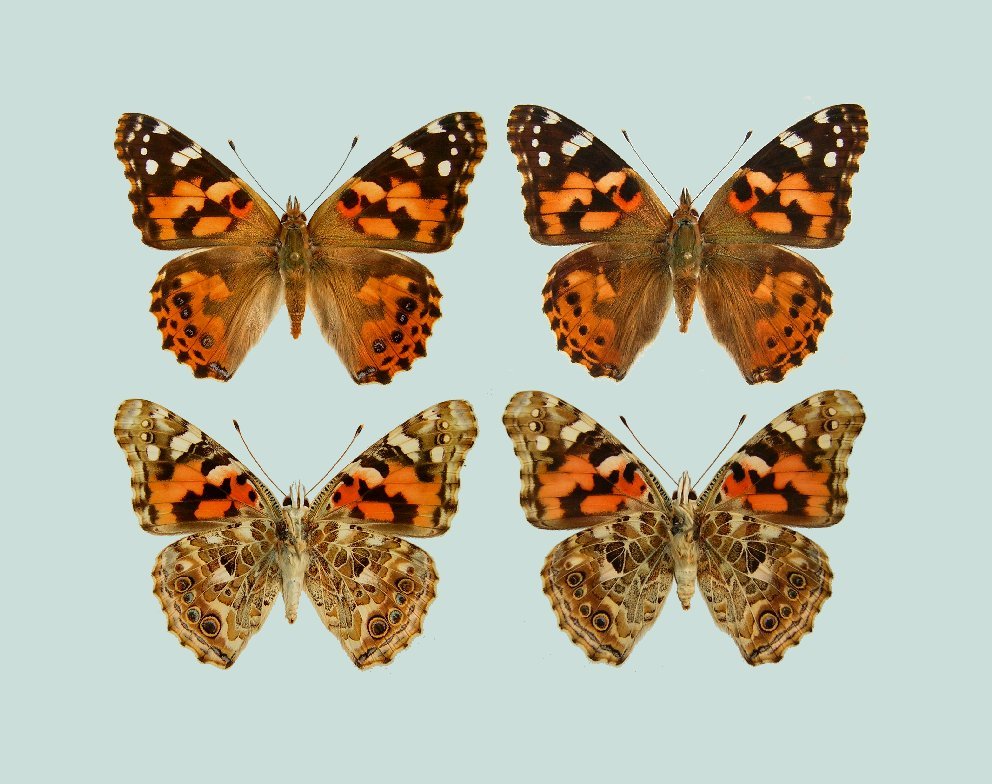
> **Figure 6.** The wings of *Vanessa cardui*. Dorsal surfaces are in the top row; ventral surfaces are the bottom row. Males are on the left; Females on the right. Females tend to be larger than males, but there is no reliable pattern to distinguish the sexes. (Image source: http://www.raisingbutterflies.org/painted-lady/)
#### Genes with known roles in butterfly wing patterning
- **WntA** encodes a morphogen that organizes much of the pattern across the wing ([Mazo-Vargas et al., 2017](https://www.pnas.org/content/114/40/10701)). CRISPR experiments in *V. cardui* targetting *WntA* have bee quite successful, including in undergraduate courses (Martin & O'Connell, in press).
- ***Distal-less* (*Dll*)** encodes a transcription factor required for the development of distal appendages in most animals. It is also known to be required for the border ocelli and marginal elements of the butterfly wing. *Dll* loss-of-function produces different phenotypes depending on the part of the protein that is targeted ([Zhang & Reed, 2016](https://www.nature.com/articles/ncomms11769); [Connahs et al., 2019](https://dev.biologists.org/content/146/9/dev169367)).
- ***optix*** encodes a protein required for orange pigmentation ([Zhang et al., 2017a](https://www.pnas.org/content/114/40/10707)).
- Several genes with roles in melanic pigment production are known or strongly predicted to have role in wing pigmentation, including the transcription factor ***spineless***, and the enzymes encoded by *Dopadecarboxylase* (***Ddc***), ***yellow***, ***ebony***, and ***black*** ([Zhang & Reed, 2016](https://www.nature.com/articles/ncomms11769); [Zhang et al., 2017b](https://www.genetics.org/content/205/4/1537)).
#### Additional candidate genes
- **EGF** signaling is important in the development of insects wings, especially in veins. Since the placement of veins is key the patterning of butterfly wings, it is possible EGF signaling is involved in this process.
- The **atypical cadherin pathway**, also known by the names of two of its components **fat** and **Hippo**, controls planar cell polarity (the orientation of epithelial cells) in the wings of *Drosophila*. Since each scale in the wing of a butterfly is homologous to the bristles of flies, it is possible that atypical cadherin signaling plays a role in patterning butterfly wings.
- ***doublesex*** (***dsx***) encodes a transcription factor that is a key regulator of somatic sex determination in insects.
## Materials
### Animals
- *Vanessa cardui* caterpillars (nature-gifts.com, [Caterpillar Refill Kit](https://www.nature-gifts.com/shop/grow-butterflies/caterpillar-refill-kit/))
### Larval food
This recipe is basd on instructions from Frontier Agricultural Sciences and Martin et al. (in press). Item #F9698B from Frontier Agricultural includes a dry mix (including soy flour, wheat germ, brewer's yeast, sugars, salts and perservatives), KOH solution, and dry agar. (Enough to make 10L.) The instructions below are for preparation of 1L. Ingredients can be mixed using a handheld kitchen mixer.
- In a 2-L beaker, mix 19 g dry agar with 710 ml water
- On a hot plate with a large stirring bar, bring the solution to a boil for 1 min
- Remove the mixture from the heat
- Add 246.1 g of dry diet and mix with hand-held mixer
- Add 6.84 ml of KOH solution (provided with the Frontier Agricultural diet) and mix for 10 s
- Add 300 ul of 25% (v/v) glacial acetic acid and mix for 10 s
- Optionally, add up to 30 g of fresh leaves from mallow, hollyhocks or sunflower
- Blend for 20 s or until thoroughly mixed
- Add 4 ml formaldehyde (37%)
- Add 8 ml canola oil
- Blend for 30 s or until thoroughly mixed
- Aliquot into 1.25 oz Plastic Souffle Cups (Frontier Agriculture Sciences, item 9091)
- Store in a sealed container at 4˚C for up to 2 weeks
### Housing and equipment for raising caterpillars
- an incubator
- 1.25 oz Plastic Souffle Cups (Frontier Agriculture Sciences, [item 9091](https://insectrearing.com/product/1-25-oz-plastic-cup/))
- tray for cups (Frontier Agriculture Sciences, [item 9040](https://insectrearing.com/product/cup-tray-30-wells/))
Pack larval food into the bottom of the cups. Each caterpillar needs 8-10 ml of food to complete development. Cover the cup with a small square of paper towel or KimWipe and snap on the lid. Keep them at 23-25°C with 40-60% relative humidity and a 12/12 light/dark cycle. Cover them from direct light to minimize condensation.
### Housing and equipment for keeping adult butterflies
- collapsible mesh enclosure (Carolina Biological Supplies, [item #674291](https://www.carolina.com/butterfly-habitats/carolina-butterfly-sanctuary/674291.pr))
- fresh leaves of mallow, hollyhock, or sunflower (available from a florist) in a cup or beaker of water
- an incandescent light bulb to heat plants to encourage oviposition
- a 1:1 solution of Gatorade and spring water
- a feeding station can be purchased with butterfly kits (e.g. from nature-gifts.com) or constructed by cutting a hole in a small plastic container and creating a wick out of a cotton ball
## References
- **Barrangou R.** (2015). The roles of CRISPR-Cas systems in adaptive immunity and beyond. *Curr. Opin. Immunol*. **32**, 36-41. [Link](https://www.ncbi.nlm.nih.gov/pubmed/25574773).
- **Beldade P, Brakefield PM**. (2002). The genetics and evo-devo of butterfly wing patterns. *Nature Reviews Genetics*. **3**(6), 442-52. [Link](https://www.ncbi.nlm.nih.gov/pubmed/12042771)
- **Connahs, H., Tlili, S., van Creij, J., Loo, T. Y., Banerjee, T. D., Saunders, T. E., Monteiro, A.** (2019). Activation of butterfly eyespots by *Distal-less* is consistent with a reaction-diffusion process. *Development*. **146**, dev169367. [Link](https://dev.biologists.org/content/146/9/dev169367)
- **Martin A, Wolcott NS, O'Connell LA.** (in press). Bringing immersive science to laboratory courses using CRISPR gene knockouts in butterflies and frogs. *J. Evol. Biol.*
- **Mazo-Vargas, A., Concha, C., Livraghi, L., Massardo, D., Wallbank, R. W., Zhang, L., Papador, J. D., Martinez-Najera, D., Jiggins, C. D., Kronforst, M. R.** (2017). Macroevolutionary shifts of WntA function potentiate butterfly wing-pattern diversity. *Proc. Natl. Acad. Sci.* **114** (40), 10701-10706. [Link](https://www.pnas.org/content/114/40/10701)
- **Zhang, L. & Reed, R. D.** (2016). Genome editing in butterflies reveals that *spalt* promotes and *Distal-less* represses eyespot colour patterns. *Nature Communications*. **7**, 11769. [Link](https://www.nature.com/articles/ncomms11769)
- **Zhang, L. & Reed, R. D.** (2017). A Practical Guide to CRISPR/Cas9 Genome Editing In Lepidoptera. In *Diversity and Evolution of Butterfly Wing Patterns: An Integrative Approach* (eds. Sekimura, T. & Nijhout, H. F.), pp.155–172. Singapore: Springer Singapore. [Link](https://www.researchgate.net/publication/319369908_A_Practical_Guide_to_CRISPRCas9_Genome_Editing_in_Lepidoptera/fulltext/59a74da3a6fdcc61fcfbd675/A-Practical-Guide-to-CRISPR-Cas9-Genome-Editing-in-Lepidoptera.pdf)
- **Zhang, L., Mazo-Vargas, A. and Reed, R. D.** (2017a). Single master regulatory gene coordinates the evolution and development of butterfly color and iridescence. *Proc. Natl. Acad. Sci.* **114**, 10707–10712. [Link](https://www.pnas.org/content/114/40/10707)
- **Zhang, L., Martin, A., Perry, M. W., van der Burg, K. R. L., Matsuoka, Y., Monteiro, A., Reed, R. D.** (2017b). Genetic basis of melanin pigmentation in butterfly wings. *Genetics*. **205**(4), 1537-1550. [Link](https://www.genetics.org/content/205/4/1537)
- **Zuo Z, Liu J.** (2016). Cas9-catalyzed DNA Cleavage Generates Staggered Ends: Evidence from Molecular Dynamics Simulations. *Scientific Reports*. **6**, 37584. [Link](https://www.nature.com/articles/srep37584)
---
[BI379 at MBL Lab](https://hackmd.io/@ColbyMBL/index)
 Google Drive
Gist
Clipboard
Google Drive
Gist
Clipboard
 Sign in via Google
 Sign in via Facebook
 Sign in via X(Twitter)
 Sign in via GitHub
 Sign in via Dropbox
 Sign in with Wallet






