---
title: "ELP305 - DESIGN AND SYSTEM LABORATORY"
subtitle: "CYCLE 1- DESIGINING SUSTAINABLE HOME"
author: "Tribe-B"
date: "January 19, 2022"
geometry: margin=2cm
output: pdf_document
---
<center ><img src= "https://upload.wikimedia.org/wikipedia/en/f/fd/Indian_Institute_of_Technology_Delhi_Logo.svg" width="200" height="200" /> </center>
<div style="page-break-after: always"></div>
<style>
img {
filter: grayscale(100%);
}
</style>
## Table of Contents
- [Authors](#authors)
- [Documentation](#documentation)
- [Documentation Statistics](#documentation-statistics)
- [Documentation Readability Indices](#documentation-readability-indices)
1. [Abstract](#Abstract)
2. [Introduction](#Introduction)
3. [Requirements](#requirements)
1. [Appliances](#appliances)
1. [Basic Appliances](#Basic-Appliances)
2. [Intermediate Appliances](#Intermediate-Appliances)
3. [Advanced Appliances](#Advanced-Appliances)
2 [General purpose appliances](#General-purpose-appliances)
3 [Kitchen Appliances](#kitchen)
4 [Living Room Appliances](#Living-Room)
5 [Sanity](#Sanity)
6 [Luxury](#Luxury)
7 [Water Supply](#water-supply)
8 [Domestic Electricity Consumption Statistics](#Domestic-Electricity-Consumption-Statistics)
9 [Energy Solutions](#Energy-Solutions)
1. [Solar Energy](#Solar-Energy)
2. [Wind Energy](#wind-energy)
3. [Organic Energy](#organic-energy)
4. [Hydro Energy](#hydro-energy)
5. [Piezoelectricity ](#Piezoelectricity )
6. [Geothermal Energy](#geothermal-energy)
7. [Storage Batteries ](#storage-batteries)
4. [Specifications](#Specifications)
1. [Energy Sources](#Energy-Sources)
1. [Wind Energy](#wind-energy)
2. [Solar Energy](#solar-energy)
3. [Biogas Energy](#biogas-energy)
4. [Micro Hydro](#Micro-Hydro)
5. [Piezoelectricity](#Piezoelectricity)
6. [Other Sources](#Uncoventional-Energy-Sources)
2. [Batteries](#Batteries)
1. [Nickel Metal Hydride Battery](#Nickel-Metal-Hydride-Battery)
2. [Lead Acid Battery](#Lead-Acid-Battery)
3. [Gell Battery](#Gell-Battery)
4. [Nickel Cadmium Battery](#Nickel-Cadmium-Battery)
5. [Lithium Ion Battery](#Lithium-Ion-Battery)
6. [Battery Comparision Table](#Battery-comaprision-table)
5. [Conclusion](#Conclusion)
5. [Appendix](#Appendix)
1. [Units](#units)
2. [Abbrevations](#abbrevations)
- [References](#references)
<div style="page-break-after: always;"></div>
## Documentation
| Document ID | v3.001 |
|--------------------------------------|-------------------------------------------------------------|
| Tribe | Tribe B |
| Approved for submission |Gurusha Juneja |
| Contact for correction/clarification |Gurusha Juneja- +91 83770 64625 |
| Submitted to | Prof. Subrat Kar, Instructor, ELP305 Design and Systems Lab |
| Date of submission | 26 January, 2022 |
## Documentation Statistics
- Word count : 2561
- Total number of unique words: 937
- Total number of repeated words: 1624
- Average number of words per sentence: 10
- Total number of sentences: 248
- Total number of characters: 8731
- Average number of characters per word: 3.4
- Average number of syllables per word: 2
## Documentation Readability Indices
| Index | Description | Value(0-10) |
|-------------------|--------------|----------------|
|Gunning Fog | The Gunning-Fog index returns a score that correlates approximately with the years of formal education needed for a reader to understand a textt | 9 |
|Coleman/Liau index | It gives a score that approximates the years of formal education needed to comprehend a sentence. | 6 |
|Automated Readability Index (ARI) | It produces an approximate representation of the US grade level needed to comprehend the text. | 3.2 |
|Smog Index |Outputs a U.S. school grade level; this indicates the average student in that grade level can read the text|8|
<div style="page-break-after: always;"></div>
## Authors
| Name | Entry No. | Role | Email ID | Participation(0-1) |
|---------------------|-------------|--------------------------------|----------------------|--------------------|
| Gurusha Juneja | 2019EE10480 | Tribe Coordinator,Wind Energy,Lead Acid Battery | ee1190480@iitd.ac.in | 1 |
| Bojja Neeraja | 2019EE10470 | Documentation Team Coordinator | ee1190470@iitd.ac.in | 1 |
| Ayush Verma | 2019MT60749 | Documentation Team Coordiantor, Wind Energy | mt6190749@iitd.ac.in | 1 |
| Akshat Gadhwal | 2019EE30551 | Documentation Team,Lithium-ion polymer batteries | ee3190551@iitd.ac.in | 1 |
| Deepanshu Chawala | 2018EE30537 | Documentation Team | ee3180537@iitd.ac.in | 1 |
| Mrityunjai Singh | 2019MT10705 | Documentation Team, Nickel–iron battery | mt1190705@iitd.ac.in | 1 |
| Sangeet Chourasia | 2019EE11082 | Documentation Team, Biogas Energy,Gell Battery| ee1191082@iitd.ac.in | 1 |
| Sarang Dev | 2019EE10519 | Documentation Team, Unconventional sources | ee1190519@iitd.ac.in | 1 |
| Vijay kumar | 2019EE30606 | Documentation Team,Solar Energy | ee3190606@iitd.ac.in | 1 |
| Adika Malviya | 2019MT10670 | Solar Energy,Unconventional sources | mt1190670@iitd.ac.in | 1 |
| Anjleena Shakeba | 2019MT10675 | Solar Energy | mt1190675@iitd.ac.in | 1 |
| Anurag Chaudhary | 2018EE10448 | Solar Energy | ee1180448@iitd.ac.in | 1 |
| Ashish Bhaskar | 2019EE30560 | Wind Energy | ee3190560@iitd.ac.in | 1 |
| Ashok Mali | 2019EE30561 | Wind Energy | ee3190561@iitd.ac.in | 1 |
| Amarjeet Kumar | 2018EE10438 | Micro--Hydro Energy | ee1180438@iitd.ac.in | 0.8 |
| Amit Maurya | 2019EE10460 | Micro--Hydro Energy | ee1190460@iitd.ac.in | 0.8 |
| Yerrasani Deepa | 2019MT10736 | Micro--Hydro Energy | mt1190736@iitd.ac.in | 0.8 |
| Chirag Bhatt | 2018MT10750 | Biogas Energy | mt1180750@iitd.ac.in | 0.8 |
| Deepak | 2019EE30565 | Biogas Energy | ee3190565@iitd.ac.in | 0.8 |
| Vishal Saini | 2019EE10546 | Biogas Energy | ee1190546@iitd.ac.in | 1 |
|Aditya Thalwal | 2019EE10772 | Piezoelectricity | ee1190772@iitd.ac.in | 1 |
| Akshitha Jain | 2019EE30552 | Piezoelectricity | ee3190552@iitd.ac.in | 0.8 |
| Parth Baghel | 2019EE10502 | Piezoelectricity | ee1190502@iitd.ac.in | 0.8 |
| Priyanka Kumari | 2019EE10509 | Flow Batteries | ee1190509@iitd.ac.in | 0.6 |
|Prerna | 2019EE10508 |Flow Batteries |ee1190508@iitd.ac.in |0.6|
| Aakash Goel | 2019MT10668 | Gell Batteries | mt1190668@iitd.ac.in | 1 |
| Ritik Kumar Rangari | 2019EE30596 | Gell Batteries | ee3190596@iitd.ac.in | 0.8 |
| Girish Katewa | 2019EE30568 | Lead–acid battery | ee3190568@iitd.ac.in | 1 |
| Shubham Jakhar | 2019EE10530 | Lead–acid battery | ee1190560@iitd.ac.in | 1 |
| Sahil Chauhan | 2019EE10517 | Lithium-ion polymer batteries | ee1190517@iitd.ac.in | 1 |
| Shivpratap yadav | 2019EE10526 | Lithium-ion polymer batteries | ee1190526@iitd.ac.in | 1 |
| Ananya Mohit | 2019EE10159 | Nickel–iron battery | ee1190159@iitd.ac.in | 1 |
| Mohit Mehra | 2019EE30581 | Nickel–iron battery | ee3190581@iitd.ac.in | 1 |
| Mudit Aggarwal | 2019EE30813 | Nickel–iron battery | ee3190813@iitd.ac.in | 1 |
| Kuldeep Bhardwaj | 2018EE30552 | Nickel Cadmium Batteries | ee3190552@iitd.ac.in | 1 |
| Md Adil Hussain | 2019EE30580 | Nickel Cadmium Batteries | ee3190580@iitd.ac.in | 1 |
| Naman Gupta | 2019EE10497 | Nickel-Metal Hydride Battery | ee1190497@iitd.ac.in | 1 |
| Narendra Kumar | 2019EE10105 | Nickel-Metal Hydride Battery | ee1190105@iitd.ac.in | 1 |
| Om Agrawal | 2019MT10710 | Nickel-Metal Hydride Battery | mt1190710@iitd.ac.in | 1 |
| Sahil Gurnani | 2019EE10518 | Nickel-Metal Hydride Battery | ee1190518@iitd.ac.in | 0.8 |
| Shreyansh Agrawal | 2019EE10842 | Nickel-Metal Hydride Battery | ee1190842@iitd.ac.in | 0.8 |
|Tony Abhishek | 2019MT10692 | | mt1190692@iitd.ac.in |0.2 |
| Aakash Gaurav | 2017MT10721 | | mt1170721@iitd.ac.in | 0 |
| Midhil Naik | 2016MT10640 | | mt1160640@iitd.ac.in | 0 |
<div style="page-break-after: always;"></div>
## Abstract
In this report, we present the need of off grid power system for an individual house, followed by the analysis of various energy resources and storage devices. The analysis includes factors like feasibility, efficiency, power production, cost, life, maintainence etc. Finally we conclude by giving a rough design of energy production and storage for an offgrid system for an average middle class delhi house with 4BHK house consuming 25kWh daily average.
## Introduction
World nowadays is facing with a lot of environemnt and energy related problems like Global warming, increasing pollution levels. Our coal resources are dying, we are continpously extracting petroleum from oceans and soon we would be left with none. All these issues motivate us to move towards more sustainable sources of energy, that would last long, would require only the installation costs and can be replineshed by the nature easily. Coal and oil might get exhausted but renuable energy is reliable and will not exhaust. Using these sources also reduces the carbon footprint, hence reducing global warming. Finally, the distribution of renuable energy resources is far more normalised over the world as compared to coal or natural gas reserves. Hence in this report, we give a completely off grid system that entirely depends upon renewable energy sources.
<div style="page-break-after: always;"></div>
## Requirements
### Updated Requirements
The Location provded by Prof. Kar near the coast of Bay of Bengal in Odisha. Near coastal areas the weather is almost always plesent, so additional equipment like air conditioners and heaters are not required.
#### Water for domestic needs
Water needs to be stored during the monsoon soon and treated appropriately for use. For example, water being used in the washrooms can be recycled water and various drinking and cooking water needs to be treated with utmost care.
Assuming each member bathes daily and a bucket capacity of 10 L:
Bathing +washing own clothes: 60 L
Cooking Water: 5 L
Drinking Water: 2*6 = 12 L
77L of water is required daily
So, Yearly requirements are 28105 L
So taking cleaning utensils, bedsheets and more, we are taking yearly water uses of 6 memeber family is 40k L.
To store this water tank of 4X4X3 = 48m<sup>3</sup>.
This will store water during the monsoons and because freshwater is relatively pure, it can be used for daily purposes with minimum treatments.
#### Cooking
Fruits, vegetables can be easily procured from trees or grown in the backyard. Induction stove and water can be used for food preparation.
#### Electricity Requirements
**Induction Stove**(1500-2000 W): for 2-4 hours - 5.25 kWh
**Walkie Talkie**: Standard voltage 7.6 V (6.4-8.4V), can be achieved via a batteries
**Laptop**: Assuming its battery lasts 1 day (since both parents as well as the children would be using it) In general it takes 3 hours for a macbook to charge.
61 W - 3 hours = 0.183kWH
**Lighting**:
The coast is a well lit area, with sufficient windows, artificial lighting is required only in the evening, from 6 to 11 pm.
For 6 people, it is safe to assume that at any point in time, not more than 4 rooms will be occupied.
We will use LED lights to minimize our electricity usage and maintenance cost.
4 L.E.D lights are sufficient for 1 room
LED of 15 Watts (equivalent to light bulbs of 100 W) will be used
Assuming 4 rooms occupied for 5 hours everyday after sunset:
4*4*15*5 = 1200Wh= 1.2kWh
**Fridge**
For a 6 member family a 195L fridge is sufficient. A 195litres, 5star rating fridge consumes around 106 kWh/year.
Per day it consumes 0.3 kWh.
**Water Purifier**
Drinking water comsumption for a family of six is 17 litres. A 25 watt water purifier with purification capacity of 15litre/hour consumes around 12 kWh per year.
per day it comsumes = 0.033 kWh.
**Washing Machine**
Average washing cycle of washing machine is 30min. An Average family of 6 people requires 2 washing machine cycle to wash clothes.
A 500 watt washing machine consumes around 0.5kWh energy every day.
### Appliances
#### Basic Appliances
These are the essential requirment of every household. These appliences consumes less energy and are cheap.
- Light bulb / Tubelight
- Charging points (sufficient to charge mobile and laptops)
- Fan
#### Intermediate Appliances
- TV
- Fridge
- Washing Machine
- Inverter
#### Advanced Appliances
- Geysor
- Air Conditioner
- Electric Motor
- Microwave
- Iron
<div style="page-break-after: always;"></div>
#### General purpose Appliances
| Appliance | Necessity | Rated Watts(in W) | Quantity | usage time(in hrs/day) | Total units(in kWh) |
|-------------------|-----------|----------------------------|-------------------------------|-------------------------------|---------------------|
| 1. bulb | Yes | 10-20 | 4-5 | 8-12 | 0.75 |
| 2. mobile charger | Yes | 15-30 | 4-5 | 30-60 min | 0.05 |
| 3. charger(pc) | Yes | 30-45 | 1-2 | 3 hr | 0.17 |
| 4. wifi | Yes | 10 - 15 | 1 | 17 hrs | 0.21 |
| 5. water pump | Yes | 1000-1500 | 1 | 1 hrs | 1.25 |
| 6.Tube light | Yes | 40(T12 is Thick) | 4 | 3-4 hrs | 0.476 |
| | | 36(T8 is Slim) | (Taking avg Rated watts=34.66 | | |
| | | 28 (T5 is UltraSlim )| | | |
| 7.Ceiling fan | Yes | 60-80 watts | 4-6 | 8-12(avg annual consumption) | 3 |
| | | | | | |
| | | | | | |
| | | | | | |
- Total = 5.86 units/day
<div style="page-break-after: always;"></div>
#### Kitchen
| Appliance | Necessity | Rated Watts(in W) | Quantity | usage time(in min/day or h/day) | Total units(in kWh) |
|-----------------------------|-----------|-------------------|----------|------------------------|---------------------|
| 1. induction cook top | yes | 1500-2000 | 1 | 2:30- 3:30 h | 4.5 |
| 2. toaster | No | 1000 | 1 | 10-20min | 0.25 |
| 3. microwave oven | No | 900 | 1 | 10-20min | 0.225 |
| 4. mixer | Yes | 500 | 1 | 10-20min | 0.125 |
| 5. fridge.( 200 litre) | Yes | 30 | 1 | 24 h | 0.7 |
| 6. water purifier | Yes | 50 | 1 | 2h | 0.1 |
| 7. exhaust | no | 70 | 1 | 30-60 min | 0.05 |
| 8. water geyzer for kitchen | yes | 2000 | 1 | 20-30 min | 1 |
| 9. Chimney | yes | 120-200 | 1 | 30-60 min | 0.12 |
* Total =7.07 units/day (during winters).
* Total = 6.07 units/day (during summer). Geyser out for summer.
* Total = 6.54 units/day for only neccessary applinaces during summers.
<div style="page-break-after: always;"></div>
#### Living Room
| Appliance |Necessity|Rated Watts(in W)|Quantity|usage time(in hrs)|Total units(in kWh)|
|----------|-|-|-|-|-|
|TV (LCD/LED)|Yes|150-300|1|4-6|1.125|
|Set-top-box|Yes|20-30|1|4-6|0.125|
|AC(1.5 ton)|No|1500-2000|1|4-6|7.875|
- Total = 9.125 units/day
#### Sanity
| Appliance |Necessity|Rated Watts(in W)|Quantity|usage time(in h)|Total units(in kWh)|
|----------|-|-|-|-|-|
|Washing Machine|Yes|255-300|1|2|0.555|
|Trimmer|No|20|1|0.5|0.01|
|Hair Dryer|No|1500|1|0.166|0.25|
|Geyser|No|2000|1|2|4|
|Vaccum Cleaner|No|1500-1900|1|0.5|0.85|
Total essential sanity= 0.555units/day
Total= 5.665units/day
<div style="page-break-after: always;"></div>
#### Luxury
| Appliance | Rated Watts(in W) | Quantity | usage time(in h/day) | Total units(in kWh) |
|----------------------------------|-------------------|----------|------------------------|---------------------|
| Security Cameras | 5-6 | 1 | 20-24 | 0.05 |
| Inverter | 756-1000 | 1 | 5-10 | 6.375 |
| Chandelier | 200-400 | 1 | 10-15 min | 0.005 |
| Heater | 1500 | 1 | 8 | 1 |
| Recliner | 58 | 1 | 20-30 min | 0.019 |
| Play Station | 85-150 | 1 | 1 | 0.085-0.15 |
| 1.5 Ton Inverter Air Conditioner | 800-1500 | 1 | 0-8 | 1.5-2 |
#### Water Supply
Assuming water will be directly supplied to storage tank from ground
and then to fill the water tank located on terrace we will use a water pump of 1000-1500W for 1h daily
<div style="page-break-after: always;"></div>
### Domestic Electricity Consumption Statistics
#### Domestic Electricy Consumption in Delhi
| Period | Domestic Consumers | Domestic Electricity Consumption(in million units) |Annual % growth rate of elctrical consumption |
|----------|-|-|-|
|2007-8|2627975|6945|---|
|2008-9|2755225|7481|7.7|
|2009-10|3000383|8753|17|
|2010-11|3258647|9723|11.08|
|2012-12|3464611|10396|6.9|
|2012-13|3616611|10796|3.8|
#### Population vs Electricity Demand
|Population Share(%)|Electricty DemandShare(%)|
|----------|-|
|Top 20|53|
|Middle 40|34|
|Bottom 40|13|
It is no surprise that over half of electricity consumed in India in 2004-05 serves the top 20 percent of the population.
#### Average Monthly Household Electricity Consumption
||Mean|Standard deviation|Coefficient of variation|
|----------|-|-|-|
|Overall monthly consumption|373.55|288.39|0.772|
|Summer season|470.35|390.796|0.83|
|Winter season|275.67|225.089|0.816|
|Moderate weather|383.43|338.777|0.883|
<div style="page-break-after: always;"></div>
### Energy Solutions
#### Solar Energy
Solar energy is the fastest-growing self-sustainable energy industry in India. Every year India gets 5000 Trillion kWh per year which is the highest in terms of energy per square feet in the whole world. India produced around 50.13 TWh of solar electricity in 2019. Below we are trying to get requirements and possibilities of using solar energy in off-grid areas.
- 5.4×3.25 ft solar panel can produce 300 W/h.
- Considering 8 hours of sunlight availability in summer we can produce 2.4 kWh/day.
- If we have roof space of 1100 sq feet out of which 700sq feet is available for pannels installation,
- Number of solar panels can be used is approximately 23 with regular spacing
- Thus, max power that can be generated = 55 kWh/day considering whole terrace space to be used
- Cost of each solar panel of average quality ≃ 12,000 Rs
- Total cost of solar panels ≃ 2,76,000 Rs
- Reliability of this solution depends on weather conditions, in summer it is 90% reliable while in other seasons it is relatively less reliable.
<center><img src= "https://content.saveonenergy.com/wp-content/uploads/2021/06/solar_for_home_hero_min.jpg"/></center>
<center>(source: https://content.saveonenergy.com/wp-content/uploads/2021/06/solar_for_home_hero_min.jpg )</center>
<div style="page-break-after: always;"></div>
#### Wind energy
Wind energy contributes 4% of total energy production in India. Recent studies have shown that India can produce 685GW energy. Below are the requirements and possibilities of wind energy for an off-grid household located in delhi.
- Average Wind speed in Delhi is ~3m/s.
Considering 2types of windmills,
- Windmill: Nature Power 70701 Wind Turbine
- Maximum Power output = 2000 W
- No. of windmill required = 1
- Cost per windmill installation ≃ 2,50,000 Rs
- Extra Charges ≃ Rs.2,000
- Total Cost of installation = 2,52,000 Rs
- Windmill: [Low Cost Windmill](https://nif.org.in/innovation/low-cost-windmill/750#:~:text=Price%20%3A%20Rs.,Ex%2Dstores%20%26%20packaging)
- Apparent Power = 1kVA
- Specifications: 0.8 - 1.2kVA at 3-3.5m/s wind speed
- Installation Requirement:
- Height = 34ft
- No. of windmill required = 1
- Cost per windmill installation ≃ 80,000 Rs
- Total Cost of installation ≃ 82,000 Rs
Power Output for a Windmill:
<center><img src="https://i.imgur.com/aed6Rag.jpg" height="400" width="500"/></center>
<center>(source:https://i.imgur.com/aed6Rag.jpg )</center>
<div style="page-break-after: always;"></div>
#### Organic Energy
India produces more than 350 million tonnes of organic waste every year. This waste can make 18000MW of electricity every year. Usually, this form of energy production is more of community-based energy production than individuals. Below are the possibilities and requirements for organic energy in India.
- Size calculations for fixed dome (hemisphere design) biogas plant:
- Plant Diameter = 2.4m
- Plant Volume = 3.62 cu.m
- Digester Volume = 2.90 cu.m
- Gas Storage Volume = 0.72 cu.m
- Rated Daily Gas Production = 1.21 cu.m/day
- Different feed stocks can be used for biogas production like dung, night soil, poultry manure, dry leaf.
- For a plant size of 3.62 cubic meters if only cattle dung is taken as feed stock, approximately 4 cattles are required (considering a cattle produce 10 kg of dung/day on average)
- 1 cu.m of biogas would produce 4.698 kWh of electricity.
- Daily electricity production => 4.698×1.21 = 5.68458 kWh
- Fabrication cost for this biogas plant ≃ 22,000 Rs.
- Fixed Cost of the plant = 0.71 Rs/hr
- Operational Cost = 1.31 Rs/hr
- To produce 1.21 cubic meters of biogas, the plant needs to be operative for atleast 15 hours/day
- Therefore daily maintenance cost => 2.02*15 = 30.03 daily and 900 Rs in a month whereas construction cost is one time investment which is 22000 Rs approximately.
<center><img src= "https://static.vikaspedia.in/media/images_en/energy/energy-production/solar-energy/bio-gastest.jpg"/></center>
<center>(source:https://static.vikaspedia.in/media/images_en/energy/energy-production/solar-energy/bio-gastest.jpg)</center>
<div style="page-break-after: always;"></div>
#### Hydro Energy
As the name suggest Hydro Energy stands for energy using following water. Below are the possibilities and requirements for Hydro energy in India.
- Around 60% of all renewable electricity is generated by hydropower.
- The sector produces about 16% of total electricity generation from all sources.
- Hydropower installed capacity reached 1,330 gigawatts (GW) in 2020 as generation hit a record 4,370 terawatt hours (TWh)
- Energy Calculation:
P=m×g×H_net×η
P- power(Watts), g=9.81m/s^2
H_net= the net head. This is the gross head physically measured at the site, less any head losses. To keep things simple head losses can be assumed to be 10%, so
H_net=Hgross x 0.9
N is efficiency, For a typical small hydro system the turbine efficiency would be 85%, drive efficiency 95% and generator efficiency 93%, so the overall system efficiency would be: 0.85 x 0.95 x 0.93 = 0.751 i.e. 75.1%
If we had low gross head of 2.5 m then
H_net= 2.5x0.9 = 2.25m.
For a small hydra, assuming turbine could take max flow = 3 cu.m/s= 3000 ltr per sec.
Power (W) = m x g x Hnet x η = 3,000 x 9.81 x 2.25 x 0.751 = 49,729 W = 49.7 kW
<center><img src= "https://www.eia.gov/energyexplained/hydropower/images/hydro-dam.png"/></center>
<center>(source: https://www.eia.gov/energyexplained/hydropower/images/hydro-dam.png)</center>
<div style="page-break-after: always;"></div>
#### Power through treadmill
The treadmill's maximum output is 200W an hour. Considering, 4 hours workout on treadmill by whole family, per day power generation = 4×200 Watts hour.
Thus, 0.8 kW-h per day can be generated by treadmill.
#### Piezoelectricity
- The power generated by the vibration of the piezoelectric is to be a maximum of 2mW, and provide enough energy to charge a 40mAh button cell battery in one hour.
- Piezoelectric materials form transducers that are able to interchange electrical energy and mechanical motion or force.
- Output voltage from 1 piezo disc is 13V. Thus the maximum voltage that can be generated across the piezo tile is around 39V.
- Cost of Installation : The piezoelectric sheets of the same material currently cost $165 in bulk from Piezo Systems (for 100 sheets of 10.64 cu. cm each), the cost per cu. cm of this material is about $0.155 or 11.47 Rs
<center><img src="https://uogesw.files.wordpress.com/2017/11/piezoelectric-effect-by-abhishek-dubey-27-638.jpg"></center>
<center>(source:https://uogesw.files.wordpress.com/2017/11/piezoelectric-effect-by-abhishek-dubey-27-638.jpg)</center>
<div style="page-break-after: always;"></div>
#### Geothermal Energy
Home systems can’t generate electricity like Industrial-scale geothermal power plants, but they can save electricity by replacing conventional home heating and cooling with more efficient equipment.
##### Geothermal heating and cooling system:
- In the ground: A water-filled, closed-loop of 1-inch high-density polyethylene (HDPE) pipe ferries heat between the earth and the house. Pipes descend 4- to 6-inch-diameter vertical wells (the number and depth depend on the house's site and size) and bring lukewarm water.
- In the house: Pumps cycle water through the pipe loop to the heart of the system: the geothermal unit, which acts as furnace and air conditioner. This machine uses refrigerant and temperate water from the underground pipes to heat or cool air. The air is then circulated through standard ductwork.
<center><img src="https://i.pinimg.com/564x/48/1f/f8/481ff81b09541af2acbac5eda868b29e.jpg"></center>
<center>(source:https://i.pinimg.com/564x/48/1f/f8/481ff81b09541af2acbac5eda868b29e.jpg)</center>
- Cost of installation for a closed-loop horizontal system ≃ 7,00,000 Rs
- The cost depends on the house’s site. Although the upfront installation cost of geothermal systems is high, ground source heat pumps are much more efficient than traditional heating and cooling systems. They can achieve a Coefficient of Performance (COP) of 3-5, which means that with every unit of energy used by the system to power itself, it’ll produce 3-5 units of heat for the home.
<div style="page-break-after: always;"></div>
#### Storage Batteries
<center><img src="https://www.researchgate.net/profile/Sushil-Soonee/publication/313869435/figure/fig1/AS:616250778583040@1523937043634/A-typical-all-India-daily-load-curve.png"/></center>
<cen>ter>A typical demand curve on an average day in India</center>
- Total energy required to be stored
- Averaging to get per capita peak demand, 136 W
- Multiplying by 5 assuming a family size of 5, 680 W
- Assuming + 50% percentage change for day to day variations, maximum possible energy demand required to be produced = 1020 W
- Number of no-sun hours = 15 (peak winters)
- Total energy required from the battery over a day = 15 KWh
- Excess energy would need to be produced in the afternoon to meet current requirements and the rest of the energy stored in batteries to be used in evening and night.
- Battery storage is a cost effective and efficient way to store energy.
- Li ion batteries among them are relatively cheap, low profile and suited for other needs. In off grid we would need more frequent charging and discharging cycles than being dependent on grid electricity and for that we prefer Li ion batteries over Lead acid batteries.
- Calculations for Lithium ion batteries
- 1kg can store 150Wh of energy
- Total amount required = 15KWh(Total requirement to store)/150Wh = 100kg
- Cost of Li ion battery = 100 Rs/kg
- Total Cost = 100×100 =10,000 Rs
Specifications:
Electrochemical storage (batteries)
- Lithium-ion (LMO, NMC, NCA, LFP)
- Lead acid (Flooded, VRLA)
- Nickel based (NiCd)
- Flow (RFB, HFB)

<center>Comparison of costs of different storage options</center>
<center>(source:https://elum-energy.com/wp-content/uploads/2019/10/unsubsidized-levelized-cost-of-storage-comparison%CE%B3coe-mwh-100.jpg)</center>
<div style="page-break-after: always;"></div>
## Specifications
## Energy Sources
### Wind energy
Wind power is one of the fastest-growing renewable energy technologies. It has enormous advantages.
#### Advantages of wind turbines:
- High Efficiency : Fully utilizes the wind energy, satisfying annual power generation. Superior generation capacity generally can cover normal household electricity consumption, and provides surplus electricity; Optimized design of aerodynamic contour and structure, low start-up wind speed; Auto wind direction adjustment.
- Save Energy Bills : Surplus electricity can sell to power company; Low maintenance cost, high production, better ROI.
- Safe and reliable : Adopts mechanical and electromagnetic dual over-speed control design, improve safety and reliability in operation.
- Durable and Sturdy : UV, mould, salt spray and damp air resistance; The shell is robust and compact; Can be used for 15 years without any maintenance if it is correctly applied.
- Low Noise : The aluminum alloy case of the wind turbine is light and pretty, low vibration noise interference.
However there are few factors to consider before Installing your own Residential Wind Turbine:
- Height to turbine: The turbine should be placed in an area that is free from obstacles that can block the passage of the wind or may create turbulence. As a rule your turbine should be placed at least 30 feet higher than the surrounding obstacles in a 300 foot radius or if it the obstacle is too high then it should be at least 500 feet away.
- Surroundings: In placing your turbine, you must also consider the surroundings if there are obstructions. The turbine should be placed in an area that is free from obstacles that can block the passage of the wind or may create turbulence. The problem of turbulence can be solved easily by increasing the tower height. As a rule your turbine should be placed at least 30 feet higher than the surrounding obstacles in a 300 foot radius or if it the obstacle is too high then it should be at least 500 feet away
- System Considerations: It is encouraged that you only consider small wind turbines that have been tested and certified to national performance and safety standards. When siting be sure to leave enough room to raise and lower the tower for maintenance. If your tower is guyed, you must allow room for the guy wires. Whether the system is stand-alone or grid-connected, you also will need to take the length of the wire run between the turbine and the load (house, batteries, water pumps, etc.) into consideration. A substantial amount of electricity can be lost as a result of the wire resistance—the longer the wire run, the more electricity is lost. Using more or larger wire will also increase your installation cost. Your wire run losses are greater when you have direct current (DC) instead of alternating current (AC). If you have a long wire run, it is advisable to invert DC to AC.
Now, looking at the seasonal wind patterns in delhi and analysing whether it can satisfy our requirements within a feasible price range.
#### Seasonal wind patterns In Delhi
This section discusses the wide-area hourly average wind vector (speed and direction) at 10 m above the ground. The wind experienced at any given location is highly dependent on local topography and other factors, and instantaneous wind speed and direction vary more widely than hourly averages.
- The average hourly wind speed in New Delhi experiences significant seasonal variation over the course of the year.The windier part of the year lasts for 5.9 months, from January 31 to July 28, with average wind speeds of more than 6.7 miles per hour.
- The windiest month of the year in New Delhi is May, with an average hourly wind speed of 8.0 miles per hour.
- The calmer time of year lasts for 6.1 months, from July 28 to January 31. The calmest month of the year in New Delhi is October, with an average hourly wind speed of 5.2 miles per hour. The predominant average hourly wind direction in New Delhi varies throughout the year.
- The wind is most often from the east for 1.5 months, from July 14 to August 29, with a peak percentage of 41% on July 30. The wind is most often from the west for 4.1 weeks, from August 29 to September 27 and for 7.9 months, from November 18 to July 14, with a peak percentage of 34% on August 30. The wind is most often from the north for 1.7 months, from September 27 to November 18, with a peak percentage of 40% on November 4


<center>[source: :https://www.windfinder.com/windstatistics/delhi_indira_gandhi_airport ]</center>
Looking at the above graph, the average speed is 6.7 mph in delhi. The maximum speed is 14mph, which is ideal for maximum turbines. Hence, we can use a solar, wind hybrid and make maximum out of wind in the months of Jan-Jul.
> Calculating the power output for a wind power system,
> Number of hours=24 (Since we took hourly average as the speed and
> we would be storing energy in a battery, effective time is full day)
> Energy produced by Tumo-Int 3000W 3 Blades at 6.7mph =600W
> Total energy per day = 24 * 600W = 14.4kWh/day.
Life of a windmill is around 15 years and it requires low/no maintainence. For production of 14.4kWh/day, we need to make an expense of 1.95 lakh INR.
Pyback Period:
Assuming electricity cost to be 5.7 INR per KW, daily cost of electricity is 14.4*5.7 INR = 82.08INR.
We will save 1,95,000 INR in 1,95,000/82.08 = 2375 days = 6.6 years. Hence, we will get 5 years of free electricity.
Hence,from our analysis, we plan to use only one windmill which would be used mostly in the months of Jan-July.
Considering all above discussions, we are listing few available options which one might like to go through
#### Wind Turbine Generators
|Windmill Name |Speed Vs Output| Starting Speed |Average power output|Price|Link|
|----------------------|----------------|---------------|---------------------|-----|----|
|Tumo-Int 1000W 5Blades|<img src="https://imgur.com/ABOrMOL.png" width="500" height="200" />|6 mph |20 W |1.5 Lakhs |[Link](https://store.tumo-int.com/products/tumo-int-1000w-5blades-wind-turbine-generator-kits-with-mppt-controller-24-48v)|
|Tumo-Int 3000W 3 Blades|<img src="https://imgur.com/cjOYks2.png" width="500" height="200" /> |2 mph |600 W |1.95 Lakhs |[Link](https://store.tumo-int.com/products/tumo-int-3000w-3blades-wind-turbine-generator-kit-with-wind-boosting-controller-24-48v?pr_prod_strat=collection_fallback&pr_rec_pid=6621981605987&pr_ref_pid=6663976157283&pr_seq=uniform)|
|Tumo-Int 2000W 3 Blades|<img src="https://imgur.com/BT0V089.png" width="1000" height="200" /> |3 mph |140 W |1.51 Lakhs |[Link](https://store.tumo-int.com/products/tumo-int-2000w-5blades-wind-turbine-generator-kit-with-wind-boosting-controller-48v-1)|
|Tumo-Int 5000W 3 Blades|<img src="https://imgur.com/N8zYAnb.png" width="500" height="200" /> |2 mph |800 W |3.5 Lakhs |[Link](https://store.tumo-int.com/products/tumo-int-3000w-5blades-wind-turbine-generator-kit-with-wind-boosting-controller-48v)|
The above options come with a hybrid solar-wind operator and a dump loader to store energy for 48V version.
<div style="page-break-after: always;"></div>
### Solar energy
Solar panels capture whatever sunlight is available and convert it to DC power. An inverter converts the DC power to AC power (which is what we use to power electronic devices). To power an entire home with the sun's rays, the extra power needs to be converted and stored in the form of battery energy. This way, the house still can have a source of power at night or in poor weather.

<center>Off grid solar penal generator with back up </center>
[source:[Image Link](https://images.squarespace-cdn.com/content/v1/5354537ce4b0e65f5c20d562/1547363004968-1Z1PQGZ6J4IORZ2UYVW4/Off-grid+AC+coupled+solar+system+layout+diagram.jpg?format=1500w)]
#### Power generation and penals required:
* Daily energy consumption for the designed house = 25 kW-hr.
* 1kWp solar rooftop plant will generate on an average over the year 3.86 kW-hr of electricity per day.
* Total solar penal capacity to be installled = 25kW-hr / 3.86 kWp = 6.47 kW.
* No. of solar penals required = 6.47 kW / 650 W ~ 10 solar penals ( 650 W each ).
* Power degradation is less than 2.0 % in first year and less than 0.55 % / year in 2-30 years.
* Considering, 5.5 hours sunlight availability, 1kWp solar penal can produce 3.86 kW-hr per day.
* Dimensions and weight of the individual panel are = 2390 mm x 1303 mm x 35 mm and 33.6 Kg respectively.
* Total space required to install the full set-up with proper spacing = 10 x 37.60 sq. Feet = 376 sq. ft.
#### Cost analysis, efficiency and payback time:
* Monocrystalline solar panels are highly-efficient and cost-effective panels. The monocrystalline solar panels from Adani are 10% more power-efficient than a multi-crystalline module and are expensive then them.
* Contect of the Adani solar team for inquiry purposes ([contact link ](https://www.adanisolar.com/Solutions/Rooftop))
* Considering installation of 650 Watt Solar Panels for our requirements, we would require 10 solar panels, which would cost 10 x 18,850 = Rs. 1,88,500 (At the rate of Rs. 29 / W ).
* After considering 30 % subsidy by the state Government = Rs. 1,31,950.
* Service charges to set up the penals on the rooftop = Rs. 10,000 ( Rs. 1000 / penal ).
* Total cost for the solar plant = Rs. 1,31,950 + Rs. 1000 x 10 = 1,41,950.
Payback period:
- Assuming electricity cost to be 5.7 INR per KW, daily cost of electricity is Rs. 5.7 x 25 = Rs. 142.5 / day.
- Rs. 1,41,950 will be paid off in time = 1,41,950 / 142.5 = 996 days = 2.72 years.
- Service life of the solar plant is 25-30 years with 12 years manufactorers waranty.
<div style="page-break-after: always;"></div>
### Biogas Energy
Biogas is a renewable fuel produced by the breakdown of organic matter such as food scraps and animal waste.Biogas contains roughly 50-70 percent methane, 30-40 percent carbon dioxide, and trace amounts of other gasses.
- Current process of biomethanisation is highly inefficient as it uses feedstock like cattle dung,human feces, distillery effluents whose nutritive values are low.
- New Technique uses high calorie feedstock, consisting of starchy or sugary material.
- This high calorie content in the material allows to produce 250 kg of methane per tonne of feedstock.(on dry weight basis)
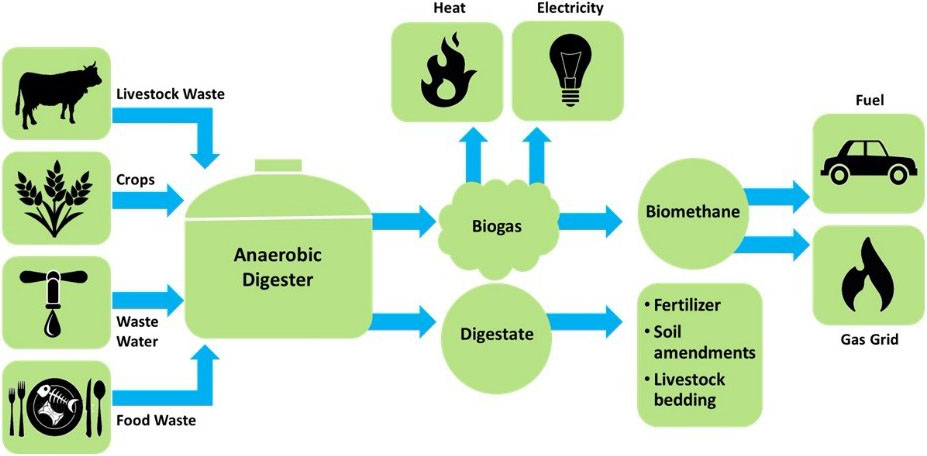
<center>Anaerobic digestion process (Graphic by Sara Tanigawa, EESI).</center>
<center>(source: https://www.eesi.org/papers/view/fact-sheet-biogasconverting-waste-to-energy)</center>
#### Biogas Generation:
- Equipments Required:
1. 2 plastic water tanks of 1000L.
2. Inlet and Outlet pipe
3. Gas Pipeline.
- Space Required:
1. Levelled surface and at higher level than surrounding.
2. Exposure to sunlight.
3. Diameter=2m , Volume=2.4cu.m
- Total biogas Production Capacity:
- 2kg waste=1000l biogas=> 500-700l of methane= 45% cooking requirement.
- According to reports avg LPG consumption is 11.7 kg per month i.e. 0.39 kg per day.
- If 1kg LPG is equivalent to 2.1 cu.m of methane then 0.39 kg is equivalent to 0.819 kg of methane= 1225 L methane.
- therefore 500-700L of methane=600/1225=45-55% daily cooking requirement.
<p float="center">
<img align="right" src="https://i.imgur.com/bbj3Kd8.jpg" width="200", height="200" />
<img align="right" src="https://i.imgur.com/MH9L3lh.jpg"width="200", height="200"/>
</p>
[Source :Down To Earth Organisation](https://www.youtube.com/watch?v=sq-qNVhxZm0)
|Feed stock|Litre /kg of dry matter|% Methane content|
|----------|-|-|
|Dung|350|60|
|Night-soil|400*|65|
|Poultry manure|440|65|
|Dry leaf|450|44|
|Sugar cane Trash|750|45|
|Maize straw|800|46|
|Straw Powder|930|46|
* Average gas production from dung may be taken as 40 l/kg. of fresh dung when no temperature control is provided in the plant. One cu.m gas is equivalent to 1000 l.Efficiency depends on the nutrient contents of the food waste.
- Installation Cost: 7000-10,000 Rs
- Stores to contact:
- [Vaayu](https://vaayu-mitra.com/)
- [Appropriate Rural Technology Institute]( http://www.arti-india.org/default.aspx)
- [Enersol Biopower Private Limited](https://www.enersolbiopower.in/biogas-generator-set.html)
- Steps to Use:
The plant is filled with a starter mix, either cattle dung mixed with water and waste flour or else effluent from an existing biogas plant mixed with starch. The feeding of the plant is built up over a few weeks until it provides a steady supply of gas, typically 250 g of gas per day from 1 kg (dry matter) of feed.
- Benefits of installation:
- Low input or initial cost for installation.
- This kind of small biogas plant is good to dispose of food waste.
- This setup reduces dependence on LPG cylinders in households.
- Size of the setup is small which requires less space.
- These setup don’t require any electricity or any fuel for working.
- Along with biogas we also get natural fertilizer or bio-slurry which can be used as fertilizers for plants.
- Safety:
The lower explosive limit being 5% methane and the upper limit 15% methane. Biogas mixtures containing more than 50 % methane are combustible, while lower percentages may support, or fuel, combustion. With this in mind no naked flames should be used in the vicinity of a digester and electrical equipment must be of suitable quality, normally "explosion proof".
**Increasing Productivity: If we can collect food waste from vegetable and fruit vendor in our locality, we may get approx 8-10 kg of input material for biogas. It will increase our biogas production by at least 4-5 times which will meet all daily cooking requirement.**
#### For Biogas to Electricity generation:
- Equipments/ Machines Required:
ESB-RBG15 - 15KVA Biogas Generator Set, 420 V
- Made By Enersol Biopower.
- Fuel mode:-producer gas
- Three phase . No. of cylinders:6. frequency=50Hz.
- Space Required:
- 25x15x20(in ft)=7.62x6.096x4.572(in m)
- Weight 4-4.5 ton.
- Biogas consumption: 1.3-1.5 kg per kWh produced
- Installation Cost: 2.8 lakhs.
- Benefits of installation:-
- Portable, sound proof , low maintenance, and easy to operate.
- About 50% saving in power generation as compared to diesel oil.
- Ash generated can be used as soil binder for agricultural purposes.
- Drawback:-
Space requirements are not very feasible in urban areas.
<img src="https://i.imgur.com/s1wfEG0.png">
[Source: Enersol Biopower](https://pdf.indiamart.com/impdf/3787877533/SELLER-3688128/biogas-generator-set.pdf))
### Micro Hydro
###### Reason Why sewage micro-hydro plant is not feasible-
1. Micro Hydro power from sewage is not suitable for households as it demands high maintenance.
2. Can be installed only at sewage treatment plants with high cost. So it can not be done by an individual.
3. If we install it in the sewage near the house then the turbine will be blocked by other solid particles flowing with water and it wont rotate.
4. Water flow rate is also not so high near the house.
###### Energy produced calculation for From over head tank(600L)(while filling the tank)-
> Power(W)=m*g*H(net)*n
> H(net)=H(gross)*0.9
> n=0.751
> Where H is head,m is max flow, g is gravity
> For over head tank case:
> H(gross)=1m
> m=0.2221 lit/sec
> P=(0.221)*(9.81)*(1*0.9)*(0.751)=1.47W
As it runs 45 min/day
Electrical Energy Produced=0.001095 kWh/day
Energy produced calculation for Harvesting energy from rainfall
Assuming heavy rainfall during monsoon of about 100mm per day, the potential energy available per day for the buildings with terrace area of 100 square meter area =
Power generated/day=no*d*(0.1*100)*9.81*H
no= efficiency
considering density of water=1000kg/m3, Head H=6m with no =0.7. The total power output from the turbine will be 0.1144 kWh.
<div style="page-break-after: always;"></div>
### Piezoelectricity
The piezoelectric effect was discovered in 1880, by two French physicists brothers Pierre and Paul. A piezoelectric sensor is a device that uses the piezoelectric effect to measure pressure, acceleration, and force by converting them to an electrical signal. When pressure is applied to piezoelectric crystals electricity is developed over the crystal lattice. Piezoelectric devices are made of lead zirconate titanate-piezoelectric ceramic materials.
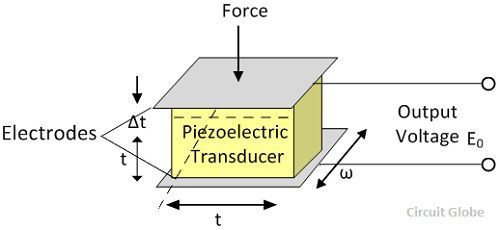
<center>[Source : [Image Link] (https://circuitglobe.com/wp-content/uploads/2017/08/photo-electric-effect-crystals.jpg) ]</center>
#### Cost analysis and other calculations
* Space required by each PZT sensor generation circuit = 12 cm x 7.9 cm = 94.8 sq cm.
* Total PZT sensor generation circuit to be installed = 100.
* So total space required = 100 x 94.8 sq cm = 9480 sq cm.
* Power generated by each piezoelectric sensor = 0.277 W.
* Power generated by 1 PZT circuit = 1.11 W.
* Each PZT circuit contains 4 cells which total can produce upto 10 voltage ( 2.5 voltage by each cell).
* Total power generated by 100 PZT circuit = 100 x 1.1111 = 111.11 W.
* Cost of each PZT sensor generation circuit = Rs. 349.
* Total cost to install the setup = 100 x 349 = Rs. 34,900.
<div style="page-break-after: always;"></div>
### **Uncoventional Energy Sources**
There are a quite a few unconventional energy sources avalaible but most of them either do not generate enough energy or are still under research. So after a lot of research we were able to identify 2 energy sources of use namely, **energy generation through treadmill** and **magnetic energy generator**.
#### Treadmill
The eco-friendly Verde treadmill’s maximum output is 200W an hour. Considering, 4 hours workout on treadmill by whole family, per day power generation = 4*200W. Thus, 0.8 kWh per day can be generated by the treadmill.
* [Product purchase link](https://www.fitnesszone.com/product/sportsart-g690-verde-treadmill.html)
* Product cost: Rs.7.7 Lakhs approximately
##### Product Technical details
| Property | Product Specification |
| ------------------ | ----------------------- |
| Dimensions | 213.6 x 90.5 x 165.5 cm |
| Running Area (LxB) | 147.32 x 53.34 cm |
| Speed Range | 3.2-24 kph |
| Incline | 4° fixed incline |
| Power requirements | 120V/60Hz |
| Maximum user weight |150kg |
| Unit weight | 258kg |
#### Magnetic energy generator:
This machine can generate energy of 10kWh from Infinity MG10 model and 5kWh from Infinity MG5 model.
* [Product image link](https://infinitysav.com/magneticgenerator/)
* Product cost analysis: First of all, the price will be determined by the distributor. A completely installed INFINITY MG10 model will cost between US$14,000 to US$25,000; INFINITY MG5 model will cost between US$8,000 to US$12,000. The price will vary among countries and strongly depend on your distributor’s pricing policy, shipping cost, country’s import taxes, government laws and regulations towards renewable energy products, particular property layout, warranty and maintenance policy, etc.
##### Product technical details
| Property | INFINITY MG10 | INFINITY MG5 |
| -------------------------- | --------------------------- | ----------------------------- |
| Motor consumption | Idle- 200 W, full load- 3KW | Idle- 200 W, full load- 1.5KW |
| Total capacity | 13050W | 6550W |
| Generated voltage | 900AC | 900AC |
| Generated frequency | 400Hz | 400Hz |
| Generated current | 11.2A | 5.6A |
| Effective frequency output | 50/60 Hz | 50/60Hz |
| Effective power output | 10KW | 5KW |
| Weight | 80kg | 60kg |
| Control system consumption | 50W | 50W |
## Batteries
Now, coming to Batteries:-
### Nickel Metal Hydride Battery
The detailed analysis of a nickel-metal hydride battery is given below. The different components involved in its formation, efficiency, power rating, battery life and various other important characteristics are listed below.
- Components:
The components of NiMH batteries include a cathode of Nickel-hydroxide, an anode of Hydrogen absorbing alloys and a Potassium-hydroxide (KOH) electrolyte which are collectively more benign than the active chemicals used in rival Lithium batteries. These batteries are rechargeable.
- Advantages:
They are less prone to leaking and explosion. They can also be used as a substitute for similarly shaped non-rechargeable alkaline batteries. These batteries have 30-40% higher capacity than a standard NiCd battery. They are easy to store and transport, not subjected to regulatory control. It contains only mild toxins, i.e. it is environment friendly. It is less prone to memory than NiCd, and can be rejuvenated. Nickel content makes recycling profitable and they have a wide temperature range.
- Applications:
They have many low cost consumer applications, however Lithium cells are taking over this market. Some of the applications include, electric razors, toothbrushes, cameras, camcorders, mobile phones, pagers, automotive batteries, medical instruments and equipment, high power static applications like Telecoms, UPS, Smart grid, etc.
- Battery Life:
NiMH batteries can have two to three times the capacity of NiCd batteries of the same size, with significantly higher energy density, although much less than lithium-ion batteries.
The battery life depends on the discharge rate of the battery. A NiMH battery discharges at the following rates
- LP (Low Power): Medium discharge rate: normally 5C discharge rate
- HP (High Power): High discharge rate: normally 10C discharge rate
- UP (Ultra Power): Normally 10C or 30A discharge rate, up to maximum 15 C rate discharge
A discharging rate of 1C means that the battery will discharge in an hour. When the discharging rate is 10C, it means that it will discharge in 6 minutes. So it depends on how quickly we discharge the battery.
Typically NiMH batteries can be recharged hundreds of times, potentially allowing them to be equivalent to hundreds of alkaline batteries in total service over their lifetime. However, battery life is limited to 5 years or less
- Working Principle:
NiMH works on the principle based on the absorption, release and transport of Hydrogen within the two electrode.

These reactions are reversible during charging, and the equations will flow from right to left.
- Backup Time:
Typically NiMH batteries can be recharged hundreds of times, potentially allowing them to be equivalent to hundreds of alkaline batteries in total service over their lifetime. However, battery life is limited to 5 years or less.
- Cost:
While Ni-MH batteries still have the advantage of being safe to use, the competition from low cost lithium-ion batteries with high performance is posing a great threat to replace Ni-MH batteries.
On [Flipkart](https://www.flipkart.com/panasonic-rechargeable-ni-mh-aaa-cordless-phone-toys-pack-2-pcs-battery/p/itmce4802b5e046b?pid=ACCFZJUHCWU4HMV5&lid=LSTACCFZJUHCWU4HMV5CHLWIF&marketplace=FLIPKART&store=tyy%2F4mr%2Fw65&srno=b_1_4&otracker=browse&fm=organic&iid=bb03309f-541f-4026-961b-f30357344679.ACCFZJUHCWU4HMV5.SEARCH&ppt=dynamic&ppn=productListView&ssid=6od0ggd7740000001642104414347) rate of simple NiMH battery is: Rs 144 per cell
- Used in Solar/Wind/Geothermal power plants:
Wind energy is converted to battery power(NiMH) for usage. The typical specific energy for small NiMH cells is about 100 Wh/kg. Charging voltage of NiMH is in the range of 1.4–1.6 V/cell. NiMH batteries have a relatively low internal resistance. The IR of fresh, fully charged NiMH batteries is typically less than 50 milliohms. The IR of fresh, fully charged NiMH batteries is typically less than 50 milliohms. Wind velocity taken is 25m/s
- Comparison with Lithium-Ion Batteries:
Lithium-ion batteries are a better alternative than NIMH batteries as per the [research](https://www.sciencedirect.com/topics/engineering/nickel-metal-hydride-battery) and the former is expected to gradually replace the latter in many applications. This [research](https://auto.howstuffworks.com/lithium-ion-batteries-improve-hybrids1.htm) gives a point to point comparison between Lithium ion and NiMH batteries comparing them on different parameters like cost, weight, power, durability etc.
<div style="page-break-after: always;"></div>
### Lead Acid Battery
The detailed analysis of a Sealed Lead Acid Battery is given below. The different components involved in its formation, efficiency, power rating, battery life and various other important characteristics are listed below.
- Components:

<center>[Source:(https://examvictory.com/lead-acid-battery/) ]</center>
- Advantages:
Lead Acid Battery does not require any maintenence and quite affordable. About 97% of lead can be recycled and reused in new batteries. It offers low self discharge, which is lowest among rechargeable batteries. It offers good performance at low and high temperature.
- Disadvantages:
Lead Acid battery has lot of advatages but it is heavier compare to other batteries. Its weight to energy reatio is poor. It can be charged slowly i.e. fully saturated charge takes 14 to 16 hours. It is not environmentally friendly.
- Applications:
Lead Acid Batteries are used in automobiles and electric bicycle and wheelchairs. These are also used in UPS System.
- Battery Life:
3 - 5 years.
- Working Principle:

- Backup time:
Lead acid batteries produce a substantial amount of heat when charging. Because of this, they require a “cool down” period afterward. A typical charge and use cycle for a lead acid battery is 8 hours of use, 8 hours of charging and 8 hours of rest or cool down.
- Cost:
A 12V, 150Ah battery costs around 14,290INR. Here are some selleres from [Indiamart](https://www.indiamart.com/proddetail/exide-it500-inva-tubular-battery-20867278530.html).
<center>[Source:(https://www.sciencedirect.com/science/article/pii/B9780128176269000071) ]</center>
<div style="page-break-after: always;"></div>
### Gell Battery
A gel battery is a valve regulated, maintenance free, lead acid battery. Gel batteries are extremely robust and versatile. These type of batteries produce few fumes and can be used in places without much ventilation.
Components:
<img src="https://www.researchgate.net/publication/334564888/figure/fig1/AS:782363097329664@1563541306003/Lithium-ion-Li-Ion-technology-comparison-a-LCO-b-LMO-c-LFP-d-NMC-e-NCA.png">
Source:https://www.researchgate.net/figure/Lithium-ion-Li-Ion-technology-comparison-a-LCO-b-LMO-c-LFP-d-NMC-e-NCA_fig1_334564888
Advantages:
- Best suited for Deep cycle applications and their life is generally in the 500 to 5000 cycles range
- Maintenance free
- Spill proof
- Minimal corrosion therefore compatible with sensitive electronic equipment
- Rugged and vibration-resistant
- Very safe as less risk of sulphuric acid burns
- Lowest cost-per-month (cost / months of life)
- Lowest cost-per-cycle (cost / life cycles)
<img height="400" width="400" src="https://www.researchgate.net/profile/David-Rand-4/publication/323824220/figure/fig4/AS:631578661253131@1527591495696/Schematic-of-section-through-a-valve-regulated-lead-acid-VRLA-cell-Components-modified_Q320.jpg">
<center>[Source:(https://www.researchgate.net/publication/323824220_SECONDARY_BATTERIES-LEAD-ACID_SYSTEMS]</center>
Disadvantages:
- High initial cost
- In case of overcharging water cannot be refilled
Special chargers and regulators are required
- Hot temperatures can affect adversely acid can turn the gel hard and may shrink away from plates
Applications:
- Used in solar power systems and deep cycle applications
Battery Life:
- 500 to 5000 cycles range
Cost:
- A 150 Ah, 12 V Battery costs Rs. 17,400 [Source: (https://www.luminousindia.com/lpt-12150h-1.html?gclid=EAIaIQobChMIveefzv679QIVEAkrCh2PVQOJEAYYASABEgItIPD_BwE)]
<div style="page-break-after: always;"></div>
### Nickel Cadmium Battery
The detailed analysis of a Nickel Cadmium Battery is given below. The different components involved in its formation, efficiency, power rating, battery life and various other important characteristics are listed below.
Components:

<center>[Source:(https://www.solarreviews.com/blog/best-uses-for-nickel-cadmium-batteries) ]</center>
Advantages:
- Excellent performance under any type of condition including low temperatures. Only power cell that can be charged in an ultra-fast rate. Economically sound and cheaper compared to other battery types. Tough and durable, allowing it to have a longer shelf life. It can be manufactured in various sizes and can power any type of device. Reduces equipment or device downtime and boosts productivity.
Disadvantages:
- Lower energy density compared to other new power cell technologies available today. The risk of suffering from “Memory Effect” that will lessen or decrease its performance. Higher rate of self-discharge that will require users to frequently charge the battery. The use of toxic metallic elements that is considered to be harmful to the environment
Applications:
- D Cells are used in Toys, Toy car, Cordless Phones, Small DRONES, GPS, Mp4 player, ipod, DVD, Mobiles backup power supply, Power bank, Tablet PC and other device
Battery Life:
- AAA battery lasts 15-20 years
Backup Time:
- Back-up time = (Battery cap. * Battery voltage) / (Load(in Watts)), where Battery cap. is 300-500 Ah, and voltage is 1.2 V.
Cost:
AAA battery: Rs. 38 a piece, Source: [Amazon.in](https://www.croma.com/duracell-aaa-copper-black-alkaline-battery-du-cb-al-black-gold-pack-of-4-/p/198150?utm_source=google&utm_medium=ps&utm_campaign=sok_pla_ssc-other_accessories&gclid=EAIaIQobChMIu97W_IG89QIVzGkqCh1-_w0YEAYYASABEgIgg_D_BwE)
Charging characteristics of NiCd Cell
- Figure shows the relationship of cell voltage, pressure and temperature of a charging NiCd. Everything goes well up to about 70 percent charge, when charge efficiency drops. The cells begin to generate gases, the pressure rises and the temperature increases rapidly. To reduce battery stress, some chargers lower the charge rate past the 70% mark.Charge efficiency is high up to 70% SoC* and then charge acceptances drops. NiMH is similar to NiCd. Charge efficiency measures the battery’s ability to accept charge and has similarities with coulombic efficiency.

<center>[Source:(https://batteryuniversity.com/article/bu-407-charging-nickel-cadmium
) ]</center>
- Discharge characteristics of NiCd Cell
The chemical action is reversed during discharge. The positive plates slowly give up oxygen, which is regained by the negative plates. This process results in the conversion of the chemical energy into electrical energy. During discharge the plates absorb a quantity of the electrolyte. On recharge the level of the electrolyte rises and at full charge the electrolyte will be at its highest level. Therefore, water should be added only when the battery is fully charged.
- Self-Discharge
Self-discharge (which occurs in all batteries) determines the "shelf life" of a battery. Figure below shows typical self-discharge rates for the three chemistries, exact values will vary with manufacturer. In general, Li-Ion is the best of the lot, while Ni-Cd and Ni-MH are fairly comparable to each other. Ni-Cd is typically a little better than Ni-MH, but this may even out as Ni-MH manufacturing technology matures. It is important to note that self-discharge is highly dependent on temperature, increasing as the battery temperature is increased. Another unpleasant characteristic (I have heard voiced with respect to Ni-MH batteries used in cellular phones and laptop computers) is that the discharge rate is extremely non-linear. A battery which loses 30% in a month may lose 15 to 20% in the first few days (not good if you are taking a couple of spare batteries on a week-long trip, and you don't want to carry the charging station).

- AAA battery
|Voltage | ~1.25 V |
|-------------------|-----------|
|Weight |32-35 gm |
|Capacity |300–500 mAH|
|Maintenance |Cool, dry place If not using recharge and discharge once in a year|
|Price |35/piece|
|Life |15-20 years|
|Recharge time|~ 16 hrs (at (Capacity/10) mA current)|
|Max Hours | Find according to load. Back-up time = (Battery cap. * Battery voltage) / (Load(in Watts))|
D cell
|Voltage|1.2 V|
|-------|-----|
|Weight|200 g|
|Capacity|5000 mAH|
|Price|750/2pcs Invento D Cells|
|Applications|Toys, Toy car, Cordless Phones, Small DRONES, GPS, Mp4 player, ipod, DVD, Mobiles backup power supply, Power bank, Tablet PC and other device|
|Life|500 cycles|
<div style="page-break-after: always;"></div>
### Lithium Ion Battery
Now a days lithium ion batteries is most prefered energy storage solution for high performance, low maintenance and overall low cost in long term perspective.
##### Components
- Lithium ions move from negative to positive electrode through an electrolyte.
- DoD (depth of discharge): 80%-90%
- density: approximately 200 Wh/kg ( Wh: watt hours )
#### Specification
##### Advantages of Lithium-Ion Batteries
- High Energy Density.
- Low Self Discharge
- Low to Minimum Maintenance
- Longer lifespan
- More usable storage capacity (deeper discharges)
- No off-gassing/ventilation required
- Options: One of the biggest advantages of lithium ion batteries is the fact that they come in all shapes and sizes- presenting users with a large number of options to choose from according to their needs.
##### Disadvantages of Lithium-Ion Batteries
- Inflammable
- Initial High Cost (though the when you compare with other batteries for long time period, say 10 years, then Li-ion batteries are more economical)
##### Applications of Lithium-Ion Batteries
- Power backups/UPS
- Mobile, Laptops, and other commonly used consumer electronic goods
- Electric mobility
- Energy Storage Systems
##### Battery Life
- Lifetime: around 3000 cycles
##### Cost
- cost: around 30000-35000 INR per KWh (KWh: killo watt hours )
## Battery comaprision table:
| Batttery namen | Rating Ah | Rating V | Charging Time | Life | Total Capacity in KWh | Cost buying | Cost Maintainence | Handling(Easy/moderate/difficult) | Link |
| ---------------------------------------------| ----------------------------------| ------------------------------ | ------------------------------------ | ----------------- | ------------------------------------| ---------------------- | ------------------------------ | ----------------------------------------------------------------------------------- | ---------------------------------------------------------------------------------------------------------------------------------------------|
| Vandium Redox Flow Battery | 150Ah | 24V |4-12 hours | 25+ years | |Rs 1,00,000 /kWh | | Easy | |
| Lithium-Ion | 100 Ah | 48V | 2-4 Hours |10 Years | 4.8KWh | Rs 1,50,000 for 4.8KWh | low | Light weight as compare to SMF, lead acid batteries. | [Link](https://www.loomsolar.com/collections/lithium-battery/products/100-ah-4800-watt-hour-lithium-battery-for-inverter) |
| Nickel-iron Battery | 800 Ah |48 V (if 40 cells used) | 5-7 Hours | 30-50 Years | |Rs 2,50,000 | low | Difficult due its heavy weight | [Link](https://ironedison.com/shop/batteries/nickel-iron/nickel-iron-ni-fe-battery/) |
| Lead acid battery Low load appliances |150-250Ah(can handle 250W appliance unitl it's full backup time)| | | 3-years | | Around Rs 20,000/ 3kWh | low|Moderate | [Link](https://www.indiamart.com/proddetail/exide-it500-inva-tubular-battery-20867278530.html) |
| Nickel-Metal hydride battery | 20 Ah | 24 V | 5-14 hours | 3-5 years | | Around Rs 38,000 | low | Moderate | [Link]((https://power.tenergy.com/at-tenergy-24v-20-000mah-nimh-rechargeable-battery-pack-20s2p-240-0wh-10a-rate/)) |
| | 20 Ah (960 Wh) | 48V | 5-14 hours |Approximately 5 years | | Around Rs 67,000 | low|Moderate | [Link](https://www.batteryspace.com/NiMH-Battery-Pack-48V-10Ah-480Wh-Battery-with-Discharging-/-Charger-1.aspx) |
|Nickel-Cadmium Battery | 5 Ah | 48 V (if 40 cells are used) | ~ 16 hours | 15-20 years | | Around Rs 15,000 | Free | Moderate |[Link](https://inventosales.com/Batteries-C-and-D-Cell/2pcs-1.2V-5000-mah-D-Cell-Ni-Cd-Rechargeable-Battery-for-Home-toys-clock) |
<div style="page-break-after: always;"></div>
## Conclusion
Looking at the facts and figures stated above, we have decided to use a hybrid of Solar-Wind-Biogas to produce the energy required. Solar would be our main source of energy as delhi recieves quite a lot of sunlight, yearly and using this alone can suffice for our needs accordint o the calculation done above, but for the sake of safety, we include wind and biogas as well. We plan to use wind mostly in the months of Jan to July. We plan to use biogas for production of LPG which would serve as our cooking gas. Using piezo electricity would not be a good idea since this technology is not really efficient and economically unviable. Other sources of energy like using threadmill to generate electricity can be used but these technologies are still under development. Hence, we plan to extract 10kWh from windmill and 15kWh from solar energy to meet our 25kWh electricity requirements and biogas for cooking gas for a one time investment of 3,43,950 INR.
For storage, requirements, we see that lithium ion battery is the most viable option in terms of life and storage capacity. Although the price may seem high at the first glance, but taking into the account it's long life and high storage capacity, the costs come almost equal to the same amount of energy storing lead acid batteries for lifetime of a single lithium ion battery. After Lithium Ion batteries, the best battery is Lead acid. We plan to use a hybrid battery comprising of Lead acid batteries for low power appliances like tubelights/bulbs, fans, charging points and Lithium ion for heavy use appliances like AC, TV, fridge, iron, washing machine etc. We plan to use a total of five Lithium ion batteries and three Lead acid batteries, assuming all batteries are avaliable for one single charge-drain cycle in a day, hence providing us a total of 33 kWh storaye a day which is more than our requirements for a one time investment of 8,10,000 INR for 10 years.
<div style="page-break-after: always;"></div>

<center>Planning was done according to the chart shown above</center>
## Appendix
### Units:
| Symbol | Fullform |
| ------ | ------------------- |
| cm | centimeter |
| cu | cubic |
| g | grams |
| h | hours |
| k | kilo |
| kg | kilograms |
| kWh | kilo-watt-hour |
| l | Liter |
| m | meter |
| min | minutes |
| V | Volt |
| W | Watt |
| ° | Degree |
| A | Ampere |
| kph | kilometers per hour |
| Hz | Frequency |
| Ah | Ampere-hour |
### Abbreavtions
|Symbol|Fullform|
|---------|-----------|
|AC|Alternating currents|
|DC|Direct currents|
|LPG|Liquefied petroleum gas|
## References
(“Adani Solar Panel Price in India [Jan-2022]” n.d.)
(“Alkaline Battery” 2022)
(“Alkaline Battery - Wikipedia” n.d.)
(Bhaskar | 2019)
(Bisu, Kuhe, and Iortyer 2016)
(“Development of Biogas Conversion Kit for Diesel Engine” n.d.)
(discoveragriculture 2021)
(Down To Earth 2016)
(“Energy Density” 2022)
(“ESB-RBG15 - 15KVA Biogas Generator Set, 420 V - PDF Catalogue” n.d.)
(“Factors to Consider Before Installing Your Own Residential Wind Turbine” n.d.)
(“Fact Sheet | Biogas: Converting Waste to Energy | White Papers | EESI” n.d.)
(“How to Build the ARTI Compact Biogas Digestor - Howtopedia - English” n.d.)
(“How Can Lithium-Ion Batteries Improve Hybrids?” 2010)
(“How to Compress Hydrogen to Power an Engine” n.d.)
(Jain et al. 2015)
(“Lithium-Ion Batteries - an Overview | ScienceDirect Topics” n.d.)
(“Lithium-Ion Battery” 2022)
(“New Delhi Climate, Weather By Month, Average Temperature (India) - Weather Spark” n.d.)
(“Nickel–Cadmium Battery” 2021)
(“Nickel Metal Hydride Battery - an Overview | ScienceDirect Topics” n.d.)
(“Ni-MH Battery (Theory) : Energy Storage Labs : Mechanical Engineering : Amrita Vishwa Vidyapeetham Virtual Lab” n.d.)
(“Panasonic Rechargeable Ni-MH AAA Rechargeable For Cordless Phone And Toys (Pack Of 2 Pcs) Battery - Panasonic” n.d.)
(PluginIndia Electric Vehicles 2020)
(“Rooftop Wind Turbines: Are They Worthwhile? | Engineering.Com” n.d.)
(“RuTAG” n.d.)
(“Solar-Calculator” n.d.)
(Surata et al. 2014)
(“Vaayu-Mitra – Vaayu” n.d.)
(“Vikaspedia Domains” n.d.)
(“What Is the Maximum Discharge Rate of Ni-MH Batteries? | Grepow Blog” n.d.)
 Google Drive
Gist
Clipboard
Google Drive
Gist
Clipboard
 Sign in via Google
 Sign in via Facebook
 Sign in via X(Twitter)
 Sign in via GitHub
 Sign in via Dropbox
 Sign in with Wallet






