Jim00000
    • Create new note
    • Create a note from template
      • Sharing URL Link copied
      • /edit
      • View mode
        • Edit mode
        • View mode
        • Book mode
        • Slide mode
        Edit mode View mode Book mode Slide mode
      • Customize slides
      • Note Permission
      • Read
        • Only me
        • Signed-in users
        • Everyone
        Only me Signed-in users Everyone
      • Write
        • Only me
        • Signed-in users
        • Everyone
        Only me Signed-in users Everyone
      • Engagement control Commenting, Suggest edit, Emoji Reply
    • Invite by email
      Invitee

      This note has no invitees

    • Publish Note

      Share your work with the world Congratulations! 🎉 Your note is out in the world Publish Note

      Your note will be visible on your profile and discoverable by anyone.
      Your note is now live.
      This note is visible on your profile and discoverable online.
      Everyone on the web can find and read all notes of this public team.
      See published notes
      Unpublish note
      Please check the box to agree to the Community Guidelines.
      View profile
    • Commenting
      Permission
      Disabled Forbidden Owners Signed-in users Everyone
    • Enable
    • Permission
      • Forbidden
      • Owners
      • Signed-in users
      • Everyone
    • Suggest edit
      Permission
      Disabled Forbidden Owners Signed-in users Everyone
    • Enable
    • Permission
      • Forbidden
      • Owners
      • Signed-in users
    • Emoji Reply
    • Enable
    • Versions and GitHub Sync
    • Note settings
    • Note Insights
    • Engagement control
    • Transfer ownership
    • Delete this note
    • Save as template
    • Insert from template
    • Import from
      • Dropbox
      • Google Drive
      • Gist
      • Clipboard
    • Export to
      • Dropbox
      • Google Drive
      • Gist
    • Download
      • Markdown
      • HTML
      • Raw HTML
Menu Note settings Versions and GitHub Sync Note Insights Sharing URL Create Help
Create Create new note Create a note from template
Menu
Options
Engagement control Transfer ownership Delete this note
Import from
Dropbox Google Drive Gist Clipboard
Export to
Dropbox Google Drive Gist
Download
Markdown HTML Raw HTML
Back
Sharing URL Link copied
/edit
View mode
  • Edit mode
  • View mode
  • Book mode
  • Slide mode
Edit mode View mode Book mode Slide mode
Customize slides
Note Permission
Read
Only me
  • Only me
  • Signed-in users
  • Everyone
Only me Signed-in users Everyone
Write
Only me
  • Only me
  • Signed-in users
  • Everyone
Only me Signed-in users Everyone
Engagement control Commenting, Suggest edit, Emoji Reply
  • Invite by email
    Invitee

    This note has no invitees

  • Publish Note

    Share your work with the world Congratulations! 🎉 Your note is out in the world Publish Note

    Your note will be visible on your profile and discoverable by anyone.
    Your note is now live.
    This note is visible on your profile and discoverable online.
    Everyone on the web can find and read all notes of this public team.
    See published notes
    Unpublish note
    Please check the box to agree to the Community Guidelines.
    View profile
    Engagement control
    Commenting
    Permission
    Disabled Forbidden Owners Signed-in users Everyone
    Enable
    Permission
    • Forbidden
    • Owners
    • Signed-in users
    • Everyone
    Suggest edit
    Permission
    Disabled Forbidden Owners Signed-in users Everyone
    Enable
    Permission
    • Forbidden
    • Owners
    • Signed-in users
    Emoji Reply
    Enable
    Import from Dropbox Google Drive Gist Clipboard
       owned this note    owned this note      
    Published Linked with GitHub
    Subscribed
    • Any changes
      Be notified of any changes
    • Mention me
      Be notified of mention me
    • Unsubscribe
    Subscribe
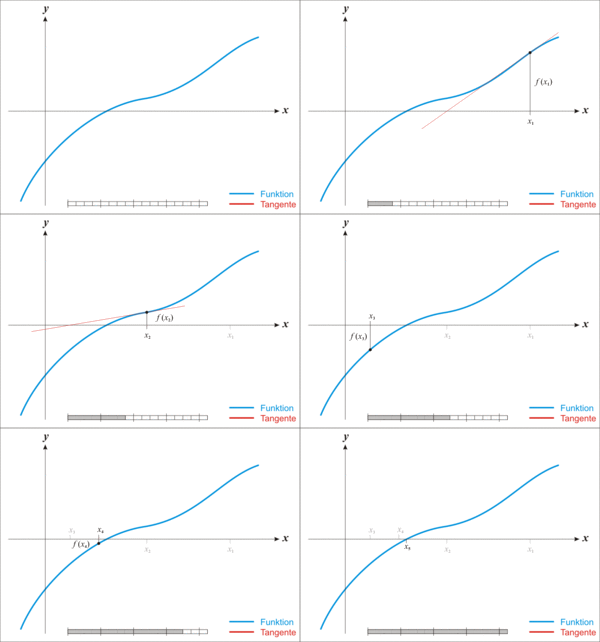
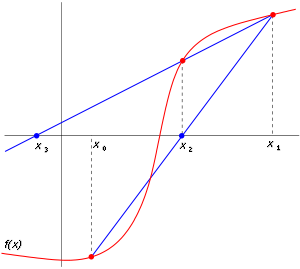
    # A03 - Computing pi 計算$\pi$的方法有很多,我來提供一些其他有趣計算$\pi$的方法 ## Fixed-Point Iteration 不知道您有沒有嘗試過在計算機上連續對一個正數連續根號計算, 最後的值會是1 ![image alt](http://i.imgur.com/3v7OHsp.gif) 實際上,你可以把它想成是在計算$x = \sqrt{x}$,然後在求x的解是多少,顯然它就是$x = 1$ or $x = 0$ 以圖表示的話: ![image alt](http://i.imgur.com/W6cV95X.png) 假設我們從$x = 4$開始計算起,那麼 ![image alt](http://i.imgur.com/7IydmBm.gif) 點會朝$x = 1$靠近,因此到最後我們可以取得一個近似解$x = 1 + \epsilon_{x}$,$\epsilon_{x}$為誤差,可惜不會找到解$x = 0$ 這個方法被稱為**Fixed-Point Iteration**,就由計算如$x_{i+1} = x_{i} + ...$等形式不斷求得$x$來近似真正解$r$,另外你得自己決定初始項$x_0$是多少 當然並非所有方程式都適合用FPI來解 ![image alt](http://i.imgur.com/GyReB74.png) 我們可以使用這個方法來求出$\pi$的近似解 ### 求出$\pi$的近似解 首先我們要找出$\pi$的遞迴式 :::info $0 = \sin{\pi}$ $\Rightarrow \pi = \pi + \sin{(\pi)}$ 接下來將$pi$以$x$取代 $\Rightarrow x = x + \sin{(x)}$ $\Rightarrow x_{i+1} = x_i + \sin{(x_i)}$ ::: 接下來用$x_{i+1} = x_i + \sin{(x_i)}$來求$\pi$的近似解 ```python= import math import numpy as np it = 10 # Iteration init = 5 # Initial guess pi = 3.1415926535897932384626433832795028841971 # The real value of pi f = lambda x : x + math.sin(x) # function handle data = np.zeros(it) forward_error = np.zeros(it) conv_rate = np.zeros(it) data[0] = init forward_error[0] = abs(pi - init) conv_rate[0] = float("nan") for i in range(1,it) : data[i] = f(data[i-1]) forward_error[i] = abs(pi - data[i]) if forward_error[i-1] == 0 : conv_rate[i] = float("nan") else : conv_rate[i] = forward_error[i] / forward_error[i-1] for i in range(it) : print('Iteration %02d -> x = %.15f, forward error = %.15f, e_{i} / e_{i-1} = %.15f' %( i, data[i], forward_error[i], conv_rate[i])) ``` 輸出: ``` Iteration 00 -> x = 5.000000000000000, forward error = 1.858407346410207, e_{i} / e_{i-1} = nan Iteration 01 -> x = 4.041075725336862, forward error = 0.899483071747069, e_{i} / e_{i-1} = 0.484007488177743 Iteration 02 -> x = 3.258070248108248, forward error = 0.116477594518455, e_{i} / e_{i-1} = 0.129493926208327 Iteration 03 -> x = 3.141855850823108, forward error = 0.000263197233315, e_{i} / e_{i-1} = 0.002259638296988 Iteration 04 -> x = 3.141592653592832, forward error = 0.000000000003039, e_{i} / e_{i-1} = 0.000000011546103 Iteration 05 -> x = 3.141592653589793, forward error = 0.000000000000000, e_{i} / e_{i-1} = 0.000000000000000 Iteration 06 -> x = 3.141592653589793, forward error = 0.000000000000000, e_{i} / e_{i-1} = nan Iteration 07 -> x = 3.141592653589793, forward error = 0.000000000000000, e_{i} / e_{i-1} = nan Iteration 08 -> x = 3.141592653589793, forward error = 0.000000000000000, e_{i} / e_{i-1} = nan Iteration 09 -> x = 3.141592653589793, forward error = 0.000000000000000, e_{i} / e_{i-1} = nan ``` 參考圖: ![image alt](http://i.imgur.com/aFUwFSf.png) 基本上,5個Iteration,準確率可以達小數點後15位,不過很明顯準確率受到浮點數的精度(在Python3.X為小數點後16位)限制 ## Newton's method ![image alt](https://upload.wikimedia.org/wikipedia/commons/thumb/e/e0/NewtonIteration_Ani.gif/300px-NewtonIteration_Ani.gif) 牛頓法在求解時比起FPI方法有個優勢,牛頓法的收斂會比FPI還要快,因為牛頓法屬於quadratically convergent $$ M = \lim_{i \rightarrow \infty} \frac{e_{i+1}}{e^2_{i}} < \infty $$ ### 推導Newton's method $f'(x_0) = \frac{0 - f(x_0)}{x - x_0}$ $\Rightarrow x = x_0 - \frac{f(x_0)}{f'(x_0)}$ $\Rightarrow x_{i+1} = x_{i} - \frac{f(x_i)}{f'(x_i)}$ ### 求出$\pi$的近似解 已知$0 = sin(\pi)$ 令$f(x) = sin(x)$ 求$f(x)$的root 然後代入牛頓法,並假設initial guess $x_0 = 3$ $\Rightarrow x_{i+1} = x_i - \frac{\sin{(x_i)}}{\cos{(x_i)}}$ $\Rightarrow x_{i+1} = x_i - \tan{(x_i)}$ ```python= import math import numpy as np it = 10 # Iteration init = 3 # Initial guess pi = 3.1415926535897932384626433832795028841971 # The real value of pi f = lambda x : x - math.tan(x) # function handle data = np.zeros(it) forward_error = np.zeros(it) conv_rate = np.zeros(it) data[0] = init forward_error[0] = abs(pi - init) conv_rate[0] = float("nan") for i in range(1,it) : data[i] = f(data[i-1]) forward_error[i] = abs(pi - data[i]) if forward_error[i-1] == 0 : conv_rate[i] = float("nan") else : conv_rate[i] = forward_error[i] / math.pow(forward_error[i-1], 2) for i in range(it) : print('Iteration %02d -> x = %.15f, forward error = %.15f, e_{i} / e_{i-1}^2 = %.15f' %( i, data[i], forward_error[i], conv_rate[i])) ``` 輸出: ``` Iteration 00 -> x = 3.000000000000000, forward error = 0.141592653589793, e_{i} / e_{i-1}^2 = nan Iteration 01 -> x = 3.142546543074278, forward error = 0.000953889484485, e_{i} / e_{i-1}^2 = 0.047579143449619 Iteration 02 -> x = 3.141592653300477, forward error = 0.000000000289316, e_{i} / e_{i-1}^2 = 0.000317962951472 Iteration 03 -> x = 3.141592653589793, forward error = 0.000000000000000, e_{i} / e_{i-1}^2 = 0.000000000000000 Iteration 04 -> x = 3.141592653589793, forward error = 0.000000000000000, e_{i} / e_{i-1}^2 = nan Iteration 05 -> x = 3.141592653589793, forward error = 0.000000000000000, e_{i} / e_{i-1}^2 = nan Iteration 06 -> x = 3.141592653589793, forward error = 0.000000000000000, e_{i} / e_{i-1}^2 = nan Iteration 07 -> x = 3.141592653589793, forward error = 0.000000000000000, e_{i} / e_{i-1}^2 = nan Iteration 08 -> x = 3.141592653589793, forward error = 0.000000000000000, e_{i} / e_{i-1}^2 = nan Iteration 09 -> x = 3.141592653589793, forward error = 0.000000000000000, e_{i} / e_{i-1}^2 = nan ``` ## Secant's method 示意圖: ![image alt](https://upload.wikimedia.org/wikipedia/commons/thumb/9/92/Secant_method.svg/300px-Secant_method.svg.png) ### 推導Secant's method 從Newton's method將$f'(x)$改為$\frac{f(x_i) - f(x_{i-1})}{(x_i - x_{i-1})}$ $\Rightarrow x_{i+1} = x_{i} - \frac{f(x_i)(x_i - x_{i-1})}{(x_i - x_{i-1})}$ for $x_0$ and $x_1$ are initial guess 從方程式中可以發現不必計算$f'(x)$而是改採以$\frac{f(x_i) - f(x_{i-1})}{(x_i - x_{i-1})}$做替代(approximation),在這裡以數值方式取代$f'(x)$ ### Error Relationship $$ e_{i+1} \approx | \frac{f''(r)}{2f'(r)} | e_i e_{i-1} $$ secant's method的convergence介於linearly convergent與quadratically convergent,屬於superlinear ### 求出$\pi$的近似解 secant's method的定義 ```python= def secant_method(f, x0, x1, k) : x = np.zeros(k) x[0] = x0 x[1] = x1 err = np.zeros(k) err[0] = abs(x0 - pi) err[1] = abs(x1 - pi) for i in range(1,k - 1): if f(x[i]) - f(x[i - 1]) == 0 : return x, err x[i + 1] = x[i] - f(x[i]) * (x[i] - x[i - 1]) / (f(x[i]) - f(x[i - 1])) err[i+1] = abs(x[i+1] - pi) return x, err ``` ```python= it = 10 pi = 3.1415926535897932384626433832795028841971 f = lambda x : math.sin(x) data, err = secant_method(f, 3, 4, it) for i in range(it): print('Iteration %02d -> x=%.16f, forward error = %.16f' %(i, data[i], err[i]) ) ``` 輸出: ``` Iteration 00 -> x=3.0000000000000000, forward error = 0.1415926535897931 Iteration 01 -> x=4.0000000000000000, forward error = 0.8584073464102069 Iteration 02 -> x=3.1571627924799470, forward error = 0.0155701388901539 Iteration 03 -> x=3.1394590982180786, forward error = 0.0021335553717146 Iteration 04 -> x=3.1415927279848570, forward error = 0.0000000743950639 Iteration 05 -> x=3.1415926535897367, forward error = 0.0000000000000564 Iteration 06 -> x=3.1415926535897931, forward error = 0.0000000000000000 Iteration 07 -> x=3.1415926535897931, forward error = 0.0000000000000000 Iteration 08 -> x=0.0000000000000000, forward error = 0.0000000000000000 Iteration 09 -> x=0.0000000000000000, forward error = 0.0000000000000000 ``` 比起Newton's method, secant's method需要更多的iterations才能達到相同的精度,推測是使用以數值解取代以符號運算微分$f(x)$所產生的誤差導致 ## False Position Method ![image alt](https://upload.wikimedia.org/wikipedia/commons/thumb/9/97/False_position_method.svg/351px-False_position_method.svg.png) ### False Position Method推導 把Secant's method做移位整理就可以導出 false position method $$ c = \frac{bf(a) - af(b)}{f(a) - f(b)} $$ 另外在加上bisection method以$c$更新$a$或$b$ ### 求出$\pi$的近似值 False Position Method的定義: ```python= def false_position_method(f, a, b, k) : if f(a) * f(b) >= 0 : raise ValueError('f(a) * f(b) must be < 0') data = np.zeros(k) for i in range(k) : c = (b * f(a) - a * f(b)) / (f(a) - f(b)) data[i] = c if f(c) == 0 : return data if f(a) * f(c) < 0 : b = c else : a = c return data ``` ```python= it = 10 pi = 3.1415926535897932384626433832795028841971 f = lambda x : math.sin(x) data = false_position_method(f, 3, 4, it) for i in range(it): print('Iteration %02d -> x=%.15f, forward error = %.15f' %(i, data[i], abs(pi - data[i])) ) ``` 輸出: ``` Iteration 00 -> x=3.157162792479947, forward error = 0.015570138890153 Iteration 01 -> x=3.141546255589150, forward error = 0.000046398000643 Iteration 02 -> x=3.141592655458965, forward error = 0.000000001869172 Iteration 03 -> x=3.141592653589793, forward error = 0.000000000000000 Iteration 04 -> x=3.141592653589793, forward error = 0.000000000000000 Iteration 05 -> x=3.141592653589793, forward error = 0.000000000000000 Iteration 06 -> x=3.141592653589793, forward error = 0.000000000000000 Iteration 07 -> x=3.141592653589793, forward error = 0.000000000000000 Iteration 08 -> x=3.141592653589793, forward error = 0.000000000000000 Iteration 09 -> x=3.141592653589793, forward error = 0.000000000000000 ``` ## Inverse Quadratic Interpolation $$ x_{i+3} = x{i+2} - \frac{r(r - q)(c - b) + (1 - r)s(c - a)}{(q - 1)(r - 1)(s - 1)} $$ where $a = x_i, b = x_{i+1}, c = x_{i+2}$ and $q = \frac{f(a)}{f(b)}$, $r = \frac{f(c)}{f(b)}$, and $s = \frac{f(c)}{f(a)}$ ## Pros & Cons ### 優勢 - 比起使用Leibniz formula與Monte Carlo Method,只需要較少的iterations就可以達到相同精度的$\pi$,也不需要取樣 - 方程式簡單,只需要計算sin與tan與x相加減就可以完成一次Iteration計算,因此計算效率與精度取決於sin與tan實作 - 精度隨著iteration增加而上升,因此很適合用於time-sensitived系統或是real-time系統 ### 缺點 - 很顯然地,精確度限於浮點數,因此若要更大精確度必須重新實作更高精確度的浮點數機制以及sin與tan的實作 - sin與tan的實作成為效率關鍵 ## 參考資料 - Sauer - Numerical Analysis , 2nd Edition

    Import from clipboard

    Paste your markdown or webpage here...

    Advanced permission required

    Your current role can only read. Ask the system administrator to acquire write and comment permission.

    This team is disabled

    Sorry, this team is disabled. You can't edit this note.

    This note is locked

    Sorry, only owner can edit this note.

    Reach the limit

    Sorry, you've reached the max length this note can be.
    Please reduce the content or divide it to more notes, thank you!

    Import from Gist

    Import from Snippet

    or

    Export to Snippet

    Are you sure?

    Do you really want to delete this note?
    All users will lose their connection.

    Create a note from template

    Create a note from template

    Oops...
    This template has been removed or transferred.
    Upgrade
    All
    • All
    • Team
    No template.

    Create a template

    Upgrade

    Delete template

    Do you really want to delete this template?
    Turn this template into a regular note and keep its content, versions, and comments.

    This page need refresh

    You have an incompatible client version.
    Refresh to update.
    New version available!
    See releases notes here
    Refresh to enjoy new features.
    Your user state has changed.
    Refresh to load new user state.

    Sign in

    Forgot password

    or

    By clicking below, you agree to our terms of service.

    Sign in via Facebook Sign in via Twitter Sign in via GitHub Sign in via Dropbox Sign in with Wallet
    Wallet ( )
    Connect another wallet

    New to HackMD? Sign up

    Help

    • English
    • 中文
    • Français
    • Deutsch
    • 日本語
    • Español
    • Català
    • Ελληνικά
    • Português
    • italiano
    • Türkçe
    • Русский
    • Nederlands
    • hrvatski jezik
    • język polski
    • Українська
    • हिन्दी
    • svenska
    • Esperanto
    • dansk

    Documents

    Help & Tutorial

    How to use Book mode

    Slide Example

    API Docs

    Edit in VSCode

    Install browser extension

    Contacts

    Feedback

    Discord

    Send us email

    Resources

    Releases

    Pricing

    Blog

    Policy

    Terms

    Privacy

    Cheatsheet

    Syntax Example Reference
    # Header Header 基本排版
    - Unordered List
    • Unordered List
    1. Ordered List
    1. Ordered List
    - [ ] Todo List
    • Todo List
    > Blockquote
    Blockquote
    **Bold font** Bold font
    *Italics font* Italics font
    ~~Strikethrough~~ Strikethrough
    19^th^ 19th
    H~2~O H2O
    ++Inserted text++ Inserted text
    ==Marked text== Marked text
    [link text](https:// "title") Link
    ![image alt](https:// "title") Image
    `Code` Code 在筆記中貼入程式碼
    ```javascript
    var i = 0;
    ```
    var i = 0;
    :smile: :smile: Emoji list
    {%youtube youtube_id %} Externals
    $L^aT_eX$ LaTeX
    :::info
    This is a alert area.
    :::

    This is a alert area.

    Versions and GitHub Sync
    Get Full History Access

    • Edit version name
    • Delete

    revision author avatar     named on  

    More Less

    Note content is identical to the latest version.
    Compare
      Choose a version
      No search result
      Version not found
    Sign in to link this note to GitHub
    Learn more
    This note is not linked with GitHub
     

    Feedback

    Submission failed, please try again

    Thanks for your support.

    On a scale of 0-10, how likely is it that you would recommend HackMD to your friends, family or business associates?

    Please give us some advice and help us improve HackMD.


    Thanks for your feedback

    Remove version name

    Do you want to remove this version name and description?

    Transfer ownership

    Transfer to
      Warning: is a public team. If you transfer note to this team, everyone on the web can find and read this note.

        Link with GitHub

        Please authorize HackMD on GitHub
        • Please sign in to GitHub and install the HackMD app on your GitHub repo.
        • HackMD links with GitHub through a GitHub App. You can choose which repo to install our App.
        Learn more  Sign in to GitHub

        Push the note to GitHub Push to GitHub Pull a file from GitHub

          Authorize again
         

        Choose which file to push to

        Select repo
        Refresh Authorize more repos
        Select branch
        Select file
        Select branch
        Choose version(s) to push
        • Save a new version and push
        • Choose from existing versions
        Include title and tags
        Available push count

        Pull from GitHub

         
        File from GitHub
        File from HackMD

        GitHub Link Settings

        File linked

        Linked by
        File path
        Last synced branch
        Available push count

        Danger Zone

        Unlink
        You will no longer receive notification when GitHub file changes after unlink.

        Syncing

        Push failed

        Push successfully

