# State of the Art Research
## How might we create a fun and engaging world that bonds people through a team-oriented task?
### AR Post | [competitive|market]
[The Advantages of Using Virtual Reality for Team Building](https://arpost.co/2020/08/28/using-virtual-reality-team-building/)
submitter: Donia Tung
Benefits of using AR/VR games for team bonding exercises:
* fun, immersive way to build relationships and develop effective communication
* place you in situations that would be difficult/impossible to model in reality
* increasingly accessible & cost effective (esp. for large orgs); don't have to pay for housing, transport, food. you just pay for a headset that can then be used over and over again.
Examples of competitive solutions:
* Keep Talking & Nobody Explodes
* Arizona Sunshine
* The Infinite Loop
### MIT Dept. of Electrical Engineering & CS | [method]
[Multiplayer Collaboration in Educational VR Games](https://dspace.mit.edu/bitstream/handle/1721.1/119701/1078151496-MIT.pdf?sequence=1)
submitter: Donia Tung
Central questions:
1) How dowe engage players in a cross platform education game?
2) Is it possible for VR to be one of these platforms effectively?
3) how do we design the game so that the players have to collaborate?
Defines collaboration as "how players come to make decisions and what communication lead ot those decisions".
Parallel decisions: made by both players independnetly, based solely on the information available to them
Dictated decisions: made predominately by one party and shared with thee second with the expectation to follow
Negotiated decisions: decisions made in conjunction by both parties, based on information shared between them.
*Cocoverse* world allows players to interact with the same virtual objects, "having a shared sense of controls helped immensely with collaboration."
"Information support came in the form of users experiencing higher levels of presence, a higher level of realism, and increased interactivity with the environment. All of these contributed increasing users' ability to process information."
Uni. of Piraeus study found that technology actively engaged students' interests and led to a richer interaction between them.
"Players are usually not only in the same environmeent, but in the same platform as well"
### Conference Paper, 28th Internat'l Conference on Human Factors in Computing Systems | [method]
[Understanding and Evaluating Cooperative Games](https://www.researchgate.net/publication/221516170_Understanding_and_evaluating_cooperative_games)
submitter: Donia Tung
* interviewed 60 6-16 year olds
* 77% said they'd like to play games with both competitive and cooperative options
* not many methods of evaluation for cooperative games
* "propose Cooperative Performance Metrics (CPMs) for analyzing and evaluating cooperative play occuring over the network or within the same space"
* 6 cooperative game design patterns:
* complementary: players pplay different character roles to complement each others' activities within the game
* synergies between abilities: allows one character type to assist or change the abilities of another
* abilities that can only be used on another player
* shared goals: force players to work together
* synergies between goals: forces players to cooperate through synchronized goals
* special rules denote rules that are used to enforce cooperation within teams
* suggest methods of evaluation relating to shared expressions (laughter at the same time, utterances of enjoyment, nonverbal behaviors taht expressed happiness or excitement), strategies of problem solving (talked aloud, divided a game zone in order to divide and conquer, navigated the world while consulting each other), helping each other (talked about controllers, told each other the correct way of passing a shared obstacle, saved and rescued the other player)
### Wanderer | [competitive]
[wanderer website](https://www.wanderervr.com/)
submitter: Donia Tung
* VR time travel game with the basic premise that the world is in ruin, and the player must travel back in time to change the past in order to save the future; sorta similar to our game's narrative
* Single-player
* Not released yet (so not that much info about its impact or actual structure/storyline)
### JMIR Publications | [market|background]
[What Players of Virtual Reality Exercise Games Want: Thematic Analysis of Web-Based Reviews](https://www.jmir.org/2019/9/e13833/)
submitter: Donia Tung
Players prefer...
* highly realistic games
* games that are intuitive, in terms of body movements and controls
* games that provide gradual increases in skill acquisition
* good music and social aspects of games
* multiplayer options to include friends or receive help from experienced players
They do not like...
* bugs that make gameplay frustrating
* low quality graphics. graphics quality had a strong impact on perceived enjoyment
* overly complex controls and display functions that evoke motion sickness.
---
### FrontiersInVR | [method]
[A Best-Fit Framework and Systematic Review of Asymmetric Gameplay in Multiplayer Virtual Reality Gamese](https://www.frontiersin.org/articles/10.3389/frvir.2021.694660/full)
submitter: Julian Wu
`"Multiplayer games enable social environments wherein players can engage, interact, and develop trust toward each other"`
`"They can foster relatedness between players, which supports well-being"`
`...they showed that asymmetric gameplay can increase social presence, connectedness, and immersion compared to a symmetric game. Their findings highlight the resulting increased interdependence between players—their degree of reliance on each other`
Long study which talks about asymmetric gameplay and how varying levels of player responsibility, as well as an asymmetric world, can drive players to work together more. Also talks briefly about how multiplayer games in VR enable players to foster a form of camaraderie and trust among each other.
### UploadVR | [competitive]
[Carly and the Reaperman Review](https://uploadvr.com/carly-and-the-reaperman-review/)
submitter: Julian Wu

* 1 player in VR / 1 player on PC
* 8 sets of levels
* Each level introduces new ideas and iterates on older ones
* Takes around 5-6 hours to complete, with hidden levels & secret collectibles
* Rated "Great"
### Forbes | [market]
[VR Needs More Social](https://www.forbes.com/sites/johnkoetsier/2018/04/30/virtual-reality-77-of-vr-users-want-more-social-engagement-67-use-weekly-28-use-daily/?sh=584739b718fc)
submitter: Julian Wu
* Study in 2018
* 77% of people who use VR wnat more social engagement
* 28% use headsets daily, 39% weekly, 19% monthly
* Familiarity with VR is rising
* Google & Apple entering the space
* Movies like Ready Player One
### Exyte | [competitive|background]
[The Deep](https://exyte.com/thedeep-vr-development-case-study)
submitter: Julian Wu
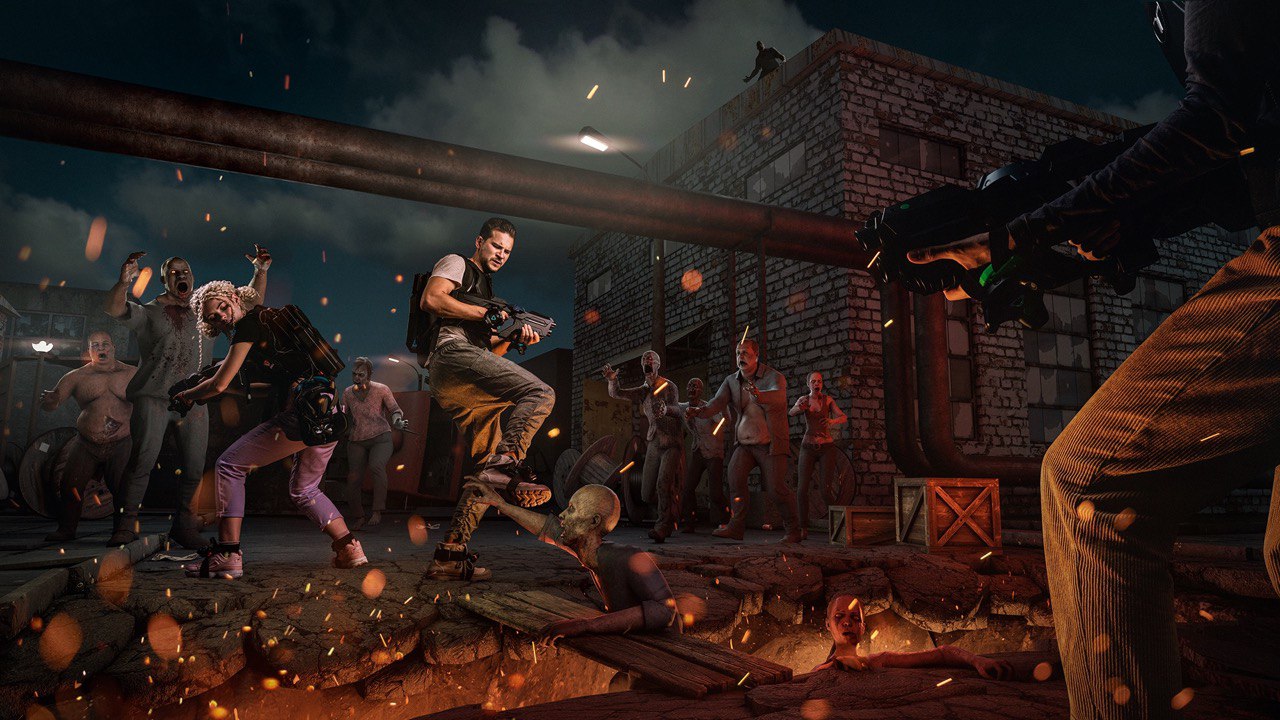
* Time Quest Lab is a huge escape room company
* Trying to extend escape rooms to cooperative VR gaming
* Currently creating a multiplayer VR FPS
* No headset cords and can interact with objects naturally
* No controllers
* Similar to mixed reality experience with real life objects
* Technology
* HTC VIVE PRO
* Vive trackers for body tracking
* 75k-100k in price
* Wearable backpack that allows free range of motion
### MCV | [competitive|market]
[Unsigned - The multiplayer VR RPG A Township Tale](https://www.mcvuk.com/wp-content/uploads/3-Forest-768x432.jpg)
submitter: Julian Wu

* A Township Tale
* Multiplayer VR RPG
* Fantasy landscape (similar to ours)
* Experiencing a fantasy medieval time in VR
* Crafting/fighting mechanics
* Designed to be a continuous experience
* Up to 8 players
* Very open-ended with no explicit story or quest line
* Nearly every object is physics-driven and networked
* Easy to pass objects off to one another!
* Technology
* Unity
* Easy to make early demos
* Fast development of proof of concepts
---
### IGN | [competitive|background]
[It Takes Two](https://www.ign.com/articles/it-takes-two-review)
submitter: Maria Mora

* Similarities
* Multiplayer Console RPG
* Fantasy landscape
* Low-poli fun obstacle game mechanics
* Simple crafting/fighting animations
* Designed to be a continuous experience
* The players help one another get across the paths (similar to our tool time travel idea)
* Designed to bring couples/friends together
* Differences
* Very explicit storyline and quest timeline (no open world concept like our idea)
* Split screen view
* "There are occasionally moments where [...] one character is pinballed around an area while the other can only watch, but it all evens out in the end"
* "if anything – it makes me want to replay it with swapped characters, just to see how the other half lived."
* Hopefully we can create a game experience where the other character can continously play
### Venture Beat | [competitive|background]
[Cook-Out (Similar to Overcooked but for VR)](https://venturebeat.com/2021/10/04/making-mental-health-stigma-a-thing-of-the-past-and-improving-brand-perception-at-the-same-time-vb-live/)
submitter: Maria Mora

Similarities
* Multiplayer Cooperative Game
* Great voice communication between players
* No single cook can make a dish alone (same way as you can't continue through time without each other)
* Never ending game (we would love for our game to be a world that people can always come back to)
* Low-poly game
* Interactable game objects
Differences
* Only one scene and environment
* No world movement (stay in one location)
### Prototypr | [method]
[5 Lessons for Making a Social VR Experience](https://blog.prototypr.io/5-lessons-for-making-a-social-vr-experience-94a68a80293b)
submitter: Maria Mora
How can we create a good social VR experience?
Here are some tips that this article mentioned that we should keep in mind throughout our building and desiging process:
* Tip #1: A lot of user testing
* Tip #2: Have visual representation of the other users in the game
* To make a shared experience feel real
* now the others are in the space with them
* Ex. arrows, character, dots
* Tip #3: Give them tasks, make the experience meaningful
* Tip #4: Push back your deadlines, understand that VR takes time
* Tip #5: Test different platforms
* Some things that work on Oculus won’t work on Gear VR and Google Cardboard
### Wired | [market]
[Virtual Reality Needs to Be Social to Succeed](https://www.wired.com/2016/12/virtual-reality-needs-to-be-social-to-succeed/)
submitter: Maria Mora
* VR is antisocial: "once you strap on a VR headset, you’re cut off from the outside world"
* "Adding a social component to a virtual experience — whether that’s interacting with an artificially intelligent character or another person playing the same game — deepens those feelings of immersion"
* Companies are expanding this principal beyond gaming
* People normally take turns putting on the headset
* This is currently the way most people are making VR social
* Goals for the future for VR companies:
* Connect the people already using VR to one another
* Build friend-oriented social networks so compelling that everyone will want a headset
Our game would fit right in this social scenario. People can come to a house together and make a night out of it, playing the game in joined spaces and listening to each other talk. However, even if they are apart in real-life, our game should have a strong social component so we can deepen those feelings of immersion and create a beautiful game people will want to buy headsets for.
### Game Developer | [method]
[Analysis: The Psychology of Immersion in Video Games](https://www.gamedeveloper.com/design/analysis-the-psychology-of-immersion-in-video-games)
submitter: Maria Mora
We want our world to be as immersive as possible, where people feel like they are there. This could allow us to create a deeper connection with the players so that they feel like they are really together in the game.
This article talks about the psychology behind video game immersion and how we can use it to our advantage when creating our game. Here are some interesting facts and tips I found:
* A game creates spatial presence when the user starts to feel like he is "there"
* Spatial presence happens in 2 steps:
1. Players form a representation in their mind of the which the game is presenting them
2. Players begin to see the media-based space as where they "are" currently
* 2 general categorias of characteristics of games that facilitate immersion:
1. Those that create a rich mental model of the game environment
* (ex. cognitively demanding environments, strong and interesting narrative)
* the more those senses work in tandem, the better
3. Those that create consistency between the things in that environment
* the fewer blanks about the mental model of the game world that the player has to fill in, the better
* Abstractions and contrivances = enemy of immersion
* (ex. tows filled with people who looked like they were doing normal stuff)
* Tip: dealing in a familiar environment allows the player to comfortably make assumptions about blank spaces
* "Knowing what the wild West is supposed to look like and having Red Dead Redemption conform to those stereotypes goes a long way towards creating spatial presence"
* We could use this tip for our medieval world idea
---
### UBISOFT | [method|competitive]
[Prince of Persia Returns As A VR Escape Room With The Dagger of Time](https://news.ubisoft.com/en-us/article/7blWJHwrcI3SfRztGTYMTk/prince-of-persia-returns-as-a-vr-escape-room-with-the-dagger-of-time)
submitter: Gregory Macharia

I found this to a be a very similar product to what we are aiming to build in that it:
* Uses VR as a platform
* Allows multiplayer
* Uses a time-bending approach to puzzle solving
* Is collaborative not adversarial
* Has an aspect of exploration
* Is goal oriented gameplay as opposed to open world
* Aims to be used by both gamers and non-games
### AbleGamers | [method|market|background]
[Thoughts on Accessibility Issues with VR](https://ablegamers.org/thoughts-on-accessibility-and-vr/)
submitter: Gregory Macharia

"Play is a powerful weapon against the epidemic of social isolation. Play, specifically via gaming, gives people an accessible way to reach beyond the physical confines of their homes, connect with other players all over the world." - AbleGamers
Our product aims to facilitate connection and combat social isolation. Among the demographics that suffer from social isolation, we have people with disabilities. AJ Ryan, from his surveys and from working with AbleGamers as a game developer and accessibility specialist, believes that VR is not an accessible platform as it exists now.
* Using our bodies (morion controls) to control the experience
* VR Headsets requiring users to be in a certain physical position to play
* A lot of the problem is with hardware and not software
* Forcing game mechanics on their users. Players shouldn't have to achieve goals in order to access the environment.
* Incorporating spatial audio experience other than just visual experience.
* Thnk about users with disabilities in pre-production processes such as testing.
### RoadToVR | [method|competitive]
[‘Wanderer’ is a Time-traveling VR Adventure Coming This Year, New Gameplay Trailer Here](https://www.roadtovr.com/wanderer-vr-steam-oculus-quest-psvr-release/)
submitter: Gregory Macharia

Wanderer is another VR game that involves Time-travel in its gameplay.
It is similar to our product because it:
* Allows users to travel back in time.
* Is puzzle-centric.
* Is a Virtual Reality game.
* Involves use of interactable objects to travel through time.
Ways our product could be different:
* Involve multiplayer.
* Involve communication accross timelines.
* Same environment in different times as opposed to getting a new environment every time you "quantum leap."
### Sunday Sunday | [method]
[How To Make Low Poly Look Good](https://sundaysundae.co/how-to-make-low-poly-look-good/)
submitter: Gregory Macharia

Given our intent to go for a low-poly aesthetic, this article explores how to make a low-poly design look beautiful.
Points that can guide our modeling/design:
* What makes low-poly look good:
* There is beauty in simplicity
* Where complexity is desired, using simplicity carefully can bring out complexity of a scene/design.
* "Everything should be made as simple as possible, but not simpler" - Albert Einstein
* Low fidelity meeting with high fidelity: Taking a simple geometry and rendering it with very high resolution. Using a complex shader on the simple geometry.
* Using silhouette to make sure that the shape of the object translates to the object being represented.
* Polygons per square unit: Small objects with same number of polygons as bigger objects have more resolution than the bigger objects relative to their size. (If you are halving the size, halve the subdivisions as well to maintain cohesion)
* No smoothed normals/no shared vertices.
* Keep textues to a minimum and create complexity with lighting.
* Utilise effects like specularity, refraction, scatter etc.
* Check saturation levels.
* Lighting is the most important part:
* Directional light
* Then add skydome to fill in shadow areas
* Indirect light. 2-3 bounces.
* bake the lighting
* Add specular
* Post-Processing:
* Depth haze
* Color correction
* Depth of Field
### CG Cookie | [method]
[Maximizing Your Unity Game's Performance](https://cgcookie.com/articles/maximizing-your-unity-games-performance)
submitter: Gregory Macharia

For our product to be usable, it has to be optimized which means it runs without lagging, and it feels smooth and the input is responsive. Here are some key points that can be considered when trying to maximize our product performance:
* Keeping it simple: Determining what doesn't need to be included. "What can I get away with to achieve the same effect?"
* Using the Profiler to identify performance issues.
* Batching game objects as static or dynamic
* Reducing and reusing textures.
* Using Culling to limit what is rendered.(Oclussion culling)
* Optimizing objects that are visible.
* Using proper compression and load types for audio
* Streamline physics calculations such as Raycasts, rigidbodies, and colliders.
* Cleaning up the code: Coroutines vs Update, Using tags instead of GameObject.Find("MyObjectName") etc.
* Baking lights.
* Use of efficient shaders.
* Utilizing LODs
* Animation Instancing
* Utilizing efficient particle FX
___
### A Blueprint for Designing Inclusive AR/VR Experiences | [method|competitive]
[Medium Article](https://medium.com/facebook-design/a-blueprint-for-designing-inclusive-ar-vr-experiences-6d5c6264dc14)
submitter: Wylie Kasai

This article provides the reasoning behind a collection of safety features that Facebook made in Horizon, their upcoming VR social app. These particular features seek to address problems of avatar harassment that have been reported by women in social VR applications.
Based in research surrounding IRL harassment prevention and anthropological concepts such as Edward T. Hall's zones of interpersonal space (picture above), the Facebook Design team aimed to increase safety and comfort by inventing an immediately activatable safe room. This safe room, aside from being a place to catch a break, gave quick access to mute, block, and report other users in the virtual space. These reports are also coupled with real footage from the user's headset.
I found this article particularly interesting since social, collaborative aspects are what we are hoping gives our game the extra edge. When it comes to facilitating such interaction, it's important that we consider that, despite avatars being virtual, they can often register in our minds as our own.
Key Quotes
> "[H]ow can we bring these structures of consent, body sovereignty, and respect into brand new virtual places like Horizon?"
> "Our thinking on close-quarter interactions helped us see an opportunity to allow people to define their ideal experience up front and feel in control of their immediate virtual body."
> "Designers can introduce local behavior expectations in VR social places by creating codes of conduct customized to the activities of the place and weaving them into the fabric of how the place is designed."
### The Storyteller’s Guide to the Virtual Reality Audience | [market|background]
[Medium Article](http://link/to/source)
submitter: Wylie Kasai
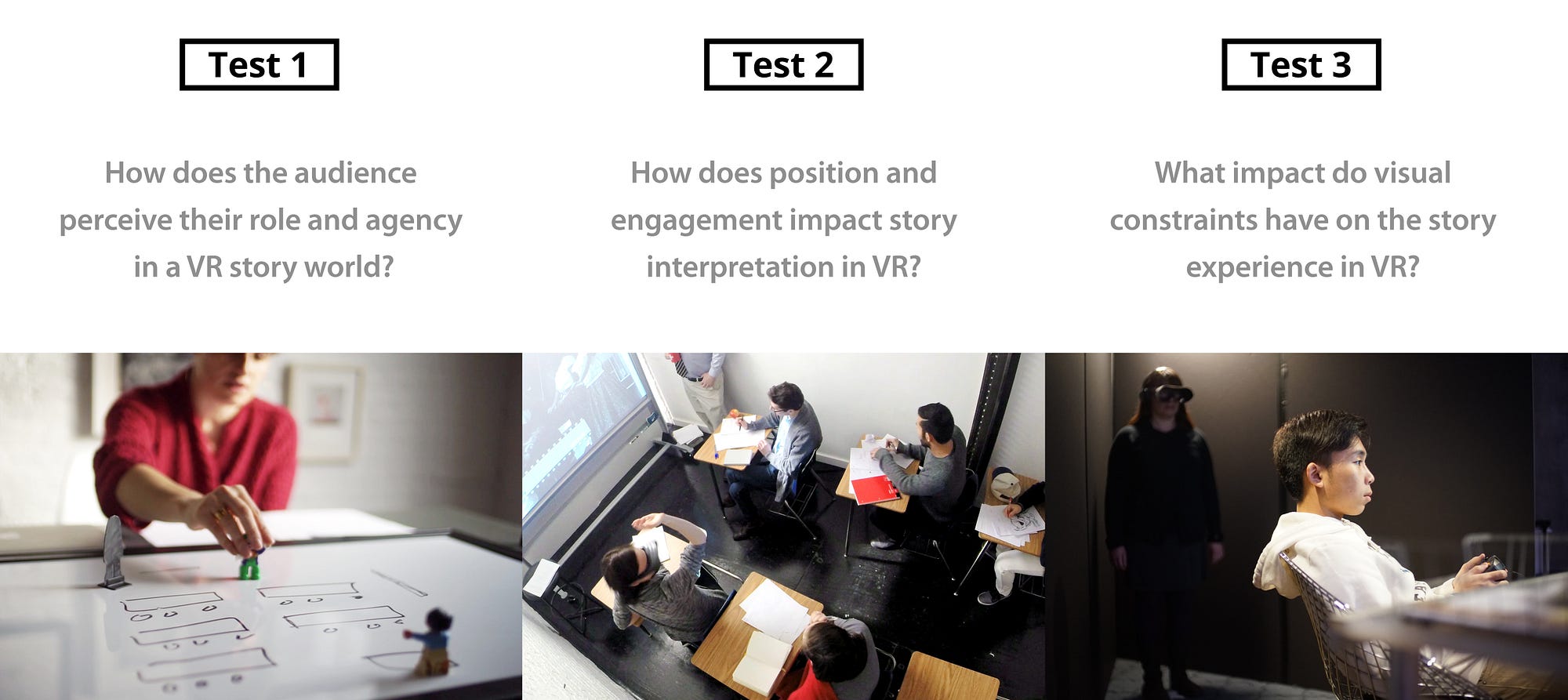
This article covers a case study of tests made to determine the best way to present a VR documentary called Taro's World by Paisley Smith. Using a lo-fidelity test with a pair of fake goggles that mimicked a Google cardboard device, the sample audience members entered environments and situations to provide feedback.
This article pertains to our project in that we are also hoping to immerse our users - or our audience, as this article may call them - in the experience and storytelling of our game. While this article does not share specific methods for excellent storytelling, it does share strategies for validation with the audience.
Key Quotes
> "Looking gives the audience agency, not to change or affect the story in VR, but to choose which pieces of the story they take in, make meaning out of and combine with other information to form a story in their minds. In this way, no two individuals experience the exact same story, because no two individuals look at the exact same things in the exact same order."
> "There’s something interesting happening here. It may be that when you feel present in an experience, you are more likely to rely on abstractions and pick up on feelings, and when you are in “detective mode” you are more likely to pick up on story details, but have difficulty accessing feelings. Perhaps being present and retaining story details are fundamentally at odds."
> Instead, storytellers have to behave like a matador, waving the red cape in the direction they want the audience to run, knowing that the power ultimately lies in the audiences hands to see what they want to see, hear what they want to hear and form their own stories about what they have experienced.
### The Tribeca Immersive Awesome List 2021 | [competitive]
[Medium Article](https://charliefink.medium.com/the-tribeca-immersive-awesome-list-2021-9f439d907518)
submitter: Wylie Kasai

I read this article by mixed-reality expert Charlie Fink recounting his vist to the Tribeca Film Festival, particularly the immersive part of the festival. Fink gives brief overviews of some of his favorite experiences and what sort of themes and storytelling tehcniques were particularly effective.
I read this article to find some good inspiration for our project (storytelling, aesthetic choices, etc.) and am looking forward to trying some of these out on my own!
### How to Reduce Motion Sickness in Virtual Reality | [method|competitive]
[Wired Article](https://www.wired.com/story/how-to-reduce-motion-sickness-virtual-reality/)
submitter: Wylie Kasai
This article immediately captured my eye as I have had a few too many VR experiences that were ultimated tainted by the splitting headache I got from being in VR, especailly when it comes to small student projects. Alongside more high level advice, the article does give some specific items to keep in mind when designing and developing for virtual reality.
Some of these tips are
* Ensure that the lenses are clean and the IPD (interpupillary distance) is set correctly
* Use your body instead of the thumbstick whenever possible
* Offer a teleportation mode option
* Allow user to adjust field of view
* Keeping a "haptic link" to the real world
* Don't force yourself if you start to feel sick
### Virtual Reality Lets You Travel Anywhere—New or Old | [competitive]
[Wired Link](https://www.wired.com/story/virtual-reality-lets-you-travel-anywhere-new-or-old/)
submitter: Wylie Kasai
Much like Charlie Fink's visit to Tribeca, *Wired* author Rose Afriyie recounts some favorite past VR experiences and highlights a few key things from each. Afriyie does truly believe that VR is the future of and offers a fantasy where such technology can bring an entire sensory experience.
> "I imagine a future world where anyone can use VR to visit Africa. From my bedroom in Chicago, I could throw on my headset and travel to Tawala Beach in Accra. As I walk, my feet feel the grainy sand and that unmistakable warm, piercing light of the sun. When I pass the kube wura—a coconut vendor—on the street, I taste the sweetness of coconut pulp. I smell the salt on my tongue wafting to me from the breeze off the Atlantic. I gaze at the waves and listen to the water as it gently tumbles into me and recedes, until I am soothed to slumber."
 Google Drive
Gist
Clipboard
Google Drive
Gist
Clipboard
 Sign in with Wallet






