# MX006: Tactical Qualities of Internet Art
Read the assigned reading, and locate the tactical qualities (as described in both text) of Internet art that you found in any one of the Internet artworks (i.e artefact analysis by using the perspective of tactical qualities). To what extent the artist is using the approach of critical making? What’s the link between critical making and tactical media? Initiate 1-2 questions for further discussion in the class.
## Anne
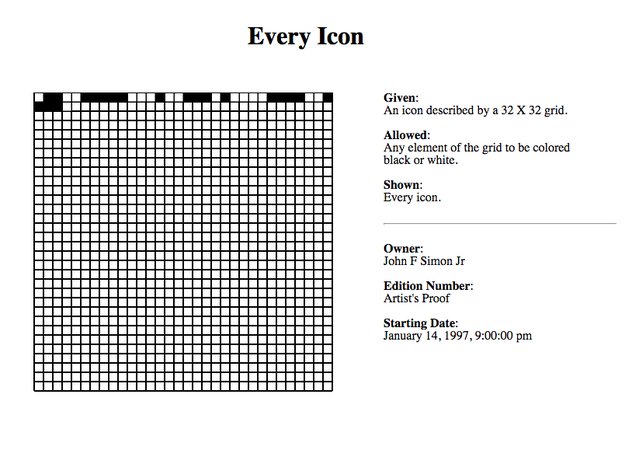
### John F. Simon, *[Every Icon](http://numeral.com/appletsoftware/eicon.html)*, 1997-present
*Every Icon* uses a mathmatical, process-based approach to create every pictorial icon possible in a 32x32 black and white square grid. Every "icon" starts with every square being white and progresses through combinations of black and white squares until every square is black, creating unique iterations along the way and will eventually show every possible image. It only takes a little over a year to display all variations of the first line, but it takes several billion years to complete the second line.
At the time of its creation, the processing power was not as efficient as it is today and it was estimated that it would take several hundred trillion years to complete and would have untold possible iterations. Though basic in its presentation, *Every Icon* showcases the potential of endless creation based in computational processing and the generativity of computer code which will exist beyond the lifespan of its author. The piece comments on the promise of technology outlasting the life of its artist and creator, creating a tangible thing that is set to exist far beyond the existence of any currently living person. In that sense, *Every Icon* fits well into what Galloway calls "the first phase" of net.art, a phase that was considered to have a "dirty" aesthetic and whose primary limitations was that of bandwidth (Galloway 219). *Every Icon* directly comments on that, showing that though the bandwidth is admittedly slow, it is consistent and evermoving.
Part of what makes *Every Icon* unique is that people can purchase their own copy. The version linked here has been running since January 14th 1997, but if you bought your own copy it will start from the time of your purchase.
Looking at this through the lense of critical making finds it lacking. There is no interaction with the artwork and its purpose is that it is able to exist without the interference of any human interference. It was made to exist beyond us and beyond the control of its creator.
**Question for dicussion:**
How does the concept of "eternity" play into net.art? Does the fact that net.art, in theory, can exist forever on the Internet for people to observe and interact with, change the way it is viewed and analyzed?
## Margrete

[Jodi's work Day66](http://wwwwww.jodi.org/day66/index.html) is a piece of net.art consisting of illegible images stacking up in the background and by using the Javascript “scroll” feature, the piece skids into view. When the page loads, it begins frantically to move, scrolling diagonally across the screen.
The tactical quality in this piece is the exposure of code and computer crashes. This is very characteristic for many of Jodi's works, where the focus is on the computer break downs and glitches. By examinging the computer's negative/limitations, Jodi creates positive computer aesthetics. The tactical quality is in the self-referencialiality, which is visible in its way of adressing the computer's own medium, and thus it also reflects its own specificity:
> [...] computer crashes, technical glitches, corrupted code, and otherwise degraded aesthetics are the key to this disengagement [from mainstream practices]. They are the “tactical” qualities of Internet art’s deep-seated desire to become specific to its own medium, for they are the moments when the medium itself shines through and becomes important. (Galloway, 213)
**Jodi + Critical Making:**
On one hand, Jodi's artistic pratice could be called critical making: They're exploring the materialities of computer/network/protocol by tweeking and subversing, and producing new computer aesthetics out of these materials. And by doing so they conceptualize, analyze and troublelize the protocols and its limitations. The material production itself therefore becomes a site for critical reflection (Ratto, Matt & Hertz, 19)
But on the other hand, I think whether or not Jodi's pratice can be called critical making comes down to a question of intentionality - in other words: where is the startingpoint or center of their practice? Is it the material, or the concept? I would argue that critical making starts from the material, and tactical media starts from the conceptual. In Jodi's case it's possible that they started from the concept of the limitations of the protocol, and then by showing/highlighting it to others through manipulation it inturn affords critical reflection by thenselves and others. They are in Dunne & Raby's terms 'alianating' the way we're used to understand technology, in order for us to see technology differently.
**Cricital making + Tactical media:**
The link is they both push onto the world new views of thought (critical reflection) through a certain practice/production.
The difference in my view is in their startingpoint:
CM: Material manipulation → Analytic knowledge → Critical reflection
TM: The technology/material as it is → Concept/analytic → Material manipulation → Critical reflection
Tactical media are derefore "*effective at exploiting flaws in protocological technologies*" (Galloway, 244) because the technology is in the startingpoint of the process (maybe?).
**Questions for discussion:**
Are we at the end of net.art?
## Rikke
Tactical qualities in Jodi's artwork OSS, the piece "**** ****":
The work is described by Jodi themselves on their [artsy page](https://www.artsy.net/artwork/jodi-oss):
> "OSS mimics a computer operating system, but in horrible disarray. Let it hijack your computer. Images and shapes take over the screen." (https://www.artsy.net/artwork/jodi-oss)

The OSS originally existed on a CD-ROM running on the user's own computer, but as Galloway argues, it can still be considered internet art as it is characterized by "a tactical relationship to protocols, not simple engagement
with this or that technology" (Galloway, 224).
I could not find the original program in a modern version (indeed if I had the CD-ROM I would probably first have to buy a CD-ROM reader and also install a simulated operating system to mimic the original environment of the computer it was created/build for), so I here let Galloway decsribe it:
> "The area called “**** ***” emulates the computer’s desktop environment
but reproduces it in horrible disarray: windows are spawned endlessly; the mouse draws a line as it moves, rather than performing its normal function as faithful point-and-click tool; the pull-down menu options are transformed into cryptic, useless ornaments." (Galloway, 224).
However, there is a similar version (https://www.oss.jodi.org/ss.html) using a website and pop-up pages, but I'm not sure it is secure.
The tactical quality of OSS can be found in focusing on the moments when computers break down and the user no longer controls the computer. Computers are made by humans to serve specific needs of the its human users, like increasing productivity and allowing for specific kind of work to be done on the computer. This relationship is based on the predictability and stability of the computer as a environment controlled by the human user. When this stability is no longer there, the computer ceases to be useful and becomes in a way autonomous, as Galloway points to: "Jodi discovers a new, autonomous aethetic" (Galloway, 224). This moment of breaking down is an interesting space for exploring the structures of computers through art. It is the moment that users do not want to experience, perhaps because users might not understand it and its concequences (like will I loose my data, will my computer work again?). Hopefully a simple reboot is enough, in most cases? But afterwards, will the user see the computer as something reliable again and trust it?
Critical making: by using the existing elements of a computer interface and functionality, Jodi explores the relationship between user and computer, a relationship of trust, reliability and most of all control. Jodi uses the material as a way to critique and/or highlight these relationships. This could lead to a critical reflection of the role computers play for humans and what role humans play for other humans through the development, distribution and commercialization of computers, software and the internet.
## Mark

[The Web Stalker](https://anthology.rhizome.org/the-web-stalker) is perhaps one of the most clear-cut examples of internet art with tactical qualities, since that's the entire point of the artwork. Its an internet browser that shows us what goes on under the hood of internet browsers, so you could say that its a very meta artwork. Instead of a HTML site it shows us a stream of HTML code, but it also has several other segments including the Crawler that shows its "connection status" and the Map that visually shows connections between HTML documents.
 Google Drive
Gist
Clipboard
Google Drive
Gist
Clipboard
 Sign in with Wallet






