katie-kiwi
    • Create new note
    • Create a note from template
      • Sharing URL Link copied
      • /edit
      • View mode
        • Edit mode
        • View mode
        • Book mode
        • Slide mode
        Edit mode View mode Book mode Slide mode
      • Customize slides
      • Note Permission
      • Read
        • Only me
        • Signed-in users
        • Everyone
        Only me Signed-in users Everyone
      • Write
        • Only me
        • Signed-in users
        • Everyone
        Only me Signed-in users Everyone
      • Engagement control Commenting, Suggest edit, Emoji Reply
    • Invite by email
      Invitee

      This note has no invitees

    • Publish Note

      Share your work with the world Congratulations! 🎉 Your note is out in the world Publish Note

      Your note will be visible on your profile and discoverable by anyone.
      Your note is now live.
      This note is visible on your profile and discoverable online.
      Everyone on the web can find and read all notes of this public team.
      See published notes
      Unpublish note
      Please check the box to agree to the Community Guidelines.
      View profile
    • Commenting
      Permission
      Disabled Forbidden Owners Signed-in users Everyone
    • Enable
    • Permission
      • Forbidden
      • Owners
      • Signed-in users
      • Everyone
    • Suggest edit
      Permission
      Disabled Forbidden Owners Signed-in users Everyone
    • Enable
    • Permission
      • Forbidden
      • Owners
      • Signed-in users
    • Emoji Reply
    • Enable
    • Versions and GitHub Sync
    • Note settings
    • Note Insights New
    • Engagement control
    • Make a copy
    • Transfer ownership
    • Delete this note
    • Save as template
    • Insert from template
    • Import from
      • Dropbox
      • Google Drive
      • Gist
      • Clipboard
    • Export to
      • Dropbox
      • Google Drive
      • Gist
    • Download
      • Markdown
      • HTML
      • Raw HTML
Menu Note settings Note Insights Versions and GitHub Sync Sharing URL Create Help
Create Create new note Create a note from template
Menu
Options
Engagement control Make a copy Transfer ownership Delete this note
Import from
Dropbox Google Drive Gist Clipboard
Export to
Dropbox Google Drive Gist
Download
Markdown HTML Raw HTML
Back
Sharing URL Link copied
/edit
View mode
  • Edit mode
  • View mode
  • Book mode
  • Slide mode
Edit mode View mode Book mode Slide mode
Customize slides
Note Permission
Read
Only me
  • Only me
  • Signed-in users
  • Everyone
Only me Signed-in users Everyone
Write
Only me
  • Only me
  • Signed-in users
  • Everyone
Only me Signed-in users Everyone
Engagement control Commenting, Suggest edit, Emoji Reply
  • Invite by email
    Invitee

    This note has no invitees

  • Publish Note

    Share your work with the world Congratulations! 🎉 Your note is out in the world Publish Note

    Your note will be visible on your profile and discoverable by anyone.
    Your note is now live.
    This note is visible on your profile and discoverable online.
    Everyone on the web can find and read all notes of this public team.
    See published notes
    Unpublish note
    Please check the box to agree to the Community Guidelines.
    View profile
    Engagement control
    Commenting
    Permission
    Disabled Forbidden Owners Signed-in users Everyone
    Enable
    Permission
    • Forbidden
    • Owners
    • Signed-in users
    • Everyone
    Suggest edit
    Permission
    Disabled Forbidden Owners Signed-in users Everyone
    Enable
    Permission
    • Forbidden
    • Owners
    • Signed-in users
    Emoji Reply
    Enable
    Import from Dropbox Google Drive Gist Clipboard
       Owned this note    Owned this note      
    Published Linked with GitHub
    • Any changes
      Be notified of any changes
    • Mention me
      Be notified of mention me
    • Unsubscribe
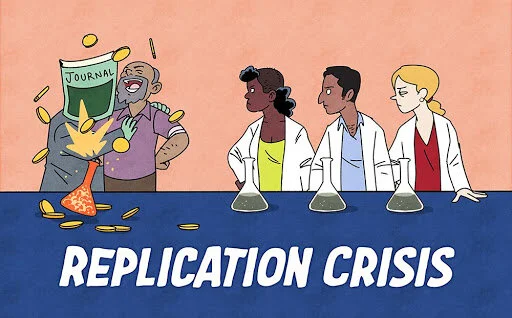
    # What do we know about the replication crisis? Originated when my homeboy Daryl Bem proved psychic powers existed. IF p < .05 we know its true. We want data like French marriages, open. ![](https://upload.wikimedia.org/wikipedia/commons/f/f4/DarylBem_%28cropped%29.jpg) **97% of the original studies produced statistically significant results Only 36% of the replication studies did so** (Open Science Collaboration, 2015) Not getting the same results when reproducing an experiment False or exaggerated results Wanting to undertake **original study** not merely copying someone elses study Ongoing issue where people struggle to replicate experiments due to biased, skewed data. > People can’t replicate experiments because of skewed or biased data e.g. not being truthful People choosing their results based on specific parts of data so as a whole the experiment can’t be replicated Replicability is important for science The whole thing about open science - transparency People feeling urgency to publish results so they force it to be significant Some studies suggest this may be a result of low statistical power in single replication studies rather than a failure to replicate results entirely Need for multiple replication studies ![](https://images.squarespace-cdn.com/content/v1/5c42e0c57e3c3a84d372fb52/1604304850802-MWX8WYZ18K5PTEZE2PXI/unnamed.jpg) People only publishing statistically significant results which can skew data, or could be due to individual differences, poor research practices and post-hoc analysis. Ultimately, sfactors such as this affects the credibility and accuracy of results. due to experimenters playing around with data they cant necessarily remember the exact process they went through and report it in the method therefore when other experimenters go to replicate it.... they dont know the exact steps that the original study undertook. ***Replication Crisis*** - Inability to get the same results - Due to publication bias - Cherry picking results - Deviation from method – need to write down the method clearly (the original study) and replication studies need to specify when they deviate from the original method - Pre-registered reports writing up the intro, method and expected results BEFOREHAND getting it confirmed by a panel of reviewers; if reviewed, paper will be published – won’t be about significance of results, rather the purpose of the study o Here, it’s not about tampering with results to get something significant, but rather having an interesting/approved purpose of a study - Replication is about finding the same result, but can use a different method – not an authentic reconstruction - Reproducibility is about using the same method, not necessarily the same result though - Publication bias failure to get a result may impact funding, therefore, force a significant result o Relaxing exclusion criteria ***cool*** ***The replication crisis: Inability to replicate results of prior findings:*** * Lack of transparency * Cherry picking data * Exploratory analyses termed as confirmatory * Inflating alpha (type 1 error rate inflation) ***Reproducibility:*** need to clearly stating methods and procedures to be able to be reproduced ***Things to help:*** * Open data * Preregistering experiments ## The Down-Low on the Replication Crisis - The replication crisis = lots of psych experiments/data not being able to be replicated by future researchers - Replication = replicating a previous experiment (following same method etc) and collecting new data - Reproducing = reperforming same analysis on same data by different analysts - Not publishing data when unsupportive of hypotheses - Altering/deleting/fabricating data to selectively support hypotheses - Data snooping - Demand for ‘new’ and ‘innovative’ findings (especially when it influences careers/holding jobs/salaries/reputation) - Unclear methods and data analysis sections - Materials sometimes behind a firewall/need to email to get it/need to pay to access - Accessibility and freedom of information an issue - Privatised papers (aka less peer review) - Underpowered/biased sample studies and over-generalisation of results - Selectively choosing statistics/graphs to make findings seem more practically important than they are in reality (eg skewed graphs) ### What is the "crisis"? - Past studies being recreated and the replications not finding significant results ### What has caused it? - Researchers fail to control for FWER (problem of multiple comparisons) - Publication bias - Biased samples - overgeneralisations - Only significant results are published - may incentivise researchers to employ invalid research methods - Ability to pay to publish - undermines peer review ### What does it mean for research to be "replicable"? - Recreate findings using the same methodology - Using new data ### What does it mean for research to be "reproducible"? - Using the same data, but different statistical procedures that generate the same result ### Are they the same thing? - No they are not the same? ## What is the replication crisis? A small percentage of psychology studies get the same result using the same methodology Replication = run same method in same way to (hopefully) get the same result Recent investigations reveal that many major findings can’t be replicated and the majority of papers published do not have open/available data. ### What caused the replication crisis? Sample sizes (underpowered) significant effect is by chance Use of multiple, incompatible analyses to get significant results Analytic flexibility → repetition of data analyses until a p < 0.5 Researchers degrees of freedom and not noting these deviations from original procedure → Desire to get significant effect: do analysis over and over until get significant result (Every extra analysis conducted increases chance of Type 1 error) Data exclusion - participants that are outliers (many assumptions?) (data manipulation?) Also inappropriate post-hoc analyses Individual differences and variability challenges replication particularly for babies due to their mood, developmental stage and short attention span Variability: babies might be engaged in one task then tired for the next Incentive for individuals to publish to get promotions etc. Significant results are more likely to be published. Pushing researchers in the wrong direction (e.g., p-hacking, Harking) P-hacking: continuous collection and/or modification of data HARKing: adding variables that were not part of the original research and adding justification ie Making a hypothesis after seeing the results of a study ## Replication Crisis - Classical experiments couldn’t be replicated in modern research - Statistics were invalid - Post-hoc vs planned analysis – caused research to be hard to replicate - Statistical analysis methods were invalid – scheffe vs bofferoni - Manipulation (intentional or unintentional) of data to get statistical significance - Lack of trust of psychology research - Poorly written methods ## To prevent replication crisis- Open Science! What is open science? - Open science is a practice of science that allows others to collaborate & contribute, where research data, lab notes & other research processes are freely available to enable reuse, redistribution and reproduction of the research and its underlying data and methods. Open science involves the materials and data being openly available to the public. Many articles will apply for pre-registration and will usually upload this information to an independent archive or repository to allow other researchers or those who are interested in the topic to understand just how the methodology and results are aligned. **Pillars of open science:** 1. open data-Sharing of data collected (e.g.: raw data, videos)- help things to be more transparent 2. Open design (pre-registering design/intentions at outset) - Preregistration: detailing hypotheses, method, and data analysis before data collection, allows for a clearer distinction between exploratory and confirmatory data analysis! - Registered reports: peer review, revision, and acceptance occurs before data collection -> will be published regardless of the results; restrict researcher degree of freedom/ publisher bias, clear intention (prevent data exploration) 3. Open analysis (give away code used to analyse results, ie. what was done to get it from raw form to statistical test on paper) 4. Open access (accessible to the public) (You're welcome :))

    Import from clipboard

    Paste your markdown or webpage here...

    Advanced permission required

    Your current role can only read. Ask the system administrator to acquire write and comment permission.

    This team is disabled

    Sorry, this team is disabled. You can't edit this note.

    This note is locked

    Sorry, only owner can edit this note.

    Reach the limit

    Sorry, you've reached the max length this note can be.
    Please reduce the content or divide it to more notes, thank you!

    Import from Gist

    Import from Snippet

    or

    Export to Snippet

    Are you sure?

    Do you really want to delete this note?
    All users will lose their connection.

    Create a note from template

    Create a note from template

    Oops...
    This template has been removed or transferred.
    Upgrade
    All
    • All
    • Team
    No template.

    Create a template

    Upgrade

    Delete template

    Do you really want to delete this template?
    Turn this template into a regular note and keep its content, versions, and comments.

    This page need refresh

    You have an incompatible client version.
    Refresh to update.
    New version available!
    See releases notes here
    Refresh to enjoy new features.
    Your user state has changed.
    Refresh to load new user state.

    Sign in

    Forgot password

    or

    By clicking below, you agree to our terms of service.

    Sign in via Facebook Sign in via Twitter Sign in via GitHub Sign in via Dropbox Sign in with Wallet
    Wallet ( )
    Connect another wallet

    New to HackMD? Sign up

    Help

    • English
    • 中文
    • Français
    • Deutsch
    • 日本語
    • Español
    • Català
    • Ελληνικά
    • Português
    • italiano
    • Türkçe
    • Русский
    • Nederlands
    • hrvatski jezik
    • język polski
    • Українська
    • हिन्दी
    • svenska
    • Esperanto
    • dansk

    Documents

    Help & Tutorial

    How to use Book mode

    Slide Example

    API Docs

    Edit in VSCode

    Install browser extension

    Contacts

    Feedback

    Discord

    Send us email

    Resources

    Releases

    Pricing

    Blog

    Policy

    Terms

    Privacy

    Cheatsheet

    Syntax Example Reference
    # Header Header 基本排版
    - Unordered List
    • Unordered List
    1. Ordered List
    1. Ordered List
    - [ ] Todo List
    • Todo List
    > Blockquote
    Blockquote
    **Bold font** Bold font
    *Italics font* Italics font
    ~~Strikethrough~~ Strikethrough
    19^th^ 19th
    H~2~O H2O
    ++Inserted text++ Inserted text
    ==Marked text== Marked text
    [link text](https:// "title") Link
    ![image alt](https:// "title") Image
    `Code` Code 在筆記中貼入程式碼
    ```javascript
    var i = 0;
    ```
    var i = 0;
    :smile: :smile: Emoji list
    {%youtube youtube_id %} Externals
    $L^aT_eX$ LaTeX
    :::info
    This is a alert area.
    :::

    This is a alert area.

    Versions and GitHub Sync
    Get Full History Access

    • Edit version name
    • Delete

    revision author avatar     named on  

    More Less

    Note content is identical to the latest version.
    Compare
      Choose a version
      No search result
      Version not found
    Sign in to link this note to GitHub
    Learn more
    This note is not linked with GitHub
     

    Feedback

    Submission failed, please try again

    Thanks for your support.

    On a scale of 0-10, how likely is it that you would recommend HackMD to your friends, family or business associates?

    Please give us some advice and help us improve HackMD.


    Thanks for your feedback

    Remove version name

    Do you want to remove this version name and description?

    Transfer ownership

    Transfer to
      Warning: is a public team. If you transfer note to this team, everyone on the web can find and read this note.

        Link with GitHub

        Please authorize HackMD on GitHub
        • Please sign in to GitHub and install the HackMD app on your GitHub repo.
        • HackMD links with GitHub through a GitHub App. You can choose which repo to install our App.
        Learn more  Sign in to GitHub

        Push the note to GitHub Push to GitHub Pull a file from GitHub

          Authorize again
         

        Choose which file to push to

        Select repo
        Refresh Authorize more repos
        Select branch
        Select file
        Select branch
        Choose version(s) to push
        • Save a new version and push
        • Choose from existing versions
        Include title and tags
        Available push count

        Pull from GitHub

         
        File from GitHub
        File from HackMD

        GitHub Link Settings

        File linked

        Linked by
        File path
        Last synced branch
        Available push count

        Danger Zone

        Unlink
        You will no longer receive notification when GitHub file changes after unlink.

        Syncing

        Push failed

        Push successfully

