# The NEW Doppler Power System
The power system has been discussed and talked about for years on end, but the actual technical depth has often been found lacking and the original document based on the concept has not only been vanished, but also contained various powers that would be horrible to implement (turning yourself into a telecomms hub is a technical nightmare), meaning that there never really was much concrete to work with.
Since about the 14th of January I (Joe) have been working non-stop developing this system, and the old design document has become too irrelevant. A new one needs to come in its place, that sets clearly achievable goals for the first implementation of the system that is both satisfactory to the player base and makes implementation of future powers a non-issue.
The goal of this document is to set the expectations of what to expect in an 'on-release' Powers System. It is more of an in-depth design document with technical limitations in mind, given the development stage we're at, as ~~2~~ 8 out of 9 archetypes are done and the overarching systems are largely completed.
This document has been updated overtime to reflect the drift in design goals and wants. Last major update was on 02/03/26 (D/M/Y)
# Goals
1. Create an overarching system for powers as a whole as well as the unique mechanics required for all 9 archetypes
2. Take inspiration from the original and diverge where apt, whether for balance, identity or fun. Ensuring each identity feels unique and appealing in their own way.
4. Keep in line with the actual LORE.
5. Ensure everything is clean and allow the playerbase to finally add things on-demand without needing to wait for the whole power-system to get done. Create overarching systems that ensure ease of implementation of new powers.
# Non-Goals
1. Try to match the content of the original design document; enough powers as examples and for players to enjoy, but not the absurd amount originally listed. (note from the future: I got carried away)
2. Treat the original laid out design document as the Constitution; not everything is realistically feasible and requires a holistic look.
3. Be overtly balanced on release. Whilst thought went in to make something not absurdly powerful, ultimately we want the first few months of the system to be dedicated to experiencing something new and fun, rather than something hyper balanced. That can come later.
---
As the powers system is massive, we'll be going through it starting with the overarching mechanical systems needed, followed then by what each specific branch needs mechanically, technically and what powers it will have/require to be in a satisfactory state.
* Global System touches on the technical systems and what we want in place for others to use later.
* Power-Specific Systems touches on what unique systems each power needs.
Note that this document gets rewritten as progress is already partially made, so some powers-systems will have more concrete contents. Its meant to both give insight in the design mentality during development, and hopefully act as a guide for future developers for how to develop content for that specific branch.
# Global Power Systems
## Costs & Restrictions
Just like the original, powers will have a cost to have your character start with them, in addition to any powers they may require on top of that. Every system is gated by a 'root' power, which gives an innate benefit and usually the gateway mechanics to using the system, but locks you out of other root powers on that power.
Basic & Advanced are removed and are one and the same; the gateway cost of the Root will already adress most types of 'multiclassing', as well as the restriction below. Point costs are not final and will thusly not be mentioned in this document unless it is exceptionally cheap or expensive.
In addition, you are restricted to two paths out of nine, with 20 points to spend across both. The distinct goal is to not muddy themes by allowing people to take too many 'dips' in various off-archetypes, but allowing in essence any and all combinations between those two. The original design's arbitrary gating of some archetypes from others felt bothersome when there was legitimacy to practically all archetypes. Just because you're a good doctor doesn't mean you can't cast spells (a la Doctor Strange).
## Antimagic
Part of the balancing factor is 'antimagic'. The suppression of Resonant magic in many shapes and forms.
First of all, Resonance is affected by normal antimagic as normal (and if its charges based, such as holy melon, it will consume those). Instead of the red antimagic glow, it is blue. There is a also new tier of antimagic specific to resonance called Anti-Resonance. This only affects the powers within this system; other magical phenomenna will be gated behind normal antimagic (or just don't care about anything because its inconsistent at times). This means that a Chaplain carrying the nullrod is immune to most Resonant powers; they will become quite the powerhouse against Resonant magic!
People using Resonant powers can be 'silenced'. This effect (confered with a trait) prevents the activation of resonant powers. Keep in mind that this does deactive anything currently active!
For that, you require Dispelling. Dispelling ends any active effects to do with a Resonant power on the target and sometimes with side effects for the target (you don't want to be dispelled while flying). Items can be dispelled as well, but the range of things that affect specifically items are small. Dispelling is largely restricted to special objects, limited powers that require set-up, and the null rod.
None of this affects Mortal powers; usually those come with a tradeoff of their own, usually being conditional on items or having some other weakness (EMP with Augments).
## Security
Security will start out with a few nifty tools to help combat the increased power of your average crewmember. Beyond a special set of handcuffs meant to suppress the powers of crew members with resonant powers (available from the Sec Vendor), the Security Records will also list any and all powers a person may have; and sometimes more technical details to do with them.
In addition, they will be able to order localized reality anchors through the Cargo console (Science also has them). This provides an anchorable structure that when anchored & enabled will periodically silence all Resonant creatures in the area, and dispel any magic on them. Useful around secure areas, dangerous prisoner and the likes. Like all forms of resonant antimagic,
This is similar to how quirks are listed in medical records; and using a SecHUD lets you see all of the ones that the target has in your chat. This obviously does not work on creatures that do not have security records.
## Cargo
Cargo gets some additional things to purchase. The highlights are
* The aforementioned Reality anchors that Securiy also gets (requiring Security or Science to open)
* Power suppressing handcuffs (requires a Security to open).
* A special crate of 'Surplus Thaumaturge Equipment' which provides replacement staves and wands for Thaumaturges that lost theirs (along with some high affinity garb).
## Preferences
The preferences UI remains the same as with currently in Doppler. While it will get exceedingly crowded with increased content, it is in a state that functionally 'works', and thusly an overhaul of it will be done AFTER the release.
The backend has been improved greatly, courtesy of Ephe's hard work, and is robust enough to easily handle the addition of new powers, their removal and ensuring they don't leave a footprint, as well as a great deal of sanitization to prevent the users from breaking it, whether purposely or on accident.
## Actions
The biggest change is that powers use their own actions system now, a branch of /action/cooldown. Spells had too much luggage and we needed a better base to twist our powers around, whilst still retaining a lot of useful core functionality like click support and cooldowns.
Each further subtype is tweaked to make interaction with the archetype as a whole easy. As an example, Theologists have their own subsystem where they use Piety as a resource, which can easily be modified in action with modify_piety(), as well as support automatic payment of Piety as a resource. Meanwhile Thaumaturge has a whole charges and preperation system akin to the Vancian spellcasting system from D&D.
Adding actions to powers is as easy as adding a type-path to action_path and tweaking it to your liking, allowing future development to be incredibly streamlined.
## Subsystems
Each archetype will be unique and strange in their own way; Psyker for example uses an organ for handling most of it's actual mechanics, and Thaumaturges have an unique subsystem dedicated to preparing spells D&D-style. By keeping all interactions with these systems handled through the actions & powers system, developer's won't need to waste time trying to find out where everything is by simply looking at the base root power. DEFINES have been set-up to allow for easy tweaking and modification of global variables and balance.
# Sorcerous Power Systems
## Thaumaturge
Thaumaturge in the original version had a 'spell preparation' mechanic, which wasn't really further elaborated on at all beyond it having charges. Their flavor is meant to exude your archetypal wizard, sorcerers and in general your standard spellcaster. In particular the ability to pull some strangely specific spells out of the air that they in turn master as theirs.
The main difference from being a Wizard (the antag) in this iteration is it's two distinct mechanics; **Spell Preparation** and **Affinity**.
### Spell Preparation
Spells can be prepared by anyone that has the root; but you need to actually select spells in your powers to get anything practical. You get a special spell preperation UI, which allows you to 'prepare' spells like you're playing a tabletop game.
How many charges a spell takes differs per spell, and how many charges you have total is dependent on how much you have invested in Thaumaturge. The cost of the power is the same as the cost to prepare the spell, and the amount of points (called Mana) you can spend in spell preperation is equal to twice the amount of points you have in Thaumaturge. If you evenly spread things out, you should be able to prepare each spell twice.
To actually use this feature, you need to have your **Spell Focus** (you can tweak saved configuration of prepared spells at any point without it, it just won't apply), which you spawn with if you have the root power. Just like a Chaplain's Null Rod, you can change it into various forms and shapes. The bulk and chosen item will have bearing on gameplay (see below); and you need to have them in your hand to gain the benefits of the below-mentioned Affinity system (in case you aren't wearing wizard robes). Make sure not to lose it; replacements can only come through Cargo!
These charges allow you to use those abilities for that set amount of times. Once you run out, you can't recharge these until you Sleep with the Spell Focus on your person. That's right, a Thaumaturge's power comes from power-napping. Upon waking up, you regain charges as you have allocated them, allowing you to keep going about your magical day shortly thereafter. As to preserve gameplay flow, the first preparation of the round doesn't require sleep.
Alternative ways to recharge are also considered, but not likely to be included in the release of the Power System.
### Affinity
Affinity is all about looking the part. If people are expecting a Fireball to come from you, they want to see a staff or a hat. Each item retroactively gains an affinity variable (this has to be curated over time and won't be fully accounted for on release) which determines how much magical prowess it grants. Items have to be used as expected; Spell Focuses have to be held and clothing has to be donned. As a Thaumaturge, you can examine items to see their affinity status. A general rule of thumb is that if you could imagine a spellcaster wearing it in a Fantasy RPG (bards, druids, wizard etc), it has Affinity.
Most spells from Thaumaturge requires Affinity to be on your person; usually a token amount at first, but anything beyond that will scale the power of the spell up (usually damage or special effects). The more you exceed your affinity, the better. So a purvayor of party-tricks can pass off with unassuming equipment, but your Fireball tosser will need a staff and/or pointy hat. You only get the affinity from your highest tier item; wearing more of the same or lower tiers does not increase affinity (but may still be useful as a fallback incase you lose your other sources).
* **Tier 1 Affinity** are things vaguely magical. A jester's hat, a cape, in essence any form of slightly mystical drip falls in this category. This is all you need to get access to most non-flashy, non-combat spells.
* **Tier 2 Affinity** are things that are usually more obvious but not cumbersome. This category is primarily populated by any Spell Focus item that can fit in every slot including pockets (pondering your orbs and the likes), or magical items that aren't pronounced on the sprite (such as amulets).
* **Tier 3 Affinity** is where you really start dressing magically. The job-specific thaumaturge robes, for example Security's, have this tier of affinity. Usually these robes provide some degree of utility, such as armor. This includes body and head slots. Spell Focuses, such as wands, that are bulkier but still fit in a backpack go here. Most spells will cap out at this requirement.
* **Tier 4 Affinity** is basically the full wizard dress. Any wizard robes without significant side-effects, such as the costume wizard robes, satisfy this condition.
* **Tier 5 Affinity** is specially reserved for Spell Focus staves, which can only be worn on the back or held in hand. In turn, holding it gets you great power. Just make sure not to lose it.
* **Whilst Tier 5 is the cap for normal player content**, Antagonist and other rare equipment can exceed these affinity tiers. Steal an actual Wizard's hat and you may just get your hands on a Tier 7 item.
In essence, the more they dress like a Thumaturge, the more powerful as a Thaumaturge they'll be.
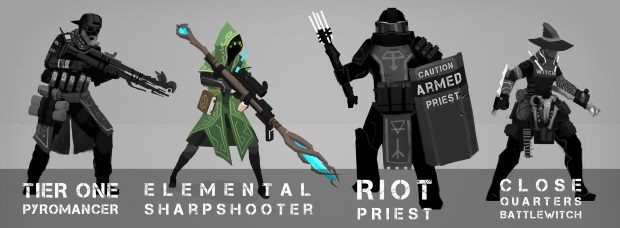
*The flexibility in affinity sources is deliberate and in-part inspired by Tactical Breach Wizards. Ultimately having control over how you present your Thaumaturge should be more prominent than trying to optimize all your slots for wizarding potential.*
*As long as people can glance that you're a wizard when you do obvious wizardry, all is well in the world.*
### Abilities
At release, Thaumaturge will include it's root power, required for all other powers, as well as a large variety of other powers. The goal of these powers is to give a mixture of utility for the light magic users, as well as some heavier-handed options for the full on dress-to-impress Thaumaturges.
* **Spell Preparation**: Spawns you with the aforementioned Spell Focus and the ability to prepare spells. Use in hand to change the form of the item, and use the attached spell to prepare charges.
* **Blend For Me!**: Immediately starts blending a tiny item in your hand (as if in a blender) and conjures a glass to hold it's outputs. Useable on a lot more than just fruit. Requires Affinity 1. Affinity gives a chance to not consume charges on cast.
* **Brazen Bindings**: Creates temporary cuffs made out of brass that dispel everything on the target and makes them unable to use resonant powers. These double as weaker normal cuffs, and break when removed. Dropping the item before applying it makes it disappear and refund the charge. Requires Affinity 1. Affinity adjusts the cuffs to take longer to struggle out of and how quickly you apply the cuffs.
*(Security has similar cuffs in the SecDrobe, so don't feel forced into taking this).*
* **Conjure Rain:** Coats a 3x3 area at the chosen location in rain. Everything in the area becomes wet, and any reagent containers are filled with 20u water, up to a maximum of 60u spread out across all containers. Mobs are splashed with the same amount and don't count towards this limit.
Holding a reagent container in hand will consume the chemical and replaces that much of the water with the held reagent (only works with chemicals that can be synthesized, with the exception of blood).
Replacing all the water in a cast will prevent slippery tiles. Requires Affinity 3. Higher affinity increases the max amount of spreadable reagents by 20u.
* **Gale Blast**: Shoots a high velocity gust of wind. The spell itself does no damage, but it extinguishes any fires in its wake, and on-impact knocks back the target 3 spaces and extinguishes their fires too. The projectile is visible, despite it being air. Requires Affinity 3. Bonus affinity gives a scaling chance to knock back an extra space.
* **Phantasmal Tool**: Summons a basic tool of your choice in your hand, chosen from a radial menu, that disappears if dropped or used to attack a creature. Requires Affinity 1. Affinity gives a chance to not consume charges on cast.
* **Prestidigitation**: Allows you to perform various minor feats of magic. Right-click opens a radial menu allowing you to select what sub-ability you will use. Left-click uses. Choices range from summoning sparks, to cleaning surfaces, to making objects glow, to making food taste better or worse.
Requires Affinity 1. Unaffected by Affinity scaling, and does not use charges.
* **Sanguine Absorption** You draw nearby blood into the target. This draws up to 100u of blood from adjacent floor/wall splatters, containers and other mobs (in that order). It then transfers that blood to the target and converts it to universally accepted blood.
Any excess blood in the target creature beyond 100% is transformed into healing, at a 10u per 4 damage ratio. This can only heal organic bodyparts and does not heal any damage-types besides Brute or Burn. This also does not affect creatures with non-blood bloodtypes such as Ethereals or Slimepeople.
Requires Affinity 3. Additional affinity increases the healing ratio by 0.5 per point
* **Vitalize Flora** Breathes life into the plants around you. This heals any and all plants (including plant creatures), makes them grow if they're still in the growth phase, and speeds up the time until the next harvest.
Requires Affinity 1. Affinity gives a chance to not consume charges.

*Your happy, diverse set of spells of various types. That you will have an anxiety attack over trying to spread out evenly.*
## Enigmatist
**(Enigmatist is not available upon release)**
Probably the one oozing the most potential for strange things and a measure of power-based strife (the positive kind), Enigmatist's specialty is chalks, runes and all manner of rituals.
To draw most of these runes, the Enigmatist uses chalk.
### Chalk & Runes
Enigmatist works similar in heretic and cultist in that they draw runes on the ground to activate various effects.
To draw their first rune, they'll need a piece of chalk and plasma to transmute it into the special resonant chalk. This is required to draw additional runes and is the gateway item to most of the powers in this system; as unlike other classes, you do not gain any powers beyond a generic 'Draw Rune' spell, similar to Heretic.
Unlike Heretic runes, you draw specific runes and fullfil their requirements. Runes can be erased with cleaning tools or using dispelling effects on them.
Further items require combinations of items to be transmuted into other objects, some of which will require cross-department collaboration or a clever mind knowing where to source things.
The original document had chalk damage implemented; but that was a tad too simple for what is the equivelant of someone messing with eldritch powers.
### Corruption
In truth, you are doing what Lovecraftian researchers tend to do; push the enveloppe on the unknown. Stare long enough in the abyss; and it will stare back at you.
Using your runes builds up a measure of Corruption, a special component attached to Enigmatists. The higher it gets, the more likely you will trigger an event on activating a rune. This can be summoning a hostile entity, the spell creating something new and different altogether (including heretic items), or you being abducted.
The key difference from Psyker is that these events are not necessarily negative; it is a measure of unpredicatability attached to the field of occult research. The particular goal with this is to create a healthy amount of character strife and maintain an aura of 'dangerous resonant magic' around the archetype.
You can decrease your Corruption, or purposely increase it, with one of the runes attached to the power, though these are usually costlier and difficult to do.
#### Corruption Chance
Corruption Chance is measured by usually three factors (sometimes four);
* Your proximity to Eldritch Influences (the same ones Heretic use)
* You can see them when you are an Enigmatist.
* This is heightened if the Eldritch Influence was harvested by a heretic.
* Your own Corruption status.
* Transmutation increases your corruption; this does not decrease by itself and has to be done through a special rune.
* Your Chalk's corruption status.
* Chalk absorbs part of the corruption you take, and turns more and more black the more you use it. Drawing runes with it will change the color, and those runes will have a heightened corruption chance. Recycle your chalk if you don't want this (or don't if you do).
* Your Rune's Catalysts.
* Explained further below, some Catalysts will rarely guarantee Corruption Events. These USUALLY are going to yield to very specific events. In this scenario, the catalyst is always consumed.
#### Corruption Catalysts
A sub-component of Corruption is Catalysts. Every rune that Enigmatist draws has tags which define what it does. To take an example, Path of Gates' rune of the Twin Gates. It has the Gates trait and the Teleporation trait. This will skew corruption events to those with matching traits (but not guarantee it), so you are likely to have events that for example teleports someone to you by accident. Note that corruption catalysts affect the result, not the chance.
However, this phenomena is not just restricted to the power you use. You can place additional items on the rune that are not required by the transmutation as catalysts. Just like traits, these may skew events towards certain resolutions. Placing a flamethrower on the rune will skew towards events that create fire; whilst offering some unique and rare items may practically guarantee certain evnts. The items here are somewhat arbitrary; however there are build-in events that tend to give measures of lore and information that can help you puzzle together what you can offer. Go with your gut on this.
Item catalysts are not additive; putting twenty flamethrowers onto a rune will not make it any more likely than just one flamethrower. Items are sorted into 'trait groups' for most interactions (for example Fire has lit candles, lighters, flamethrowers, fuel tanks, etc.) and will only use the strongest catalyst in a group. However, having multiple catalysts for differing traits can stack; if you hypothetically want to trigger an event with the FIRE and LIVING traits, you can place both a lit candle and a monkey ontop of the rune and these will stack. Some catalysts are better than others within their own category (flamethrower beats candle).
Beyond that, some events will have interactions with very specific items; if you somehow get your hands on a bottle of demon's blood, placing it on the rune will most certainly gaurantee an event and cause specific things to happen. These items are part of the CORRUPT trait group; and will guarantee corruption events. These are always consumed, and usually create a massive bias towards certain events.
#### Corruption Feeds Corruption
As disclosed earlier, Corruption Events aren't negative persay, and in fact some are strictly positive. With some persistance, you can acquire items from **select antagonists** and use them yourself, or even their spells. Keep in mind you are still beholden to the same requirements as normal; items that require you to be a hertic to activate some component will still require you to be one, and Heretic spells for example still require a focus.
There are also several Runes that are not available at roundstart which can be acquired through this system. A rune whose only purpose is to corrupt your chalk to the maximum for example, or Runes with heavier friction elements such as creating a constant atmospherics fire on the space.
Keep in mind that pushing for Corruption comes with the trials, tribulations and setbacks. You will be exposed to danger, possibly death, and probably need to do illegal things ontop of that. Some events will force you to make choices your character may not be aligned with. Not to mention, this affects both you and others; you may bring harm onto others through your actions.
It isn't as antagonistic as sacrificing people as a Heretic is, but you will not earn the crew's good graces with some of the negative situations you'll be causing. **Keep this in mind if you are making an Enigmatist; you are flirting with the dangers of the unknown, and you are the sole responsible power for invoking them.**
### Abilities
Uniquely, all of Enigmatist's powers come in bundles, meant to both synergize and resemble the various Heretic paths. At release, there'll be 4 paths, including Path of the Veilbreaker. Beyond theme, the runes from the paths have a special pool of events that only appear when triggering Corruption Events with them.
**Path of the Veilbreaker** is the root, and gives you access to the Draw Rune spell, one of the few active powers for Enigmatists. None of these runes generate Corruption.
* You get the Rune of the Veilbreaker, letting you make resonant chalk using plasma and any piece of chalk (this rune can be drawn with any chalk).
* You get the Rune of the Tempered, which reduces corruption by transmuting holy water, a diamond and a piece of resonant chalk. Resonant chalk tracks how much corruption they caused, and using chalk used in these purposes makes this more effective.
* You will also get the ability to see Eldritch Influences like a Heretic, but not interact with them. Placing your runes near them increases your corruption, which depending on your goals, may be a good thing. If a Heretic harvested the influence, the corruption is increaced massively.
* You also get the ability to identify and use Enigmatist runes you come across that others draw, even ones you do not know how to draw yourself.
**Path of Flesh** is the path of those that wish to transmute flesh and blood.
* You get the Rune of the Butcher, which sacrifices dead mobs placed on it and gives you an amount of flesh slightly more than if you were to butcher/grind it. If its a humanoid, it also expels all their organs intact.
* You get the Rune of the Fleshcrafter, which allows you to transmute flesh and 15u of blood into random organs (except for brains). If you offer an organic organ along with the transmutation (including brains), it will instead repair that organ proportional to the flesh offered. If a living person is inside the rune, it will damage them and drain their blood to heal their organs (even if all your organs are healthy).
* You get the Rune of the Lifegrafter, which allows you to **raise people from the dead**. Placing the dead person inside the rune along with a battery and a poppy make it transmute life into the target; reviving them as a defribilator would. However, there is more to this. Having organs ontop of the rune during the revival will swap (or applied if therés nothing in its place) them with the ones inside the target; and the same applies to limbs. Placing flesh inside the rune will heal the target proportional to the pounds of flesh provided, and placing blood (in containers) in the rune will transmute it into their body and converts it to their own bloodtype, even to non-conventional blood such as Ethereal's enriched liquid electricity.
None of this works on synthetic creatures or organs.
**Path of Gates** is about passage; moving through the many parts of the world unseen, and being able to unlock the barred gates that block the way.
* You get the Rune of the Unpredictable Passage. By transmuting a bottle and a dice, it teleports everyone and everything on the rune somewhere entirely random within 15 spaces of the rune (and a minimum of 5 spaces), then destroys the rune. You can draw arrows with regular chalk to skew the direction. If there's multiple arrows, it picks one randomly.
* You get the Rune of the Tresspasser's Toll. By transmuting a coin and any tool, it unlocks all doors within a 3x3 area around it (as if by a Knock spell).
* You get the Rune of the Twin Gates. By transmuting a bluespace crystal and a closet, this allows you to create a portal between this rune and another current inactive Rune of the Gate. The portal can be used by anyone, and permanently connects the two points until the rune is erased. Only works on the same Z-level.
**Path of Rust** is the path of entropy and decay, the undoing of that which still exists. It's powers are about the undoing of things; which can be surprisingly helpful.
* You get the Rune of the Inexorable Disassembly. Place it on the same space as a piece of machinery or other structure, and activate it to automatically disassemble the object. If it cannot be disassembled, it is instead constantly dealt increasing amounts of damage. This doesn't require any objects to transmute.
* You get the Rune of Entropy's Avatar. It does two seperate things depending on what you transmute; transmuting water will rust 4 random turfs within line of sight of the rune per 10u of water, whilst transmuting some wire and a wirebrush heals a creature proportional to the amount of rust in view of the rune. This can heal silicons and synthetic limbs/organs.
* You get the Rune of the Bygone Voices. By transmuting a sheet of plasma and either earmuffs or a muzzle, you will create an area (LOS requirement) where no words can be spoken. This Silences all Resonance powers and prevents speaking. Runes of the Bygone Voices also destroys any other Runes inside its area. The rune is obvious with a glowing spotlight while active.
**Path of the Void** is all about endless space; both space itself, but other endless 'spaces' as well (such as mirrors). It's powers typically interact with it, and provide boons to do with the manipulation of 'endless' space.
* You get the Rune of the Devourer's Pull. By transmuting a fishing rod, you throw all objects in view of the rune towards it. Mobs are thrown a shorter distance, and you are immune to the pull (but not everything hurling towards it).
* You get the Rune of the Maiden's Glimmer. By transmuting a glass shard and 1 sheet of Silver, you can view the world from any mirror onboard the station, as well as talk and hear through it. You are visible in the mirror while doing so.
Creatures immune to scrying cannot be perceived or heard by you through the mirror. The effect persists until you move off the rune, after which you need to transmute it again to activate.
* You get the Rune of the Homewards Waltz. By transmuting a bluespace crystal and a carpet tile; this becomes your 'prime' rune. Any other Runes of the Home Waltz you draw will teleport the creature on it to the Prime rune and destroy the non-Prume rune. The non-prime rune require a paper to be transmuted with the Prime Rune's keyphrase (given when you make it). This teleporation only works from other Z-levels.
## Theologist
Theologist uses Piety as a mechanic; gained by healing others using the Root powers. Compared to the original, the powers were largely restricted behind long, lengthy cooldowns that made them non-conductive, especially when compared to other powers. The most sweeping changes here is root powers being meatier, as well as introducing proper UI elements and more tightly defining the sub-types of the roots.
* **A Burden Revered** takes elements from the warrior priest, legendary warrior kings who mend with but the touch of their hands, and the crusaders. They are the most combat-oriented out of the three.
* **A Burden Twisted** takes elements from cults, witch doctors and more. These will mend, but will often have measures of randomness and side-effects attached.
* **A Burden Shared** takes elements from messiahs and prophet figures similar to those from biblical lore; holy-men and saints whose acts are miraculous and deeds pure of heart, often at their own cost. Note that this doesn't mean you are required to be religious; it's just similar theming.
With that in mind, let us quickly take a detour to explain Piety.
### Piety
Whenever you restore 5 points of hitpoints to someone, you get a point of Piety, which is a currency to spend. You start at 0, and it caps out at 50. The only way to gain more is to either use your Root Powers or any other Theologist powers that grant you Piety, and you spend it on skills that cost it.
The Chaplain uniquely has a cap of 100, and gains some extra small benefits with certain powers such as Pious Prayer.
### Abilities
At release, Theologist will have it's 3 root powers and 4 additional powers.
The root powers are as followed.
* **A Burden Revered** Heals the target for 1 health per second, over a period of 30 seconds, healing brute and burn damage at random. The target is also immune to pain for the duration. The effect ends if they become healthy or if you cast this on another creature. You gain your piety after the effect expires. 5 second cooldown. Does not work on non-organic bodyparts.
* **A Burden Twisted:** A channelled beam that requires both parties to hold still. Over time, this heals up to 30 damage, then deals half of it back as random damage types. The heal-rate is entirely random, and with a bit of fortune, can bring someone alive again in a moment. 20 second cooldown, cooldown doesn't start until after the ability is completed.
* **A Burden Shared:** A continuously channelling beam onto a target of your choice. Damage is transferred to the least damaged participant at a steady rate. If this causes the target to recover life, you gain piety, or lose it if you are transferring damage onto them. Does not work on dead people.
The beam has no duration and does not end on movement; only on loss of line of sight, distance or you being stunned. Losing Piety while at 0 Piety has consequences. 15 second cooldown.
* **A Burden Unattended:** The burdens of other's are not your duty to tend to. Doesn't grant any bonuses but grants you access to theologist powers. Only costs 1 point.

*Design partially inspired by the worst enemy in Tactical Breach Wizards.*
The specific powers are as followed.
* **Flagellant Piety:** You suffer so others may live. You gain Piety from being hurt by creatures. The damage taken must be directly caused by a creature; some indirect methods of damaging you such as throwing explosives or using area-of-effect magics may not grant piety.
The Piety gained is based on the pre-mitigation damage (block, armor etc): if the source is yourself, it is instead based on the total damage you took.
* **Cull the Unholy:** You are invested in a holy mission; to cleanse evil wherever it may take root. Defeating unholy mobs (most mining mobs, undead and cultist constructs) will grant you 1 Piety, capped to 20.
Elite Mining mobs grant 10 piety, whilst Sentient Elites and Megafauna grants you 25 Piety. Both of these are uncapped.
You do not need to participate in the kill: as long as you witness their death and are in their proximity, you will gain the Piety.
* **Pious Prayer**: Allows you to pray while you stand still, passively gaining Piety up to 5. If you are a Chaplain, this becomes 10. Every 5 seconds has a chance of giving the Piety; with the chance going up the more religious you are (carrying a bible, chaplain, religious quirk or standing on blessed tiles). This becomes 100% in the Chapel. Useful on a quiet day when no one is getting injured.
* **Divine Protection** You gain a block chance (separate from all other block chance) equal to half your piety; reduce Piety by 5 when this triggers.
* **Purify:** Cleanses impurity from objects and creatures in melee range. The chosen target is immediately dispelled and purified of all poisons.
If the target is an object with a holy equivelant, it turns it into that (e.g water into holy water). Has varying piety costs, but usually defaults to 5.
Requires A Burden Shared and 5 Piety.
* **Entropic Mending:** Invokes the effects of entropy, to make time literally heal all. Attempts to close the wound's targets; moderate wounds always close, other wounds are chance-based. Afterwards, for 3 minutes, the target triples their blood regeneration rate, metabolism and hunger rate. Requires Burden Twisted and 5 Piety.
* **Smiting Strike:** Channel smiting powers into a weapon, causing it to deal 15 extra burn damage and 4 knockback on the next creature hit (this knockback does not stun on wall hit). Dropping the item will cause the blessing to end, as does blessing another item. Works on ranged weapons too. Requires A Burden Revered and 5 Piety.
* **Imbued Armaments:** Through baptism, prayer chants or otherwise, your Smiting Strike is upgraded to no longer expire when exchanging hands, nor being removed when you bless another. This means you can hand out blessed weaponry to others. Reduces burn damage by 5 and knockback by 2. Requires Smiting Strike.

*Praise the Omnisiah, for they have blessed this Desert Eagle*
# Resonant Power Systems
## Psyker
Psyker is the umbrella for all the strange powers invoked purely by the MIND. Unique to it are a variety of quirks to do with that; such as not having cooldowns and instead a resource mechanic emphasizing the strss on their body, as well as being susceptible to anti-mental powers in the case of some powers.
### Stress
Using your powers passively or actively stresses you out, but not in the mental sense; but in the physical sense. Your root power gets you a special psyker organ called a paracausal gland (we will refer to it as the psyker organ for convenience), which undergoes physical stress as you engage in the metaphysical qualities of your powers. You never are directly told the amount you have directly; instead, certain thresholds will cause 'backlash events' to appear.
If you are ineligible for an event, it will roll another event of the tier; you are never safe from your consequences.
* **Under 100 Stress:** Nothing happens, you are free to do as you please. While at this amount, you passively lose 1 stress per second.
* **100 - 149 Stress:** You start suffering minor backlash events, which may not only clue you in on your overuse, but those around you as well. There is a status effect in the UI which informs you of this as well. Headaches, nosebleeds, and the likes. You no longer passively lose stress, and need to mediate to lower it.
* **150 - 199 Stress:** You start suffering major backlash events. Your eyes begin to bleed, you start to hallucinate, your ears ring. These are obvious to you and others around you; and your last warning to stop and meditate.
* **200+ Stress:** You reached the breaking point. At this point you will suffer what is called a catastrophic backlash event, often with lingering effects. Your heart might stop, you may be physically be torn apart by your telekinetic powers, you may suffer a brain trauma or even the loss of your powers. After this triggers, you are back to 0 Stress. This means, if urgency calls, you can burn yourself up like a flame until you physically can't no more.

*You cannot go Virtuous in this game.*
The psyker organ cannot be replaced if removed, which means anything that deals organ damage is a threat to you (it is located within the chest). It takes about 15 minutes to fully decay if left exposed.
### Abilities
Psyker comes with it's root power and several more powers.
* **Paracausal Gland**: The earlier described psyker organ and the root power of Psyker. Doesn't do much on its own beyond providing you with your Meditate power.
* **Meditate**: Comes for free with the root power, allowing you to reduce your stress by about 2 per second. If you are a Cultivator, then the two Meditate powers combine their effects.
* **Levitate:** Who needs legs? Allows you to temporarily levitate, floating over anything on the floor, from slippery tiles to chasms. If your legs aren't functional, you can use this to move around. You are still affected by slowdowns as normal, and passively gain stress while levitating, which is reduced if you are Paraplegic, enough-so you can do it permanently.
* **Telekinesis:** Allows you to move objects with your MIND. Works similar to the MODsuit grab module; allowing you to move objects in line of sight, and even punt them. Passively holding an object stresses you; punting it does more-so, all depending on the object's weight class. Unlike the genetic power, you are very obvious when using this, and cannot use this to interact with objects.
* **Manipulate** Allows you interact with machinery and various other structures within line of sight as if it were next to you. Having UIs open from a distaince using this power causes stress build-up.
*(Works similar to genetics TK; but has visual tells that the item is being manipulated)*
* **Mirage** Creates an illusory copy of yourself for 20 seconds; it has one health and draws aggression from creatures, but doesn't deal damage and can be walked through.
Right click with the power selected to change its behavior between stationary, aggressive and flee. Creatures immune to mental and resonant effects disbelieve the illusion, making them see-through and pass-through.
Creating an illusion creates a moderate amount of stress.
* **Preminition:** You are aware when a particular something is mentioned; a hunch as it were. Select a specific word or phrase; anytime someone mentions it (no matter where they are), you will trigger your pre-chosen emote. Has a cooldown of 10 seconds.
* **Scrying:** Using a sample of a creature's blood, you can see the world through their eyes remotely. Creatures will be vague silhouettes and hard to distinguish, but their environment will appear clear. In this state, you use their sight instead of your own; but you cannot target creatures that are immune to magic, scrying; or lack the brain activity required to be detectable (dumb).
Passively builds up a large amount of stress; having the Blind quirk halves it (and is one of the few things that bypasses this blindness). The target sometimes gets preminations to indicate they are watched.
* **Telepathy:** Allows you to mentally communicate messages to targets (anonymously). Generates a very small amount of stress. Has a speech-bubble that can be toggled on and off using middle click.
For 1 point, you can upgrade Telepathy to also be able to do group telepathy to all mobs within sight.
* **Ward Mind:** Temporarily strengthens your mind to block out mental assaults. You become immune to various abilities that use the mental trait as well as scrying, such as a large variety of Psyker powers but also a handful of other interactions. This has a passive stress upkeep, enough to cancel out any regeneration.
## Cultivator
Cultivator is a broad fantasy. Between the classic concepts of cultivations, the fantasy archetype of monks and **GOKU™**. Finding a place that is both mechanically satisfying and existing in a way that makes sense for the setting is a bit of a balancing act.
### Alignments
Cultivator is thusly stylized to have a large variety of roots. Each root is an 'alignment', which determines exactly how you gain your Dantian resource and what the theming of your powers are. The alignment power can be activated to gain an aura (increasing your cool factor) and activate the passive effects of the alignment, whilst causing your Dantian to start passively draining (there's also a 200 cost on use).
Most abilities available to Cultivator are utility focused outside of alignment (and often used for aura farming), but once you enter alignment, these turn into a powerhouse of an ability to use in combat. What was once a mere lighter turns into throwable fireballs.
Dantian as a resource caps out at 1000. You can gain it by actively meditating (a power included with the roots) or using the Aura mechanic below
### Aura (Feng Shui)
Feng Shui is a common trope in many forms of cultivation; the energies of the room affecting the strength of one's meditation. Whilst Feng Shui deals with a complex system of energies feeding one another, the version that Cultivator has is called **Aura**, and is somewhat more simplistic in it's implementation.
Your alignment determines what you resonate with; Flamesoul Alignment for example resonates with fire as an element. Their Dantian will thusly rise passively while they are in the presence of exposed flames. The area is based on sight. Whether it be in the form of candles, a bonfire or being on fire, all this contributes in various proportions. Thusly, a cultivator wants to take control of their workspace and tailor it to their preferences if it didn't already. There is an upper bound to how much you can get from Aura per second, so you don't need to cram the room full of bonfires to be optimal. You also cannot gain Dantian from Aura while in Alignment.
You can still meditate as normal in any location to gain Dantian; but the two sources compound one another. If you truly are aiming for the gains, you'd indulge in both and meditate in the coziest of dens.

*Exceedingly cozy; and really aligned with fire.*
### Abilities
The starting 3 alignments are
* **Shadow Walker Alignment:** You gain your Dantian's aura through dark rooms and environments. Activating it wraps you in an aura of shadow. You are entirely unrecognizeable in this state (similar to Heretic's Cloak of Shadows), and your punches do 15 extra brute damage.
Passively, you have enhanced darkvision, and gain full on night vision while your alignment is activated.
While your armor is below it, you gain armor IV against all damage types.
* **Vanish Unseen Into Shadow** You are immune to resonant scrying and slowdowns while you're stood in darkness or are in alignment.
* **Travel Under the Veil of Night** Whilst your alignment is active, you can spend 1 seconds channeling in a space of darkness to teleport to another space of darkness within line of sight. Has a Dantian cost; no cooldown.
* **Astral Touched Alignment:** You gain your Dantian's aura by being able to view space (or space adjacent things), proportional to distance. Activating it gives you a radiant, blue aura causing your punches to do 15 extra burn damage.
Passively, your cold temprature and pressure threshold is increased by 30C; activating the alignment makes you immune to cold and pressure, allowing you to navigate space (though you still need to breathe).
While your armor is below it, you gain armor IV against all damage types.
* **Fly Like a Shooting Star** Whilst your alignment is active, you can fly. You can propel yourself through the air and space as if wearing a jetpack. If you aren't able to use your legs, you're able to move around with this ability, regardless of the current gravity.
* **The Many Stars that Dot the Night Sky** Activating the ability sends forth a little star, which stops when it reaches it's destination (or hits an object) passively glowing in an area as a light source for 5 minutes. You can have up to 8 of these active.
While in alignment, you can right click with this ability to explode all active stars that are not in motion dealing 20 burn damage to all creatures in a 3x3 area centered on it. This is affected by EXPLOSIVE proof armor.
Exploding the stars consumes Dantian per star. No cooldown.
* **Flame Soul Alignment:** You gain your Dantian's aura by being able to see exposed fires (bonfires, plasma fires, etc.) or if you are on fire yourself. Activating it gives you a burning hot aura, causing your punches to do 15 extra burn damage.
Passively, your high temprature threshold is increased by 30C regardless of species. Activating the alignment makes you completely immune to fire (but not the things you are wearing).
While your armor is below it, you gain armor III against all damage types, armor VI against Lasers and armor X against fire.
* **From Friction Comes Flame** Your punches while in alignment cause the target to heat up. Once they reach 80C, your strikes also combust the target.
* **Set Fire to Dry Hay** While not in alignment, you can summon a small flame which has the effects of a lighter. While in alignment, you can shoot flameblasts that ignite the target that deal burn damage (and are affected by FIRE armor). Costs Datain while in alignment.
Finally, there is one power that is available to all alignments:
* **Energy Dash** While in Alignment, you can dash forth at extreme speeds. Choose a space that can be reached by walking (even if it requires reasonable detours). You immediately dash there and arrive near-instantly. Costs Dantian to use.

*Cultivators are all about aura farming*
## Aberrant
Aberrant is a collection of weird, odd traits that are supernatural but don't necessarily belong in any of the other Sorcerous or Resonant archetypes. It is largely broad, and whilst it lacks a throughline mechanic, it does offer a large degree of options.
Aberrant is split in three distinct roots;
* Beastial, which has you inherit the traits of animals. Whether it is something as enigmatic as a werewolf curse, animal spirits or various other reasons, you have the qualities of other animals. Abilities such as growing claws, being able to see perfectly in the dark, and more. Most abilities in this root build-up hunger, so make sure to eat (or hunt, if you roll like that). The root itself lets you see better in the dark.
* Anomalous are folks that have very 'odd' qualities. The meat here is that all the Anomalous abilities are mutually exclusive with one-another and provide a hefty benefit at a heavy point cost. Anti-Resonance Anomaly makes you permanently immune to resonant effects, but also has you permanently silenced. Bluespace Anomaly allows you to see and use rifts that connect to various parts of the station (as if you have the Bluespace Attunment trauma). The root itself is very cheap and allows you to calm down anomalies with a touch.
* Abominations are when you start treading into the body-horror and very odd powers. There to cater to the changeling fantasies and the likes, it has a variety of quirks that are still about your 'physical' qualities but have no ties to animals. Growing an arm-blade, mimmicking the environment, grow back limbs.
### Abilities
* **Beastkindred** (Beastial Root) You have the traits of an animal; and with it, the apetite of one. In addition to your species normal preferences, you now like the following food based on your choice of Herbivore or Carnivore (including making it non-toxic)
Herbivore: Vegetables, Fruit & Nuts.
Carnivore: Raw, Gore, Meat, Bugs & Seafood.
* **Bloodhound** You gain the ability to detect and hunt down anyone based on their blood (DNA). Use the ability and click any source of blood; you will get a sense of their direction until you acquire a different creature's taste. Does not work on creatures immune to resonant scrying (this includes creatures immune to resonance & magic).
* **Tail Sweep** Your tail is a weapon in its own right. When activated, damages all creatures adjacent to you for 20 brute and 30 stamina, and knocks them away 2 spaces, potentially into walls.
Has a short cooldown, consumes hunger and the damage is affected by your opponent's chest armor. Requires a tail. If you are a large mob (such as with the Oversized quirk), you gain +1 range.
* **Web Crafter** Threads of spidery silk crafted at your leisure. You gain the Web Crafting ability. You can use it to make passive webs in an area (which do not slow you down); or you can use it to make cloth. Creating anything using web crafter makes you hungry, and you cannot use it if you are starving.
* **Tripwire Webs** Allows you to place invisible tripwires using web crafter. Any creature that isn't able to safely pass webs will trigger the tripwire when they pass through it, destroying it and warning you of which wire was triggered.
* **Restraining Webs** Allows you to craft web restraints and web bolas using web crafter. Web restraints are functionally similar to zipties. Web Bolas can be thrown just like regular bolas.
* **Snaring Webs** Allows you to craft snares. These are placed on the ground and are hard to see; but can be disarmed by being damaged.
Mobs without the ability to walk through webs will be legcuffed if they walk through it.
Simple mobs instead receive a slowing status effect for 10 seconds.
* **Cocoon** Grants you the 'Cocoon' ability, allowing you to cocoon objects and people after a delay (people must be aggressively grabbed). You can instantly destroy cocoons by attacking with an empty hand. Creatures wrapped up can escape after resisting. These cocoons can be dragged and moved around if the contained items can be as well. Also useable for scooping up all the items on the ground in a handy container. Consumes a lot of hunger depending on what you are wrapping.

*Now you can be the spider that blocks all the hallways.*
* **Anomalous Origin** (Anomalous Root) Things just don't add up with you. You can interact with anomalies to close them, as if you were using an anomaly neutralizer. Only costs 1 point.
* **Counter-Resonant:** You have a counteractive effect on resonance-based phenomena. You are immune to resonance-based effects, and you cannot use any resonance-based powers. This has no affect on highly advanced magics wielded by antagonistic forces.
* **Riftwalker:** You see the bluespace gateways that connect the world together. At round start, there are 10 bluespace gateways that only you (and others with this power) can see see in random locations (same spawning logic as Heretic influences). Each gateway has another connecting gateway. Interacting with it will after a short delay teleport you to the other connecting gateway. Having people grabbed/held will bring them along with you.
* **Radiosynthesis** Rather than the molecular degredation you experience from radioactivity, your body instead uses it as an energy source to rapidly heal your body. Radioactivity heals you instead of damaging you. Because this healing is anomalous, it heals synthetic and biological bodyparts.
*Radiosynthesis does not fully heal toxins damage; and thusly does not remove radiation unassisted.*
* **Summonable:** By speaking a specific name or word, you appear next to the speaker after a short delay. The summoning takes time, you are stunned throughout, is entirely involuntary and can only be stopped by being silenced, buckled; or by being dispelled at the start of the process. After being succesfuly summoned, you are unable to be summoned again for 1 minute.
The chosen word is a partial secret; the Security Records on your powers contain the word as well. It cannot contain any special characters, only standard letters and numbers.
*Be aware that your choice of 'word' may highly affect how often you get interrupted in roleplay.*
* **Monstrous Body** (Abomination Root) If it bleeds, you can kill it. Just with you, blood doesn't really matter. You have 130% the normal blood capacity of your species, and regenerate blood twice as fast.
* **Healing Factor** Your physical injuries heal without assistance. You heal 0.15 damage per second, randomly split between brute and burn damage while not in critical condition. Wounds such as bleeding still require medical treatment.
* **Miasmic Conversion** Your body mends itself disturbingly well, but creates toxic backlash in your system. You passively convert 1 brute or burn damage per second to 0.7 toxins damage. You also passively heal 0.1 toxins damage per second.
* **Armblade** Allows you to transform your arm into a deadly blade. The weapon itself has high damage, pierces armor and can destroy tables that block your way (but is weaker than the default changeling armblade, and can't force doors). Requires an empty hand to use.
The following powers are available to both Beastial Body and Monstrous Body:
* **Shapechange** You can adjust your body to turn into a specific type of animal (chosen at character creation). Most of the starting animals are pets. Activating the ability transforms you into the chosen animal. It does not have your name or any other identifying traits, but the number is always the same when you use it (and the security record for this power elaborates on what creature and numbers). Using the ability makes you hungry, and cannot be used while you're starving.
If the creature dies or the effect end, you are reverted to your normal form (prone on the ground), and half the damage taken is transfered to your original form (or full damage if you got forced out because you died).
* **Shapechange: Wolf** Changes your Shapechange to be a wolf. Tankier and sturdy, it has a powerful bite and resists the cold elements.
* **Shapechange: Spider** Changes Shapechange form with a spider variant.
Hunters are fast but fragile, Guards are slow and sturdy and Ambush spiders are very slow, but have strong grabs, hard-hitting attacks and invisiblity in webs.
* **Vent Crawler** Your anatomy is capable of fitting in tight spaces. You can crawl into vents if you are not wearing anything in your back slot, helmet slot or suit slot. If you are undersized, you can crawl in vents while wearing your normal equipment. Does not work on oversized mobs.
* **Bioluminescence** You can glow! You passively emit the chosen light color; which can be toggled on or off at will. Very slightly increases passive hunger gain proportional to size.
(Fun side interaction; being shaked makes you glow brighter?)
* **Darkvision** Your eyes see perfectly in the dark; but your vision gains a blue-ish hue to it.
# Mortal Power Systems
Whilst this isn't specified specifically in the three paths, the goal of these is to be easier to pick-up when mixing and matching. None of the three paths have 'root' powers, meaning you can easily mix and match, though Warfighter still has 'categories' of abilities.
## Warfighter
War(fighter) has changed; and admittedly, struggles still with it's identity.
Whilst it does not have a larger, overarching mechanic beyond what it's roots and subskills provide (and most of Mortal follows this pattern of being fairly simple out of the box), there is one recurring problem with Warfighter specifically; guns.
### The Gun Problem
The issue really with any power scaling system in fiction is that a gun is powerful. Admittedly in SS13, the gun is about the strongest thing in the game bar wizard spells and bombs, but the gun provides an incredible ease of use.
So whilst a lot of people would like to specialize in guns, the problem is that not only is it already very strong, but guns are diverse. Bolt-actions, semi-autos, shotguns. Even the reload patterns differ per gun, so finding something that fits everything that isn't too crazy is admittedly difficult.
Until something good can be hashed out in this regard, I am leaving the concept of a gun category untouched.
### The Overal Design
Warfighter is being split into four distinct categories based;
* Martial Artist is still focused on unarmed, martial arts and tackles, allowing people to even the playing field with any armed opponent. CQB will also have an unique little trick in the form of Dirty Trick, which is an active ability that allows them to temporarily silence (not dispel) Resonant users.
* Equipment Specialist revolves around specific items and mastering your skills in them. This one is particularly broad, but things such as a short, flat +50% block chance (parry) that compounds with other shields, or to cator to the various 'swordmaster' archetypes, increasing their lethality with their branch of weapons. **This will not include guns, but might include other ranged options like grenades, bows, etc.**
* Commander specializes in given target people buffs; including things like helping people up from a distance through special powers. It won't have the ally system that the previous system has, but will have bonuses for inner department stuff.
* The eventual Gun specialization that won't be included at launch.
**Importantly; Warfighter has categories instead of roots.** This means that you aren't locked into one of the four categories; you can pick up as many of them as you physically please.
### Abilities
* **Commander:** There's many facets to a good leader, but being able to delegate and manage people under pressure is an art of it's own. You gain the 'Command: Recover' ability. Using it on someone will cause them to recover from stuns faster (as if shook on help intent 2x). Has a moderate cooldown.
For any and all command abilities in this category, the effect is increased if you are in the same department as the target, and even further if you are a head of staff (regardless of department). Command abilities can never be used on yourself, and require the target to be able to see or hear you.
* **Command: Grit**. Whilst active, the target ignores pain for 15 seconds, as well as slowdown from damage and stamina loss. Has a long cooldown. Increased effects from department/role lenghtens duration.
* **Martial Artist:** A master in hand to hand combat, you are a threat up close with your fists. You deal an increaesed (+5) melee damage with your punches.
* **Krav Maga:** You innately know how to use Krav Maga.
* **Tackler:** You innately can use tackling, as if wearing tackling gloves. You are also somewhat better at tackling.
* **Greater Tackler:** You are a much better at tackling, and your range for tackles increases by +2. Requires Tackler.
* **Equipment Specialist:** Some folks have studied warfare in their own specialized way for years, putting them on an equal ground with many others. This category includes things such as swords, shields and more (but never guns). The power itself grants you the 'Quick Draw' ability, letting you 'acclimate' with an item of your choice. Whilst acclimated, you can use the power to instantly draw the item to your hand, as long as it is anywhere on your person, or within melee range of you. You can even use this to snag it back from your enemies.
* **Dual Wielder:** You gain the Twin Striker toggled ability. Toggling it on will have you attack with both melee weapons on hit, but both have a 35% chance to miss.
* **Heavy Slam:** You perform a massive, arcing strike that hits a large area. You strike the 2x3 area adjacent to you in the target direction, hitting everyone in the area (and everything, if in combat mode). A creature can only be hit once by this power, but large creatures take double damage. Requires you to actively be wielding a two-handed weapon.
* **Focused Block:** You raise your block chance by 50 for 1.5 seconds, as long as you are holding a bulky-sized item or an item with a block chance. This stacks on-top of any existing block you may have, guaranteeing blocks with most shields. Has a short cooldown.
* **Explosives Specialist:** Bombs and grenades are your forte. You can see the countdown on grenades (and bombs, but practically all bombs already come with a display for DRAMATIC FLAIR).

*Quick Draw works off of types, so if you want to specialize in fishing teargas grenades out of your backpack rapidly, you can infact specialize in warcrimes.*
## Experts
Expert is all about doing your job noticeably better, contributing to the fantasy of being masters of their crafts. Because jobs are so broad and there's a lot of overlap in various parts (e.g being able to see chemicals is both a Chemist and a Bartender thing), I've elected to get rid of roots for Expert all together to increase accessibility, allowing a way to round-off the skills of characters from other archetypes and avoid having them be one-trick ponies. The drunken-fist style cultivator may make for a good bartender.
### Abilities
Expert has no roots; it starts with 9 'niche but useful bonuses'
* **Eye for Ingredients:** You've interacted with food, drinks and/or chemicals so often, you can see at a glance if something's off with it. You can see the precise reagent contents of all containers by simply examining it.
* **False Power** A bit of misinformation about your capabilities and its immediately on record. Allows you to add a 'fake' power entry to your Security Records, tailored entirely to your own design. Only costs 1 point.
* **Heavy Lifter:** A strong back does a lot when it comes to carrying crates. You ignore the slowdown from dragging objects and having creatures grabbed (other slowdowns still apply). You also start at Journeyman in the Athletics skill
* **Punt:** Requires Heavy Lifter. Using your foot or some other part of your body, you send an object barreling down a long distance away from you. If someone is hit by the object and it is solid, they are knocked down and take damage.
Distance (and damage) scale with your Athletics skill. Double distance on crates and non-bulky objects!.
* **Strider:** Requires Heavy Lifter. You also ignore the slowdowns from held & worn items. You start out at Master proficiency for Athletics instead.
* **Hidden Powers** Your capabilities were never put on paper, for one reason or another. Your powers are not visible in the security records.
If you have False Power, it will be the only preserved record of your powers.
* **Zoologist:** You are capable of befriending just about any creature, given the opportunity. You gain the 'Befriend Creature' ability; using it on a mob in melee range will befriend it and any of it's other nearby cousins. This doesn't prevent them from turning hostile on other creatures. You can befriend just about any creature that can also be revived with a Lazurs Injector. There's no limit to how many creatures you can befriend.
* **Creature Tamer:** Requires Zooologist. Grants an ability that automatically tames a creature that is already tameable. Works on a lot of specific things, such as space carps, blobbernauts, goliaths and more. This won't change their usual tamed behavior; so goliaths won't do anything til you saddle them as usual.

*Turn a carp migration into your personal army, if you're able to catch the wave.*
* **Obfuscate Voice:** Like an actor, the sheer range in your voice is enough, with a little effort, to sound like someone entirely unfamiliar. Grants the 'Obfuscate Voice' action, making your voice unrecognizeable while active (appears as Unknown).
* **Omnilingual** You speak an absurd amount of languages; you are able to understand and speak every language at full proficiency. Does not apply to languages not available to your character at character selection.
* **Master Surgeon:** Surgery takes composure and skill which you have aplenty. Increases your success rate and action speed with surgery by a factor of 1.5x.
* **Rich:** Whether through good savings, connections or just nepotism; you have way more spendable cash on hand than your peers. You start the shift with 2500 extra credits in your account.
* **Filthy Rich:** With this much disposable money it's even a question as to why you even work anymore. You start with 10000 extra credits (includes the amount from being Rich already). And probably tons more in off-shore savings accounts. Requires being Rich already.
## Augmented
The original design document laid out a complicated system of roots and co-dependent systems, almost like a computer-system with its subpart. The problem with it however was that it was written in a vacuum without interacting with or respecting the baseline augment system.
Augmented thusly has been redone. Given that the goal of this update is to provide the systems first and a baseline content for players to enjoy, I've elected to focus on having Augmented be an incredibly versatile framework that allows adding **any** augment as a power, by simply declaring a name, description, value and typepath. All the heavy-lifting for mechanics should be done by the augment, meaning that people familiar with making augments won't need to learn new tricks to add content to Augmented.
Augmented's main mechanics is two-fold; one is it's unique requirements, the other is that it is split between Standard and Premium augments.
### Requirements
For requirements it does not have root powers; instead it adheres to the same restricts as the base game Augment system; only 1 of each organ, except for the arm, of which you can have two. You'll be glad to know that a high amount of time went into specifically allowing you to choose which arm augments go where, so you no longer need to cope with the left-handed quirk, and even allowing you to mix and match multiple arm augments. You can even double up (for no extra cost); want to go double drills as a miner? Shoot for the stars.
### Standard & Premium Augments
The general augments available onboard the station are what's called 'Standard' grade augments. They by all accounts are commonly manufactured, are standard quality and does nothing too crazy. They work; and that is that.
Premium Augments are slightly different; this is a market of unique equipment, often made on order, with high quality parts. Not only do they boast much more unique effects, but often stronger effects than normal augments that yield comparable results.
However; these parts and components are not available on the station. Not only can these not be made through Robotics, their maintenance is equally difficult.
Premium Augments possess a quality meter; you start at 75% at the start of the shift. Quality influences the strength of your augment; for example a Premium Pneumatic Arm's damage scales with the quality, and goes down with use.
As a rule of thumb, quality decreases passively by 1% around every 5 minutes. Using the power decreases it actively.
* At 76%-100%, it yields it's most optimal results and grants it the keenest edge. There's no difference between 76% and 100% quality; merely the buffer you have before it drops.
* At 51%-75%, it is still very capable and is to be the 'expected' tier for all balance. Expect about a 20% downgrade in performance compared to 100%
* At 26%-50%, the effects of augments begin to sharply drop. Expect about a 20% downgrade in performance compared to 75%.
* At 1%-25%, the augment is barely functional. Expect about a 30% downgrade in performance compared to 50%.
* At 0%, the augment becomes unuseable until repaired. You will be required to do a proper refurbish rather than Premium Maintenance to raise it up from 0%.
So, how do you repair it? Roboticists (and by extension Medical) can perform Premium Mainteance as a surgery. It requires tools and targeting a bodypart with a premium part. Much like treating wounds, a repeatable step lets you restore up to 75% quality.
To really get a proper refurbish going however, you have to do a more thorough repair. This involves using organ/limb manipulation to remove the part and taking the required steps (usually using tools) to repair the item. Doing so succesfully pushes it up to 100% quality.
If the Premium part is a physical limb, it usually massively increases the limb's health to offset the difficulty to repair (superficial damage can still be welded and cabled).
Being EMP'd has negative effects as per usual; as well as always doing quality damage.
#### Why have the split? Why not universal quality mechanics?
We are admittedly beholden to the woes of base /tg/ code. Whilst I'd love to make this a more universal and broadly applied concept, the issue is that deviating from what's already there comes with a responsibility to maintain it. In the future mayhaps, but for now the split exists.

*Deliberate care was put in to make it as easy as possible for people to tell how to handle these augments; health analyzers will show quality and a tooltip on how to repair it. Refurbishing is equally easy; simply follow the steps outlined on the item when you uexamine it*
### Augments (Premium)
* **ANGL Auto Retriever (Chest):** Some assets are far too wealthy to risk losing. Created by Interdyne Pharmaceuticals, this allows their premium customers to be rescued from the most greivous of circumstances; and recently came with a support API for other healthcare providers.
Once you reach critical condition or when manually activated, you begin a slow (and obvious) 15 second teleport towards your station's medbay lobby (regardless of Z-level). Once it fires, a warning message is issued over the radio. The teleportation sets the quality to 0%, and can be interupted by Epinephrine in the bloodstream, EMP, or healing you above the critical threshold; after which it loses 25% quality and enters a several minute cooldown period.
Passively decreases in quality (significantly faster than the standard passive decay); reducing in quality by 1% every minute. Lower quality decreases the speed of the teleport.
* **TNFL Mental Shielding (Brain (CNS):** Based on the nullifying effects that tinfoil has on certain magical phenomena, this dermal implant creates a protective coating around your brain. Creates a barrier that blocks resonant based scrying, as well as mental abilities used on you (including magic stronger than Resonant).
Blocking mental abilities consumes quality, increasing consumption rate the lower the quality is.
* **DSTR Pneumatic Arm (Arm):** A popular choice for the augmented bodyguards, given it turns your arms into weapons; ideal for places that don't allow weapons. Passively increases your punch damage by +5 per arm. In addition, it allows you actively 'overcharge' the arm, making your next punch knockback someoneone 1 space (potentially stunning them on walls) and dealing an additional 15 brute damage in exchange for a hefty quality cost.
Quality decreases from using the pneumatic arm's active ability. Quality affects damage (passive and active).
* **SPRY Reagent Cannon (Arm):** Usually included in various company contracts, those who work in mega-scale botanics and cleaning need to push for optimal efficiency. Manufcatured by Nex-Zephyr, this beauty will be your lifelong replacement of a spray bottle.
When activated, transform your arm into a chemsprayer, allowing you to deploy chemicals rapidly in a large area. Capable of containing up to 600 chemicals.
Because this is an incredibly invasive augment, this requires a cybernetic arm to wield effectively. Your arm will be replaced with a synthetic variant at roundstart to facilitate this.
* **PRCG Precognitive Scanners (Eyes):** Though some market it as being able to see the future, this invention by Oracle Neuro-Systems is instead a specialized AI recognition model hooked into a BULLET DODGER skillchip, allowing you to automatically dodge any incoming projectiles.
This doesn't come without drawbacks, as the visual load is exhausting and suffers from the same drawbacks as the skillchip by tiring you out, causing more exhaustion than usual proportional to the damage of the projectile. This has no safeguard beyond disabling the augment manually, meaning you can be stamina-critted by any projectiles.
Requires a BULLET DODGER Skillchip to function; comes pre-packaged with one at roundstart.
### Augments (Standard)
These are the standard tier augments, available to all. These are existing augments, readily available.
**Arms**
* Razor Claws
* Hydroponics Toolset Implant
* Sanitation Toolset Implant
* Surgical Toolset Implant
* Engineering Toolset Arm Implant
**Chest**
* Atlas Gravitronic spinal implant
* Nutrient Pump Implant
**Eye HUDs**
* Medical HUD implant
* Diagnostic HUD implant
**Eyes**
* Shielded Robotic Eyes
**Misc.**
* CNS Skillchip Connector Implant
 Google Drive
Gist
Clipboard
Google Drive
Gist
Clipboard
 Sign in via Google
 Sign in via Facebook
 Sign in via X(Twitter)
 Sign in via GitHub
 Sign in via Dropbox
 Sign in with Wallet






