Ironhack Education Team
  • NEW!
    NEW!  Connect Ideas Across Notes
    Save time and share insights. With Paragraph Citation, you can quote others’ work with source info built in. If someone cites your note, you’ll see a card showing where it’s used—bringing notes closer together.
    Got it
      • Create new note
      • Create a note from template
        • Sharing URL Link copied
        • /edit
        • View mode
          • Edit mode
          • View mode
          • Book mode
          • Slide mode
          Edit mode View mode Book mode Slide mode
        • Customize slides
        • Note Permission
        • Read
          • Only me
          • Signed-in users
          • Everyone
          Only me Signed-in users Everyone
        • Write
          • Only me
          • Signed-in users
          • Everyone
          Only me Signed-in users Everyone
        • Engagement control Commenting, Suggest edit, Emoji Reply
      • Invite by email
        Invitee

        This note has no invitees

      • Publish Note

        Share your work with the world Congratulations! 🎉 Your note is out in the world Publish Note No publishing access yet

        Your note will be visible on your profile and discoverable by anyone.
        Your note is now live.
        This note is visible on your profile and discoverable online.
        Everyone on the web can find and read all notes of this public team.

        Your account was recently created. Publishing will be available soon, allowing you to share notes on your public page and in search results.

        Your team account was recently created. Publishing will be available soon, allowing you to share notes on your public page and in search results.

        Explore these features while you wait
        Complete general settings
        Bookmark and like published notes
        Write a few more notes
        Complete general settings
        Write a few more notes
        See published notes
        Unpublish note
        Please check the box to agree to the Community Guidelines.
        View profile
      • Commenting
        Permission
        Disabled Forbidden Owners Signed-in users Everyone
      • Enable
      • Permission
        • Forbidden
        • Owners
        • Signed-in users
        • Everyone
      • Suggest edit
        Permission
        Disabled Forbidden Owners Signed-in users Everyone
      • Enable
      • Permission
        • Forbidden
        • Owners
        • Signed-in users
      • Emoji Reply
      • Enable
      • Versions and GitHub Sync
      • Note settings
      • Note Insights New
      • Engagement control
      • Make a copy
      • Transfer ownership
      • Delete this note
      • Save as template
      • Insert from template
      • Import from
        • Dropbox
        • Google Drive
        • Gist
        • Clipboard
      • Export to
        • Dropbox
        • Google Drive
        • Gist
      • Download
        • Markdown
        • HTML
        • Raw HTML
    Menu Note settings Note Insights Versions and GitHub Sync Sharing URL Create Help
    Create Create new note Create a note from template
    Menu
    Options
    Engagement control Make a copy Transfer ownership Delete this note
    Import from
    Dropbox Google Drive Gist Clipboard
    Export to
    Dropbox Google Drive Gist
    Download
    Markdown HTML Raw HTML
    Back
    Sharing URL Link copied
    /edit
    View mode
    • Edit mode
    • View mode
    • Book mode
    • Slide mode
    Edit mode View mode Book mode Slide mode
    Customize slides
    Note Permission
    Read
    Only me
    • Only me
    • Signed-in users
    • Everyone
    Only me Signed-in users Everyone
    Write
    Only me
    • Only me
    • Signed-in users
    • Everyone
    Only me Signed-in users Everyone
    Engagement control Commenting, Suggest edit, Emoji Reply
  • Invite by email
    Invitee

    This note has no invitees

  • Publish Note

    Share your work with the world Congratulations! 🎉 Your note is out in the world Publish Note No publishing access yet

    Your note will be visible on your profile and discoverable by anyone.
    Your note is now live.
    This note is visible on your profile and discoverable online.
    Everyone on the web can find and read all notes of this public team.

    Your account was recently created. Publishing will be available soon, allowing you to share notes on your public page and in search results.

    Your team account was recently created. Publishing will be available soon, allowing you to share notes on your public page and in search results.

    Explore these features while you wait
    Complete general settings
    Bookmark and like published notes
    Write a few more notes
    Complete general settings
    Write a few more notes
    See published notes
    Unpublish note
    Please check the box to agree to the Community Guidelines.
    View profile
    Engagement control
    Commenting
    Permission
    Disabled Forbidden Owners Signed-in users Everyone
    Enable
    Permission
    • Forbidden
    • Owners
    • Signed-in users
    • Everyone
    Suggest edit
    Permission
    Disabled Forbidden Owners Signed-in users Everyone
    Enable
    Permission
    • Forbidden
    • Owners
    • Signed-in users
    Emoji Reply
    Enable
    Import from Dropbox Google Drive Gist Clipboard
       Owned this note    Owned this note      
    Published Linked with GitHub
    • Any changes
      Be notified of any changes
    • Mention me
      Be notified of mention me
    • Unsubscribe
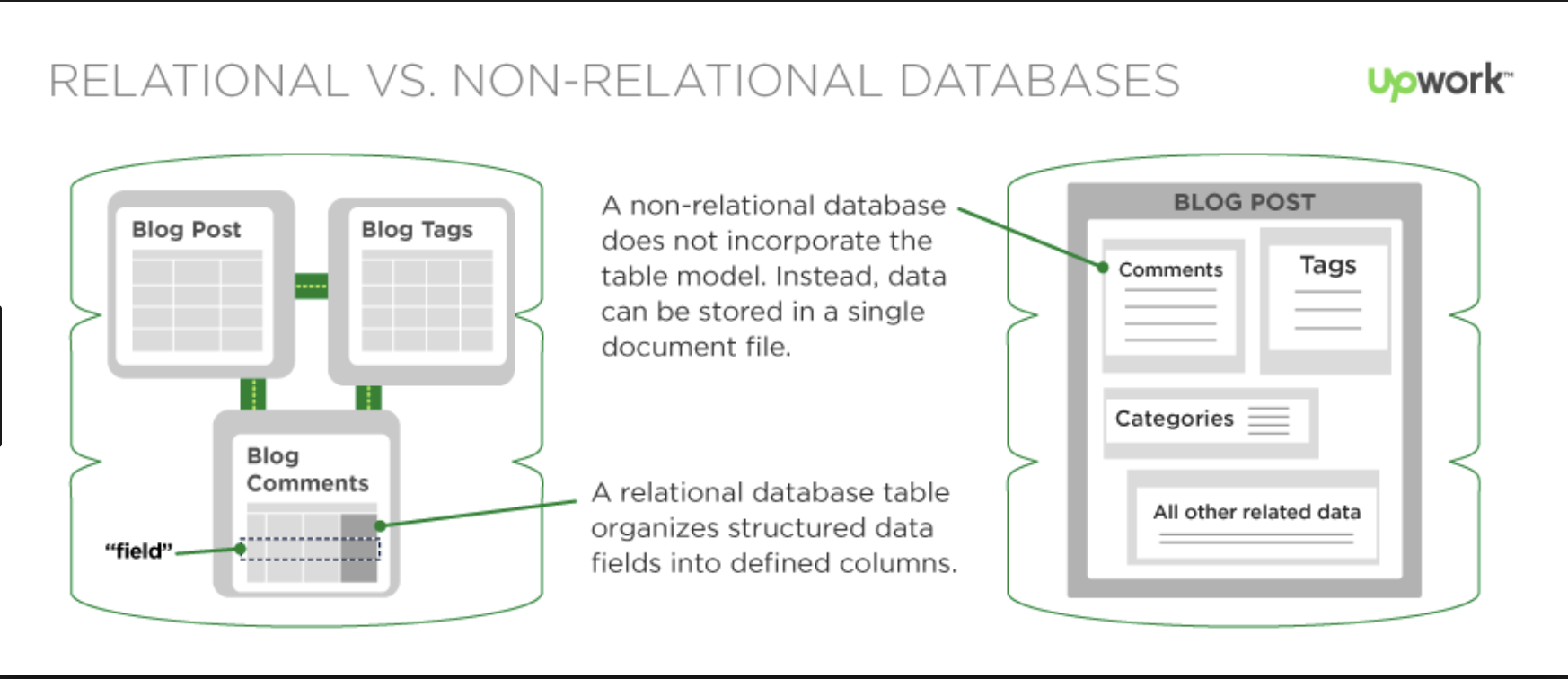
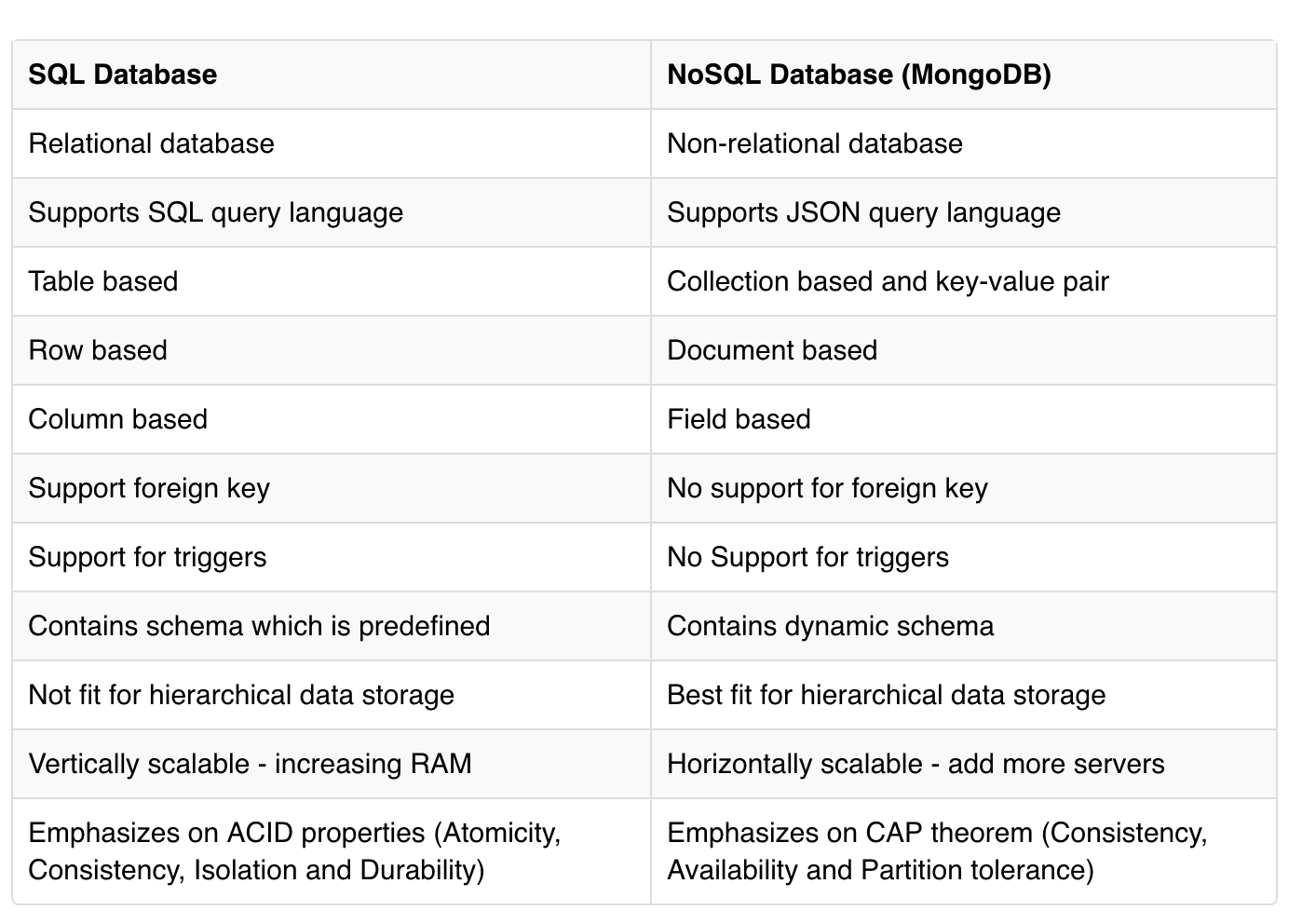
    # MongoDB and NoSQL ## Intro to NoSQL NoSQL DB is a database used to manage huge sets of unstructured data, where the data is not stored in tabular relations like relational databases. ### NoSQL Database Types Following are the NoSQL database types: - **[Document databases](https://en.wikipedia.org/wiki/Document-oriented_database)**: In this type, key is paired with a complex data structure called *document*. Example: MongoDB; - **[Graph stores](https://en.wikipedia.org/wiki/Graph_database)**: This type of database is ususally used to store networked data. In this type of NoSQL DB we can relate data based on some existing data. - [Key-value stores](https://en.wikipedia.org/wiki/Key-value_database): These are the simplest NoSQL databases. In this each document is stored with a key to identify it. It is used to save data in a type known today as dictionary or hash table. Dictionaries contain a collection of objects, or records, which in turn have many different fields within them, each containing data. These records are stored and retrieved using a key that uniquely identifies the record, and is used to quickly find the data within the database. The most popular implementation of a key-value database is Redis. - [Wide-column stores](https://en.wikipedia.org/wiki/Wide_column_store): It uses tables, rows, and columns, but unlike a relational database, the names and format of the columns can vary from row to row in the same table. Example : Cassandra (used in Facebook), HBase etc. ## MongoDB :::info MongoDB: - is a document oriented database that stores data in collections instead of tables; collection is nothing but a set of documents; being schemaless, any type of document can be saved in a collection (although similarity is recommended); - is a NoSQL database which stores the data in form of key-value pairs (like in JSON). ::: ![](https://s3-eu-west-1.amazonaws.com/ih-materials/uploads/upload_5a8442407114925ba583ca66f53e7cdd.png) Most of the currently existing relational databases have failed in solving some of the complex modern problems like: - Continuosly changing nature of data - structured, semi-structured, unstructured and polymorphic data. - Applications now serve millions of users in different geo-locations, in different timezones and have to be up and running all the time, with data integrity maintained - Applications are becoming more distributed with many moving towards cloud computing. NoSQL plays a vital role in an enterprise application which needs to access and analyze a massive set of data that is being made available on multiple virtual servers (remote based) in the cloud infrastructure and mainly when the data set is not structured. Hence, the NoSQL database is designed to overcome the Performance, Scalability, Data Modelling and Distribution limitations that are seen in the Relational Databases. ### What is Structured data? Structured data is usually text files, with defined column titles and data in rows. Such data can easily be visulaized in form of charts and can be processed using data mining tools. ### What is Unstructured Data? Unstructured data can be anything like video file, image file, PDF, Emails etc. What does these files have in common, nothing. Structured Information can be extracted from unstructured data, but the process is time consuming. And as more and more modern data is unstructured, there was a need to have something to store such data for growing applications, hence setting path for NoSQL. ## mongo vs sql The major difference between MongoDB and SQL Databases is the way they handle data. In SQL databases, data is stored in form of traditional 2 dimensional row-column structure while in MongoDB rich data document model is followed, which allows storage of any type of data. Let us see some of the key differences between MongoDB and other SQL databases: ![](https://s3-eu-west-1.amazonaws.com/ih-materials/uploads/upload_05f143c87fbf3995fffee03e7171bedd.png) [picture source](https://www.studytonight.com/mongodb/mongodb-vs-rdbms) Additional explanation: - *MongoDB doesn't support foreign key*: We can define the so-called foreign key in MongoDB. However, we need to maintain the data integrity BY ourselves. For example: ```shell student { _id: ObjectId(...), name: 'Jane', courses: ['bio101', 'bio102'] # <= ids of the courses } course { _id: 'bio101', name: 'Biology 101', description: 'Introduction to biology' } ``` The *courses* field contains *_ids* of courses. It is easy to define a one-to-many relationship. However, if we want to retrieve the course names of student Jane, we need to perform another operation to retrieve the course document via *_id*. This process is not automated, as well as if some of the courses gets removed, we need to perform another operation to update the courses field in the student document.[resource](https://stackoverflow.com/questions/6334048/foreign-keys-in-mongo/6334282) - *[MongoDB doesn't support triggers](https://www.percona.com/live/18/sessions/triggers-in-mongodb)* To learn more about triggers, visit this [online resource](https://www.essentialsql.com/what-is-a-database-trigger/). - *MongoDB is the best fit for hierarchical data storage*: read more [here](https://docs.mongodb.com/manual/applications/data-models-tree-structures/). **One of the best adventages of the MongoDB**: MongoDB documents also align with the structure of objects in modern programming languages, as they are a form of JSON. This makes it easy for developers to map the data used in the application to its associated document in the database. While in SQL Database, creating a table with columns mapped to the attributes of an object in programming language, appears a little tedious. ### Some Advantages of NoSQL Databases Here we will be discussing some of the main advantages of NoSQL databases with examples. 1. **Dynamic Schemas** In Relational Databases like MySQL, we define table structures. For example, if we want to save records of Student Data, then we will have to create a table named Student, add columns to it, like student_id, student_name etc, this is called defined schema, where in we define the structure before saving any data. If in future we plan to add some more related data in our Student table, then we will have to add a new column to our table. Which is easy, if we have less data in our tables, but what if we have millions of records. Migration to the updated schema would be a hectic job. NoSQL databases solve this problem, as in a NoSQL database, **schema definition is not required**. 2. **Sharding** In Sharding, large databases are partitioned into small, faster and easily manageable databases. The (classic) Relational Databases follow a vertical architecture where in a single server holds the data, as all the data is related. Relational Databases does not provide Sharding feature by default. NoSQL Databases have the Sharding feature as default. No additional efforts required. They automatically spread the data across servers, fetch the data in the fastest time from the server which is free, while maintaining the integrity of data. 3. **Replication** Auto data replication is also supported in NoSQL databases by default. Hence, if one DB server goes down, data is restored using its copy created on another server in network. ## When to use MongosDB over SQL DBs One single main benefit it has over MySQL is its ability to handle large unstructured data. It is magically faster because it allows users to query in a different manner that is more sensitive to workload. Developers note that MySQL is quite slower in comparison to MongoDB when it comes to dealing with large databases. When designing schemas in Mongo DB, expecially the first times, a quick useful checklist to choose whether or not to use embedded documents in one-to-many relation. So here is the checklist: - **Type of query**: ask yourself what could be the best model representation for the most frequent queries you'll need to do. Everytime I'll get the parent document I'll always (or really often) need all the child documents. Answer: Nested. - **Data model lifecycle**: think about the life cycle of the container document and its content: make sense that child documents will still have to exist when the parent document is deleted? If the answer is "no" nested is the way. - **Direct access**: how many times you need to easily access the nested document (without caring of its container). If you need this, go for a flat design with references. - **Number of nested object**: a MongoDB document has a size limit of 16MB (quite big amount of data). If your subcollection can growth without limits go flat.

    Import from clipboard

    Paste your markdown or webpage here...

    Advanced permission required

    Your current role can only read. Ask the system administrator to acquire write and comment permission.

    This team is disabled

    Sorry, this team is disabled. You can't edit this note.

    This note is locked

    Sorry, only owner can edit this note.

    Reach the limit

    Sorry, you've reached the max length this note can be.
    Please reduce the content or divide it to more notes, thank you!

    Import from Gist

    Import from Snippet

    or

    Export to Snippet

    Are you sure?

    Do you really want to delete this note?
    All users will lose their connection.

    Create a note from template

    Create a note from template

    Oops...
    This template has been removed or transferred.
    Upgrade
    All
    • All
    • Team
    No template.

    Create a template

    Upgrade

    Delete template

    Do you really want to delete this template?
    Turn this template into a regular note and keep its content, versions, and comments.

    This page need refresh

    You have an incompatible client version.
    Refresh to update.
    New version available!
    See releases notes here
    Refresh to enjoy new features.
    Your user state has changed.
    Refresh to load new user state.

    Sign in

    Forgot password
    or
    Sign in via Google Sign in via Facebook Sign in via X(Twitter) Sign in via GitHub Sign in via Dropbox Sign in with Wallet
    Wallet ( )
    Connect another wallet

    New to HackMD? Sign up

    By signing in, you agree to our terms of service.

    Help

    • English
    • 中文
    • Français
    • Deutsch
    • 日本語
    • Español
    • Català
    • Ελληνικά
    • Português
    • italiano
    • Türkçe
    • Русский
    • Nederlands
    • hrvatski jezik
    • język polski
    • Українська
    • हिन्दी
    • svenska
    • Esperanto
    • dansk

    Documents

    Help & Tutorial

    How to use Book mode

    Slide Example

    API Docs

    Edit in VSCode

    Install browser extension

    Contacts

    Feedback

    Discord

    Send us email

    Resources

    Releases

    Pricing

    Blog

    Policy

    Terms

    Privacy

    Cheatsheet

    Syntax Example Reference
    # Header Header 基本排版
    - Unordered List
    • Unordered List
    1. Ordered List
    1. Ordered List
    - [ ] Todo List
    • Todo List
    > Blockquote
    Blockquote
    **Bold font** Bold font
    *Italics font* Italics font
    ~~Strikethrough~~ Strikethrough
    19^th^ 19th
    H~2~O H2O
    ++Inserted text++ Inserted text
    ==Marked text== Marked text
    [link text](https:// "title") Link
    ![image alt](https:// "title") Image
    `Code` Code 在筆記中貼入程式碼
    ```javascript
    var i = 0;
    ```
    var i = 0;
    :smile: :smile: Emoji list
    {%youtube youtube_id %} Externals
    $L^aT_eX$ LaTeX
    :::info
    This is a alert area.
    :::

    This is a alert area.

    Versions and GitHub Sync
    Get Full History Access

    • Edit version name
    • Delete

    revision author avatar     named on  

    More Less

    Note content is identical to the latest version.
    Compare
      Choose a version
      No search result
      Version not found
    Sign in to link this note to GitHub
    Learn more
    This note is not linked with GitHub
     

    Feedback

    Submission failed, please try again

    Thanks for your support.

    On a scale of 0-10, how likely is it that you would recommend HackMD to your friends, family or business associates?

    Please give us some advice and help us improve HackMD.


    Thanks for your feedback

    Remove version name

    Do you want to remove this version name and description?

    Transfer ownership

    Transfer to
      Warning: is a public team. If you transfer note to this team, everyone on the web can find and read this note.

        Link with GitHub

        Please authorize HackMD on GitHub
        • Please sign in to GitHub and install the HackMD app on your GitHub repo.
        • HackMD links with GitHub through a GitHub App. You can choose which repo to install our App.
        Learn more  Sign in to GitHub

        Push the note to GitHub Push to GitHub Pull a file from GitHub

          Authorize again
         

        Choose which file to push to

        Select repo
        Refresh Authorize more repos
        Select branch
        Select file
        Select branch
        Choose version(s) to push
        • Save a new version and push
        • Choose from existing versions
        Include title and tags
        Available push count

        Pull from GitHub

         
        File from GitHub
        File from HackMD

        GitHub Link Settings

        File linked

        Linked by
        File path
        Last synced branch
        Available push count

        Danger Zone

        Unlink
        You will no longer receive notification when GitHub file changes after unlink.

        Syncing

        Push failed

        Push successfully

