Laurent Gatto
    • Create new note
    • Create a note from template
      • Sharing URL Link copied
      • /edit
      • View mode
        • Edit mode
        • View mode
        • Book mode
        • Slide mode
        Edit mode View mode Book mode Slide mode
      • Customize slides
      • Note Permission
      • Read
        • Only me
        • Signed-in users
        • Everyone
        Only me Signed-in users Everyone
      • Write
        • Only me
        • Signed-in users
        • Everyone
        Only me Signed-in users Everyone
      • Engagement control Commenting, Suggest edit, Emoji Reply
    • Invite by email
      Invitee

      This note has no invitees

    • Publish Note

      Share your work with the world Congratulations! 🎉 Your note is out in the world Publish Note

      Your note will be visible on your profile and discoverable by anyone.
      Your note is now live.
      This note is visible on your profile and discoverable online.
      Everyone on the web can find and read all notes of this public team.
      See published notes
      Unpublish note
      Please check the box to agree to the Community Guidelines.
      View profile
    • Commenting
      Permission
      Disabled Forbidden Owners Signed-in users Everyone
    • Enable
    • Permission
      • Forbidden
      • Owners
      • Signed-in users
      • Everyone
    • Suggest edit
      Permission
      Disabled Forbidden Owners Signed-in users Everyone
    • Enable
    • Permission
      • Forbidden
      • Owners
      • Signed-in users
    • Emoji Reply
    • Enable
    • Versions and GitHub Sync
    • Note settings
    • Note Insights New
    • Engagement control
    • Make a copy
    • Transfer ownership
    • Delete this note
    • Save as template
    • Insert from template
    • Import from
      • Dropbox
      • Google Drive
      • Gist
      • Clipboard
    • Export to
      • Dropbox
      • Google Drive
      • Gist
    • Download
      • Markdown
      • HTML
      • Raw HTML
Menu Note settings Note Insights Versions and GitHub Sync Sharing URL Create Help
Create Create new note Create a note from template
Menu
Options
Engagement control Make a copy Transfer ownership Delete this note
Import from
Dropbox Google Drive Gist Clipboard
Export to
Dropbox Google Drive Gist
Download
Markdown HTML Raw HTML
Back
Sharing URL Link copied
/edit
View mode
  • Edit mode
  • View mode
  • Book mode
  • Slide mode
Edit mode View mode Book mode Slide mode
Customize slides
Note Permission
Read
Only me
  • Only me
  • Signed-in users
  • Everyone
Only me Signed-in users Everyone
Write
Only me
  • Only me
  • Signed-in users
  • Everyone
Only me Signed-in users Everyone
Engagement control Commenting, Suggest edit, Emoji Reply
  • Invite by email
    Invitee

    This note has no invitees

  • Publish Note

    Share your work with the world Congratulations! 🎉 Your note is out in the world Publish Note

    Your note will be visible on your profile and discoverable by anyone.
    Your note is now live.
    This note is visible on your profile and discoverable online.
    Everyone on the web can find and read all notes of this public team.
    See published notes
    Unpublish note
    Please check the box to agree to the Community Guidelines.
    View profile
    Engagement control
    Commenting
    Permission
    Disabled Forbidden Owners Signed-in users Everyone
    Enable
    Permission
    • Forbidden
    • Owners
    • Signed-in users
    • Everyone
    Suggest edit
    Permission
    Disabled Forbidden Owners Signed-in users Everyone
    Enable
    Permission
    • Forbidden
    • Owners
    • Signed-in users
    Emoji Reply
    Enable
    Import from Dropbox Google Drive Gist Clipboard
       Owned this note    Owned this note      
    Published Linked with GitHub
    • Any changes
      Be notified of any changes
    • Mention me
      Be notified of mention me
    • Unsubscribe
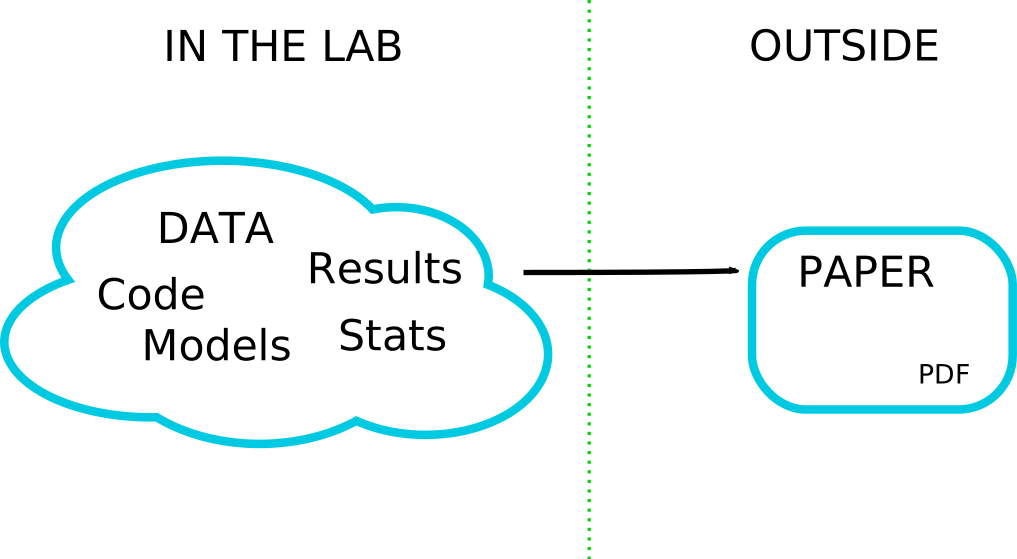
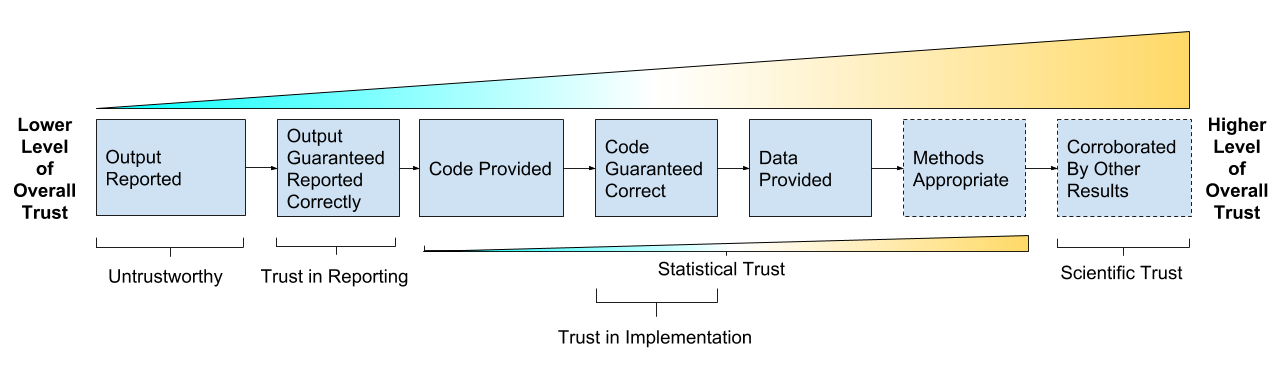
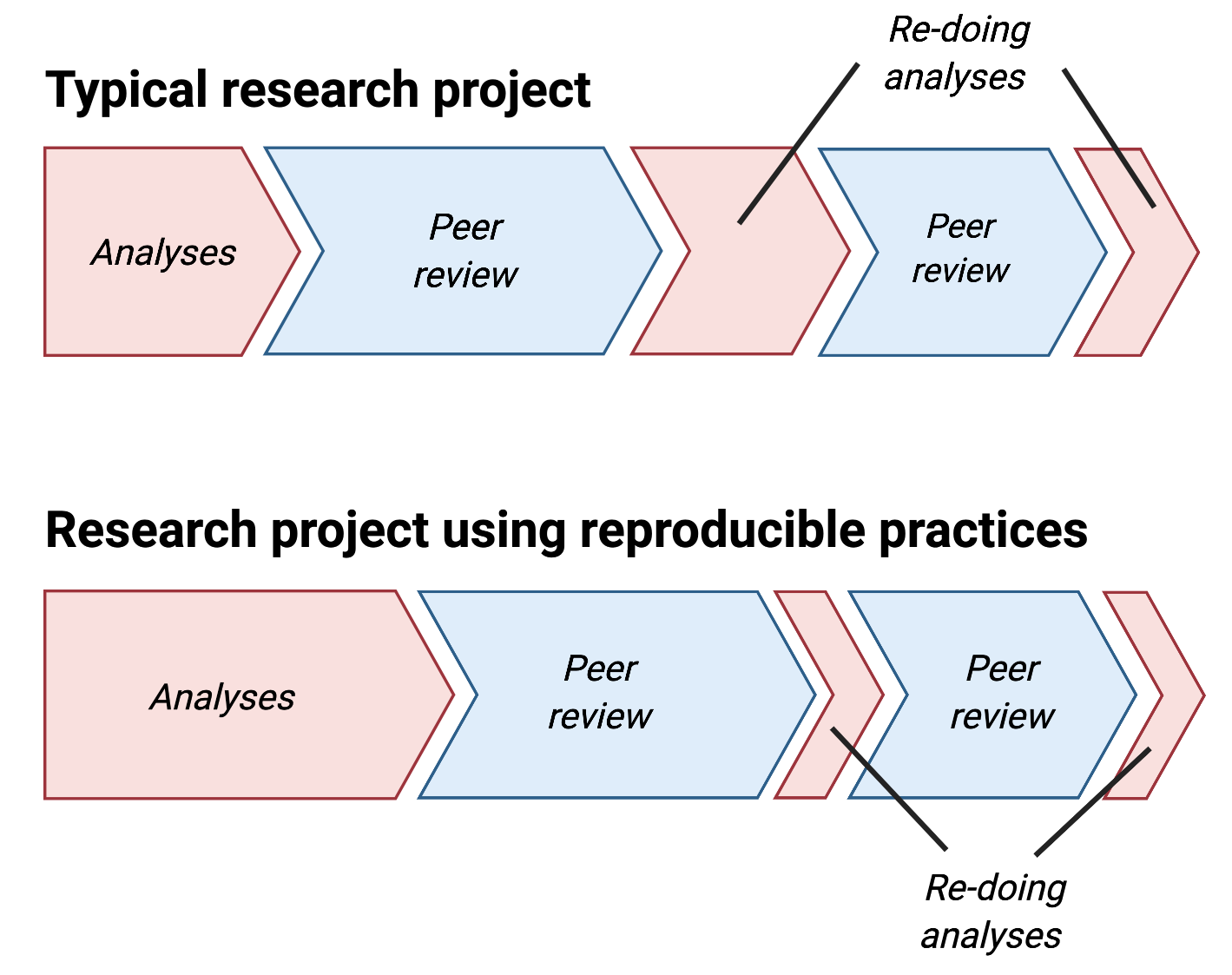
    # Open and reproducible research - CSAMA 2022 Laurent Gatto and Charlotte Soneson ## Pitch ### Motivation Inverse problems are hard Example and figure borrowed from [Stephen Eglen](https://sje30.github.io/talks/2017/cam_eglen.html#inverse-problems-are-hard). | Score (%) | grade | |:---------:|:-----:| | 70-100 | A | | 60-69 | B | | 50-59 | C | | 40-49 | D | | 0-39 | F | - **Forward problem**: I scored 68, what was my grade? - **Inverse problem**: I got a B, what was my score? **Research sharing**: the inverse problem ![](https://lgatto.github.io/images/inv-paper.svg) ### Where is the scholarship? > An article about computational science in a scientific publication is not the scholarship itself, it is merely advertising of the scholarship. The actual scholarship is the complete software development environment and that complete set of instructions that generated the figures. [Buckheit and Donoho 1995, after Claerbout] ### The R words From a [*But what to we mean by reproducibility?*](https://lgatto.github.io/rr-what-should-be-our-goals/) blog post. - **Repeat** my experiment, i.e. obtain the same tables/graphs/results using the same setup (data, software, ...) in the same lab or on the same computer. That's basically re-running one of my analysis some time after I original developed it. - **Reproduce** an experiment (not mine), i.e. obtain the same tables/graphs/results in a different lab or on a different computer, using the same setup (the data would be downloaded from a public repository and the same software, but possibly different version, different OS, is used). I suppose, we should differentiate replication using a fresh install and a virtual machine or docker image that replicates the original setup. - **Replicate** an experiment, i.e. obtain the same (similar enough) tables/graphs/results in a different set up. The data could still be downloaded from the public repository, or possibly re-generate/re-simulate it, and the analysis would be re-implemented based on the original description. This requires openness, and one would clearly not be allowed the use a black box approach (VM, docker image) or just re-running a script. - Finally, **re-use** the information/knowledge from one experiment to run a different experiment with the aim to confirm results from scratch. Another view (from a talk by [Kirstie Whitaker](https://figshare.com/articles/Publishing_a_reproducible_paper/4720996/1)): | | Same Data | Different Data | |--------------------|-----------|----------------| | **Same Code** | reproduce | replicate | | **Different Code** | robust | generalisable | See also this opinion piece by Jeffrey T. Leek and Roger D. Peng, [*Reproducible research can still be wrong: Adopting a prevention approach*](https://www.pnas.org/content/112/6/1645). ### Discussion points - Open vs reproducible - Why working reproducibly? - Is working reproducible difficult? Does it take more time? - What tools do you use to work reproducibly/openly? - Cost benefit of reproducible research. - Should every piece of work be reproducible? <hr> ## Open vs reproducible - open != reproducible, but they often go hand in hand - open != good (by default) - reproducible != good (by default) ## Why working reproducibly? Reproducible != correct, but reproducible -> trust. From > Gabriel Becker [*An Imperfect Guide to Imperfect > Reproducibility*](https://gmbecker.github.io/MayInstituteKeynote2019/outline.html), > May Institute for Computational Proteomics, 2019. **(Computational) Reproducibility Is Not The Point** Take home message: > The goal is **trust**, **verification** and **guarantees**: - **Trust in Reporting** - result is accurately reported - **Trust in Implementation** - analysis code successfully implements chosen methods - **Statistical Trust** - data and methods are (still) appropriate - **Scientific Trust** - result convincingly supports claim(s) about underlying systems or truths Reproducibility As A Trust Scale (copyright Genentech Inc) ![Reproducibility As A Trust Scale](https://gmbecker.github.io/MayInstituteKeynote2019/trustscale3.png) ## More reasons to become a reproducible research practitioner Florian Markowetz, [**Five selfish reasons to work reproducibly**](https://doi.org/10.1186/s13059-015-0850-7), Genome Biology 2015, 16:274. ![Five selfish reasons to work reproducibly](https://lgatto.github.io/images/2017-09-22-selfish-rr.png) > And so, my fellow scientists: ask not what you can do for > reproducibility; ask what reproducibility can do for you! Here, I > present five reasons why working reproducibly pays off in the long > run and is in the self-interest of every ambitious, career-oriented > scientist. 1. **Reproducibility helps to avoid disaster**: a project is more than a beautiful result. You need to record in detail how you got there. Starting to work reproducibly early on will save you time later. I had cases where a collaborator told me they preferred the results on the very first plots they received, that I couldn't recover a couple of month later. But because my work was reproducible and I had tracked it over time (using git and GitHub), I was able, after a little bit of data analysis forensics, to identify why these first, preliminary plots weren't consistent with later results (and it as a simple, but very relevant bug in the code). Imagine if my collaborators had just used these first plots for publication, or to decide to perform further experiments. 2. **Reproducibility makes it easier to write papers**: Transparency in your analysis makes writing papers much easier. In dynamic documents (using [rmarkdown](http://rmarkdown.rstudio.com/), [juypter notebook](https://jupyter.org/) and other similar tools), all results are automatically update when the data are changed. You can be confident your numbers, figures and tables are up-to-date. 3. **Reproducibility helps reviewers see it your way**: a reproducible document will tick many of the boxes enumerated above. You will make me very happy reviewer if I can review a paper that is reproducible. 4. **Reproducibility enables continuity of your work:** quoting Florian, "In my own group, I don't even discuss results with students if they are not documented well. No proof of reproducibility, no result!". 5. **Reproducibility helps to build your reputation:** publishing reproducible research will build you the reputation of being an honest and careful researcher. In addition, should there ever be a problem with a paper, a reproducible analysis will allow to track the error and show that you reported everything in good faith. ## Working reproducible is difficult - both for those that want others to reproduce their work, and for those trying to reproduce others ## Does it take more time to work reproducibly? **No**, it is a matter or relocating time! ![](https://lgatto.github.io/images/reproducibiity_relocates_time.png) ## Tools for RR - R markdown - Git/GitHub - Docker - renv - ...

    Import from clipboard

    Paste your markdown or webpage here...

    Advanced permission required

    Your current role can only read. Ask the system administrator to acquire write and comment permission.

    This team is disabled

    Sorry, this team is disabled. You can't edit this note.

    This note is locked

    Sorry, only owner can edit this note.

    Reach the limit

    Sorry, you've reached the max length this note can be.
    Please reduce the content or divide it to more notes, thank you!

    Import from Gist

    Import from Snippet

    or

    Export to Snippet

    Are you sure?

    Do you really want to delete this note?
    All users will lose their connection.

    Create a note from template

    Create a note from template

    Oops...
    This template has been removed or transferred.
    Upgrade
    All
    • All
    • Team
    No template.

    Create a template

    Upgrade

    Delete template

    Do you really want to delete this template?
    Turn this template into a regular note and keep its content, versions, and comments.

    This page need refresh

    You have an incompatible client version.
    Refresh to update.
    New version available!
    See releases notes here
    Refresh to enjoy new features.
    Your user state has changed.
    Refresh to load new user state.

    Sign in

    Forgot password

    or

    By clicking below, you agree to our terms of service.

    Sign in via Facebook Sign in via Twitter Sign in via GitHub Sign in via Dropbox Sign in with Wallet
    Wallet ( )
    Connect another wallet

    New to HackMD? Sign up

    Help

    • English
    • 中文
    • Français
    • Deutsch
    • 日本語
    • Español
    • Català
    • Ελληνικά
    • Português
    • italiano
    • Türkçe
    • Русский
    • Nederlands
    • hrvatski jezik
    • język polski
    • Українська
    • हिन्दी
    • svenska
    • Esperanto
    • dansk

    Documents

    Help & Tutorial

    How to use Book mode

    Slide Example

    API Docs

    Edit in VSCode

    Install browser extension

    Contacts

    Feedback

    Discord

    Send us email

    Resources

    Releases

    Pricing

    Blog

    Policy

    Terms

    Privacy

    Cheatsheet

    Syntax Example Reference
    # Header Header 基本排版
    - Unordered List
    • Unordered List
    1. Ordered List
    1. Ordered List
    - [ ] Todo List
    • Todo List
    > Blockquote
    Blockquote
    **Bold font** Bold font
    *Italics font* Italics font
    ~~Strikethrough~~ Strikethrough
    19^th^ 19th
    H~2~O H2O
    ++Inserted text++ Inserted text
    ==Marked text== Marked text
    [link text](https:// "title") Link
    ![image alt](https:// "title") Image
    `Code` Code 在筆記中貼入程式碼
    ```javascript
    var i = 0;
    ```
    var i = 0;
    :smile: :smile: Emoji list
    {%youtube youtube_id %} Externals
    $L^aT_eX$ LaTeX
    :::info
    This is a alert area.
    :::

    This is a alert area.

    Versions and GitHub Sync
    Get Full History Access

    • Edit version name
    • Delete

    revision author avatar     named on  

    More Less

    Note content is identical to the latest version.
    Compare
      Choose a version
      No search result
      Version not found
    Sign in to link this note to GitHub
    Learn more
    This note is not linked with GitHub
     

    Feedback

    Submission failed, please try again

    Thanks for your support.

    On a scale of 0-10, how likely is it that you would recommend HackMD to your friends, family or business associates?

    Please give us some advice and help us improve HackMD.


    Thanks for your feedback

    Remove version name

    Do you want to remove this version name and description?

    Transfer ownership

    Transfer to
      Warning: is a public team. If you transfer note to this team, everyone on the web can find and read this note.

        Link with GitHub

        Please authorize HackMD on GitHub
        • Please sign in to GitHub and install the HackMD app on your GitHub repo.
        • HackMD links with GitHub through a GitHub App. You can choose which repo to install our App.
        Learn more  Sign in to GitHub

        Push the note to GitHub Push to GitHub Pull a file from GitHub

          Authorize again
         

        Choose which file to push to

        Select repo
        Refresh Authorize more repos
        Select branch
        Select file
        Select branch
        Choose version(s) to push
        • Save a new version and push
        • Choose from existing versions
        Include title and tags
        Available push count

        Pull from GitHub

         
        File from GitHub
        File from HackMD

        GitHub Link Settings

        File linked

        Linked by
        File path
        Last synced branch
        Available push count

        Danger Zone

        Unlink
        You will no longer receive notification when GitHub file changes after unlink.

        Syncing

        Push failed

        Push successfully

