Mikel Cortes
    • Create new note
    • Create a note from template
      • Sharing URL Link copied
      • /edit
      • View mode
        • Edit mode
        • View mode
        • Book mode
        • Slide mode
        Edit mode View mode Book mode Slide mode
      • Customize slides
      • Note Permission
      • Read
        • Only me
        • Signed-in users
        • Everyone
        Only me Signed-in users Everyone
      • Write
        • Only me
        • Signed-in users
        • Everyone
        Only me Signed-in users Everyone
      • Engagement control Commenting, Suggest edit, Emoji Reply
    • Invite by email
      Invitee

      This note has no invitees

    • Publish Note

      Share your work with the world Congratulations! 🎉 Your note is out in the world Publish Note

      Your note will be visible on your profile and discoverable by anyone.
      Your note is now live.
      This note is visible on your profile and discoverable online.
      Everyone on the web can find and read all notes of this public team.
      See published notes
      Unpublish note
      Please check the box to agree to the Community Guidelines.
      View profile
    • Commenting
      Permission
      Disabled Forbidden Owners Signed-in users Everyone
    • Enable
    • Permission
      • Forbidden
      • Owners
      • Signed-in users
      • Everyone
    • Suggest edit
      Permission
      Disabled Forbidden Owners Signed-in users Everyone
    • Enable
    • Permission
      • Forbidden
      • Owners
      • Signed-in users
    • Emoji Reply
    • Enable
    • Versions and GitHub Sync
    • Note settings
    • Note Insights New
    • Engagement control
    • Make a copy
    • Transfer ownership
    • Delete this note
    • Save as template
    • Insert from template
    • Import from
      • Dropbox
      • Google Drive
      • Gist
      • Clipboard
    • Export to
      • Dropbox
      • Google Drive
      • Gist
    • Download
      • Markdown
      • HTML
      • Raw HTML
Menu Note settings Note Insights Versions and GitHub Sync Sharing URL Create Help
Create Create new note Create a note from template
Menu
Options
Engagement control Make a copy Transfer ownership Delete this note
Import from
Dropbox Google Drive Gist Clipboard
Export to
Dropbox Google Drive Gist
Download
Markdown HTML Raw HTML
Back
Sharing URL Link copied
/edit
View mode
  • Edit mode
  • View mode
  • Book mode
  • Slide mode
Edit mode View mode Book mode Slide mode
Customize slides
Note Permission
Read
Only me
  • Only me
  • Signed-in users
  • Everyone
Only me Signed-in users Everyone
Write
Only me
  • Only me
  • Signed-in users
  • Everyone
Only me Signed-in users Everyone
Engagement control Commenting, Suggest edit, Emoji Reply
  • Invite by email
    Invitee

    This note has no invitees

  • Publish Note

    Share your work with the world Congratulations! 🎉 Your note is out in the world Publish Note

    Your note will be visible on your profile and discoverable by anyone.
    Your note is now live.
    This note is visible on your profile and discoverable online.
    Everyone on the web can find and read all notes of this public team.
    See published notes
    Unpublish note
    Please check the box to agree to the Community Guidelines.
    View profile
    Engagement control
    Commenting
    Permission
    Disabled Forbidden Owners Signed-in users Everyone
    Enable
    Permission
    • Forbidden
    • Owners
    • Signed-in users
    • Everyone
    Suggest edit
    Permission
    Disabled Forbidden Owners Signed-in users Everyone
    Enable
    Permission
    • Forbidden
    • Owners
    • Signed-in users
    Emoji Reply
    Enable
    Import from Dropbox Google Drive Gist Clipboard
       Owned this note    Owned this note      
    Published Linked with GitHub
    • Any changes
      Be notified of any changes
    • Mention me
      Be notified of mention me
    • Unsubscribe
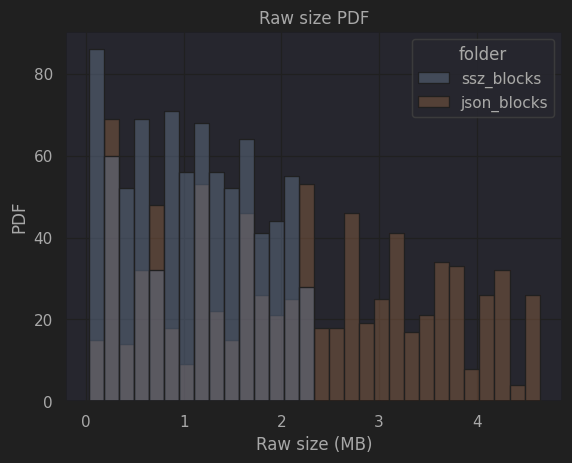
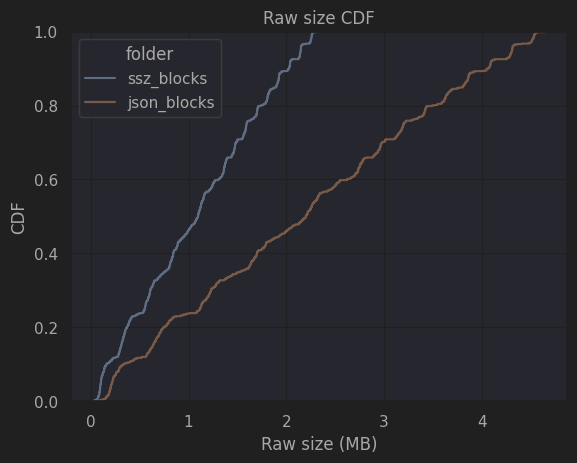
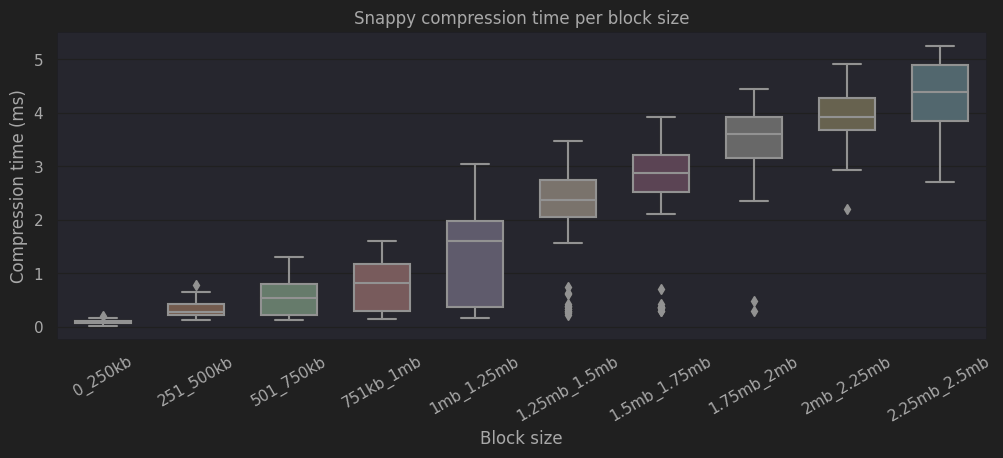
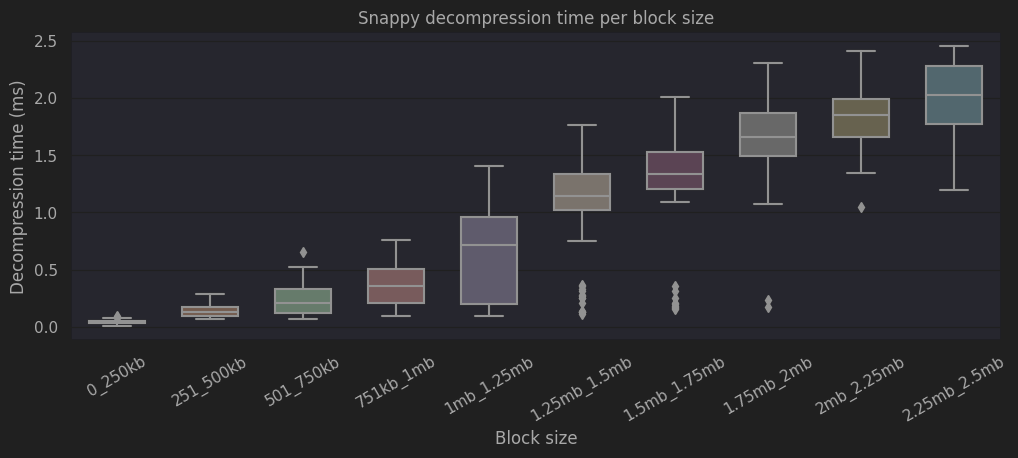
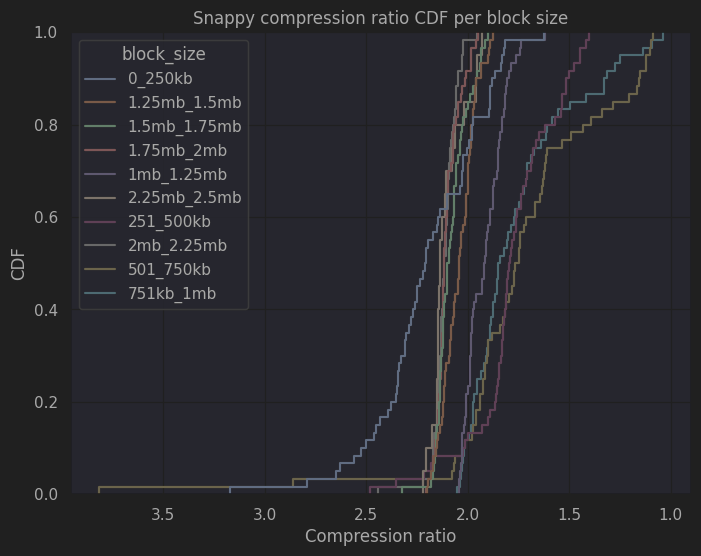
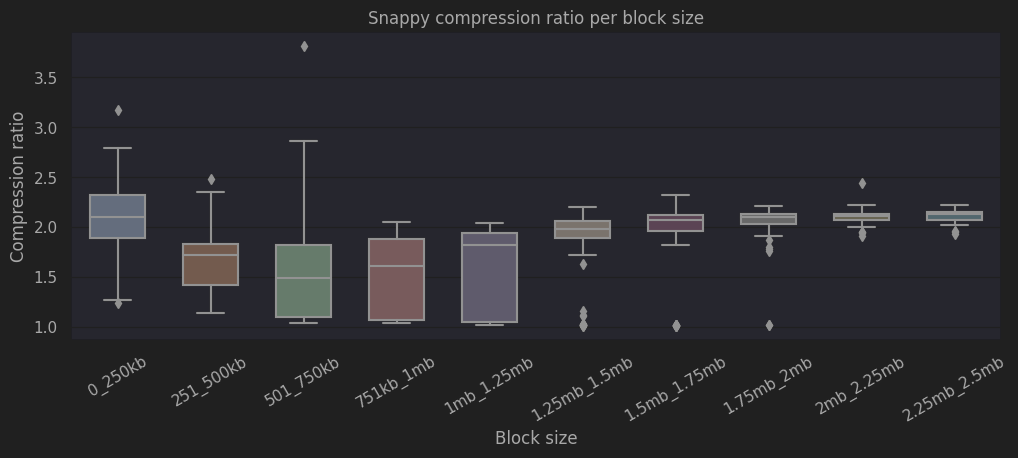
    # Snappy Compression Benchmark on Ethereum's Mainnet Blocks In a p2p network nodes share information by sending messages to each other. In the Ethereum p2p network, nodes send blocks, transactions, and many other type of messages. All nodes need to send the data (e.g., blocks) in a format that other nodes can understand. Thus, messages get serialized before being sent over the network. After the data has been serialized, it can be compressed to reduce the network bandwidth consumption and speed up network transfers. ## Data Serialization on Ethereum The most common serialization format is JavaScript Object Notation [(JSON)](https://www.json.org/json-en.html) , which is generally preferred because of its wide usage, its human-readable format, and its wide support in most of the available languages. ```json # Ethereum Block example JSON serialized {"message": { "slot": "5900800", "proposer_index": "38712", "parent_root": "0x1873a84d7ab44903d500b787ef17388d6ba9d280...9c06066e026", "state_root": "0xbc2f460f05aefdac814543a6f796408c7d6f031...16ae827fa5", "body":{ ... } } ``` However, JSON is too verbose for our purposes. When encoding/serializing any object, JSON writes everything using strings, which makes it human-readable, but it also substantially increases the size of the output file. Another serialization tool is [SSZ](https://github.com/ethereum/consensus-specs/blob/dev/ssz/simple-serialize.md). SSZ is a simple serialization tool that aims to be light, while limiting the max-size of each variable. Ethereum uses SSZ to serialize data before sending it across nodes in the network. The following figure shows the differences in size for the same Ethereum blocks when comparing different serialization approaches. In the following figures, we can see the raw bytes size of each block serialized in JSON and in SSZ. In the figure, we can clearly see that JSON serialized blocks take up to twice as much as the SSZ version, demonstrating the benefits of SSZ over JSON. | Raw block size (CDF) | Raw block size (PFD) | | -------------------- | -------------------- | | ![](https://hackmd.io/_uploads/BkJGesVR3.png) | ![](https://hackmd.io/_uploads/BJ8zxoN02.png) | ## Data Compression on Ethereum After serialization, blocks are compressed to reduce network bandwidth consumption, hence reducing transmission times. To achieve this goal, Ethereum uses [Snappy](https://github.com/google/snappy) for fast compression, hoping to gain more time in network transmission, than the lost time in compression. More specifically, [SSZ is combined with Snappy](https://github.com/ethereum/consensus-specs/blob/dev/specs/phase0/p2p-interface.md#ssz-snappy-encoding-strategy) when sending Blocks, Attestations, and Aggregations. We performed a [short analysis]() of Snappy years ago, but that was done even before the Beacon chain was launched, so the data used then was not representative of what we see currently on-chain. Therefore, we decided to study the performance of Snappy compression today with real blocks in Mainnet. ### Evaluation Setup It is important to note that blocks of different sizes might have different types of data, thus they might exhibit different behavior when compressed. Therefore, to further enhance our compression benchmark, we used a set of different sized blocks extracted from Mainnet. We used 60 blocks for each size range, except for the last one (2251 KB - 2500 KB) because we did not find more blocks of such size occurring in the last six months. | Block size range (KB) | Number of samples | | --- | --- | | 0000 - 0250 | 60 | | 0251 - 0500 | 60 | | 0501 - 0750 | 60 | | 0751 - 1000 | 60 | | 1001 - 1250 | 60 | | 1251 - 1500 | 60 | | 1501 - 1750 | 60 | | 1751 - 2000 | 60 | | 2001 - 2250 | 60 | | 2251 - 2500 | 20 | | **Total** | **560** | ### Compression Speed The following figure shows the compression time for each of the different block-size ranges. As one would expect, larger blocks need more time to be compressed. However, the time for compressing the data barely exceeds the 5ms on the largest blocks. This demonstrates that Snappy is a library clearly focused on high compression speed. | Compression time for different sized blocks | | --- | | ![](https://hackmd.io/_uploads/BJWJroN02.png) | In common scenarios, with blocks rounding the 100 KB, Snappy compression time remains under the 1ms. This overhead is close to nothing when we compare it to network latencies that oscillate between [50 and 100 ms](https://monitoreth.io/nodes). ### Decompression Speed Regarding decompression speed, we can observe that the process takes only half of the compression time, barely reaching 2.5ms for the largest blocks. | Decompression speed per block size | | --- | | ![](https://hackmd.io/_uploads/HkedXro1a.png) | ### Compression Ratio As explained previously, compression speed is useless if the compression ratio is zero. In the worst case, nodes will expend between 1-5 ms to compress the block plus 0-2.5 ms to decompress it on arrival, to reach a 1/1 compression ratio. So, is compression really useful? Let's find out. The following figure shows the CDF of the compression ratio for the different block size ranges. Several things are clearly visible. i) There are 2 blocks that achieve a compression ratio higher than 3, which is a great compression ratio for such compression speed. ii) Over half of the blocks (53.5%) achieve a compression ratio higher than 2. iii) Almost 95% of all the blocks tested, achieve a compression ratio higher than 1.5. Overall, these seem to be quite good results given the short compression times presented above. | CDF of the compression ratio per block size | | ---- | | ![](https://hackmd.io/_uploads/HkCEZroJp.png) | The next figure shows the quartiles of the compression ratio for the different block size ranges. The first thing we notice is that we see a higher variance for blocks between 0 KB and 1250 KB, which have an approximate median compression ratio of 1.8. Blocks over 1250 KB have a much lower variance but also exhibit a slightly higher compression ratio. The higher compression ratio could be explained by the fact that to produce such large blocks, the block should have a significant number of zeros. This is related to the cost of CALLDATA. Using CALLDATA to store data on a block, costs 16 gas per byte for non-zero bytes, and 4 gas per byte for zero bytes. The maximum gas used in a block is 30,000,000. Assuming the block is full of non-zero bytes in CALLDATA, the maximum block size would be 30,000,000/16 = 1,875,000 bytes. However, when the data has many zeros (which only cost 4 gas), it is easier to inflate the block size. Thus, it is to expect that large blocks have a significant number of zeros, which Snappy exploits during the compression. In addition, it is virtually impossible to reach such block size using standard transactions. It follows then, that the large majority of big blocks have the same internal structure, which in turn explains the low variance we observe in these results. | Compression ratio per block size | | --- | | ![](https://hackmd.io/_uploads/ryCrWriyT.png) | Interestingly, we also observe high compression ratio in small blocks, which can be explained by very small blocks that are almost empty and that are very easy to compress. # Conclusion These results show that Snappy takes only a few milliseconds to compress and decompress blocks in Ethereum. The large majority of blocks in Ethereum have a size of about 100 KB, and this study shows that using Snappy those blocks will be reduced to half their size when sent over the network. It is worth highlighting that big blocks also reach good compression ratios, which is good news for [EIP-4844](https://www.eip4844.com/). # References - [JSON](https://www.json.org/json-en.html) - [SSZ](https://github.com/ethereum/consensus-specs/blob/dev/ssz/simple-serialize.md) - [Snappy](https://github.com/google/snappy) - [Ethereum p2p spec](https://github.com/ethereum/consensus-specs/blob/dev/specs/phase0/p2p-interface.md#ssz-snappy-encoding-strategy) - [Go-benchmark code](https://github.com/cortze/eth-snappy-benchmarks)

    Import from clipboard

    Paste your markdown or webpage here...

    Advanced permission required

    Your current role can only read. Ask the system administrator to acquire write and comment permission.

    This team is disabled

    Sorry, this team is disabled. You can't edit this note.

    This note is locked

    Sorry, only owner can edit this note.

    Reach the limit

    Sorry, you've reached the max length this note can be.
    Please reduce the content or divide it to more notes, thank you!

    Import from Gist

    Import from Snippet

    or

    Export to Snippet

    Are you sure?

    Do you really want to delete this note?
    All users will lose their connection.

    Create a note from template

    Create a note from template

    Oops...
    This template has been removed or transferred.
    Upgrade
    All
    • All
    • Team
    No template.

    Create a template

    Upgrade

    Delete template

    Do you really want to delete this template?
    Turn this template into a regular note and keep its content, versions, and comments.

    This page need refresh

    You have an incompatible client version.
    Refresh to update.
    New version available!
    See releases notes here
    Refresh to enjoy new features.
    Your user state has changed.
    Refresh to load new user state.

    Sign in

    Forgot password

    or

    By clicking below, you agree to our terms of service.

    Sign in via Facebook Sign in via Twitter Sign in via GitHub Sign in via Dropbox Sign in with Wallet
    Wallet ( )
    Connect another wallet

    New to HackMD? Sign up

    Help

    • English
    • 中文
    • Français
    • Deutsch
    • 日本語
    • Español
    • Català
    • Ελληνικά
    • Português
    • italiano
    • Türkçe
    • Русский
    • Nederlands
    • hrvatski jezik
    • język polski
    • Українська
    • हिन्दी
    • svenska
    • Esperanto
    • dansk

    Documents

    Help & Tutorial

    How to use Book mode

    Slide Example

    API Docs

    Edit in VSCode

    Install browser extension

    Contacts

    Feedback

    Discord

    Send us email

    Resources

    Releases

    Pricing

    Blog

    Policy

    Terms

    Privacy

    Cheatsheet

    Syntax Example Reference
    # Header Header 基本排版
    - Unordered List
    • Unordered List
    1. Ordered List
    1. Ordered List
    - [ ] Todo List
    • Todo List
    > Blockquote
    Blockquote
    **Bold font** Bold font
    *Italics font* Italics font
    ~~Strikethrough~~ Strikethrough
    19^th^ 19th
    H~2~O H2O
    ++Inserted text++ Inserted text
    ==Marked text== Marked text
    [link text](https:// "title") Link
    ![image alt](https:// "title") Image
    `Code` Code 在筆記中貼入程式碼
    ```javascript
    var i = 0;
    ```
    var i = 0;
    :smile: :smile: Emoji list
    {%youtube youtube_id %} Externals
    $L^aT_eX$ LaTeX
    :::info
    This is a alert area.
    :::

    This is a alert area.

    Versions and GitHub Sync
    Get Full History Access

    • Edit version name
    • Delete

    revision author avatar     named on  

    More Less

    Note content is identical to the latest version.
    Compare
      Choose a version
      No search result
      Version not found
    Sign in to link this note to GitHub
    Learn more
    This note is not linked with GitHub
     

    Feedback

    Submission failed, please try again

    Thanks for your support.

    On a scale of 0-10, how likely is it that you would recommend HackMD to your friends, family or business associates?

    Please give us some advice and help us improve HackMD.


    Thanks for your feedback

    Remove version name

    Do you want to remove this version name and description?

    Transfer ownership

    Transfer to
      Warning: is a public team. If you transfer note to this team, everyone on the web can find and read this note.

        Link with GitHub

        Please authorize HackMD on GitHub
        • Please sign in to GitHub and install the HackMD app on your GitHub repo.
        • HackMD links with GitHub through a GitHub App. You can choose which repo to install our App.
        Learn more  Sign in to GitHub

        Push the note to GitHub Push to GitHub Pull a file from GitHub

          Authorize again
         

        Choose which file to push to

        Select repo
        Refresh Authorize more repos
        Select branch
        Select file
        Select branch
        Choose version(s) to push
        • Save a new version and push
        • Choose from existing versions
        Include title and tags
        Available push count

        Pull from GitHub

         
        File from GitHub
        File from HackMD

        GitHub Link Settings

        File linked

        Linked by
        File path
        Last synced branch
        Available push count

        Danger Zone

        Unlink
        You will no longer receive notification when GitHub file changes after unlink.

        Syncing

        Push failed

        Push successfully