## Networked Adaptive Organisms (NAO)
### An immune response to the metacrisis
#### The Problem
Humanity has reached a state that any unchecked dominant species likely would reach on any planet with life. Our 'selfish gene' has gotten so good at controlling everything to its benefit that we've overshot the planetary boundaries of the very resources and systems that all of nature, including us, depends on.
Beyond that, we've invented [technologies that can destroy us](https://www.nature.com/articles/d41586-024-00147-z) even before we exhaust the planet, without the knowledge or wisdom necessary to control or even understand them.
In a nutshell, we're in the midst of a [metacrisis](https://ernesto-87727.medium.com/the-metacrisis-how-to-navigate-our-epochs-greatest-challenge-b127a4f23a00). It's not a problem we can fix; it's an era.
But how we navigate it is up to us. How can humanity thread a path through to the best possible future?
#### What hope?
We've long known that climate, biodiversity loss, water, soil, and many other crises were looming, but it's now [one minute to midnight](https://en.wikipedia.org/wiki/Doomsday_Clock). What hope do we have of changing fast enough to avoid the worst case outcomes?
What hope do we have of realizing the best possible futures, a '[world that works for all](https://www.bfi.org/about-fuller/big-ideas/world-game/)'?
Our only hope is to *rise above our current planetary operating systems* (nation states, oligarchy, nature as a commodity, zero-sum games) to dramatically new forms of multiscale coordination that allow us to address global problems cooperatively.
Is that possible?
We believe it is, not to 'solve' the metacrisis, but to outcompete the current systems, and emergently coordinate at scale to minimize damage and shift to regenerating the planet instead of exploiting it.
#### But how?
Short answer: *networked adaptive organisms; a large global citizenry, manifested as digital networks of trust and respect, good at prosocial superorganism behavior*.
> “The only organization capable of unprejudiced growth, or unguided learning, is a network. All other topologies limit what can happen.” - Kevin Kelly
Think neurons and synapses, mycelial networks, etc.
There are 100s of Ms of people who do believe that a world that works for all is possible. Yet that cohort has little real agency to affect the changes needed, because it's diffuse and marginalized.
The solution is to manifest that constituency as global networks of trust and respect, propagating by invitation from key leadership, aka *kernels*.
And to exploit the powerful innate capacity for emergent coordination, sensemaking, and action that only networks possess.
Kernels set the initial conditions, the intent, principles, goals of a network, and the invitation requirement ensures a high *density of trust and respect* and *coherence of intent* as it grows.
Networks that align can easily aggregate and federate (e.g. climate, social justice, indigenous, decentralized web, ...)
The world is waiting for a credible approach to pulling together cooperatively. This approach can work now.
#### Strategy
The core opportunity is to rapidly span a large and growing segment of humanity, through such trust networks, that embodies a worldview with wide appeal, and has the agency to begin to realize it and a growing suite of new coordination capabilities.
We can grow such networks now, and create the new coordination tools that use them as they grow, spirally.
Our working title is ***WhoKnows***, and it is effectively a decentralized, cooperatively owned analog to Respect Networks / Connect.me from 14+ years ago. Those two qualifiers make it immune to attack by LinkedIn or other corporate entities.
The following approach makes sense in terms of spiralling constituencies:
* the Tech for Good community
* comfortable with new tech, able to innovate on it
* e.g. [Internet Identity Workshop](https://internetidentityworkshop.com/), [DWeb](https://getdweb.net/), [Metagov](https://metagov.org/)
* 1000s
* the [Regenerative movement](https://thinkregeneration.com/regeneration-q%26a) and [Climate Majority](https://climatemajorityproject.com/)
* Millions of regen practitioners worldwide
* Agroforestry, regen ag, biodiversity conservation, oceans...
* Bioregional constituencies
* Dozens of climate orgs with hundreds of local hubs
* 100s of 1000s or Ms
* The global left in general
* 100s of Ms support environmentalism, social justice, economic equity, cooperation vs. competition...
* The persuadable middle
* A large portion of humanity has no concept that a regenerative planet is possible
* And are mainly focused on themselves and their families
* But would greatly benefit from a healthy planet and major shifts to equitable economics
* Bs
Yes, the same approach can be taken by alternative worldviews, but those would be, what, a world that doesn't work for all?
#### Value Proposition and Financial Bootstrapping
Besides saving the planet, this approach has serious financial value that can be used as nutrients for rapid innovation.
All the constituencies listed above have deep knowledge in their heads of the expertise of others, currently not accessible to software.
The invitation mechanism, and further *people curation*, converts that soft knowledge into *edges* in a *social graph* that can hold detailed *respect vectors*. For instance, Chris respects Kelly in the domains of *ocean acidification* and *project management*.
The aggregate result is a [social graph](https://en.wikipedia.org/wiki/Social_graph), and we all know that [social graphs have high value](https://www.forbes.com/sites/anthonykosner/2012/05/31/facebook-values-itself-based-on-metcalfes-law-but-the-market-is-using-zipfs/?sh=2f95017168f5).
Such a *social substrate* needs to be cooperatively owned, hence a *[network cooperative](https://docs.google.com/presentation/d/16XERa0eLGq2PgwT3xmC8lvYQRxwN2jdMtaLzwmRVQ2E/edit#slide=id.g1a4567fb90a_0_0)*, a new organizational form with the same potential for emergent coordination.
Most importantly, it is a shared user community for ecosystems of applications that benefit from reducing the cost and risk of user acquisition to near zero.
Thus, the network can earn revenues through coop membership dues and revenue sharing from the app ecosystem, among numerous other options. See [Network Cooperatives](https://docs.google.com/presentation/d/16XERa0eLGq2PgwT3xmC8lvYQRxwN2jdMtaLzwmRVQ2E/edit#slide=id.g1a4567fb90a_0_0).
#### Fractal Subnetworks
Any community or filtered subset (e.g. *oceans* experts) is a *subnetwork* with the full suite of capabilities, e.g. governance, value creation, app ecosystem.
For instance, the subnetwork of *biodiversity* experts in *Amazonia* could be paid by foundations to identify hotspots for protection. And a subnetwork of *AI risk* experts could publish an auto-curated newsletter.
#### Example Applications
* Governance
* decisioning using liquid democracy, quadratic voting, …
* Resource Allocation, Financial Irrigation
* [optimize distribution of resources](https://docs.google.com/presentation/d/117eanmkVTPIeQcpe19py9O2N7Iz6oGCBpcGkL6xPdfI) using subnetworks of experts
* e.g. Rainforest Guardions - uses bioregional connections to directly fund on-the-ground stewards
* Collective Sensemaking, Trusted News
* domain-expert subnets as emergent editorial boards
* auto-curate news feeds and antidotes to misinformation
* LinkedIn Killer
* do their job better for cooperative value
* Biodiversity Conservation
* rapidly prioritize hotspots for protection
* Coordi-nations - a new institutional structure for global coordination
#### Political applications
There are numerous ways this approach can create major changes in politics worldwide. Two that come immediately to mind are a *transnational political party*, and *global bioregional citizen assemblies*. Existing and emerging [liquid democracy](https://en.wikipedia.org/wiki/Liquid_democracy) tools (e.g. Pol.is, sociocracy, ...) would allow them to outcompete legacy parties trapped in old ways.
**Transnational politival party**
Aligned networks could aggregate and act as a global political party, becoming one of the largest in the world.
It could use its size and unique coordination advantages to:
* articulate a hugely popular platform with global appeal;
* aggregate financial resources globally
* allocate those resources strategically for maximum impact
* take over the [US Democratic party](https://docs.google.com/document/d/1ak9N-VqXErkFj5oJW2ejE6l7B3m4Zna93pOyW7DwP8c/) from within
* force reform of the US electoral system to reduce the dominance of duopoly (e.g. [Final Five Voting](https://www.aei.org/politics-and-public-opinion/election-qa-katherine-gehl-explains-final-five-voting/), [National Popular Vote Interstate Compact](https://en.wikipedia.org/wiki/National_Popular_Vote_Interstate_Compact). ...)
There are only a handful of [transnational political parties](https://en.wikipedia.org/wiki/Transnational_political_party), and none are in the top 30 globally or greater than 2M members. The Green Party is not transnational; it's a few national parties only four of which are in the [top 160 worldwide](https://en.wikipedia.org/wiki/List_of_largest_political_parties), totalling less than 1M.
**Global and bioregional citizen assemblies**
[Citizen assemblies](https://hac.bard.edu/programs/democracyworkshop2023/) are an important new innovation in global governance that are synergistic with network-empowered liquid democracy.
[Bioregional Mycelia](https://docs.google.com/presentation/d/15zQhLCVOB2Jjmm5JBT4-iNt2yj23YYgeJuL49Ie16cU/edit#slide=id.g1a4567fb90a_0_0) is an example of application of WhoKnows focused on connecting to people with domain expertise in every one of the hundreds of bioregions in the world. People in the Global North can link to colleagues who know a given bioregion, and those colleagues flesh out local networks, all the way to on-the-ground practitioners/experts and indigenous leaders.
Those local networks can function as local citizen assemblies, and can convene globally as an emergent global governance mechanism.
**Liquid Democracy**
[Jordan Hall on disrupting politics](https://www.facebook.com/search/top?q=degraf%20smartocracy%20), from 2016.
> So with liquid democracy, you have a fluid “swarm” of governance that forms clusters of expertise around given issues and concerns — expertise that is identified not by credentials or graft, but by real “chains of trust” all the way back down to the individual citizens from whom all sovereignty extends. Rather than a slow moving bureaucracy made up of easy to exploit single points of failure (“representatives”) that change hands only once every few years, you have a platform that can update in realtime and “flow” power and attention where it is needed. In other words, a platform for a resilient and adaptive collective intelligence.”
#### Tech Stack
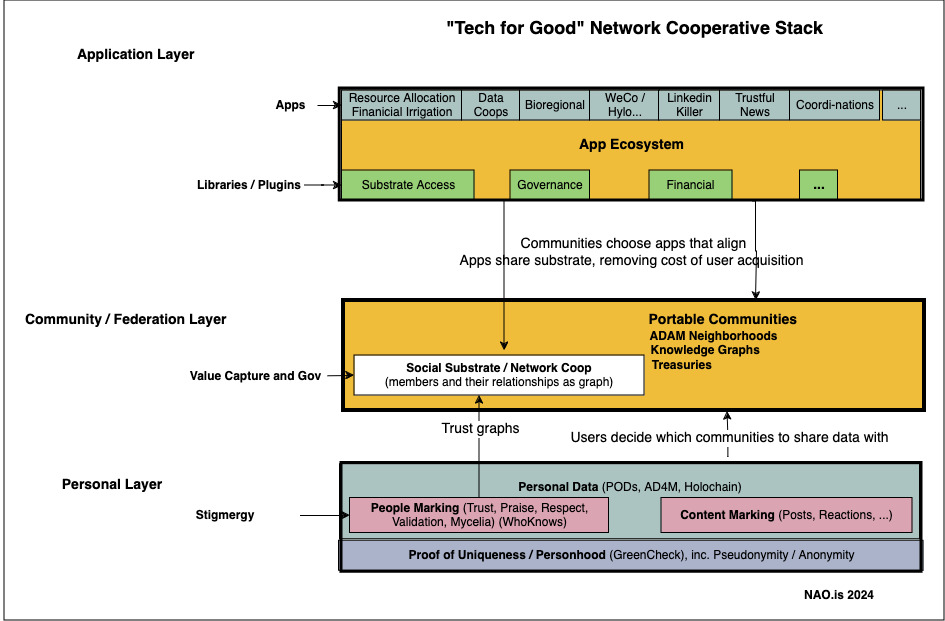
Here's [our tech stack for making this vision a reality](https://standingwave.net/apps/simple_tech_stack/). Be sure to watch the short Overview video.
It shows how community networks and the network cooperative concept fit with self-sovereignty, decentralization, and app ecosystems. Watch the videos there for elaboration.
#### AI
Clearly, AI is evolving fast and will have lots of implications. Two key points on that front:
* The many overlapping networks provide powerful and unique training data for Graph Neural Networks, under self-sovereignty control. This provides a lot of potential value.
* Trust networks are a valuable human antidote to the many problems anticipated. For instance, trusted networks of experts are well suited to combatting misinformation
#### Current State
[Elaborate here on existing tools, infrastructure, e.g.
* ArangoDB for graphs,
* GreenCheck for proof of humanity and respect vectors, ...
* WhoKnows for actual respect network,
* Bioregional Mycelia as application of WhoKnows for biodiversity conservation
* Allies like WorldWiseWeb, DWeb, IIW, Collaborative.tech, kernel.community, many more
* ]
#### Horizon 1 plan (4-6 months)
* Demonstration projects with one or more communities, ideally IIW
* Polish GreenCheck proof of personhood
* UX and interaction design
* React developer upgrade according to design
* Work with IIW-recommended identity and security developers
* Polish Group/Community invitation and on-boarding
* Portable Communities protocol
* New schema in collaboration with IIW
* Apps
* social bookmarking (adapt BestOfNow.net)
* bioregional biodiversity project with OneEarth
...
#### Horizon 2 plan
* Follow-on communities, ideally DWeb, Metagov
* ...
#### NooNAO:
NooNAO is a fiscally-sponsored project of [Planetwork](https://www.planetwork.net/), a 501(c )3. Donations are tax-deductible.
#### Contact
[Brad DeGraf]([mailto:bdegraf@gmail.com]()) and [Drummond Reed](mailto:drummond.reed@gendigital.com) 
 Google Drive
Gist
Clipboard
Google Drive
Gist
Clipboard
 Sign in with Wallet






