China's Pre-Primary Education Market at USD 55 Billion: Ken Research Maps the Post-Reform Consolidation and Premium Kindergarten Surge to 2027
==============================================================================================================================================
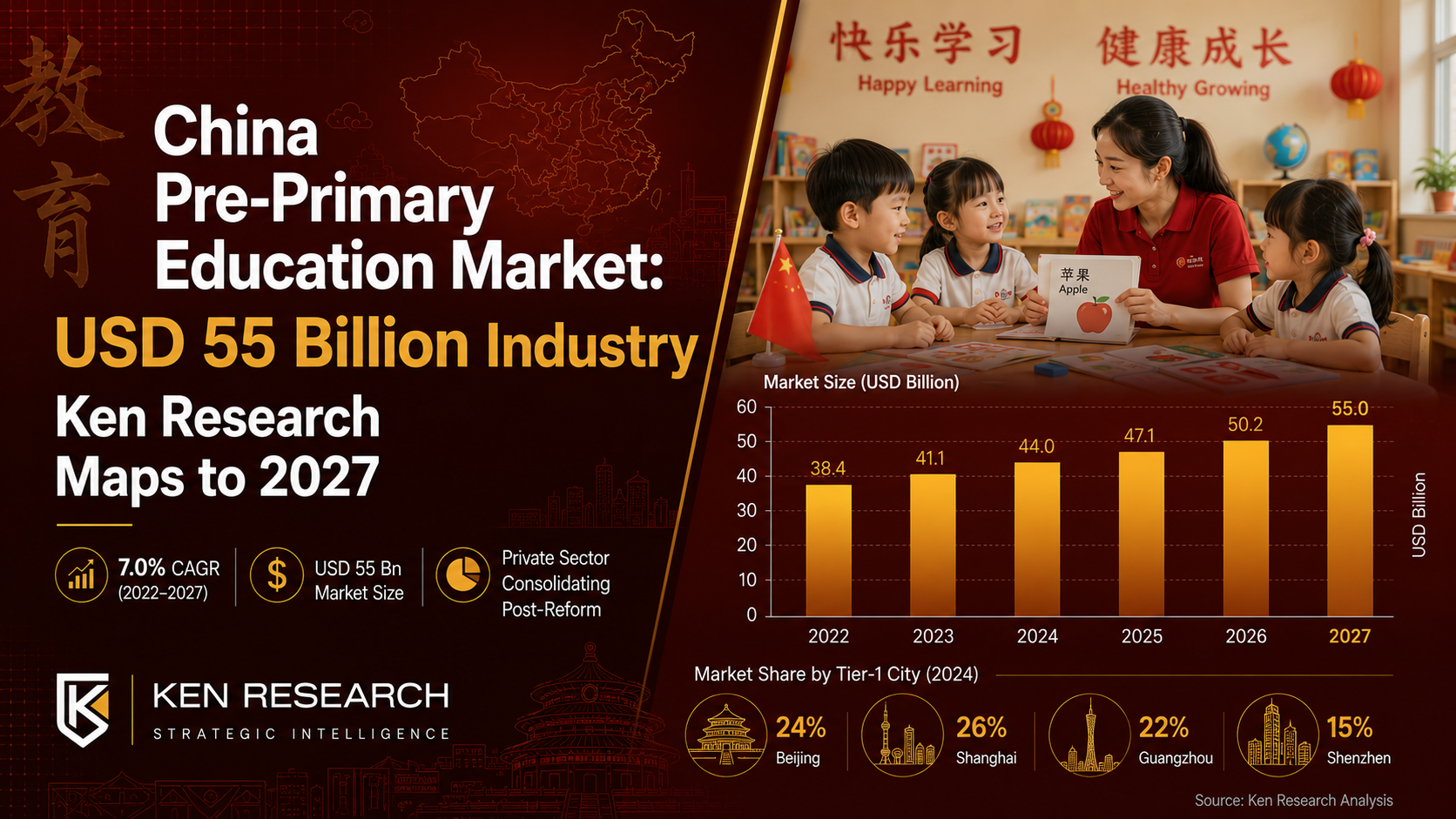
China's pre-primary education market has undergone a seismic regulatory shift that has restructured the competitive landscape more dramatically than any other major education market in the world. [Ken Research](https://www.kenresearch.com/?utm_source=HackMD&utm_medium=Referral&utm_campaign=Automation) has published a detailed analysis of the [China Pre-Primary Education Market](https://www.kenresearch.com/industry-reports/china-pre-primary-education-market?utm_source=HackMD&utm_medium=Referral&utm_campaign=Automation), revealing a sector valued at **USD 55+ billion in 2024** growing at a **7.0% CAGR through 2027**. The "double reduction" policy of 2021 — which effectively banned for-profit tutoring in compulsory education — redirected premium educational spending toward preschool years, creating a structural tailwind for quality kindergartens. While enrollment-based operators consolidated sharply, premium bilingual and international curriculum kindergartens in tier-1 cities expanded aggressively to capture reallocated family education budgets.
The Double Reduction Policy: How Regulation Restructured China's Preschool Market
---------------------------------------------------------------------------------
China's 2021 "double reduction" (shuang jian) policy eliminated the for-profit K-12 tutoring industry virtually overnight and simultaneously imposed restrictions on for-profit kindergartens in public school districts. This created a paradoxical effect: the overall preschool market consolidated at the bottom (budget and mid-market segments lost operators), while the top end accelerated as families redirected the budgets previously spent on tutoring toward premium preschool experiences. The broader [Asia-Pacific Pre-Primary Education Market](https://www.kenresearch.com/industry-reports/asia-pacific-pre-primary-education-childcare-market?utm_source=HackMD&utm_medium=Referral&utm_campaign=Automation) analysis shows China's premium segment growing at 2x the pace of the overall market, with bilingual kindergartens commanding fees of RMB 80,000–180,000 per year in Shanghai, Beijing, and Shenzhen.
* **For-Profit Restriction:** 2021 policy banned new for-profit kindergartens in public school districts; existing operators required to convert to non-profit or exit; reduced competitive density in budget segment.
* **Budget Reallocation:** Families previously spending RMB 30,000-60,000/year on K-12 tutoring redirected spend to preschool; premium kindergarten enrollment waitlists extended to 12+ months in tier-1 cities.
* **Non-Profit Conversion:** Large chains including RYB Education and Bright Horizons China pivoted to non-profit operating models; reduced margins but maintained enrollment base.
* **Government Expansion:** State-run kindergartens expanding in tier-2 and tier-3 cities to fill the gap left by exiting for-profit operators; government targets 85% public kindergarten coverage.
Premium Bilingual Kindergartens: The High-Margin Survivor Category
------------------------------------------------------------------
The segment that emerged strongest from China's regulatory restructuring is the premium bilingual and international curriculum kindergarten — typically priced above RMB 80,000 per year and catering to urban professional families. These operators sit in a regulatory gray zone: they serve ages 3-6 (pre-compulsory education), are not subject to the double reduction restrictions in the same way, and can maintain for-profit status. The [India Pre-Primary Education Market](https://www.kenresearch.com/industry-reports/india-pre-primary-education-market?utm_source=HackMD&utm_medium=Referral&utm_campaign=Automation) comparison shows India developing a similar premium segment, but China's is larger, more sophisticated, and more technology-integrated.
* **Kidswant (孩子王):** Premium early childhood retail and education ecosystem; integrates physical stores with online parenting community; strong brand in eastern China.
* **Bright Horizons China:** International curriculum kindergartens in Shanghai, Beijing, and Guangzhou; serving expatriate and affluent Chinese families; fees RMB 150,000-200,000/year.
* **Maple Leaf International School:** Bilingual program from kindergarten through secondary; expanding from tier-1 to tier-2 cities; integrated academic pathway from age 3.
* **Local Premium Chains:** City-specific premium brands like Shanghai Huangpu Kindergarten Group and Beijing Zhongguancun Bilingual expanding through neighborhood saturation strategies.
Want Ken Research's full breakdown of China's pre-primary education market including regulatory impact analysis, segment revenues, operator competitive positioning, and enrollment forecasts through 2027? [Download Sample Report](https://www.kenresearch.com/sample-report/china-pre-primary-education-market?utm_source=HackMD&utm_medium=Referral&utm_campaign=Automation) and access the complete intelligence.
EdTech Integration: China's Digital Kindergarten Infrastructure
---------------------------------------------------------------
China's preschool chains have built the most sophisticated digital parent-engagement and curriculum-delivery infrastructure of any preschool market globally. WeChat mini-programs for daily learning updates, AI-driven learning progress tracking, facial recognition attendance systems, and app-based homework assignments are standard features at mid-market and premium private kindergartens. This digital infrastructure creates a stickiness and differentiation that budget operators cannot easily replicate. The [South Korea Pre-Primary Education Market](https://www.kenresearch.com/industry-reports/south-korea-pre-primary-education-market?utm_source=HackMD&utm_medium=Referral&utm_campaign=Automation) leads globally in government-mandated EdTech integration; China leads in privately-driven digital ecosystem depth.
The 2027 Outlook: Tier-2 City Expansion and Quality Upgrade Cycle
-----------------------------------------------------------------
China's 7.0% CAGR through 2027 will be driven primarily by two forces. First, quality upgrading: families across all income tiers are investing in better preschool experiences, driven by awareness of early childhood development research and competitive pressure from peers. Second, tier-2 and tier-3 city expansion: premium chains that saturated tier-1 markets are expanding to cities like Chengdu, Wuhan, Xi'an, and Hangzhou where private kindergarten penetration remains below tier-1 levels but income growth is closing the gap rapidly.
* **Tier-2 City Premium:** Chengdu, Wuhan, Xi'an, and Hangzhou all seeing first-wave premium bilingual kindergarten openings; early-mover advantage available for established brands.
* **Quality Certification:** Government National Quality Standards for kindergartens driving investment in facilities, curriculum, and teacher qualifications across all segments.
* **Birth Rate Headwind:** China's declining birth rate is the primary structural constraint; the market is growing through quality-upgrade and fee-per-student expansion rather than enrollment volume growth.
* **Integrated Care Model:** Full-day care with early learning curriculum replacing half-day playschool; drives 40-60% fee premium and creates natural demand from working parents.
China's preschool market post-double-reduction is a fundamentally different competitive landscape — and the operators who understand the new dynamics will capture the premium segment's disproportionate returns. [View the China Pre-Primary Education Market Report](https://www.kenresearch.com/industry-reports/china-pre-primary-education-market?utm_source=HackMD&utm_medium=Referral&utm_campaign=Automation) to access Ken Research's full regulatory analysis, segment forecasts, and competitive maps through 2027.
Conclusion
----------
China's pre-primary education market at **USD 55 billion in 2024** has been reshaped by regulatory intervention into a two-tier structure: a consolidated non-profit segment serving the mass market and a thriving premium bilingual segment capturing the reallocated education budgets of China's urban professional class. The **7.0% CAGR** masks the divergence between these two worlds — premium segment growth significantly exceeds the blended average. Ken Research's analysis makes clear that **Bright Horizons China, Maple Leaf, and local premium chains are the structural beneficiaries** of the regulatory environment that hurt their budget competitors. Access the complete [China Pre-Primary Education Market](https://www.kenresearch.com/industry-reports/china-pre-primary-education-market?utm_source=HackMD&utm_medium=Referral&utm_campaign=Automation) report for Ken Research's full competitive intelligence and investment framework.
Frequently Asked Questions
--------------------------
### What is the size of China's pre-primary education market?
China's pre-primary education market is valued at USD 55+ billion in 2024, growing at a 7.0% CAGR through 2027. The market has been restructured by the 2021 double reduction policy, which consolidated the budget segment while accelerating premium bilingual kindergarten growth. For regional context, see the [Asia-Pacific Pre-Primary Education Market](https://www.kenresearch.com/industry-reports/asia-pacific-pre-primary-education-childcare-market?utm_source=HackMD&utm_medium=Referral&utm_campaign=Automation) from Ken Research.
### How did China's double reduction policy impact the preschool market?
The 2021 double reduction policy banned new for-profit kindergartens in public school districts and required existing operators to convert to non-profit status. This consolidated the budget segment, drove out smaller operators, and redirected premium family education budgets toward bilingual kindergartens — creating a two-tier market with different growth dynamics at each level.
### Which companies lead China's premium kindergarten segment?
Bright Horizons China, Maple Leaf International School, and Kidswant lead the premium segment. RYB Education and Good Kids operate in the mid-market non-profit model. Government-run kindergartens dominate the budget segment. The [India Pre-Primary Education Market](https://www.kenresearch.com/industry-reports/india-pre-primary-education-market?utm_source=HackMD&utm_medium=Referral&utm_campaign=Automation) report provides a parallel analysis of a comparable emerging market.
### What is the fee range for private kindergartens in China?
Budget/government: RMB 10,000-20,000/year. Mid-market private: RMB 30,000-60,000/year. Premium bilingual: RMB 80,000-130,000/year. International curriculum (Bright Horizons, Maple Leaf): RMB 150,000-200,000/year in tier-1 cities.
### How does China's preschool market compare to Japan's and South Korea's?
China's market is the largest by revenue but growth is constrained by declining birth rates and regulatory restructuring. Japan and South Korea have mature, government-subsidized systems with lower private market growth but higher per-student investment. See the [Japan Pre-Primary Education Market](https://www.kenresearch.com/industry-reports/japan-pre-primary-education-market?utm_source=HackMD&utm_medium=Referral&utm_campaign=Automation) and [South Korea Pre-Primary Education Market](https://www.kenresearch.com/industry-reports/south-korea-pre-primary-education-market?utm_source=HackMD&utm_medium=Referral&utm_campaign=Automation) for direct comparison.
 Google Drive
Gist
Clipboard
Google Drive
Gist
Clipboard
 Sign in via Google
 Sign in via Facebook
 Sign in via X(Twitter)
 Sign in via GitHub
 Sign in via Dropbox
 Sign in with Wallet






