# Exponents and logarithms
###### tags: `math` `IB`
[ToC]
## Introduction and context
Hi there, I'm David Prieto and I'm doing these classes here in markdown because I think that they are cool and I'm used to document stuff for me and for people that come after me.
I'm using the book from the editorial 0xford "Mathematics, Analysis and Approaches" (A A for short) of the IB diploma. This covers the topic 9 in the 0xford book "Representing equivalente quantities: exponentials and logarithms" from page 394 to page 431
I'm using [this](https://math.meta.stackexchange.com/questions/5020/mathjax-basic-tutorial-and-quick-reference) to write the cool mathematic stuff
## Things that you may know by now
If regarding this you have some difficulties please ask the teacher and be aware that you need to take another look.
## Exponentials
### What is an exponential
^page^ ^395^
Exponentials, or powers, or indices (in Spanish _potencias, exponentes_) are a short way for writing repeated multiplication as multiplication is a short way for writing repeated addition.

_serious diagram about the parts of the exponential operation_
Beware that, unlike addition or multiplication, exponents __are not commutative__ so $3^2$ is not the same that $2^3$
### Laws of exponents (exponents aritmetics)
These laws are used to simplify and operate when there are exponents around. You should be able to simplify formulas like
$$\left(\frac {x^9 y^6}{ x^8 y^3}\right) ^3$$
To do so we need tools

[Source](https://www.flickr.com/photos/80522246@N00/2515800654)
#### Multiplication
^page^ ^396^
$$a^m \times a^n = a^{(m+n)}$$
When you multiply powers **of the same base** you are adding the exponents together.
#### Division
^page^ ^397^
$$\frac{a^m}{a^n} = a^{(m-n)}$$
When you divide powers **of the same base** you are substracting the exponents.
#### A power of one
This one should be easy but we're covering all the tools so let's remember this:
$$a^1 = a$$
#### A power of zero
^page^ ^397^
$$a^0 = 1, a \neq 0$$
Any number to the power of zero is one. Except, in some definitions of zero using limits, that can be undefined.
Here are some videos (Spanish and English) talking briefly about the problem.
{%youtube lqBXU-9Y3kU %}
{%youtube 4Hm4fMkl5XI%}
#### Negative exponents
^page^ ^397^
Remember, guys: negative exponents are very tiny, but they don't have to be negative (they are micro-optimistic about things)
$$a^{-m} = \frac{1}{a^m}$$
#### Raising a power to a power
^page^ ^398^
Raising a power to a power equals a power to times the other power. Add "sword" to that sentence and you have a power metal lyric.

_try to say it in your most power metal voice. Then add a sick air guitar solo_
$$a+x(\ln23)=\Gamma \epsilon$$
$$(a^{m})^n = a^{m \times n}$$
##### Proposed Exercises:
^page^ ^398^
Before continuing we should try to simplify these:


#### Fractional exponents
^page^ ^399^
So far so good. We have been user integers as exponents, but we can get weirder because of course we can.
So how do we undersand $x^{\frac{1}{n}}$?
Ok, let's try with the easy example of $b^{\frac{1}{2}}$:
We know that if we multiply $b^{\frac{1}{2}}$ by $b^{\frac{1}{2}}$ we can use the multiplication of powers of the same base
$$b^{\frac{1}{2}} \times b^{\frac{1}{2}} = b^{\frac{1}{2}+\frac{1}{2}} = b ^1 = b$$
Aaaand we also know that square root of a number is the number that you have to multiply by itself to get the original number, in other words:
$$\sqrt{b} \times \sqrt{b} = b$$
So that implies that
$$\sqrt{b} = b^{\frac{1}{2}} $$
The square root was a fractional exponent _all this time_.
Now, we can expand this to say that:
$$a^{1/n} = \sqrt[n]a$$
Aaaand if we know that $(\sqrt[n]a)^m =\sqrt[n]{a^m}$, then...
$$a^{m/n} = \sqrt[n]{a^m}$$
We can say that we have the same number that we can express in a **radical form** or in an **exponential form**
##### Exercises


### Exponential equations
^page^ ^400^
Some equations in which the exponent is unknown can be solved easily.
The trick is to get both terms in the same base to use these rules that we have covered. For example:
$$5^x 9++++++++++++++++++++++++++++++++
= 25^{x+3}$$
We know that $25=5^2$ so
$$5^x = (5^2)^{x+3}$$
And we know the power of a power is a multiplication of indices so:
$$5^x = 5^{2·(x+3)}$$
And now we have the same base so we can compare just the indices:
$$ x = 2·(x+3)$$
##### Proposed Exercises:
^page^ ^401^
Now let's solve some equations:


### Exponential functions
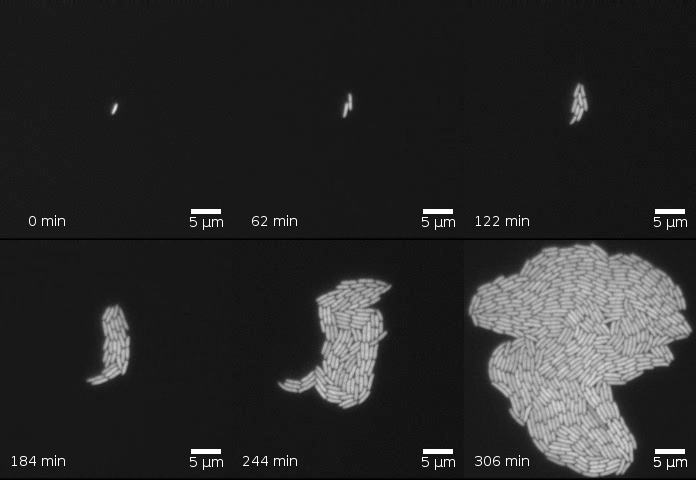
Functions: they are back (and they will never leave).
An exponential function is a function of the form $f(x)= a^x$ where $a>0, a \neq 1$
The full form is something like this:
$$f(x) = k ·a^{x/ c}$$
Buut, usually exponential worth is not measured in "x" but in time, t. So the function in general they have this form:
$$f(t) = k ·b^{t/ \tau}$$
Where:
* $k$ is the initial value of $f(t)$, so $f(0)=k$
* $b$ is the positive growth factor and
* $\tau$ (tau, greek leter) is the _time constant_, and it's the time required for $f(x)$ to increase by one factor of b
$$f(t+\tau) = k · b^{\frac{t+\tau}{\tau}}= k · b^{\frac{t}{\tau}} · b^{\frac{\tau}{\tau}} = (k · b^{\frac{t}{\tau}}) · b^1 = f(t) · b$$
What do they describe?
It depends if they grow or if they decay
### Exponential growth
If $\tau >0$ and $b> 1$ then we have *exponential growth* and they describe stuff that they grow faster and faster. Here we have an example:

Here we have this function
$$f(t)= 3·2^{t/5}$$
[Here are some examples](https://en.wikipedia.org/wiki/Exponential_growth#Examples)
Ponzi Schemes and Pyramid schemes
### Exponential decay

Exponential decay happens with, well radioactive decay
This is no Archeology class or Physics class but here you can see a use.
https://gml.noaa.gov/ccgg/isotopes/decay.html
But there are more things
Beer froth:
The volume of beer froth decays exponentially with time. (https://iopscience.iop.org/article/10.1088/0143-0807/23/1/304)

<p style="font-size: 0.9rem;font-style: italic;"><a href="undefined">"Image"</a> is licensed under <a href="undefined?ref=ccsearch&atype=html" style="margin-right: 5px;"></a><a href="undefined?ref=ccsearch&atype=html" target="_blank" rel="noopener noreferrer" style="display: inline-block;white-space: none;margin-top: 2px;margin-left: 3px;height: 22px !important;"><img style="height: inherit;margin-right: 3px;display: inline-block;" src="https://search.creativecommons.org/static/img/cc_icon.svg?image_id=undefined" /></a></p>
### Working with the GDC calculator
I have my old Texas Instruments, but now there are better tools. We are going to explore some functions with the calculator and see what happen.
If you don't know how to draw the graph, here is a tutorial:
{%youtube H5U0V9sUCgk %}
Also we can explore these tutorials and try to do some graphs and some equation solving
https://www.youtube.com/channel/UCNl64Kj5VzZzlgFh2dJZ0cA/videos
##### Homework
* Radical exercises (you can see it up)
* Exponential equations
* This 3 problems of functions:
^page^ ^404^


##### Worked solution of number 7
Here we have a generic formula that we have to fill in
The formula is
$$A = A_0(2)^{-\frac{t}{5730}}$$
And the we need to know what are
* Constants
* Variables (the input or inputs)
* The result of the function (the outcome)
That depends pretty much on _context_
In this case:
* The variable is $t$, representing time, measured in years.
* The outcome is $A$, representing mass of carbon-14, measured in mg (miligrams)
* $A_0$ is given in this case: 100mg
So the general function could be something like this
$$ A(t) = 100 · (2)^{-\frac{t}{5730}}$$
And in the first question:
If you start with 100 mg of carbon-14, find how much will remain after 1000 years.
We only need to find $A(1000)$ like this:
$$ A(1000) = 100 · (2)^{-\frac{1000}{5730}} = 88.6 \ years$$
To sketch the graph in the Casio you will have to go to graph and put something like this:
$$ Y = 100 \times 2 ^{-x\div5730}$$
And then will if we don' see anything we have to set up the window (V-window/F3) to the parameters:
Xmin : 0
Xmax : 800
scale : 500
Ymin: 0
Ymax: 100
scale: 10
Then the answer to the question
if A= 75 mg, then t = 2378 years
if A= 50 mg, then t = 5730 years (this is called Half-life of Carbon-14)
We can do it analytically using logarithms but for now you can do it using aproximations of the graph
## E constant, Euler's number, natural base
^page^ ^405-406^

_Euler gives you a wink_
(well, he had a fever in XVIII that made him lost his sight from the right eye almost completely)[Source](https://en.wikipedia.org/wiki/Leonhard_Euler)
So there are several mathematical constants that are important such as $\pi$. The number $e$ is one of them and it's important to some limits and in derivatives and in exponential and logarithms.
### Definition
How to get the number is _complicated_ and it seems unrelated. There are, as in $\pi$ several ways to get it. I'll a couple than you can get now and one that you will get later, _once the integrals are in your system_.
#### As a sume of the infinite series:
$$e = \sum_{n=0}^\infty \frac{1}{n!} = 1 + \frac{1}{1}+ \frac{1}{1·2}+ \frac{1}{1·2·3}+...$$
#### As a limit:
$$ e = \lim_{n \to \infty} \left(1+\frac{1}{n}\right)^n$$
#### As the area of the hyperbola

This area is exactly 1. The line here is $f(x) = 1/x$
### How much is it
**I's approximately 2.718**, so between 2.5 and 3. Not a rational number but a irrational one. Also it's [transcendental number](https://en.wikipedia.org/wiki/Transcendental_number), so it's not equal to any root.
### Why is important
* Some models use instead of $2^x$ they use $e^x$
* The derivative of $e^x$ is $e^x$ so that's pretty cool.
* The base e is going to be used a lot in logarithms
* One example is that the shape of 2/3 of the Eiffel Tower corresponds to the function $e^x$ [source](https://estructurando.net/2016/10/04/por-que-la-torre-eiffel-tiene-la-forma-que-tiene/)

* It has more [properties](https://en.wikipedia.org/wiki/E_(mathematical_constant)#Properties) that may be difficult to see right now. But at least you can get that there is _stuff_ there.
#### Homework

## Logarithms
^page^ ^407^ ^and^ ^following^
(I like how in English "Logarirthms" are written because in Spanish those "thms" section has too much consonants to be pronounced)
Logarithms are _pretty useful_ to say how big or how small is a number.
You may know that the number $1.5543·10^9$ is way bigger than the number $5.3254·10^4$ and both are bigger than $8.5551·10^{-2}$ in cientific notation.
To see that we only look for the index of the power of the $10$, the index.
Logarithms is the operation that give us the index of a power. If we have the same base we can operate just with the indices.
#### Example
Take $2^3 = 8$. You may be asked "what is the number I have to power 2 to get 8?" The answer in this case is "3". To express that we use the logarithm ($log$ for short) operation.
In this case, $log_2 \ 8 = 3$
This is read "log/logarithm base 2 of 8 equals 3"
### Parts of a logarithm

[(source)](http://11thgradedp.weebly.com/logarithms.html)
For $a>0, a \neq 1$ and $c>0, a^b = c$ there is a $log_a\ c = b$
### Basic properties
For any base $a>0, a \neq 1$
$$log_a \ 1 =0$$
And
$$log_a \ a =1 $$
Also
$$log_a \ (a^x) =x $$
### Common bases
There are two bases that are more used than other and you should be aware of:
#### Natural logarithm
Natural logarithm, neperial logarithm or $ln$ for short is a logarithm with base $e$
#### Decimal logarithm
Decimal logarithm is logarithm of base 10. If you put "log" in your calculator, by default it's going to base 10. Try it setting how much is "log" of 10 (it should be 1)
#### Homework
Write in exponential form:


Write in logarithm form:

Find the value of each expresion:


Exam type of question:

Solution

why $4^{(3/2)}=8$? One way of seing it: $4^{(3/2)}= \sqrt{4^3} = \sqrt{4^2 · 4^1} =\sqrt{4^2} · \sqrt{4^1} =4· \sqrt{ 4} = 4·2 = 8$
### The laws of logarithms
_they seem not to be in the booklet_
$$log_a (x·y) = log_ax +log_ay$$
$$log_a \left(\frac{x}{y}\right) =log_ax -log_ay$$
$$log_a (x^n) = n·log_a x$$
#### Change of exponent
$$a^{\log_ax}=x$$
Because if we make that a variable $m$ is $m=\log_ax$ then we can say that
$$a^{\log_ax}=a^m$$
And if $m=\log_ax$, then $a^m=x$ because is how logarithms are related to exponentials. Hence:
$$a^{\log_ax}=x$$
Example:
$$2^{\log_264} = 2^6 = 64$$
#### Change of base
Change of base is very useful because scientific calculators nowadays usually only have the table of natural logarithms (with base $e$) or decimal logarithms, so how we calculate $\log_7 345$?
We use this:
$$log_ax = \frac{log_bx}{log_ba}$$
Where does it come from?
Imagine that we want to express $\log_ax$ in terms of base $b$ because we can calculate in that base easily.
Let $y = \log_ax$ (we add this to help us out). Then $a^y = x$
We make both sides of this expresion the argument of a logarithm with base $b$
$$\log_b{(a^y)} = \log_b(x)$$
We can take y outside of the left logarithm like this:
$$y\log_b{a} = \log_bx$$
And we isolate the y by dividing both sides by $\log_ba$
$$y= \frac{\log_bx}{\log_b{a}}$$
Since we established that $y = \log_ax$ then... we substitute $y$ and we have...
$$log_ax = \frac{log_bx}{log_ba}$$
ta-dah!
### Natural logarithms
Natural logarithms or naperian logarithms are logarithms with base of the number $e$ that we covered before (that 2.718...).
So instead of writing $\log_e x$ we use the abreviation $\ln x$
$\ln$ was derived from French "Logarithme Naturel", so there is a bit of French in your calculators.
The laws of logarithms are the same for natural logarithms as any other base.
### Logarithm functions
If $f(x)=a^x$, then the inverse, $f^{-1} = \log_ax$

#### Properties
If a logarithmic function has the shape of $y=log_ax$, where $a>0$ and $a\neq1$:
x = 0 is an asymptote
The curve croses the x-axis at (1,0)
The **domain** is the set of all _positive_ real numbers $+\mathbb R$
The **range** is the set of al real numbers $\mathbb R$
#### Using logarithms to solve equations
They are pretty helpful to find solutions to equations with incognitas in the exponents and it's hard to express both parts in the equation as the same base.
For example
$$e^x = 12$$
Can be solved taking logarithms, in this case:
$$x= \ln 12$$
This is around 2.48
Example 2
If we have other bases that we can't calculate directly we make use of the change of base property to make it feasable.
For example, $17^{x-2}=20$ could be solved like $x-2 = \log_{17} 20$ since we don't handle base $17$ easily, we convert it. For example using natural logaritms this would be:
$$x-2=\frac{\ln20}{\ln17}$$ and then we make the calculations that I guess that would be around 3.1 or 3.2
### Homework for Monday 20th December:
#### Logarithmic and exponential functions
Page 404 exercise 4


Page 409 exercise 1 (this uses transformation stuff)

#### Arithmetics and applying laws of logarithms
Page 414 exercise 1. Supose that all logs are base 10 or base a. Letters b, d, f, g, i k


Here we are doing some substitutions.
Page 415, exercise 1, 3,4


#### Base e
Page 416, exercise 1 and 2

#### Solving equations
page 421, exercise 7

 Google Drive
Gist
Clipboard
Google Drive
Gist
Clipboard
 Sign in with Wallet






