Sevda Shukrieva
    • Create new note
    • Create a note from template
      • Sharing URL Link copied
      • /edit
      • View mode
        • Edit mode
        • View mode
        • Book mode
        • Slide mode
        Edit mode View mode Book mode Slide mode
      • Customize slides
      • Note Permission
      • Read
        • Only me
        • Signed-in users
        • Everyone
        Only me Signed-in users Everyone
      • Write
        • Only me
        • Signed-in users
        • Everyone
        Only me Signed-in users Everyone
      • Engagement control Commenting, Suggest edit, Emoji Reply
    • Invite by email
      Invitee

      This note has no invitees

    • Publish Note

      Share your work with the world Congratulations! 🎉 Your note is out in the world Publish Note No publishing access yet

      Your note will be visible on your profile and discoverable by anyone.
      Your note is now live.
      This note is visible on your profile and discoverable online.
      Everyone on the web can find and read all notes of this public team.

      Your account was recently created. Publishing will be available soon, allowing you to share notes on your public page and in search results.

      Your team account was recently created. Publishing will be available soon, allowing you to share notes on your public page and in search results.

      Explore these features while you wait
      Complete general settings
      Bookmark and like published notes
      Write a few more notes
      Complete general settings
      Write a few more notes
      See published notes
      Unpublish note
      Please check the box to agree to the Community Guidelines.
      View profile
    • Commenting
      Permission
      Disabled Forbidden Owners Signed-in users Everyone
    • Enable
    • Permission
      • Forbidden
      • Owners
      • Signed-in users
      • Everyone
    • Suggest edit
      Permission
      Disabled Forbidden Owners Signed-in users Everyone
    • Enable
    • Permission
      • Forbidden
      • Owners
      • Signed-in users
    • Emoji Reply
    • Enable
    • Versions and GitHub Sync
    • Note settings
    • Note Insights New
    • Engagement control
    • Make a copy
    • Transfer ownership
    • Delete this note
    • Save as template
    • Insert from template
    • Import from
      • Dropbox
      • Google Drive
      • Gist
      • Clipboard
    • Export to
      • Dropbox
      • Google Drive
      • Gist
    • Download
      • Markdown
      • HTML
      • Raw HTML
Menu Note settings Note Insights Versions and GitHub Sync Sharing URL Create Help
Create Create new note Create a note from template
Menu
Options
Engagement control Make a copy Transfer ownership Delete this note
Import from
Dropbox Google Drive Gist Clipboard
Export to
Dropbox Google Drive Gist
Download
Markdown HTML Raw HTML
Back
Sharing URL Link copied
/edit
View mode
  • Edit mode
  • View mode
  • Book mode
  • Slide mode
Edit mode View mode Book mode Slide mode
Customize slides
Note Permission
Read
Only me
  • Only me
  • Signed-in users
  • Everyone
Only me Signed-in users Everyone
Write
Only me
  • Only me
  • Signed-in users
  • Everyone
Only me Signed-in users Everyone
Engagement control Commenting, Suggest edit, Emoji Reply
  • Invite by email
    Invitee

    This note has no invitees

  • Publish Note

    Share your work with the world Congratulations! 🎉 Your note is out in the world Publish Note No publishing access yet

    Your note will be visible on your profile and discoverable by anyone.
    Your note is now live.
    This note is visible on your profile and discoverable online.
    Everyone on the web can find and read all notes of this public team.

    Your account was recently created. Publishing will be available soon, allowing you to share notes on your public page and in search results.

    Your team account was recently created. Publishing will be available soon, allowing you to share notes on your public page and in search results.

    Explore these features while you wait
    Complete general settings
    Bookmark and like published notes
    Write a few more notes
    Complete general settings
    Write a few more notes
    See published notes
    Unpublish note
    Please check the box to agree to the Community Guidelines.
    View profile
    Engagement control
    Commenting
    Permission
    Disabled Forbidden Owners Signed-in users Everyone
    Enable
    Permission
    • Forbidden
    • Owners
    • Signed-in users
    • Everyone
    Suggest edit
    Permission
    Disabled Forbidden Owners Signed-in users Everyone
    Enable
    Permission
    • Forbidden
    • Owners
    • Signed-in users
    Emoji Reply
    Enable
    Import from Dropbox Google Drive Gist Clipboard
       Owned this note    Owned this note      
    Published Linked with GitHub
    • Any changes
      Be notified of any changes
    • Mention me
      Be notified of mention me
    • Unsubscribe
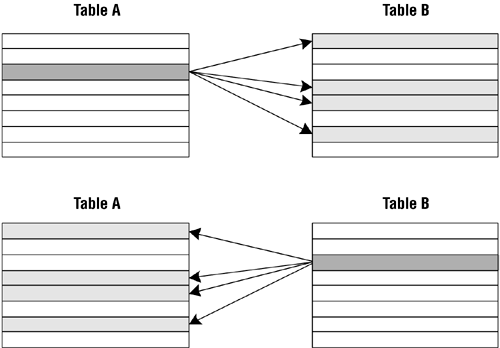
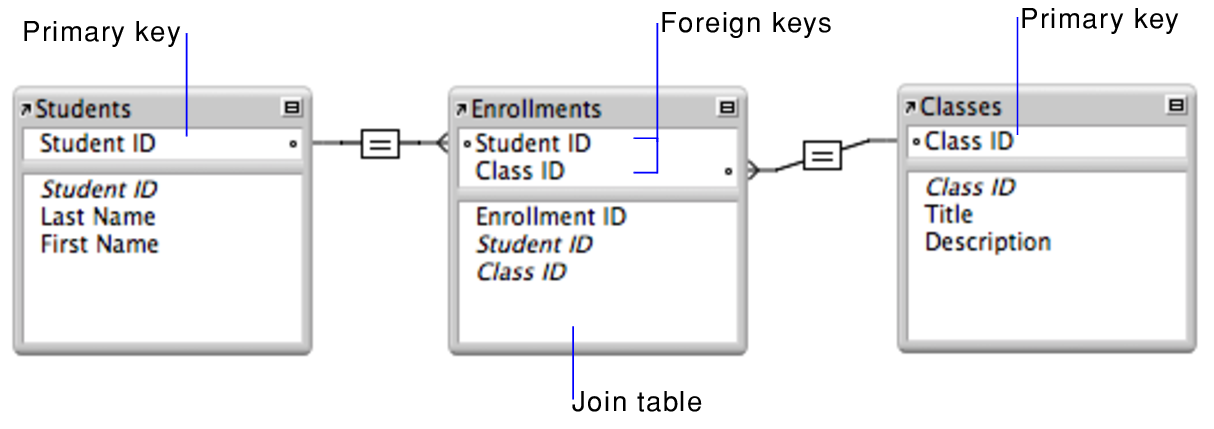
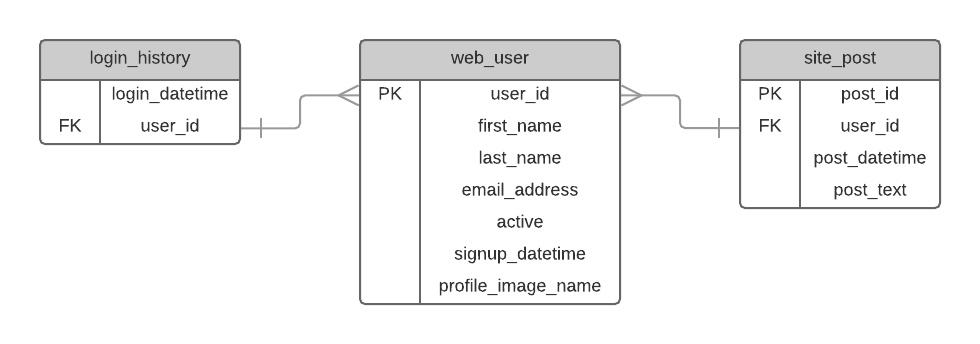
    # Week 5 Database - Schemas and relationships --- ## What kinds of data relationships are there? - Amy Sometimes we want to link two separate tables through a relationship, rather than creating one giant franken-table. There are names for each of the possible relationships. --- One - to - One: This is the least common form of relationship (that would be too convenient). One of the reasons is that there aren't many examples of one-to-one relationships in real life, and even those that are one-to-one become one-to-many over time. Examples of one-to-one relationships: 1. UK marriage 2. Passports 3. Fingerprints 4. Capital cities --- One - to - Many: This is the most common type of relationship! This kind of relationship means that one row in a table (usually called the parent table) can have a relationship with many rows in another table (usually called child table). Examples: 1. Authors and books 2. Customer purchases from a particular shop --- Note: It is a good practice to keep the name of the referencing columns the same as in the referenced (parent) table. This makes it even simpler to understand the relationship. --- There are also scenarios where the one-to-many relationship occurs between rows of the same table. This kind of one-to-many relationship is also called a hierarchical relationship; it’s used in many systems to represent tree-like structures, i.e. an organization chart, a file system structure, or a product and its component parts. That means we need to use a single table that references itself. --- Many - to - Many: Examples: 1. Facebook friends 2. University students and professors 3. Recipes and ingredients 4. Employees and tasks 5. Us and projects --- ![](http://etutorials.org/shared/images/tutorials/tutorial_35/10fig12.gif) --- The only way to deal with many to many relationships in SQL is to use two or more tables, along with one or more join tables. Join tables can access fields and data across tables without having to create a separate relationship. A join table creates two one-to-many relationships. --- ![](https://fmhelp.filemaker.com/help/18/fmp/en/FMP_Help/images/relational.07.06.1.png) Foreign keys can be used to join tables. --- ## What’s a foreign key? - Chun --- A foreign key is a column or a group of columns in a table that reference the primary key of another table.<!-- .element: class="fragment" data-fragment-index="1" --> --- The table with the foreign key is called the **child table**, and the table with the primary key is called the **referenced** or **parent table**.<!-- .element: class="fragment" data-fragment-index="0" --> --- A table can have multiple foreign keys depending on its relationships with other tables. --- ![](https://i.imgur.com/6JQBjBa.png) <!-- <img src="https://i.imgur.com/YBRHhWR.png" style="height: 500px;"> --> --- In PostgreSQL, you define a foreign key using the foreign key constraint. It prevents invalid data from being inserted into the foreign key column, because it has to be one of the values contained in the parent table. A foreign key constraint indicates that values in a column or a group of columns in the child table equal the values in a column or a group of columns of the parent table. --- Foreign key syntax ``` [CONSTRAINT fk_name] FOREIGN KEY(fk_columns) REFERENCES parent_table(parent_key_columns) [ON DELETE delete_action] [ON UPDATE update_action] ``` --- ## How does a schema describe a relational database? - Jo --- ![schema definition](https://i.imgur.com/LmzyCWF.png) Originates from the Greek word *skhēma*, which means form, figure, shape, or plan. --- A **schema** is a representation of the different things in a database. --- The schema describes the categories of information, how they are organised and the relationships between them. --- It's like a map for finding your way round the database. :face_with_monocle: --- A database schema can be represented with a visual diagram: ![](https://www.databasestar.com/wp-content/uploads/2019/07/ERD-Website.png) This is also known as an Entity Relationship Diagram, or ERD. --- In some database systems, the schema and the database are basically the same thing. Confusingly, in MySQL, "schema" is a synonym for "database". `CREATE SCHEMA` <=> `CREATE DATABASE` --- In PostgreSQL, a schema is also the namespace where data objects and tables are stored. --- As well as tables, Postgres schemas contain other objects such as data types, functions, operators. --- Postgres automatically creates a `public` schema, and every new object is placed here, unless you specify a different schema name: ![](https://i.imgur.com/xURYfMI.png) --- These two statements are exactly the same: `CREATE TABLE table_name(...);` `CREATE TABLE public.table_name(...);` --- ### Why do you need to use schemas - Schemas allow you to organize database objects e.g., tables into logical groups to make them more manageable. - Schemas enable multiple users to use one database without interfering with each other. --- To access an object in a schema, you need to qualify the object by using the following syntax: `schema_name.object_name` --- The same object name can be used in different schemas: e.g. `sales` schema and `public` schema can both contain tables called `staff`. You would have to make sure you refer to the correct staff table by writing: `public.staff` or `sales.staff` --- If you don't use the schema name when referring to a table, PostgreSQL will access the first matching table in the ***schema search path***. The first schema in the search path is the *current schema* (and this is the schema that will be used by default when creating a new object). --- ![](https://i.imgur.com/OILS4ee.png) but... ![](https://i.imgur.com/8BmK9BQ.png) --- "The value for `search_path` has to be a comma-separated list of schema names. If one of the list items is the special value `$user`, then the schema having the name returned by `SESSION_USER` is substituted, if there is such a schema. (**If not, `$user` is ignored**.) --- You can edit the search path: `SET search_path TO sales, public;` Now, if you create a new table named staff without specifying the schema name, PostgreSQL will put this staff table into the `sales` schema, rather than the `public` schema: --- ### Summary --- Confusingly, a schema means a few different things, but broadly: 1. A collection of multiple tables and other database objects. 2. A description of a single table (including its relationships to others). --- ## How can foreign key help us design schemas with relational data? -- Sevda -- --- - The process of database design involves defining entities. - An entity represents a real world object, or a set of data that we want to model within our database; - Referencal Integrity database feature system to ensure database consistency. --- ![](https://i.imgur.com/2nW9SWd.png) Wow, that's a lot of information all in one table! There are other issues here as well, such as duplication of data. --- Duplicating data in this way can lead to issues with data integrity. --- How do we deal with this situation:question: --- The answer is to split our data up across multiple different tables, and create relationships between them. --- ![](https://i.imgur.com/H1XlVhZ.png) Now we have defined the entities we need, we can plan tables to store the data for each entity. --- <!-- To better understand that relationship, Imagine for instance that we have two tables, one called colors and one called shapes. --> <!-- The ``<color_id>`` column of the shapes table is a Foreign Key which references the id column of the colors table. --> <img src="https://i.imgur.com/5aVCwQG.png" alt="" width="450"> In the diagram above, the 'Red' row of our colors table is associated with the 'Square' and 'Star' rows of our shapes table.'Orange' isn't currently associated with any row in the shapes table, but there is the potential to create such an association if we insert a row into shapes with a color_id of 3. --- In other words, PostgreSQL won't allow you to add a value to the Foreign Key column of a table if the Primary Key column of the table it is referencing does not already contain that value which is the core concept of referential integrity --- <!-- In another example here, --> The Courses table's primary key is Course_ID. Its ==foreign key== is Teacher_ID: <img src="https://i.imgur.com/bnkM6Op.png" alt="" width="400"> You can see that the foreign key in Courses matches a primary key in Teachers: <img src="https://i.imgur.com/wRgM2fk.png" alt="" width="300"> We can say that the Teacher_ID foreign key has helped to establish a relationship between the Courses and the Teachers tables. ---

    Import from clipboard

    Paste your markdown or webpage here...

    Advanced permission required

    Your current role can only read. Ask the system administrator to acquire write and comment permission.

    This team is disabled

    Sorry, this team is disabled. You can't edit this note.

    This note is locked

    Sorry, only owner can edit this note.

    Reach the limit

    Sorry, you've reached the max length this note can be.
    Please reduce the content or divide it to more notes, thank you!

    Import from Gist

    Import from Snippet

    or

    Export to Snippet

    Are you sure?

    Do you really want to delete this note?
    All users will lose their connection.

    Create a note from template

    Create a note from template

    Oops...
    This template has been removed or transferred.
    Upgrade
    All
    • All
    • Team
    No template.

    Create a template

    Upgrade

    Delete template

    Do you really want to delete this template?
    Turn this template into a regular note and keep its content, versions, and comments.

    This page need refresh

    You have an incompatible client version.
    Refresh to update.
    New version available!
    See releases notes here
    Refresh to enjoy new features.
    Your user state has changed.
    Refresh to load new user state.

    Sign in

    Forgot password
    or
    Sign in via Facebook Sign in via X(Twitter) Sign in via GitHub Sign in via Dropbox Sign in with Wallet
    Wallet ( )
    Connect another wallet

    New to HackMD? Sign up

    By signing in, you agree to our terms of service.

    Help

    • English
    • 中文
    • Français
    • Deutsch
    • 日本語
    • Español
    • Català
    • Ελληνικά
    • Português
    • italiano
    • Türkçe
    • Русский
    • Nederlands
    • hrvatski jezik
    • język polski
    • Українська
    • हिन्दी
    • svenska
    • Esperanto
    • dansk

    Documents

    Help & Tutorial

    How to use Book mode

    Slide Example

    API Docs

    Edit in VSCode

    Install browser extension

    Contacts

    Feedback

    Discord

    Send us email

    Resources

    Releases

    Pricing

    Blog

    Policy

    Terms

    Privacy

    Cheatsheet

    Syntax Example Reference
    # Header Header 基本排版
    - Unordered List
    • Unordered List
    1. Ordered List
    1. Ordered List
    - [ ] Todo List
    • Todo List
    > Blockquote
    Blockquote
    **Bold font** Bold font
    *Italics font* Italics font
    ~~Strikethrough~~ Strikethrough
    19^th^ 19th
    H~2~O H2O
    ++Inserted text++ Inserted text
    ==Marked text== Marked text
    [link text](https:// "title") Link
    ![image alt](https:// "title") Image
    `Code` Code 在筆記中貼入程式碼
    ```javascript
    var i = 0;
    ```
    var i = 0;
    :smile: :smile: Emoji list
    {%youtube youtube_id %} Externals
    $L^aT_eX$ LaTeX
    :::info
    This is a alert area.
    :::

    This is a alert area.

    Versions and GitHub Sync
    Get Full History Access

    • Edit version name
    • Delete

    revision author avatar     named on  

    More Less

    Note content is identical to the latest version.
    Compare
      Choose a version
      No search result
      Version not found
    Sign in to link this note to GitHub
    Learn more
    This note is not linked with GitHub
     

    Feedback

    Submission failed, please try again

    Thanks for your support.

    On a scale of 0-10, how likely is it that you would recommend HackMD to your friends, family or business associates?

    Please give us some advice and help us improve HackMD.


    Thanks for your feedback

    Remove version name

    Do you want to remove this version name and description?

    Transfer ownership

    Transfer to
      Warning: is a public team. If you transfer note to this team, everyone on the web can find and read this note.

        Link with GitHub

        Please authorize HackMD on GitHub
        • Please sign in to GitHub and install the HackMD app on your GitHub repo.
        • HackMD links with GitHub through a GitHub App. You can choose which repo to install our App.
        Learn more  Sign in to GitHub

        Push the note to GitHub Push to GitHub Pull a file from GitHub

          Authorize again
         

        Choose which file to push to

        Select repo
        Refresh Authorize more repos
        Select branch
        Select file
        Select branch
        Choose version(s) to push
        • Save a new version and push
        • Choose from existing versions
        Include title and tags
        Available push count

        Pull from GitHub

         
        File from GitHub
        File from HackMD

        GitHub Link Settings

        File linked

        Linked by
        File path
        Last synced branch
        Available push count

        Danger Zone

        Unlink
        You will no longer receive notification when GitHub file changes after unlink.

        Syncing

        Push failed

        Push successfully

