# 第六講:不僅是個執行單元的 Process
> 本筆記僅為個人紀錄,相關教材之 Copyright 為[jserv](http://wiki.csie.ncku.edu.tw/User/jserv)及其他相關作者所有
* 直播:==[Linux 核心設計:不僅是個執行單元的 Process - 2018/12/15](https://www.youtube.com/watch?v=kcEcN43J3CQ)==
* 詳細共筆:[Linux 核心設計: 不僅是個執行單元的 Process](https://hackmd.io/@sysprog/linux-process)
* 主要參考資料:
* [Process Address Spaces and Binary Formats](https://www.cs.unc.edu/~porter/courses/cse506/s16/slides/address-spaces.pdf)
* [Native POSIX Threading Library (NPTL)](https://www.cs.unc.edu/~porter/courses/cse506/s16/slides/nptl.pdf)
* [Process Management](https://wiki.csie.ncku.edu.tw/embedded/ProcessManagement.pdf)
* [Linux 核心設計: Scheduler(2): 概述 CFS Scheduler](https://hackmd.io/@sysprog/B18MhT00t)
* [Scheduling (1)](https://www.cs.unc.edu/~porter/courses/cse506/s16/slides/scheduling.pdf)
* [Scheduling (2)](https://www.cs.unc.edu/~porter/courses/cse506/s16/slides/scheduling2.pdf)
* [Signals and Inter-Process Communication](https://www.cs.unc.edu/~porter/courses/cse506/s16/slides/ipc.pdf)
* [Thread & Synchronization](https://wiki.csie.ncku.edu.tw/embedded/2015q1w9/thread-sync.pdf)
* [Process Management: Abstracting Computing Resources](https://web.archive.org/web/20221028025241/https://www.pf.is.s.u-tokyo.ac.jp/wp-content/uploads/2018/10/AdvancedOperatingSystems4.pdf)
* [ARM-Linux 技術報告](http://wiki.csie.ncku.edu.tw/embedded/arm-linux)
---
本筆記旨在闡述 Linux 核心中 Process 的設計與實作,不僅探討其作為執行單元的角色,更深入其作為資源抽象容器的複雜性。我們將回顧 Linux 在 Process 設計上的演進、與 Microkernel (微核心) 思想的交織、Thread 的實作機制,以及相關的記憶體管理、排程、同步和訊號處理等關鍵議題。
---
## Process 的基本概念與資源抽象
一個 Process 不僅僅是一個正在執行的程式,它更是作業系統對計算資源的一種抽象。當我們執行一個程式時,作業系統會為其建立一個 Process,這個 Process 擁有自己獨立的 Virtual Address Space (虛擬位址空間),使其看起來像是獨佔了系統的所有記憶體。
### Virtual Address Space (VAS)
每個 Process 都在其 VAS 中運作,程式碼透過指標存取記憶體中的資源 (如變數、資料結構)。VAS 通常是一個看起來線性的、廣闊的定址範圍,例如從 `0x00000000` 到 `0xffffffff` (32位元系統)。作業系統負責將這些虛擬位址映射到實際的 Physical Memory (實體記憶體),並提供保護機制,防止 Process 存取不屬於自己的記憶體區域。

我們可以透過 `ldd` 命令查看一個程式執行時動態連結的共享函式庫及其在 VAS 中的載入位址。例如,`ldd /usr/bin/git` 可能會顯示 `libz.so` (壓縮函式庫)、`libpthread.so` (POSIX Thread 函式庫) 等及其對應的虛擬記憶體位址。這些位址通常分佈在 VAS 的不同區段。
```shell
$ ldd /usr/bin/git
linux-vdso.so.1 (0x00007ffc2c2db000)
libpcre2-8.so.0 => /lib/x86_64-linux-gnu/libpcre2-8.so.0 (0x00007ff1d6bc5000)
libz.so.1 => /lib/x86_64-linux-gnu/libz.so.1 (0x00007ff1d6ba9000)
libc.so.6 => /lib/x86_64-linux-gnu/libc.so.6 (0x00007ff1d6997000)
/lib64/ld-linux-x86-64.so.2 (0x00007ff1d706f000)
```
### vm_area_struct (VMA)
Linux 核心使用 `vm_area_struct` (簡稱 VMA) 來描述 VAS 中的一個個連續的記憶體區域。每個 VMA 記錄了:
* **起始與結束位址**:定義了該區域在 VAS 中的範圍。
* **權限 (Protection)**:如可讀 (read)、可寫 (write)、可執行 (execute)。例如,程式碼段通常是可讀可執行的,但不可寫;堆疊段 (stack) 則是可讀可寫的,但通常不可執行,以增強安全性。
* **映射來源**:可能映射到一個檔案 (如程式執行檔本身、共享函式庫、透過 `mmap` 映射的檔案) 或是一個匿名區域 (anonymous mapping,如stack、heap)。
* **其他簿記資訊 (Bookkeeping)**:如時間戳、資源使用情況等。
由於 VAS 通常很大且使用上是稀疏的 (sparse),Linux 核心採用了高效的資料結構來管理 VMA。早期可能使用**簡單的 Linked List**。

但隨著 VMA 數量增多,為了提升查找效率,引入了 **[Red-Black Tree (紅黑樹)](https://hackmd.io/@sysprog/linux-rbtree)** 這樣的平衡樹結構。此外,核心還會 **快取 (cache) 上一次查找的 VMA 指標**,利用時間局部性 (temporal locality) 來加速後續查找,據稱有約 35% 的命中率。
<center>
<img src="https://developer.ibm.com/developer/default/tutorials/l-completely-fair-scheduler/images/figure1.gif" alt="RBtree" />
</center>
> [!Note] Linux 6.1 後的 VMA 管理變革
> 上述 `Linked List` + `Red-Black Tree` + `vmacache` 架構,已在 **Linux 6.1 (2022 年底)** 迎來重大重構。
>
> 為了進一步解決多核心下的鎖競爭以及 CPU Cache Miss 問題,Linux 核心將管理 VMA 的資料結構統一替換為全新的 **Maple Tree** (一種專為範圍查找優化、且支援 RCU、對 CPU 快取極度友善的 B-Tree 變體)。
>
> 因為 Maple Tree 本身的查找效率極高,原先用來彌補紅黑樹效能瓶頸的 `vmacache` 失去了存在意義,已被正式移除。
> 延伸閱讀:[Process Address Spaces and Binary Formats](https://www.cs.unc.edu/~porter/courses/cse506/s16/slides/address-spaces.pdf)
---
## Linux 設計的演化與 Microkernel 的影響
Linux 的設計深受 UNIX 哲學影響,但其發展歷程充滿了基於現實需求的取捨 (trade-off) 與逐步演化 (evolution),並且也受到了 Microkernel 設計思想的啟發。
### Microkernel 簡介
Microkernel 的核心思想是將作業系統 **核心的功能最小化**,僅保留最基本的部分 (如行程間通訊 IPC, 基本排程, 記憶體管理),而將傳統上屬於核心的服務 (如檔案系統、網路堆疊、裝置驅動程式) 移至 User Space 以 Process 的形式執行,稱為 Server。
* **Mach Microkernel**:由美國卡內基梅隆大學 (CMU) 於 1980 年代開發,目標是提供一個與 UNIX 相容、物件導向、跨平台且適合分散式運算的基礎。Mach 的設計影響深遠,其開發者後來也對 Microsoft 和 Apple 的作業系統發展作出貢獻。Mach 的 Task (類似 UNIX Process) 和 Thread 是獨立的物件。
* **L4 Microkernel**:針對第一代 Microkernel (如 Mach) 的效能問題進行改進,致力於降低 IPC 成本和 Cache Footprint。L4 及其變種被廣泛應用於 **嵌入式系統** 和 **行動裝置** 中。
> 延伸閱讀:[Microkernel Evolution (2013)](https://www.slideshare.net/slideshow/microkernel-evolution/19018410)
### Linux 對 Microkernel 思想的借鑒
儘管 Linux 本身是一個 Monolithic Kernel (單體核心,或稱巨核心),即核心本身包含大部分系統服務,但它也採納了一些 Microkernel 的概念,將特定服務使用者空間化:
* **FUSE (Filesystem in Userspace)**:允許在 user space 開發和執行檔案系統。例如,Ceph 這種分散式儲存系統的客戶端可以透過 FUSE 介面運作。
* **X Window System 的 Video Device Driver**:部分顯示相關的驅動邏輯也運作在 user space。
* **Android 的設計**:雖然基於 Linux 核心,但其上層框架 (如 Binder IPC/RPC, Activity, Service) 帶有濃厚的 Microkernel 色彩。

Linux 核心的 `task_struct` 結構體非常龐大,包含了行程狀態、檔案系統資訊、訊號處理、記憶體管理、排程資訊、追蹤機制、thread 相關欄位等多方面內容,這與 Microkernel 追求核心精簡的理念形成對比。Linux 核心的擴充通常需要重新編譯,難以做到核心層面的二進位相容。
然而,Linux 生態系統透過將核心及相關底層技術 (如編譯器 GCC, Clang) 視為「公共財」,鼓勵社群和企業共同貢獻和維護,使得上層應用和框架可以與核心演進相對獨立地發展。
---
## Process 與 Thread 的關係及 Linux 實作
在 Linux 中,Process 和 Thread 的界線有時顯得模糊,這與其歷史發展和設計選擇有關。
### 早期 LinuxThread
早期 Linux (1996年左右) 透過 LinuxThread 套件實現多執行緒,採用的是 M:1 模型,即多個使用者層級的執行緒 (User-level Threads) 映射到單一個核心層級的執行單元 (Kernel-level Entity)。這種模型的缺點是,如果任何一個 user thread 執行了 Blocking I/O (阻塞式輸出入),整個 Process (包括其下的所有 thread) 都會被阻塞。此外,它也無法真正利用多核心處理器的並行能力。


### NPTL (Native POSIX Thread Library)
後來,主要由 IBM 貢獻的 [NPTL](https://en.wikipedia.org/wiki/Native_POSIX_Thread_Library) (約世紀初提出) 取代了 LinuxThread,成為 Linux 上 POSIX Thread 的標準實作。NPTL 採用 1:1 模型,即每個 user thread 都對應一個獨立的核心層級執行單元。這使得一個 thread 的阻塞不再影響其他 thread,並且能夠更好地利用 SMP (Symmetric Multiprocessing, 對稱多處理) 架構。


> 延伸閱讀:[Native POSIX Threading Library (NPTL)](https://www.cs.unc.edu/~porter/courses/cse506/s16/slides/nptl.pdf)
### `clone()` 系統呼叫
Linux 提供了一個強大的系統呼叫 `clone()`,**它是 `fork()` 和 `pthread_create()` 的基礎**。`clone()` 與 `fork()` 類似,都是建立一個新的執行單元,但 `clone()` 允許更細緻地控制父子執行單元之間共享哪些資源。
透過傳遞不同的 flags 給 `clone()`,可以決定新建立的執行單元 **是否與父執行單元共享**:
* 位址空間 (Address Space)
* 檔案系統資訊
* 已開啟的檔案描述符
* 訊號處理常式 (Signal handlers)
等等。
當 `clone()` 被用於建立一個共享位址空間但擁有獨立 thread ID (TID) 和 stack 的執行單元時,它實質上就建立了一個 thread。如果它建立了一個擁有全新獨立位址空間的執行單元,則類似於傳統的 `fork()` 建立 Process。
### `task_struct` 與 thread
在 Linux 核心內部,**Process 和 Thread 都由 `task_struct` 結構體來描述**。`task_struct` 是核心中用於管理所有執行單元的核心資料結構。一個 Process 可以看作是一個容器,其中包含一個或多個共享相同記憶體空間和大部分資源的 Thread (由 `task_struct` 表示)。每個 Thread **擁有自己獨立的程式計數器 (PC)、stack pointer、暫存器集合,以及排程屬性**。
參照 [linux/include/linux/sched.h](https://github.com/torvalds/linux/blob/master/include/linux/sched.h#L812)
```c
struct task_struct {
/* 存放與底層硬體架構相關的 thread 狀態資訊 */
struct thread_info thread_info;
...
/* 排程實體,內含 RB-tree node */
struct sched_entity se;
...
/* 所有 task 的 Linked-List */
struct list_head tasks;
...
/* 指向該行程的虛擬記憶體空間 (VAS) 描述子 */
struct mm_struct *mm;
struct mm_struct *active_mm;
...
/* 子行程, 兄弟行程的 Linked-List */
struct list_head children;
struct list_head sibling;
...
/* PID/PID hash table linkage. */
struct pid *thread_pid;
struct hlist_node pid_links[PIDTYPE_MAX];
struct list_head thread_group;
struct list_head thread_node;
...
/* CPU-specific state of this task、register 備份區、...*/
struct thread_struct thread;
}
```
#### 建立 Thread 的優缺點:
* **優點**:
* 建立成本遠低於建立一個完整的 Process (因為不需要複製整個位址空間)。
* Thread 間的 Context Switch 成本較低 (因為共享位址空間,不需要切換 MMU 的分頁表等)。
* Thread 間共享資料方便,因為它們在同一個位址空間內。
* **缺點**:
* 一個 thread 的錯誤 (如非法記憶體存取、除零) 可能導致整個 Process (包括其所有 thread) 崩潰。
* Thread 間的同步問題較為複雜,需要仔細設計以避免 Race Condition 和 Deadlock。
* Debugging 多執行緒程式,通常比單執行緒程式更困難。
> 現代程式語言如 Go (透過 Goroutine 和 Channel) 和 Java (內建 thread 和記憶體回收機制) 提供了更抽象和易用的多執行緒編程模型,簡化了開發者處理同步和資源共享的複雜性。
---
## Context Switch (上下文交換)
Context Switch 是作業系統 **暫停一個正在執行的 Process 或 Thread,並將 CPU 控制權轉移給另一個 Process 或 Thread 的過程**。這對於實現多工至關重要。
### Context Switch 的成本主要包括:
1. **保存當前執行單元的狀態**:包括通用暫存器、程式計數器 (PC)、stack pointer、狀態暫存器等。對於包含 FPU 或 SIMD 指令集的現代處理器,還可能需要保存這些擴展暫存器的狀態。
2. **載入下一個執行單元的狀態**:從其儲存的上下文中恢復上述暫存器內容。
3. **更新核心資料結構**:如排程佇列、Process 狀態等。
4. **位址空間切換 (如果需要)**:
* **Process 間切換**:需要切換 MMU (Memory Management Unit, 記憶體管理單元) 使用的分頁表 (Page Table),通常是透過修改特定控制暫存器 (如 x86 的 CR3) 來指向新 Process 的分頁表。這一步驟成本較高,因為可能導致 TLB (Translation Lookaside Buffer, 位址轉譯旁觀緩衝區) 的快取失效 (flush)。
* **同一 Process 內 Thread 間切換**:由於共享相同的位址空間,通常不需要進行分頁表切換,這使得 Thread 間的 Context Switch 比 Process 間的更快。
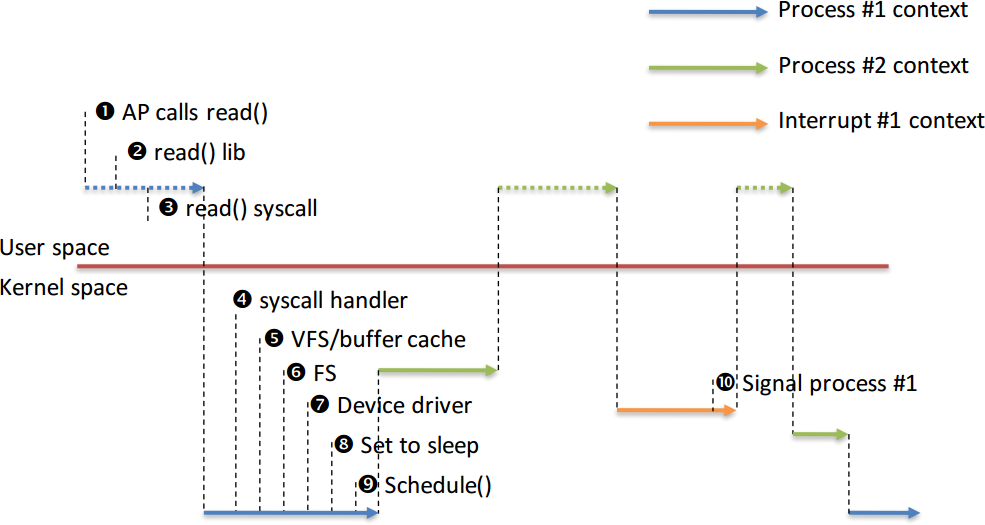
> Microkernel 架構有時會 **利用 Context Switch 的過程來優化 IPC**。例如,如果兩個 Task (任務) 需要交換少量資料,可以透過在 Context Switch 時不保存/恢復某些約定好的暫存器,**讓後一個 Task 直接從這些暫存器讀取前一個 Task 留下的資料**,從而避免了顯式的記憶體複製。
Linux 核心中 (因架構而異的實作),`switch_to()` 負責執行實際的上下文交換操作。 `switch_mm()` 負責執行 virtual memory 的上下文交換操作。
> 延伸閱讀:
> * [第七講:不只挑選任務的排程器 - 上下文交換 (Context Switch)](https://hackmd.io/@Jaychao2099/Linux-kernel-7#%E4%B8%8A%E4%B8%8B%E6%96%87%E4%BA%A4%E6%8F%9B-Context-Switch)
> * [Process Management](https://wiki.csie.ncku.edu.tw/embedded/ProcessManagement.pdf)
---
## Scheduling (排程)
排程器 (Scheduler) 是作業系統核心的一部分,負責決定在 CPU 上執行的下一個 Process 或 Thread。
### Linux Scheduler 的演進
* **O(1) Scheduler**:在 Linux 2.6 早期版本中使用,其目標是在常數時間內選出下一個要執行的任務,不論系統中有多少個任務。它為每個 CPU 維護一個 Run Queue (執行佇列),每個 Run Queue 包含多個優先權佇列。

* **CFS (Completely Fair Scheduler)**:自 Linux 2.6.23 起引入,成為預設排程器。CFS 的目標是為每個任務提供「公平」的 CPU 時間分配。它不再使用固定的時間片 (time slice),而是根據任務的 `nice` 值 (影響其虛擬執行時間 `vruntime`) 來決定哪個任務應該下一個執行。`vruntime` 最低的任務會被選中。CFS 使用 **紅黑樹** 來高效地管理 Run Queue 中的任務。

> 延伸閱讀:
> * [第七講:不只挑選任務的排程器 - CPU 排程器的演化](https://hackmd.io/@Jaychao2099/Linux-kernel-7#CPU-%E6%8E%92%E7%A8%8B%E5%99%A8%E7%9A%84%E6%BC%94%E5%8C%96)
> * [Linux 核心設計: Scheduler(2): 概述 CFS Scheduler](https://hackmd.io/@sysprog/B18MhT00t)
> * [Scheduling (1)](https://www.cs.unc.edu/~porter/courses/cse506/s16/slides/scheduling.pdf)
> * [Scheduling (2)](https://www.cs.unc.edu/~porter/courses/cse506/s16/slides/scheduling2.pdf)
### Run Queue 和 Wait Queue
* **Run Queue**:包含所有處於可執行狀態 (Runnable) 的 Process 或 Thread。每個 CPU 核心通常有其自身的 Run Queue。排程器從 Run Queue 中選擇下一個要執行的任務。
* **Wait Queue**:當一個任務因為等待某個事件 (如 I/O 完成、資源釋放) 而無法繼續執行時,它會被移出 Run Queue 並放入相應的 Wait Queue,進入阻塞 (Blocked) 狀態。一旦等待的事件發生,該任務會被喚醒並移回 Run Queue。
### Process 狀態
一個 Process 或 Thread 在其生命週期中會經歷多種狀態:
* **TASK_RUNNING**:正在執行或在 Run Queue 中等待執行。
* **TASK_INTERRUPTIBLE**:正在睡眠 (sleeping),等待某個條件成立或訊號到來。可以被訊號中斷。
* **TASK_UNINTERRUPTIBLE**:正在睡眠,等待某個條件成立,但不能被訊號中斷。通常用於等待短期且必須完成的 I/O 操作,以避免被中斷導致資料不一致。
* **TASK_STOPPED**:執行已停止,通常是被 SIGSTOP, SIGTSTP 等訊號暫停。
* **TASK_TRACED**:正在被另一個 Process (如除錯器 gdb) 追蹤。
* **EXIT_ZOMBIE**:行程已終止,但其 `task_struct` 仍保留在核心中,等待父行程透過 `wait()` 系統呼叫來獲取其退出狀態。
* **EXIT_DEAD**:行程已終止且父行程已回收其狀態,`task_struct` 即將被釋放。
<!--  -->
```graphviz
digraph ProcessStates {
rankdir=LR; // 從左到右排版
node [fontname="Microsoft JhengHei", fontsize=15, style=filled, fillcolor="lightblue"];
edge [fontname="Microsoft JhengHei", fontsize=15];
// 定義各個節點(狀態)
Ready;
// 隱形的 dummy node,只供排版用
Stop;
dummy1 [shape=point, width=0, height=0, label="", style=invis];
Running;
Interruptible;
Uninterruptible;
Zombie;
Dead;
// 用一個隱藏的起點(point 節點)代表「creation」
start [label="", shape=point];
start -> Ready [label="creation"];
Running -> Stop [label="signal"];
Stop -> Ready [label="signal"];
Ready -> dummy1 [style=invis];
dummy1 -> Running [style=invis];
Running -> Ready [label="scheduling", dir="both"];
Running -> Uninterruptible [label="event"];
Uninterruptible -> Ready [label="event"];
Running -> Interruptible [label="signal or event"];
Interruptible -> Ready [label="signal or event"];
Running -> Zombie [label="termination"];
Zombie -> Dead;
// 排版提示
{ rank = same; Stop; dummy1; Interruptible; Uninterruptible; }
}
```
### 優先權與排程策略
* **`nice` 值**:傳統 UNIX 概念,範圍從 -20 (最高優先權) 到 +19 (最低優先權)。`nice` 值越小 (越 "不友善"),優先權越高。CFS 會 **參考 `nice` 值來調整任務的 `vruntime` 增長速度**。
* **Real-time Priority (即時優先權)**:Linux 支援即時排程策略 (如 `SCHED_FIFO`, `SCHED_RR`),這些策略下的任務擁有比普通任務 (使用 `SCHED_OTHER`,即 CFS) 更高的優先權。即時優先權範圍通常是 0 到 99。
* **Dynamic Priority**:現代排程器通常會動態調整任務的優先權,以平衡系統的響應性 (responsiveness) 和吞吐量 (throughput)。
> 例如,對於 I/O-bound (輸出入密集型) 的任務,可能會暫時提升其優先權,以便在其 I/O 完成後能快速獲得 CPU 執行,從而提高系統整體效率和使用者介面 (UI) 的響應速度。
* **CPU Rebalancing**:在 SMP 系統中,排程器會嘗試將負載均勻分配到各個 CPU 核心上。這可能涉及到將任務從一個繁忙的 CPU 遷移 (migrate) 到一個較空閒的 CPU。任務遷移本身有成本 (如 Cache 失效),排程器需要權衡。
> NUMA (Non-Uniform Memory Access, 非均勻記憶體存取) 架構和 Hyper-threading (超執行緒) 技術會進一步增加排程的複雜性。
有些研究甚至嘗試將機器學習 (Machine Learning) 技術應用於排程決策中,根據歷史執行模式來預測任務行為,以做出更優的排程選擇。
---
## Signal (訊號)
Signal 是一種在 UNIX 和類 UNIX 系統中用於 Process 間 **非同步通訊** 和 **事件通知** 的機制。它類似於硬體中斷,但作用於軟體層面,通常是用來通知 Process 發生了某個特定事件。
### 常見 Signal
* **SIGFPE (Floating-Point Exception)**:發生浮點運算錯誤,如除以零。
* **SIGSEGV (Segmentation Violation)**:Process 嘗試存取其無權存取的記憶體區域 (例如,寫入一個唯讀區域,或讀取/寫入/執行一個未映射的位址)。
* **SIGINT (Interrupt)**:通常由使用者按下 `Ctrl+C` 產生,用於中斷當前執行的 Process。
* **SIGTERM (Terminate)**:請求 Process 正常終止。
* **SIGKILL (Kill)**:強制終止 Process,此訊號不能被捕獲或忽略。
* **SIGSTOP (Stop)**:暫停 Process 執行,不能被捕獲或忽略。
* **SIGTSTP (Terminal Stop)**:通常由使用者按下 `Ctrl+Z` 產生,請求終端前景 Process 暫停。
### Signal 的產生與處理
當核心檢測到一個事件 (如硬體異常、使用者操作、或另一個 Process 呼叫 `kill()` 系統呼叫) 需要通知某個 Process 時,它會向該 Process 發送一個 Signal。
Process 可以為特定的 Signal 註冊 **Signal Handler (訊號處理常式)**。當 Process 接收到一個它已註冊處理常式的 Signal 時,核心會:
1. 暫停該 Process 的當前執行。
2. 將執行流程切換到註冊的 Signal Handler。
3. Signal Handler 執行完畢後,通常會返回到 Process 被中斷的地方繼續執行 (除非 Signal Handler 中執行了 `exit()` 或 `longjmp()`)。

如果 Process 沒有為某個 Signal 註冊處理常式,核心會 **採取預設動作 (default action)**,例如終止 Process、忽略 Signal、或產生 Core Dump。
#### 範例:除零錯誤
當一個程式執行如 `return 0/0;` 這樣的操作時:
1. CPU 檢測到除零異常,觸發一個硬體中斷。
2. 核心的中斷處理常式 (Inturrupt handler)接管,識別出這是一個算術異常。
3. 核心向導致此異常的 Process 發送 `SIGFPE` 訊號。
4. 如果該 Process 沒有捕獲 `SIGFPE`,則執行預設動作,通常是終止 Process 並在控制台 (如 Shell) 打印錯誤訊息 (如 "Floating point exception")。這個訊息是由 Shell (作為父行程) 在收到子行程異常終止的通知後打印的。
Android 系統中的 `debuggerd` 服務就是一個利用 Signal 機制的例子。當應用程式發生 Crash 時,核心會發送 Signal,`debuggerd` (作為一個註冊的處理者或透過 `ptrace` 追蹤) 會介入,在應用程式完全終止前收集其狀態資訊 (如暫存器內容、stack 追蹤),用於後續的除錯分析。
> 延伸閱讀:[Signals and Inter-Process Communication](https://www.cs.unc.edu/~porter/courses/cse506/s16/slides/ipc.pdf)
---
## Thread Synchronization (執行緒同步)
在多執行緒環境中,多個 thread 共享相同的記憶體空間,這雖然方便了資料共享,但也帶來了 **同步問題**。如果多個 thread 同時存取和修改共享資料,而沒有適當的保護機制,就可能 **導致 Race Condition**,使得程式行為不可預測或產生錯誤結果。

### Reentrancy (可重入性)
一個函式被稱為 Reentrant (可重入的),如果它可以被多個執行流程 (如主程式流程和一個中斷服務常式,或者多個 thread) 安全地同時呼叫或交錯執行,而 **不會導致資料損壞或不正確的結果**。
#### 不可重入函式
通常使用了:
* **靜態 (Static) 或全域 (Global) 變數**:如果一個中斷服務常式修改了主程式流程正在使用的全域變數,就可能出錯。
* **返回指向靜態資料的指標**。
#### 範例:`strtok()` vs. `strtok_r()`
* **[strtok()](https://github.com/eblot/newlib/blob/master/newlib/libc/string/strtok.c)**:由 libc 提供,用於 **分割字串**。它在內部維護一個靜態指標來 **記錄下一次開始掃描的位置**,因此它是不可重入的。如果在一個 thread 呼叫 `strtok()` 的過程中,被另一個也呼叫 `strtok()` (處理不同字串) 的 thread 中斷,內部狀態就會混亂。
* **[strtok_r()](https://github.com/eblot/newlib/blob/master/newlib/libc/string/strtok_r.c)**:由 POSIX 標準提供,r 代表 reentrant,它 **額外接受一個由呼叫者提供的指標參數,用於保存上下文狀態**,從而使其可重入且 thread 安全。
> 許多舊的不可重入函式都有其對應的 `_r` 版本。
### Mutex (Mutual Exclusion, 互斥鎖)
Mutex 是最基本的同步原語之一。它用於 **保護 Critical Section** (臨界區段,即一段存取共享資源的程式碼)。一個 thread 在進入臨界區段前必須先獲取 (acquire 或 lock) Mutex,如果 Mutex 已被其他 thread 緒持有,則該 thread 會阻塞等待。離開臨界區段時,thread 必須釋放 (release 或 unlock) Mutex。
#### 基礎 mutex 函式
```c
int pthread_mutex_init(pthread_mutex_t *mutex, const pthread_mutexattr_t *mutexattr);
int pthread_mutex_lock(pthread_mutex_t *mutex);
int pthread_mutex_trylock(pthread_mutex_t *mutex);
int pthread_mutex_unlock(pthread_mutex_t *mutex);
int pthread_mutex_destroy(pthread_mutex_t *mutex);
```
* **使用範例**:
```c=
#include <pthread.h>
...
pthread_mutex_t my_mutex; // 須為全域變數
...
int main() {
int tmp = pthread_mutex_init(&my_mutex, NULL); // 初始化 mutex
...
// create threads
...
pthread_mutex_lock(&my_mutex); // 取得鎖
do_something_private(); // critical section
pthread_mutex_unlock(&my_mutex); // 釋放鎖
...
return 0;
}
```
#### Linux 提供了多種 Mutex 實作,以平衡效能和功能:
* 考慮死鎖檢測 (Deadlock detection) 的速度與正確性。
* 是否允許同一個 thread 多次鎖定同一個 Mutex (Recursive Mutex)。
* 處理 [優先權反轉 (Priority Inversion)](http://www.slideshare.net/jserv/priority-inversion-30367388) 問題。
* 處理持有鎖的 thread 意外終止的情況。
### Futex (Fast Userspace Mutex)
Futex (Fast Userspace Mutex) 是 Linux 提供的一種高效同步機制。其「快」(Fast) 的核心設計在於 **只在必要時才進入核心**,最大程度地減少了因 System Call 產生的昂貴開銷。
#### 運作原理:區分競爭與否
樂觀地 **假設鎖在大多數情況下是無競爭的**,並為此「快速路徑」提供極致的效能。
1. **無競爭情況 (Uncontended Case - The "Fast Path")**
* 當一個 thread 嘗試鎖定一個未被持有的 Mutex 時,它可以在 **user space** 內透過 **原子操作 (atomic operations)** 直接完成鎖定。
* 同樣地,解鎖一個後面沒有其他 thread 在等待的 Mutex,也僅需在 user space 完成。
* 在此情況下,**完全無需系統呼叫**,因此沒有進入核心模式的效能損耗。
2. **競爭情況 (Contended Case - Kernel Intervention)**
只有當 user space 的原子操作無法解決競爭時,才會請求核心協助。
* **等待 (Wait):** 當 thread A 嘗試鎖定一個已被 thread B 持有的 Mutex,thread A 會發出 `sys_futex` 系統呼叫,請求核心將其 **放入等待佇列 (wait queue) 並使其睡眠**。
* **喚醒 (Wake):** 當 thread B 釋放 Mutex 時,它會再次發出 `sys_futex` 系統呼叫,通知核心去 **喚醒** 正在等待佇列中的一個或多個 thread (如 thread A)。
#### Futex 與核心排程器 (Scheduler) 的互動
Futex 的 wait/wake 操作與 Linux 核心的 CPU 排程器緊密相關,這也是其高效的關鍵:
* **進入睡眠 (`futex_wait`)**: 當一個 thread 因等待鎖而進入睡眠時,核心不僅是將它放入 waiting queue,**排程器還會收回其 CPU 時間配額**,並將 CPU 資源分配給其他處於 ready queue 的 thread。
* **被喚醒 (`futex_wake`)**: 當鎖被釋放,被喚醒的 thread 會被核心從 waiting queue 移至 **ready queue**,排程器便會重新將它納入 CPU 的排程考量中。
<center>
<img src="https://hackpad-attachments.s3.amazonaws.com/embedded2016.hackpad.com_K6DJ0ZtiecH_p.537916_1461038745673_thr.png" alt="futex" width="50%" />
</center>
#### 進階議題:避免優先權反轉 (Priority Inversion)
Futex 的核心層實作也考慮到了複雜的同步問題。例如,為了避免高優先權的 thread 被一個持有鎖的低優先權 thread 無限期阻塞 (Priority Inversion),核心的 Futex 機制支援 **優先權繼承 (Priority Inheritance)** 等策略,確保系統的即時性和回應性。
> 延伸閱讀:[並行程式設計: 實作輕量級的 Mutex Lock](https://hackmd.io/@sysprog/concurrency-mutex)
### Kernel Preemption (核心搶佔)
**早期 Linux 核心是不可搶佔的**,即一個任務一旦進入核心模式執行 (例如,透過系統呼叫),它會一直執行直到它自願放棄 CPU (例如,等待 I/O) 或從核心模式返回。這可能導致高優先權任務長時間得不到執行,造成較大的排程延遲 (dispatch latency)。
**現代 Linux 核心支援核心搶佔**,意味著:
* 即使一個任務正在核心模式下執行,它也可能被一個更高優先權的任務搶佔 (除非它持有了禁止搶佔的鎖,如 Spinlock,或者處於不可搶佔的特定區域)。
* 核心搶佔有助於降低系統延遲,提高即時任務的響應性。
:::info
**「核心可被中斷 (interruptible)」$\neq$「核心可被搶佔 (preemptive)」**:
* **不可搶佔核心**:中斷發生後,Interrupt handler 執行完畢,控制權總是返回給 **被中斷的任務**。
* **可搶佔核心**:中斷發生後,Interrupt handler 執行完畢,如果此時有一個 **更高優先權的可執行任務**,排程器可能會選擇執行它,而不是返回給原先被中斷的任務。
:::
<center>
<img src="https://hackpad-attachments.s3.amazonaws.com/embedded2016.hackpad.com_K6DJ0ZtiecH_p.537916_1461039425394_preempt.png" alt="image" width="70%" />
</center>
> 延伸閱讀:[Linux 核心搶佔](https://hackmd.io/@sysprog/linux-preempt) - jserv
#### Background tasks 實作範例 (kernel thread):
```c=
static struct task_struct *tsk;
static int thread_function(void *data) {
int time_count = 0; // 初始化計數器
do {
// 使用 printk 函數向 kernel 日誌打印信息
printk(KERN_INFO "thread_function: %d times\n", ++time_count);
msleep(1000);
} while(!kthread_should_stop() && time_count <= 30);
// 當其他地方調用 kthread_stop(tsk) 時,停止 loop
return time_count;
}
// 初始化函式,當 kernel module 被 insmod 時會被調用
static int hello_init() {
/*
* 創建並啟動一個新的 kernel thread
* 返回新創建 thread 的 task_struct 指標,如果失敗則返回一個錯誤指針。
* (指向函數的指針, 函數的參數, thread 的名稱)
*/
tsk = kthread_run(thread_function, NULL, "mythread%d", 1);
if (IS_ERR(tsk)) {
return PTR_ERR(tsk); // 出錯時返回 錯誤碼
}
return 0; // 創建成功,返回 0
}
// 卸載函式 (exit function)
static void hello_exit(void) {
if (tsk) {
kthread_stop(tsk);
printk(KERN_INFO "Kernel thread stopped.\n");
}
}
```
### Work Queue (工作佇列)
Work Queue 是 Linux 核心中用於 **延遲執行某些工作的一種機制**,特別是那些 **不適合在中斷上下文中執行的**、**可能睡眠的或耗時較長的** 工作。
* 當 Interrupt handler 或其他核心程式碼需要執行一個這樣的任務時,它可以將該任務 (封裝為一個 `work_struct`) 提交到一個 Work Queue。
* 每個 Work Queue 都關聯一個或多個專用的 Kernel Thread (稱為 Worker Thread)。
<center>
<img src="https://hackpad-attachments.s3.amazonaws.com/embedded2016.hackpad.com_K6DJ0ZtiecH_p.537916_1461040784455_f3.png" alt="image" />
</center>
* Worker Thread 會從 Work Queue 中取出任務並在 Process Context (行程上下文,允許睡眠) 中執行它們。
<center>
<img src="https://hackpad-attachments.s3.amazonaws.com/embedded2016.hackpad.com_K6DJ0ZtiecH_p.537916_1461039802354_wq.png" alt="image" />
</center>
> 類似於 Tasklet 或 Softirq 的延遲處理機制,但 Work Queue 提供的彈性更大,因為其處理函式可以睡眠。
#### Work Structure 和 Handler 範例:
```c=
#include <linux/kernel.h>
#include <linux/module.h>
#include <linux/workqueue.h>
MODULE_LICENSE("GPL");
static struct workqueue_struct *my_wq; // work queue
typedef struct { // work
struct work_struct my_work;
int x;
} my_work_t;
my_work_t *work1, *work2;
// work queue 會執行的函式 (工作處理函式)
static void my_wq_function(struct work_struct *work) {
// 轉換回自訂的 `my_work_t` 指標,才能存取到自訂的資料成員 x
my_work_t *my_work = (my_work_t *)work;
printk(KERN_INFO "my_work.x %d\n", my_work->x);
kfree((void *)work);
}
```
#### 建立 work queue 範例:
```c=21
// 模組初始化函式,在模組載入時執行
int init_module() {
int ret; // queue_work() 回傳值,檢查工作是否成功排入 work queue
my_wq = create_workqueue("my_queue"); // 建立 work queue
if (my_wq) { // 成功建立 work queue
// --- 處理第一個工作項目 work1 ---
work1 = (my_work_t *)kmalloc(sizeof(my_work_t), GFP_KERNEL);
if (work1) {
// 初始化 work1,設定處理函式
INIT_WORK((struct work_struct *)work1, my_wq_function);
work1->x = 1; // 設定自訂資料成員 x 的值
// 將 work1 加入 `my_wq`,等待執行
ret = queue_work(my_wq, (struct work_struct *)work1);
}
// --- 處理第二個工作項目 work2 ---
// work2 同理
// ... (省略)
} else {
printk(KERN_ERR "Failed to create workqueue\n"); // work queue建立失敗
return -ENOMEM; // 回傳錯誤碼
}
return 0; // 初始化成功
}
```
#### 銷毀 work queue 範例
```c=46
int exit_module() {
if (my_wq) {
destroy_workqueue(my_wq); // 銷毀 work queue
printk(KERN_INFO "Workqueue destroyed.\n");
}
return 0; // 卸載成功
}
```
> 參照:[第十講:中斷處理和現代架構考量 - Workqueue](https://hackmd.io/fm7sqgSbTPCazZRXPLrNEw?view#Workqueue)
> 延伸閱讀:[Thread & Synchronization](https://wiki.csie.ncku.edu.tw/embedded/2015q1w9/thread-sync.pdf)
---
## Process 的生命週期與管理
### `fork()` 系統呼叫
`fork()` 是 UNIX 系統中建立新 Process 的主要方式。
* 呼叫 `fork()` 後,會建立一個幾乎與父行程 (Parent Process) 完全相同的子行程 (Child Process)。
* 子行程擁有父行程記憶體空間的副本 (邏輯上的,物理複製通常延遲到 Copy-On-Write 時)、相同的檔案描述符 (共享檔案 offset)、相同的訊號處理常式等。
* **主要區別**:
* 子行程有自己唯一的 Process ID (PID)。
* 子行程的 Parent Process ID (PPID) 是父行程的 PID。
* `fork()` 對父行程返回子行程的 PID,對子行程返回 0。如果失敗,則返回 -1。
* `fork()` 的返回值是區分父子行程執行路徑的關鍵。
```c=
int pid = fork();
if (pid == 0) {
// child code
} else if (pid > 0) {
// parent code
} else // error
```
### `exec()` 系列系統呼叫
`exec()` 系列函式 (如 `execl`, `execv`, `execve` 等) 用於 **執行一個新的程式**。
* 當一個 Process 呼叫 `exec()` 時,其當前的 Process Image (包括程式碼、資料、stack 等) 會被 **替換** 為新程式的 Process Image。
* 如果 `exec()` 成功,它 **永遠不會返回** 到呼叫它的程式中,因為原來的程式已被新程式取代。只有當 `exec()` 失敗時,它才會返回 -1。
* PID 不會改變,但 Process 的內容完全變成了新程式的內容。
* 通常,`fork()` 之後會緊跟著在子行程中呼叫 `exec()` 來執行一個不同的程式。
### Copy-On-Write (COW)
為了提高 `fork()` 的效率,特別是當子行程馬上就要呼叫 `exec()` 的情況下,Linux 採用了 Copy-On-Write 技術。
* 當 `fork()` 發生時,核心並不立即複製父行程的整個位址空間給子行程。
* 相反,父子行程暫時共享相同的實體記憶體頁面,但這些頁面會被標記為唯讀 (Read-Only)。
* 只有當父行程或子行程嘗試**寫入**這些共享頁面時,核心才會真正複製該頁面,為寫入方分配一個新的實體頁面副本,並更新其分頁表條目。
因此,只有那些實際被修改的頁面才會被複製,大大減少了 `fork()` 的開銷。
```graphviz
digraph COW {
rankdir=LR;
fontsize=12;
// -------------------
// 寫入前 (Before Write)
// -------------------
subgraph cluster_before {
label="寫入前 (Before Write)";
labelloc=t;
style=rounded;
color=gray70;
fontcolor=black;
node [shape=box, style=filled, fillcolor=lightgrey, fontname="Helvetica"];
P1_before [label="Process P1"];
P2_before [label="Process P2"];
node [shape=cylinder, style=filled, fillcolor=lightblue, fontname="Helvetica"];
Page_shared [label="頁面 A\n(refcount = 2)"];
}
// -------------------
// 寫入後 (After Write)
// -------------------
subgraph cluster_after {
label="寫入後 (After Write)";
labelloc=t;
style=rounded;
color=gray70;
fontcolor=black;
node [shape=box, style=filled, fillcolor=lightgrey, fontname="Helvetica"];
P1_after [label="Process P1"];
P2_after [label="Process P2 (欲寫入)"];
node [shape=cylinder, style=filled, fillcolor=lightblue, fontname="Helvetica"];
Page_orig [label="頁面 A\n(refcount = 1)"];
Page_copy [label="頁面 A' (copy)\n(refcount = 1)"];
}
// 連線:寫入前的狀態
P1_before -> Page_shared [arrowhead=normal];
P2_before -> Page_shared [arrowhead=normal];
// 連線:寫入後的狀態
P1_after -> Page_orig [arrowhead=normal];
P2_after -> Page_copy [arrowhead=normal];
// 標示從寫入前到寫入後的動作
P2_before -> P2_after [style=dashed, arrowhead=none, label=" fork / write ", fontsize=10, fontcolor=gray40];
}
```
### `exit()` 系統呼叫與行程終止
當一個 Process 完成其工作或遇到無法恢復的錯誤時,它會呼叫 `exit()` (或從 `main` 函式返回,[C Runtime Library](https://hackmd.io/@Jaychao2099/crt) 會間接呼叫 `exit()`) 來終止自己。
核心在處理 `exit()` 時會執行以下步驟:
1. 釋放 Process 所佔用的大部分資源,如記憶體、開啟的檔案等。
2. 將 Process 的狀態設置為 `EXIT_ZOMBIE`。此時,Process 已停止執行,但其 `task_struct` (包含退出狀態碼、PID 等資訊) 仍保留在核心中。
3. 向父行程發送 `SIGCHLD` 訊號,通知它子行程已終止。
### `wait()` 系列系統呼叫
父行程通常會呼叫 `wait()` 或 `waitpid()` 來等待其子行程終止,並獲取子行程的退出狀態。
* 如果父行程在子行程終止前呼叫 `wait()`,則父行程會阻塞,直到某個子行程終止。
* 如果子行程已經是 Zombie 狀態,`wait()` 會立即返回子行程的 PID 和退出狀態,並徹底清理該 Zombie Process (釋放其 `task_struct`)。
<center>
<img src="https://hackmd.io/_uploads/r1kSCbcGlx.png" alt="image" width="30%" />
</center>
> 延伸閱讀:
> * [UNIX 作業系統 fork/exec 系統呼叫的前世今生](https://hackmd.io/@sysprog/unix-fork-exec)
> * [Process Management: Abstracting Computing Resources](https://web.archive.org/web/20221028025241/https://www.pf.is.s.u-tokyo.ac.jp/wp-content/uploads/2018/10/AdvancedOperatingSystems4.pdf)
### Orphan Process 與 Zombie Process
* **Zombie Process**:已終止但其父行程尚未透過 `wait()` 回收其狀態的 Process。Zombie Process 不消耗 CPU 資源,但會佔用核心中的一個 `task_struct` 表項。如果大量 Zombie Process 積累,可能耗盡 PID 資源。
* **Orphan Process (孤兒行程)**:如果一個父行程在子行程之前終止,則該子行程會成為孤兒行程。在 UNIX 系統中,孤兒行程會 **被 `init` Process (PID 為 1 的行程,現在通常是 `systemd`)「收養」**,即 `init` Process 成為其新的父行程。`init` Process 會定期呼叫 `wait()` 來清理它收養的所有已終止的子行程。
### Kernel Thread
除了 user space 的 Process 和 Thread,Linux 核心本身也會建立一些在核心空間執行的 Kernel Thread。
* Kernel Thread 擁有自己的 `task_struct` 和 kernel stack,但它們不擁有使用者位址空間 (其 `task_struct` 中的 `mm` 指標通常為 NULL)。
* 它們可以直接呼叫核心函式,並在核心模式下執行。
* 用於執行各種背景任務,如 I/O 處理 (如 `kworker` 執行 Work Queue 中的任務)、排程輔助 (如負載平衡、任務遷移)、記憶體回收等。
* 在 `ps` 命令輸出中,Kernel Thread 的名稱通常被方括號 `[]` 包圍,例如 `[kthreadd]`, `[kswapd0]`。
* `kthreadd` (PID 通常為 2) 是所有其他 Kernel Thread 的祖先,新的 Kernel Thread 通常是從 `kthreadd` fork 出來的。
```shell
$ ps aux
USER PID %CPU %MEM VSZ RSS TTY STAT START TIME COMMAND
root 1 0.0 0.1 21504 12864 ? Ss 00:03 0:00 [systemd]
root 2 0.0 0.0 0 0 ? S 00:03 0:00 [kthreadd]
root 4 0.0 0.0 0 0 ? S< 00:03 0:00 [ktworker/0:0H]
...
```
---
## 記憶體管理相關機制
### `mmap()` 系統呼叫
`mmap()` (memory map) 是一個強大的系統呼叫,用於在呼叫 Process 的虛擬位址空間中建立一個新的記憶體映射區域 (VMA)。
```c
mmap(void *addr, size_t length, int prot, int flags, int fd, off_t offset);
```
* **參數**:
* 映射的起始位址建議
* 長度
* 保護權限 (PROT_READ, PROT_WRITE, PROT_EXEC)
* 映射類型 (MAP_SHARED, MAP_PRIVATE, MAP_ANONYMOUS ...)
* **一個檔案的某個部分** 映射到記憶體中。之後,對這段記憶體的讀寫操作就相當於對檔案對應部分的讀寫。這是實現記憶體映射檔案 (Memory-Mapped Files) 和共享記憶體的常用方法。
* **一個匿名區域** 映射到記憶體中,不與任何特定檔案關聯。常用於分配大塊記憶體 (例如,供 `malloc` 的底層實作使用)。
* **一個裝置** 映射到記憶體中 (Memory-Mapped I/O)。
* 檔案描述符
* 檔案內偏移量
#### 效能優勢 (特別是大型檔案):
* 避免了傳統 `read()`/`write()` 系統呼叫中資料在 kernel buffer 和 user space buffer 之間的多次複製。
* 可以利用作業系統的 Demand Paging 機制,只有在實際存取某個頁面時,該頁面才會從磁碟載入到實體記憶體。
* 多個 Process 可以將同一個檔案映射到各自的位址空間 (使用 `MAP_SHARED`),從而實現高效的共享記憶體。
> `munmap()` 系統呼叫用於解除先前由 `mmap()` 建立的記憶體映射。
### Demand Paging (請求分頁)
Demand Paging 是一種虛擬記憶體管理技術,其中頁面 **只在實際需要時才從輔助儲存 (如硬碟) 載入到實體記憶體中**。
1. 當 Process 首次建立或透過 `mmap()` 建立新的映射時,核心通常只會更新 VMA 結構和建立分頁表條目 (Page Table Entry, PTE),但不會立即分配實體記憶體頁面或從磁碟讀取資料。這些 PTE 可能會被標記為「不存在 (not present)」。
2. 當 Process 嘗試存取一個標記為「不存在」的虛擬頁面時,會 **觸發一個 Page Fault 異常**。
3. 核心的 Page Fault Handler 會介入,檢查該存取是否合法:
* 如果 **存取非法**,則向 Process 發送 `SIGSEGV`。
* 如果 **存取合法**,核心會分配一個實體記憶體頁面,如果該虛擬頁面對應檔案,則從磁碟讀取相應內容到該實體頁面,然後更新 PTE 使其指向該實體頁面並標記為「存在」。
4. Page Fault 處理完成後,導致異常的指令會被重新執行,此時存取就能成功。
Demand Paging 的好處是減少了程式啟動時間和記憶體使用量,因為只有實際用到的頁面才會被載入。
### `sbrk()` 系統呼叫
`sbrk()` 是早期 UNIX 系統中用於 **調整 Process 的 Data Segment 大小的系統呼叫**。Data Segment 通常用於存放全域變數和靜態變數,以及動態分配的記憶體。`sbrk()` 透過移動 Data Segment 的末端指標 (稱為 "program break") 來擴展或收縮 Heap 的大小。
雖然現代 Linux 系統更傾向於使用 `mmap()` 來進行記憶體分配,但 `sbrk()` 仍然被一些 C 函式庫的 `malloc` 實作所使用,以保持相容性。
> **延伸閱讀**:[第八講:記憶體管理 - 使用者空間與核心空間的互動](https://hackmd.io/@Jaychao2099/Linux-kernel-8#5-%E4%BD%BF%E7%94%A8%E8%80%85%E7%A9%BA%E9%96%93%E8%88%87%E6%A0%B8%E5%BF%83%E7%A9%BA%E9%96%93%E7%9A%84%E4%BA%92%E5%8B%95)
---
## 實驗與觀察工具
理解 Process 的行為和效能,除了理論知識,實驗觀察也非常重要。
### `ps` 和 `htop`:
常用的命令列工具,用於查看系統中正在執行的 Process 列表及其狀態 (PID, PPID, CPU 使用率, 記憶體使用量, 狀態等)。`htop` 提供了更友好的互動式介面。

### `/proc` 檔案系統:
Linux 提供的一個虛擬檔案系統,掛載在 `/proc` 目錄下。它將核心內部的許多資料結構和統計資訊以檔案的形式暴露給 user space。
* `/proc/[pid]/`:每個執行中 Process 對應一個以其 PID 命名的目錄,其中包含該 Process 的詳細資訊。
* `/proc/[pid]/maps`:顯示該 Process 的記憶體映射區域 (VMA)。
* `/proc/[pid]/status`:包含該 Process 的狀態、記憶體使用、訊號等詳細資訊。
* `/proc/[pid]/sched`:包含排程相關資訊。
* `/proc/interrupts`:顯示中斷統計。
* `/proc/meminfo`:顯示系統記憶體使用情況。
> [!Tip] 可用 `sudo cat ...` 直接在終端顯示。
### `pstree`:
以樹狀結構顯示 Process 及其父子關係。
```shell
$ pstree 1
systemd─┬─2*[agetty]
├─cron
├─dbus-daemon
├─init-systemd(Ub─┬─SessionLeader───Relay(271)───bash───pstree
│ ├─SessionLeader───Relay(407)───bash───htop
│ ├─init───{init}
│ ├─login───bash
│ └─{init-systemd(Ub}
├─rsyslogd───3*[{rsyslogd}]
├─systemd───(sd-pam)
├─systemd-journal
├─systemd-logind
├─systemd-resolve
├─systemd-timesyn───{systemd-timesyn}
├─systemd-udevd
├─unattended-upgr───{unattended-upgr}
└─wsl-pro-service───7*[{wsl-pro-service}]
```
### [LMBench](https://lmbench.sourceforge.net/):
一個廣泛使用的效能評測工具套件,包含一系列微基準測試 (micro-benchmarks),用於測量作業系統各方面的效能,如 Context Switch 延遲、記憶體頻寬、系統呼叫開銷、網路延遲等。LMBench 通常透過大量重複執行特定操作並統計時間來推斷效能指標,其設計思想是透過實驗「觀察」系統行為。

### [Cheddar](http://beru.univ-brest.fr/cheddar/):
一個針對即時系統的排程分析和模擬工具,可以幫助分析和驗證排程策略。
<center>
<img src="https://hackpad-attachments.s3.amazonaws.com/embedded2016.hackpad.com_K6DJ0ZtiecH_p.537916_1461046113504_undefined" alt="image" width="80%" />
</center>
### Ftrace, `trace-cmd`, KernelShark:
* **Ftrace**:Linux 核心內建的追蹤框架,可以用於追蹤核心函式呼叫、事件、延遲等。
* **`trace-cmd`**:Ftrace 的 user space 控制工具,用於啟動/停止追蹤、設定過濾器、記錄追蹤資料到檔案 (`trace.dat`)。
* **KernelShark**:`trace.dat` 檔案的圖形化分析工具,可以幫助視覺化核心執行流程和事件。
這些工具對於深入理解核心內部運作、除錯效能問題、分析排程行為等非常有價值。例如,可以透過追蹤 `sched_switch` 事件來觀察 Context Switch 的發生和排程決策。
> 延伸閱讀:[ARM-Linux 技術報告](http://wiki.csie.ncku.edu.tw/embedded/arm-linux)
---
## 總結
學習 Linux 核心的 Process 管理是一個複雜但回報豐厚的過程,它不僅涉及到作業系統的理論,還緊密關聯著硬體架構、編譯器、函式庫以及系統的整體設計哲學。透過結合理論學習、程式碼閱讀 (尤其是如 `task_struct` 這樣的核心資料結構和相關的標頭檔)、以及動手實驗和使用追蹤/分析工具,才能更全面地掌握這一核心議題。
---
回[主目錄](https://hackmd.io/@Jaychao2099/Linux-kernel)
 Google Drive
Gist
Clipboard
Google Drive
Gist
Clipboard
 Sign in via Google
 Sign in via Facebook
 Sign in via X(Twitter)
 Sign in via GitHub
 Sign in via Dropbox
 Sign in with Wallet






