---
# System prepended metadata
title: '"Event Thinking" -- The Hollywood Principle'
tags: [EDA, actor, OpenEMIT, streaming]
---
# "Event Thinking" -- The Hollywood Principle
| |
Wolfman Jack says:
"Don't call us. We'll call you." |
| -- | -- |
>###### tags: `streaming` `actor` `EDA` `OpenEMIT`
>
>[name=Author: George Willis] [time=Thu, Apr 19, 2018]
---
### What is the Hollywood Principle?
An **"Inversion of Invocation" design pattern** (for those familiar with the IoC design pattern.)
::: info
:trophy: Transform "**Explicit Invocations**" into "**Implicit Invocations**"
:::
### Explicit Invocation
"The way you do it now."
**Tightly coupled: The caller specifies the target**
* coupling to `add()` is hardcoded in all cases below
```
result = add(1,2) // Procedural style
result = (int 1).add(2) // OOP style
add(resultCallback(),1,2) // Async style
```
### Explicit Invocation -- Deep Call Stacks

### Explicit Invocation -- "Pass Back"
* Results must be routed back, not forward
* Inherent in recursive **orchestration** models
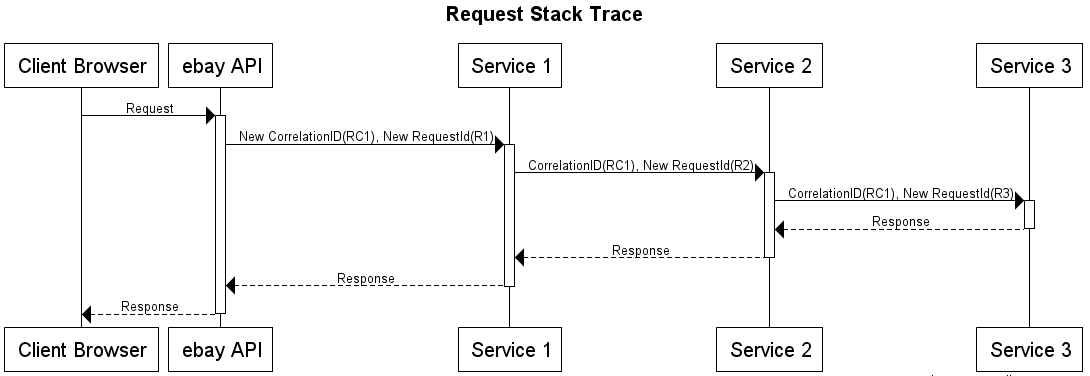
* Context held "open"
* deep stacks => large context
* RMI => contextual locks by other hosts
* **But those hosts could fail? What about hung context? How is that handled?**
* Timeout Exceptions (Identify)
* Recover to previous workflow "state" and restart from waypoint (Remediate)
:::danger
### :rotating_light: "Wait -- we don't program around state transitions any more than we invoke asynchronously!
#### We need to rethink distributed state from the ground up!
:::
### Software Evolution
* **Embarrasing industry trends**
* Majority of POs state:
* (temporal) quality goes down with each release
* (capacity) quality goes down as system grows (scaling)
* Many IT shops adopt a "fair of failure" mentality and "sunset" systems based on refactoring not requirements
:::info
:key:Technical debt of refactoring and extending is too high
:::
### Implicit Invocation ("We'll call you")
::: info
**A foundational shift -- what Gartner calls "*Event Thinking***".
**Publish/Listen** -- a cousin to **Pub/Sub**
Think "Hooks" for loose coupling :fishing_pole_and_fish:
:::
* #### Hook : I'll use {--- in homage to markdown :smile:
```
myEvent.publish(aTopic):
{--- aTopic.aListener1 // Listeners can filter (optional)
{--- aTopic.anActor2 // Ingest/Emit Contract Queue Workers
{--- aTopic.aListener3.anActor3 // Filtered Actor
=========================================================================================
dataCollectedEvent = [...]
dataCollectedEvent.publish(Users.Create) // Emit trigger event
// Users.Create:dataCollectedEvent Listeners
{--- addCredentialsToLDAP // Ingest into Active Directory
// Emit Users.Create.Credentials:savedEvent
{--- addEmailToMailgun // Ingest into User Notification domain
{--- addToDiscus // Ingest into Social Engagement domain
// Users.Create.Credentials:savedEvent Listeners
{--- sendConfirmationEmailToUser
// Users.Create Multi-Event "Merge" Listeners
{--- EndProcess(span=2s) // Upon completion of several parallel Actors/subflows, Emit User.Create:endFlowEvent
```
### Value Proposition
:::info
**Evolutionary Architectural Style -- Achieves loose-coupling of autonomous execution bundles** (container runtimes) by moving coupling from "callers" (a.k.a. Commanders, Orchestrators) to autonomous listeners known as Actors (Choreography, flocks of birds). Each Actor hooks into an event stream. :fishing_pole_and_fish:
* Extend via new hooks to existing events without impacting existing workflows -- just like in ETL
* Solves coupling isues where other approaches like Service Registry (ESBs) and Service Discovery solutions:
* move the issue to a mediation layer (reduces impact of change, but does not remove the need to reconfigure)
* add additional machinery, complexity, latency and resource utilization to an otherwise lean microprocess
* #### Solves coupling issues at the fundamental and foundational level -- invocation.
:::
* **Naturally Async()** -- no "blocking"
* Foundationally faster and more efficient
* Results move forward -- not back
* Think "incredibly fast bucket brigades"
* **Naturally Efficient** -- deep, resursive call stacks of locked, distributed context (resources) replaced with atomic, ephemeral Actor Lifecycle context
* **Naturally Resilient** -- in contrast, **Orchestration is a Resilience Antipattern**, due to:
* critical dependency of all services/steps/transformations on one component
* locked context on multiple machine of the distributed call stack when a call fails to return (syncronous)
* incremental state backups not available for instant recovery (remediation) -- not part of the "style"
* incremental monitoring not a fundamental capability, and parked on most DevOps Roadmaps (alarming)
* **Naturally Visible** -- Day 1 Monitoring of each state change, filtered by topic(s), subtopic, Domain Entities. They are called "listeners", and they are built into the runtime as a foundational component.
* **Naturally Scalable** -- "'cause concurrency ain't easy, so stop sharing forks" -- employ **Parallel Processing** instead.
* Scaling workload is all about distributing workload, and if workers keep sharing workspace resources, the result is predictively **Contention@Scale**.
* An autonomous (atomically isolation) multi-tasking environment is required. This is why **Container Multitenancy** is another **"Pillar of Digital Transformation"**
:::info
* **Naturally BPM Aligned:** Naturally Decomposes Business Processes/Steps into Topics/Events
:::
# Event-Driven Architecture
:::success
:dart: **"Event-Driven Architecture is the optimal and natural solution to Recovery, Scaling and Velocity -- Event Thinking, the foundation of true Digital Transformation." ~-George~ ~Willis~**
*[Event-Driven Architecture]: An Evolutionary Architectural Style based on Event Sourcing and CQRS design patterns. More to come...
*[Event Thinking]: Gartner's term for the foundational concepts around Event-Driven Architectures
:::
:::info
**Recovery Axiom:**
## Tracking **"state transition of processing" is required** to enable recovery from prior recorded state -- like nautical waypoints.
* ### Recovery is a key Resiliency/Availability concept.
* ### Failures on commodity devices are a statistical certainty.
* ### Must achieve HADR-as-a-Service.
### :key: "Embrace Failure" by deploying innate recovery of prior state.
:::
:rotating_light: If the last state saved is hours old, you lose hours of processing.
#### :rocket: If saved state is millaseconds old, you recover instantly!
:::info
**Events are** fine-grained, immutable **state transition ledger entries** recorded in a **Distributed Log**.
:::
*[Distributed Log]: Distributed logs like Kafka "linearly scale" on commodity hardware and in cloud VMs (Open IaaS). Blockchain (think BitCoin) adds immutability support to the ledger through encryption, opening up B2B EDA.
### Deep Dive into Event-Driven Microservices
### Summary Comparison of Invocational Styles
| Properties | Explicit Invocation| Implicit Invocation| Notes |
| ---------- | -------- | -------- | ----- |
| Complexity | High | Low | Events are simple
| Evolution | Low | High | POs currently report quality issues over releases.
| ScalingMulti-tasking | Concurrency | Parallelism | The key to Scalabinf workload.
| Microservices Execution Coupling (Flow) | Centralized Orchestration[^Choreo] | Independent Choreography with Oversight | Flocks are choreographed, independent actors.
What if orchestrator goes down? More dependency.
|BPM Alignment | Low No clear model | High |
|Resilience@Scale | Low | High | Today's systems do not solve "First things First" -- **Resilience@Scale**.
Foundational problems of lean scaling, host isolation, host failure, network partitioning, snd others are not solved by the platform -- "out-of-the-box".
| VisibilityMonitoring | Extra. Add Monitoring Traffic, Infrastructure, and Integration Code | FoundationalListeners |
| Process Efficiency | Distributed Call Stacks[^stack], Synchronous "blocking" by default, Return to Caller ("Pass Back") | Actor Context, Async by design, notify/emit ("Pass Forward") |
| Process Integrity | Currently, Ingestion throttling involves discarding invocations to maintain Transactional rates | Ingestion throttling involves backpressure on upstream event publishers to preserve all invocations |
| Network Efficiency | WET[^DRY]. Requires client caching to be DRY, and that's extra | DRY[^DRY] "Don't Repeat Yourself", Content-Centric Networking (CCN) | Events are communicated "once", while in CPU cache!
| Theorhetical Background | REST Dissertation[^REST] | Promise Theory[^PT1], Configuration Management (CM)[^PT2], Smalltalk MVC | "Events" have been around as long as Ethernet! (Xerox PARC)
[^DRY]: [Wikipedia: Don't Repeat Yourself (DRY Principle)](https://en.wikipedia.org/wiki/Don%27t_repeat_yourself#DRY_vs_WET_solutions)
[^Choreo]: [Youtube: "Who Needs Orchestration? What You Want is Choreography."](https://www.youtube.com/watch?v=kfF9IATUask)
[^REST]: [2000 Roy Fielding: "Architectural Styles and
the Design of Network-based Software Architectures"](https://www.ics.uci.edu/~fielding/pubs/dissertation/top.htm)
[^PT1]: [Wikipedia: Promise Theory](https://en.wikipedia.org/wiki/Promise_theory)
[^PT2]: [Mark Burgess: Promise Theory -- What is it?](https://www.linuxjournal.com/content/promise-theory%E2%80%94what-it)
[^stack]: [Lightbend/Akka: "How the Actor Model Meets the Needs of Modern, Distributed Systems"](https://doc.akka.io/docs/akka/current/guide/actors-motivation.html#the-illusion-of-a-call-stack)