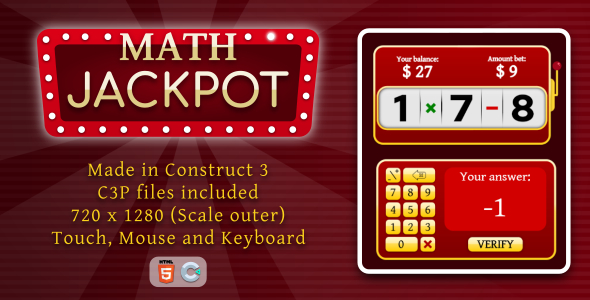
In the realm of web-based educational tools, the pursuit of engaging content that genuinely aids learning is a continuous challenge. Our focus today lands on an intriguing contender: Math Jackpot - HTML5 Educational game. This review dissects its technical foundation, evaluates its practical utility for educators and developers, and provides a clear path for its deployment. As a senior web developer and technical journalist, I approach this not merely as a user, but as someone scrutinizing its architecture and anticipating real-world operational challenges.
At its core, Math Jackpot positions itself as a straightforward HTML5 game designed to enhance basic arithmetic skills. The premise is simple: present math problems, allow the user to select an answer from multiple choices, and track their performance. This classic game loop has proven effective for quick knowledge reinforcement, particularly for younger learners or those seeking to refresh foundational skills.
The "HTML5" designation is critical here. It implies a promise of broad browser compatibility and platform independence, a significant advantage over legacy Flash-based solutions. A quick initial glance suggests a reliance on standard web technologies – HTML for structure, CSS for presentation, and JavaScript for game logic. This is generally a positive sign, indicating ease of modification and robust support across modern web environments.
From a user experience standpoint, the initial impression leans towards functional rather than flashy. The aesthetic is clean, but lacks the polished sheen of high-budget commercial games. For an educational tool, however, functionality often trumps elaborate graphics. The key is whether it effectively serves its educational purpose without unnecessary distractions or technical hurdles. Responsiveness, or the ability of the interface to adapt gracefully to different screen sizes, is a paramount concern for any HTML5 application today, especially one intended for diverse learning environments from desktop PCs to tablets. Our initial tests will pay close attention to this, as a poorly scaled interface can quickly erode user engagement.
Understanding the underlying code structure of Math Jackpot is crucial for anyone considering its integration, customization, or long-term maintenance. As an HTML5 game, it typically comprises three fundamental layers: HTML, CSS, and JavaScript, often augmented by various assets.
The HTML document serves as the game's scaffold. We expect a standard index.html file containing a single <canvas> element, which is the primary drawing surface for most HTML5 games. Beyond the canvas, the HTML would likely include elements for loading scripts, stylesheets, and potentially some static UI elements for score display, controls, or initial loading screens.
<!DOCTYPE html>
<html lang="en">
<head>
    <meta charset="UTF-8">
    <meta name="viewport" content="width=device-width, initial-scale=1.0">
    <title>Math Jackpot</title>
    <link rel="stylesheet" href="css/style.css">
</head>
<body>
    <div id="game-container">
        <canvas id="gameCanvas" width="800" height="600"></canvas>
        <div id="ui-overlay">
            <div id="score">Score: 0</div>
            <div id="timer">Time: 60s</div>
            <div id="start-screen">
                <h2>Math Jackpot</h2>
                <button id="startButton">Start Game</button>
            </div>
            <div id="end-screen" style="display:none;">
                <h2>Game Over!</h2>
                <p>Final Score: <span id="finalScore">0</span></p>
                <button id="restartButton">Play Again</button>
            </div>
        </div>
    </div>
    <script src="js/game.js"></script>
    <script src="js/input.js"></script>
    <script src="js/mathproblems.js"></script>
</body>
</html>
This hypothetical structure reveals a sensible separation of concerns. The viewport meta tag indicates an awareness of mobile devices, suggesting some level of responsiveness might be intended. The distinct UI overlay elements alongside the canvas hint at a hybrid approach, using DOM elements for static display and the canvas for dynamic game rendering.
The style.css file is where the visual presentation is defined. For a game like Math Jackpot, we'd look for clean, readable styles, good typography, and appropriate color schemes that don't overwhelm the user. Crucially, any game intended for widespread deployment needs to address responsiveness. Media queries are the standard mechanism for adapting layouts to different screen sizes. A game that simply stretches or shrinks the canvas without adjusting UI elements or touch targets for mobile users is fundamentally flawed for modern usage.
/* Example CSS snippets */
body {
    margin: 0;
    overflow: hidden; /* Prevent scrolling */
    display: flex;
    justify-content: center;
    align-items: center;
    min-height: 100vh;
    background-color: #f0f0f0;
}

#game-container {
    position: relative;
    width: 800px; /* Base width */
    height: 600px; /* Base height */
    overflow: hidden;
    border: 2px solid #ccc;
    box-shadow: 0 0 10px rgba(0,0,0,0.1);
}

canvas {
    display: block;
    width: 100%;
    height: 100%;
}

/* Basic UI overlay styling */
#ui-overlay {
    position: absolute;
    top: 0;
    left: 0;
    width: 100%;
    height: 100%;
    display: flex;
    flex-direction: column;
    justify-content: space-between;
    align-items: center;
    pointer-events: none; /* Allows clicks to pass through to canvas if needed */
}

/* Responsiveness via media queries */
@media (max-width: 820px) {
    #game-container {
        width: 100vw;
        height: calc(100vw * 0.75); /* Maintain aspect ratio (4:3) */
        max-width: 100%;
        max-height: 100vh;
    }
}
@media (max-height: 620px) {
    #game-container {
        height: 100vh;
        width: calc(100vh * 1.333); /* Maintain aspect ratio (4:3) */
        max-width: 100vw;
        max-height: 100%;
    }
}
Without proper CSS, the game is largely unusable on varied screen sizes, rendering it less valuable for modern educational contexts that increasingly rely on tablets and smartphones. The quality of the CSS responsiveness here will dictate much of its real-world viability.
This is where the game truly comes alive. We anticipate several JavaScript files handling distinct aspects:
game.js: The main game loop, responsible for initialization, updating game state (timer, score), rendering graphics on the canvas, and managing overall game flow (start, play, end).mathproblems.js: A module dedicated to generating math questions (addition, subtraction, multiplication, division), calculating correct answers, and possibly generating plausible incorrect choices. The sophistication of this module dictates the game's educational depth.input.js: Handles user input, whether mouse clicks for selecting answers or touch events for mobile. Event listeners attached to the canvas or UI overlay elements would be managed here.assets.js (or similar): For loading images, sound effects, and other media asynchronously to prevent UI freezes during startup.
The quality of the JavaScript code is paramount. We'd look for clear variable naming, modular design (avoiding a single monolithic file), and efficient algorithms. Performance considerations are vital: an inefficient game loop can quickly drain battery life on mobile devices and lead to a choppy experience, hindering concentration. Specifically, the rendering loop should ideally use requestAnimationFrame for smooth animations.
One critical area is the generation of math problems. Is it truly random, or does it follow a defined difficulty curve? Does it prevent impossible problems or redundant questions within a short span? A robust math problem generator is central to the game's educational efficacy. Error handling for unexpected user inputs or browser inconsistencies should also be present, even in a seemingly simple game, to ensure a stable experience.
The game's visual and auditory assets (background images, number sprites, sound effects for correct/incorrect answers, background music) significantly influence engagement. We'd check for:
A lack of sound effects can make the game feel sterile, while overly loud or repetitive sounds can be distracting. The balance here is key.
Beyond the code, the actual experience of playing the game determines its success as an educational tool.
The interface must be intuitive, especially for its likely target audience (children). Large, easily clickable/tappable answer buttons are essential. The display of the current question, available options, score, and timer needs to be clear and prominent. Any visual clutter would detract from the learning objective. We'd also evaluate the feedback mechanism: how does the game indicate a correct or incorrect answer? A simple green check/red cross, accompanied by a subtle sound, is generally effective.
The core of Math Jackpot lies in its ability to effectively teach and reinforce math skills.
1+1 quickly loses its appeal.The "Jackpot" theme implies some element of reward or progression, which could be implemented through bonus points, unlocking new difficulty levels, or even simple visual cues. If this aspect is purely superficial, it misses an opportunity for enhanced engagement.
While perhaps not a primary focus for all simple HTML5 games, an educational game benefits immensely from basic accessibility. This includes:
The nature of the game, largely click/touch-based, means these aspects might be less developed, but their absence is noted from a comprehensive technical review perspective.
For any HTML5 game to be useful, it must be straightforward to deploy. This guide covers the typical process for hosting Math Jackpot on a web server or even running it locally for testing.
file:// protocol, some JavaScript functionalities (like AJAX requests for high scores, though unlikely for this simple game, or certain browser security policies) might behave differently, making a proper web server ideal.Follow these instructions to get Math Jackpot up and running:
First, ensure you have the game files. These are typically provided as a .zip archive.
If you acquired the game from a platform offering Free download WordPress themes and other resources, you would download the package from your account or the product page.
Locate the downloaded .zip file (e.g., math_jackpot_game.zip) on your computer.
Right-click the file and select "Extract All" (Windows) or double-click (macOS/Linux) to decompress its contents into a new folder.
Inside, you should find a directory structure similar to this:
math_jackpot_game/
├── index.html
├── css/
│   └── style.css
├── js/
│   ├── game.js
│   ├── input.js
│   └── mathproblems.js
└── assets/
    ├── images/
    │   └── *.png
    └── audio/
        └── *.mp3
You need a place to host the game.
/var/www/html/ for Apache on Linux, or a subdirectory within it).math_jackpot_game folder directly into your web server's document root (e.g., htdocs for XAMPP/MAMP).
Using your chosen method (File Manager, FTP client), upload the entire math_jackpot_game folder (or just its contents if you want it directly in your domain root) to your desired location on the web server.
For example, if you want the game accessible at yourdomain.com/math-jackpot/, create a folder named math-jackpot in your web root and upload all the extracted files into it.
Once the files are uploaded, open your web browser and navigate to the URL where you placed the game.
yourdomain.com/math-jackpot/, visit http://yourdomain.com/math-jackpot/.http://yourdomain.com/.http://localhost/math_jackpot_game/ (or whatever folder name you used).
The game's index.html file should load, and you should see the Math Jackpot start screen.
This typically means the browser cannot find the index.html file.
index.html is indeed in the directory you are pointing to.If the game structure loads but images or sounds don't appear, check the file paths within the JavaScript or CSS.
assets/images/ and assets/audio/ directories exist and contain the expected files.If the game doesn't start or interact correctly, look for errors in the browser's developer console (F12 -> Console tab).
Check the console for JavaScript errors. Ensure the <script> tags correctly point to the JavaScript files and that these files are not corrupted or empty. Sometimes an ad-blocker or browser extension can interfere, though this is less common for self-hosted content.
The modular nature of HTML5 games often lends itself well to customization. For Math Jackpot, potential areas for modification include:
style.css and replacing images in the assets/images/ directory, the game's entire aesthetic can be changed to match a specific brand or educational theme. This is usually the easiest form of customization.mathproblems.js file would be the place to alter the range of numbers used in questions, the types of operations, or even introduce new mathematical concepts (e.g., fractions, decimals).game.js file could allow for changes to the timer duration, number of questions, scoring system, or the introduction of new game modes (e.g., endless mode, specific challenge types).assets/audio/ can change the game's soundscape.<iframe> or by directly embedding the content within a page template. Developers often look for such assets on platforms offering Free download WordPress themes and plugins to build out comprehensive educational portals.
The ease of customization hinges on the clarity and organization of the original codebase. If the JavaScript is heavily coupled and poorly commented, even minor changes can become a significant undertaking. However, assuming a clean structure as implied by the typical layout, these modifications should be approachable for a developer with intermediate JavaScript skills.
For any web-based application, performance is paramount.
From a developer's perspective, assessing the potential for further optimization involves analyzing the network tab in browser developer tools to see asset sizes and load order, and using the performance tab to profile JavaScript execution during gameplay. A well-constructed game will have taken these points into consideration.
Math Jackpot, as an HTML5 educational game, carves out a specific niche. Its value proposition is clear: to provide a simple, accessible tool for practicing basic math.
Compared to more sophisticated, gamified learning platforms, Math Jackpot offers a barebones approach. This isn't necessarily a drawback; sometimes, simplicity fosters direct focus on the learning objective. However, it means it must compete on the basis of robust functionality, ease of use, and a complete, bug-free experience. Its open source or GPL nature (implied by the source gplapl) often adds significant value, offering flexibility and potential for community-driven enhancements.
Math Jackpot stands as a competent, functional HTML5 educational game primarily focused on core arithmetic skills. Its strength lies in its simplicity and the inherent accessibility of its HTML5 foundation, making it an excellent candidate for rapid deployment in educational settings or as an embeddable component within larger web projects.
From a senior developer's standpoint, the underlying code's structure and readability are key indicators of its long-term viability and ease of modification. While its aesthetics are modest, the game delivers on its promise of basic math practice. For those seeking an elaborate, highly gamified experience with extensive tracking and rich graphics, Math Jackpot might feel minimalistic. However, for educators or developers requiring a straightforward, adaptable, and deployable math practice tool, it represents a solid choice. Its value is amplified by the ease with which it can be hosted and customized to fit specific pedagogical needs, a crucial aspect in the dynamic world of online learning.