---
tags: sysprog
---
# 課程簡介和注意須知
## 作業要求
* 從 [課程簡介和注意須知](https://docs.google.com/presentation/d/1Wo22s5aYuuyry97-z2MMmUmdxhjD0wKTdhxIW5oqjvo/edit?usp=sharing), [第 1 週測驗題](https://hackmd.io/@sysprog/HksKVpUIr) 選出你感興趣的 3 個題組進行作答,並且回答附帶的「延伸問題」
* 應當包含 [課程簡介和注意須知](https://docs.google.com/presentation/d/1Wo22s5aYuuyry97-z2MMmUmdxhjD0wKTdhxIW5oqjvo/edit?usp=sharing) 的 Page 9 到 Page 16 裡頭的 C 語言程式設計議題
* 比照 [課前測驗參考解答: Q1](https://hackmd.io/s/ByzoiggIb) 和 [對 Linked List 進行氣泡排序](https://hackmd.io/s/BklGm1MhZ) 的模式來撰寫共筆,需要詳細分析自己的想法、參閱的材料 (包含 C 語言規格書的章節),以及==進行相關實驗==
* 閱讀 [第一週課程進度](http://wiki.csie.ncku.edu.tw/sysprog/schedule) 所有材料,記錄所見所聞並提問,若有不能理解的部分,請標註出來。善用 HackMD 的語法 `:::info` 和 `:::` 標註你的提問
:::info
像是這樣標註提問
:::
* 將你的共筆加到 [2019q3 Homework1 (作業區)](https://hackmd.io/@sysprog/HJvjIvDIr)
* 截止日期:
* Sep 25, 2019 (含) 之前
## Question 1
### 問題描述
根據 [課程簡介和注意須知](https://docs.google.com/presentation/d/1Wo22s5aYuuyry97-z2MMmUmdxhjD0wKTdhxIW5oqjvo/edit#slide=id.p) P.13 所描述 :
以下範例1是合法C99/C11程式,但不是合法C++或C89程式
```clike
for (int i = 0; ;) {
int i = 1;
return i;
}
```
同時,以下範例2是合法C程式,也是合法C++程式
```clike
for (int i = 0; ;) {{
int i = 1;
return i;
}}
```
但為什麼會這樣,兩者差異在哪裡?
### 解釋
#### C89 與 C99 的差異
首先,試著以 C89 和 C99 的gcc編譯器試著編譯範例1
```shell
gcc -std=c99 ex1.c # C99,順利編譯成功
```
```shell
gcc -std=c89 ex1.c # C89
ex1.c: In function 'main':
ex1.c:3:1: error: 'for' loop initial declarations are only allowed in C99 or C11 mode
for (int i = 0; ;) {
^
ex1.c:3:1: note: use option -std=c99, -std=gnu99, -std=c11 or -std=gnu11 to compile your code
```
很好,編譯器直接了當的告訴我們 : C89 不支援 'for' loop initial declearations,但 C99 和 C11 可以。
所以在 C89 就需要改成這樣 :
```clike
int i;
for (i = 0; ;) {
int i = 1;
return i;
}
```
#### C 和 C++ 的差異
再者,試著編譯看看範例1在 C++ 中到底哪裡不合法了
```shell
gcc ex1.c # 以 C 編譯沒問題
```
```shell
gcc ex1.cpp # 以 C++ 編譯會出錯
ex1.cpp: In function 'int main()':
ex1.cpp:6:10: error: redeclaration of 'int i'
int i = 1;
^
ex1.cpp:5:14: note: 'int i' previously declared here
for (int i = 0; ;) {
^
```
編譯器告訴我問題在於 redeclaration of 'int i' 。 但為什麼在C裡面不算重複定義而在C\++裡就算呢?
根據 [DR446](http://www.open-std.org/jtc1/sc22/wg14/www/docs/n2244.htm#dr_466) 所說,原因是出在 C 和 C++ 的 for loop control declaration scope 不一樣,在 C 裡面 for 的「宣告」和「body」是兩個不同的變數可視範圍 ( scope ),`for (int i = 0; ;)` 和`{ ... }` , 而在 C++ 裡,for的「宣告」和「body」則共用同一個 scope,`for (int i = 0; ;){ ... }`,所以在此例,C++ 裡面,不能再宣告另一個`i`。
同時,裡面也有提到 : for loop initial declaration 最早是 C99 加入的,而之所以會加入就是為了**變得跟 C++ 一樣** ( 所以 C++ 最一開始也是把「宣告」和「body」看成2個不同的 scope ), 但 C++ 最終卻採用 ISO/IEC 14882:1998 的規則,這才導致了 C 和 C++ 的分道揚鑣
很顯然的,在 for loop 規範上 C++ 比 C 還嚴格,而之所以會有這種規範,主要是考慮到這種變數可視範圍的特性可能會造成隱微難查的BUG,比如文中有此範例 :
```clike
static inline int f (void) {
for (int i = 0; ; ) {
long i = 1; // valid C, invalid C++
// ...
return i; // (perhaps unexpectedly) returns 1 in C
}
}
```
可以看到,在 C 裡面`i`會回傳1,但這可能不是開發者所期望的行為。
規格書作者作者認為,這種隱性的 scope 規則會導致潛在的 BUG ,實在不是什麼好現象。 因此他也在 6.2.1 Scopes of identifiers 中**建議**撰寫時比照C++的規範 :
>*Names declared in clause-1 of the for statement are local to the for statement and shall not be redeclared in a subsequent condition of that statement nor in the outermost
block of the controlled statement.*
:::warning
這一段有疑慮 : DR466 中是如此描述,但我自己在C99規格書的 6.2.1 Scopes of identifiers 卻沒有找到此段文字。
:::
至於範例2,則是跟上述建議不同的反向操作 : 把 C++ 的行為改得跟 C 一樣。只是把變數作用範圍用==Block==寫的清清楚楚。
在 C 和 C++ 裡,Block是指由左右大括號`{`、`}`所包起來的空間,Block 定義了變數的作用範圍,且 Block 可以是巢狀式的。比如以下範例 :
```clike
#include<stdio.h>
int main()
{
{
int x = 1, y = 2;
{
printf("x = %d, y = %d\n", x, y);
int y = 3;
printf("x = %d, y = %d\n", x, y);
}
}
return 0;
}
```
執行結果將是 :
```
x = 1, y = 2
x = 1, y = 3
```
由此可以觀察到 Block 的幾個規則 :
1. 內圈的 Block 可以「看見」外圈 Block 定義的變數
2. 當內外圈 Block 的變數名稱衝突,那麼該外層變數的可視性 (visibility) 將在內層變數宣告的同時被終止。
也因此,原本的範例2,可以將其視為兩個不同的scope A、B
```clike=
for (int i = 0; ;) // A
{ // A
{ // B
int i = 1; // B
return i; // B
} // A
} // A
```
如此,`i`就不會有 re-declaration 的問題了,因為line 1的`i`在line 4、5 是不可視狀態
### 參考資料
- [DR466](http://www.open-std.org/jtc1/sc22/wg14/www/docs/n2244.htm#dr_466)
- [變數可視範圍(Scope)](https://openhome.cc/Gossip/CppGossip/Scope.html)
- [Introduction to Programming Languages/Scoping with Blocks](https://en.wikibooks.org/wiki/Introduction_to_Programming_Languages/Scoping_with_Blocks)
- [Scope rules in C](https://www.geeksforgeeks.org/scope-rules-in-c/)
<br>
<br>
## Question 2
### 問題描述
根據 [課程簡介和注意須知](https://docs.google.com/presentation/d/1Wo22s5aYuuyry97-z2MMmUmdxhjD0wKTdhxIW5oqjvo/edit#slide=id.p) P.15 所描述 : 以下範例是一個取絕對值的 funciton abs(),但為什麼這個 function 可行? 又`abs(-2147483648)`結果會是什麼?
```clike=
#include <stdint.h>
int32_t abs(int32_t x) {
int32_t mask = (x >> 31);
return (x + mask) ^ mask;
}
```
### abs(x) 的預期行為
C 語言的 signed integer 是採用二的補數編碼。而在二補數裡,一數 $x$ 與相反數 $-x$ 的編碼關係為,$-x= \neg(x-1)$。
因此,我們必須設計一個 function ,使其為 :
$$
abs(x)=
\begin{cases}
x & x\ \geq\ 0\\
\neg(x-1) & x\ <\ 0
\end{cases}
$$
因此,上述範例,我們也必須分成`x`為正數 和 `x`為負數兩種情況探討其行為。
#### x為正數
根據二補數的規律我們可以知道,若一數`x`為正,則MSB為0 ; 若`x`為負,則MSB為1。
所以當`x`為正,範例line 3的`mask`將為 0 :
```clike
int32_t mask = (x >> 31);
```
而也因此,line 4的回傳值將會是原封不動的`x`
```clike
return (x + 0) ^ 0;
```
#### x為負數
但當`x`是負的,事情就有點複雜了。 我們知道最終line 4的回傳值必須是 $\neg(x-1)$,為此,變數`mask`必須是 -1,才能達成我們的需求 :
```clike
return (x + (-1)) ^ -1;
```
因為根據 XOR 的真值表 :
| Bit A | Bit B | A XOR B|
|-------|-------|--------|
|0 |0 |0 |
|1 |0 |1 |
|0 |1 |1 |
|1 |1 |0 |
我們可以看到,當 B 為 0 時, A XOR B = A ; 但是當 B 為 1 時,A XOR B = $\neg$A,所以我們可以用 XOR 來做位元反轉 ( 0、1的反轉 )
而當我們想讓一個`int32_t`的變數每一個 bit 都反轉,那這個值就必須是 `111 ..(28).. 1`,也就是有號數的 `-1`。 所以當`mask`為`-1`,我們就可以得到 $\neg(x-1)$。
看裡來很完美。現在唯一的問題是 : `mask`真的是 -1 嗎 ? 很難說 !
### Shift Operator
我們重新回來看 line 3 :
```clike
int32_t mask = (x >> 31);
```
根據 [C99 Standard](http://www.open-std.org/jtc1/sc22/wg14/www/docs/n1124.pdf) 6.5.7 Bitwise shift operators 描述
>The result of E1 >> E2 is E1 right-shifted E2 bit positions. If E1 has an unsigned type or if E1 has a signed type and a nonnegative value, the value of the result is the integral part of the quotient of E1 / $2^{E2}$. If E1 has a signed type and a negative value, the resulting value is implementation-defined.
從上可知,當 `x` 是正的,`>>`時 MSB 毫無疑問會補 0,如此才能達到「除以$2^{E2}$後的商」的效果 。
但是當`x` 是負的,則`>>`的實際行為則是 implementation-defined ,由編譯器去決定要怎麼實做。
雖然按照常理, MSB 應該會補 1,以達到 `(-x)/2` 的結果。若是如此則`mask`會是`-1`,範例也將能正確算出 abs(x)。但有沒有可能編譯器實際上就是補 0,所以`mask`最終變成`0x00 ... 01`,也就是 1 ? 畢竟規格書沒明確規範編譯器一定要怎麼做。
#### gcc
根據 [Re: right shift of signed type - GCC](https://gcc.gnu.org/ml/gcc/2000-04/msg00152.html) 所描述 :
>For right shifts, if the type is signed, then we use an arithmetic shift;
if the type is unsigned then we use a logical.
而所謂 Arithmetic shift 為 :
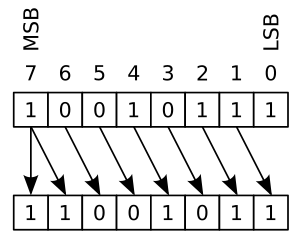
- Right shift 時,空出的 bit 填入原本的 MSB
- Left shift 時,空出的 bit 填 0
與之相對,Logical shift 為 :

- Right 和 Left shift,空出的 bit 都填 0
因此我們可以知道 : 至少在 gcc 下,right shift 在負數情況下是會補1,該範例可以正確得到絕對值。
### abs(-2147483648)
再來,我們執行看看`abs(-2147483648)`到底會產出什麼結果
```clike
#include <stdint.h>
#include <stdio.h>
int32_t abs(int32_t x) {
int32_t mask = (x >> 31);
return (x + mask) ^ mask;
}
int main() {
printf("%d\n", abs(-2147483648));
}
```
```shell
gcc -o ex1 ex1.c && ./ex1
-2147483648
```
看起來 `abs(x)` 似乎是失靈了,為什麼會這樣呢?
#### 從原理解讀二補數
之前雖然說對二補數編碼做 $\neg(x-1)$ 運算可以翻轉十進位的正負號表示,但嚴格來講,這個運算是「取得 $x$ 的反元素」
因為二補數是一個阿貝爾群,因此他的加法運算必須遵守 5 個規則 :
1. 封閉性: 若 a 和 b 是集合 G 中的元素,於是 `(a + b)` 也是集合 G 中的元素;
2. 結合律: `(a + b) + c = a + (b + c)`
3. 存在單位元素 0,使得 `a + 0 = 0 + a = a`
4. 每個元素都有反元素 (或稱「逆元」),也就是說:對於任意 a,存在 b,使得 `a + b = 0`
5. 交換律: `a + b = b + a`
再者,我們得了解 -2147483648 代表的是 int32_t 可以表示的最小值,即`1000 ..(27).. 0`,對於這樣的數,其反元素會等於自己。
因為根據群的上述規則 4,「元素 + 反元素 = 0」。 那麼以4位元舉例,4位元能表示的最小值是`1000`,則 `1000 + ? = 0000`,我們可以知道,反元素`?`也同樣是`1000`,因為`1000 + 1000 = [1]0000`,如此才符合定義。
這對 32 位元也是同理,`1000 ..(27).. 0`的反元素也會是`1000 ..(27).. 0`
### 結論
以上 C 語言函式要能夠稱為「對於輸入參數 `int32_t x` 取絕對值」,需要有兩個前提 :
1. 使用的編譯器,對於 $x<0$ 時, $x$ << $n$ 的執行結果要等同於 $x/2^n$ 的商
2. `x` 的範圍要限定在 -2147483647 ~ 2147483647
### 參考資料
- [解讀計算機編碼](https://hackmd.io/@sysprog/rylUqXLsm)
- [你所不知道的C語言:數值系統篇](https://hackmd.io/@sysprog/BkRKhQGae?type=view)
<br>
<br>
## Question 3
### 問題描述
根據 [課程簡介和注意須知](https://docs.google.com/presentation/d/1Wo22s5aYuuyry97-z2MMmUmdxhjD0wKTdhxIW5oqjvo/edit#slide=id.p) P.11 所描述 : 以下範例能否編譯並執行? 若可,為什麼呢?
```clike
#include <stdio.h>
int main() { return (*******puts)("Hello"); }
```
### 解釋
首先,我們直接對此程式做執行編譯 :
```
gcc -o ex1 ex1.c
./ex1
Hello
```
可以看到,這個範例確實是合法的 C 語言程式,而且其行為似乎與原始的 puts() 一樣。
再來我們試著以 gdb 了解 `puts` 和 `*puts` 的詳細資訊 :
```gdb
gdb ex1
(gdb) print puts
$1 = {<text variable, no debug info>} 0x7ffff7a7e5f0 <puts>
(gdb) print *puts
$2 = {<text variable, no debug info>} 0x7ffff7a7e5f0 <puts>
```
可以看到,`puts` 和 `*puts`沒有任何差別,所指向的地址都是0x7ffff7a7e5f0。
再看看 [C99](http://www.open-std.org/jtc1/sc22/wg14/www/docs/n1124.pdf) 規格書對此的解釋 :
- [6.3.2.1]
>A function designator is an expression that has function type. Except when it is the operand of the sizeof operator or the unary & operator, a **function designator** with type "function returning type" **is converted to** an expression that has type "pointer to function returning type".
- [6.5.3.2]
>The unary * operator denotes indirection. **If the operand points to a function, the result is a function designator**
因為 function name 本身就是一個 function designator,所以 `puts` 是 function designator,而根據 [6.3.2.1] 我們知道 : 當要對其進行 `*` 操作時, function designator 會自動轉換成 function pointer,變成 dereference of function pointer
而因為它變成 function pointer,再根據 [6.5.3.2] 得知 : dereference of function pointer 最後會變成 function designator
```
puts // function designator
*puts // *(function designator) -> *(function pointer) -> function designator
```
因為 `*puts == puts`,同理`*(*puts) == *(puts) == puts`。
所以我們得到結論 : 不管對函式加了幾個`*`,其操作最終都會回到原點。
### 參考資料
1. [c語法問題-結構成員指到函式記憶體位址](http://www.programmer-club.com.tw/ShowSameTitleN/c/39038.html)
2. [Lvalues and rvalues](https://www.ibm.com/support/knowledgecenter/SSGH2K_13.1.0/com.ibm.xlc131.aix.doc/language_ref/lvalue.html)
 Sign in with Wallet
Connect another wallet
Sign in with Wallet
Connect another wallet