###### tags: `leetcode` `Medium` `Link List` `Math` `Recursion`
# [2. Add Two Numbers](https://leetcode.com/problems/add-two-numbers/description/)
## Desciption
You are given two **non-empty** linked lists representing two non-negative integers. The digits are stored in **reverse order**, and each of their nodes contains a single digit. Add the two numbers and return the sum as a linked list.
You may assume the two numbers do not contain any leading zero, except the number 0 itself.
## Example
### Example 1:
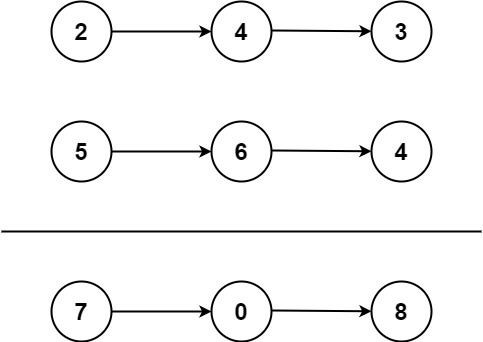
**Input**: l1 = [2,4,3], l2 = [5,6,4]
**Output**: [7,0,8]
**Explanation**: 342 + 465 = 807.
### Example 2:
**Input**: l1 = [0], l2 = [0]
**Output**: [0]
### Example 3:
**Input**: l1 = [9,9,9,9,9,9,9], l2 = [9,9,9,9]
**Output**: [8,9,9,9,0,0,0,1]
## Constraints:
- The number of nodes in each linked list is in the range `[1, 100]`.
- `0 <= Node.val <= 9`
- It is guaranteed that the list represents a number that does not have leading zeros.
## Code
```c=
/**
* Definition for singly-linked list.
* struct ListNode {
* int val;
* struct ListNode *next;
* };
*/
struct ListNode* addTwoNumbers(struct ListNode* l1, struct ListNode* l2) {
if (!l1)
return l2;
if (!l2)
return l1;
int carry = 0;
struct ListNode *tmp, *ans, *last;
ans = (struct ListNode*)malloc(sizeof(struct ListNode));
tmp = ans;
while (l1 != NULL || l2 != NULL || carry != 0) {
tmp->val =
((l1 != NULL ? l1->val : 0) + (l2 != NULL ? l2->val : 0) + carry) % 10;
carry =
((l1 != NULL ? l1->val : 0) + (l2 != NULL ? l2->val : 0) + carry) / 10;
if (l1 != NULL)
l1 = l1->next;
if (l2 != NULL)
l2 = l2->next;
last = tmp;
tmp->next = (struct ListNode*)malloc(sizeof(struct ListNode));
tmp = tmp->next;
}
last->next = NULL;
return ans;
}
```
## Complexity
|Space |Time |
|- |- |
|$O(Max(l1, l2))$ |$O(Max(l1, l2))$|
## Result
- Runtime: 20 ms, 61.42 %
- Memory usage: 7.8 MB, 29.34 %
 Sign in with Wallet
Connect another wallet
Sign in with Wallet
Connect another wallet