# Rollup-Boost and Unichain: Solutions for Addressing MEV Issues in Ethereum Rollups
*This article aims to summarize the roles of **Rollup-Boost** and **Unichain** in the Ethereum rollup ecosystem, particularly focusing on how they address MEV extraction, user experience, and decentralization. It also reflects personal thoughts on these approaches.*
## 1. Introduction
The Ethereum network has evolved around rollup technology to maximize decentralization and security while improving scalability. Over the past few years, various rollups have emerged, significantly enhancing the scalability of Ethereum. However, this expansion has introduced new challenges, particularly in the DeFi ecosystem:
- **Inefficient execution quality**: Rollup-based transaction processing can lead to suboptimal execution results, including slower processing speeds or higher costs.
- **Degraded user experience**: Rollup processing methods and speeds sometimes fail to meet user expectations, resulting in inconsistent experiences.
- **Liquidity fragmentation**: The rise of multiple rollups has dispersed assets, creating liquidity challenges. This dispersion can make trading difficult or cause price discrepancies.
A major unsolved issue is **MEV (Miner Extractable Value)**, which refers to profits gained by manipulating the order of transactions. MEV exacerbates centralization tendencies and harms user experience, necessitating technology to manage it effectively.
**Rollup-Boost**, developed by Flashbots, is a Trusted Execution Environment (TEE)-based block-building platform designed to mitigate MEV issues. By applying this system to L2 rollups like **Unichain**, it aims to achieve three goals: improving user experience, enhancing decentralization, and ensuring transparent distribution of MEV.
## 2. Rollups and the MEV Problem: The Need for Rollup-Boost
MEV refers to the profits that network participants can extract by deciding the order of transactions included in blocks. This often leads to network congestion and increased centralization tendencies as participants compete to prioritize certain transactions. Balancing user protection, efficiency, and decentralization in a decentralized system is a complex issue known as the **[MEV Trilemma]((https://www.docdroid.net/9P2o2Hr/mev-trilemma-how-zero-knowledge-proofs-will-reduce-mev-on-ethereum-docx#page=4))**. Some argue that MEV is inevitable and cannot be entirely eliminated.
| **Goal** | **Decentralization** | **Efficiency** | **User Protection** |
|----------------------|--------------------------------------------------|-------------------------------------------|-------------------------------------------|
| **MEV Extraction** | Decentralized transaction validation and block creation may sacrifice efficiency or user protection, leading to increased competition among participants to extract MEV. | Faster block creation or reduced fees can result in centralization, enabling a few participants to dominate MEV extraction. | User-centric designs can improve experiences but may weaken prioritization, allowing others to exploit gaps to extract MEV. |
Various auction methods have been proposed to address the MEV problem, including **Explicit Auction**, **Spam Auction**, and **Latency Auction**, each with unique trade-offs in terms of decentralization, efficiency, and user protection:
| **Auction Type** | **Explicit Auction** | **Spam Auction** | **Latency Auction** |
|----------------------|--------------------------------------------------|-------------------------------------------|-------------------------------------------|
| **Description** | Participants explicitly bid for transaction order in block creation. | Many transactions compete simultaneously, causing congestion and enabling MEV extraction. | Transactions submitted faster gain priority based on network propagation speed. |
| **Decentralization** | Promotes some decentralization but risks centralization if sophisticated participants dominate. | Allows widespread participation but raises concerns about centralization due to resourceful participants causing congestion. | Geographic proximity favors certain nodes, increasing the risk of centralization. |
| **User Protection** | Transparency for users but can disadvantage transactions that lose the bid. | Leads to negative user experience due to congestion and high gas fees. | Geographic bias can disadvantage users in distant locations. |
| **Efficiency** | Efficient resource use but slower block processing due to auction steps. | Causes inefficiency from network congestion and wasted gas. | Provides fast transaction processing but lacks global efficiency optimization. |
Analysis of these MEV extraction methods shows that:
- **Explicit Auction** excels in efficiency but struggles with decentralization.
- **Spam Auction** contributes to decentralization but negatively impacts user experience.
- **Latency Auction** enhances processing speed but risks centralization.
Since no method perfectly resolves MEV issues, MEV extraction remains an unavoidable challenge.
Flashbots proposed **Rollup-Boost**, a TEE-based block-building platform, opting to harness MEV rather than prevent it. Similar to MEV-Boost, which aimed to help Ethereum participants leverage MEV effectively, Rollup-Boost focuses on MEV distribution, creating economic opportunities for ecosystem participants.
*Note: The discussion on Explicit, Spam, and Latency auctions highlights their role as representative strategic patterns in MEV extraction. Other approaches may exist, but these three commonly illustrate core MEV auction strategies. For example, Flashbots' MEV-Boost resembles explicit auctions where bids determine transaction order, while First-Come-First-Served strategies align with latency auctions.*
### 3. Rollup-Boost
Rollup-Boost leverages TEEs (Trusted Execution Environments) to implement efficient transaction processing and user protection within rollup networks. Flashbots argue that TEEs enable offloading computation with complete integrity guarantees provided by remote attestation. This allows users to utilize their data and extract MEV generated from their transactions to achieve optimal outcomes. TEEs introduce a new trade-off point, moving beyond the dilemma between user experience and decentralization.
*[Reference] TEE (Trusted Execution Environment):
TEEs are secure areas within hardware (e.g., CPUs) that operate independently from the rest of the system to securely process sensitive data. Examples include ARM’s TrustZone and Intel’s SGX. TEEs prevent access to their secure area, even from OS-level programs, and ensure the integrity of executing code through verification processes. For instance, Intel SGX generates a hash value representing the code and data inside the enclave, using a private key to attest to the code’s integrity.*
#### 3.1 Flashblocks
Flashblocks creates partial blocks at 250ms intervals, enabling users to receive near-instant transaction confirmations. This approach improves user experience by maintaining compatibility with the Ethereum system while providing rapid state updates.
The transaction process involves the following steps:
1. A user sends a transaction (tx) to a rollup utilizing Rollup-Boost.
2. The user’s transaction is input into the TEE-implemented mempool.
3. Inside the TEE, the transaction is ordered and executed based on predefined rules.
4. Partial blocks are generated at 250ms intervals within the TEE.
5. Users receive preconfirmation of execution results with a latency of 250ms, allowing them to see the processing outcomes.
6. The state root is computed only once for the final block, avoiding overhead proportional to the number of partial blocks.
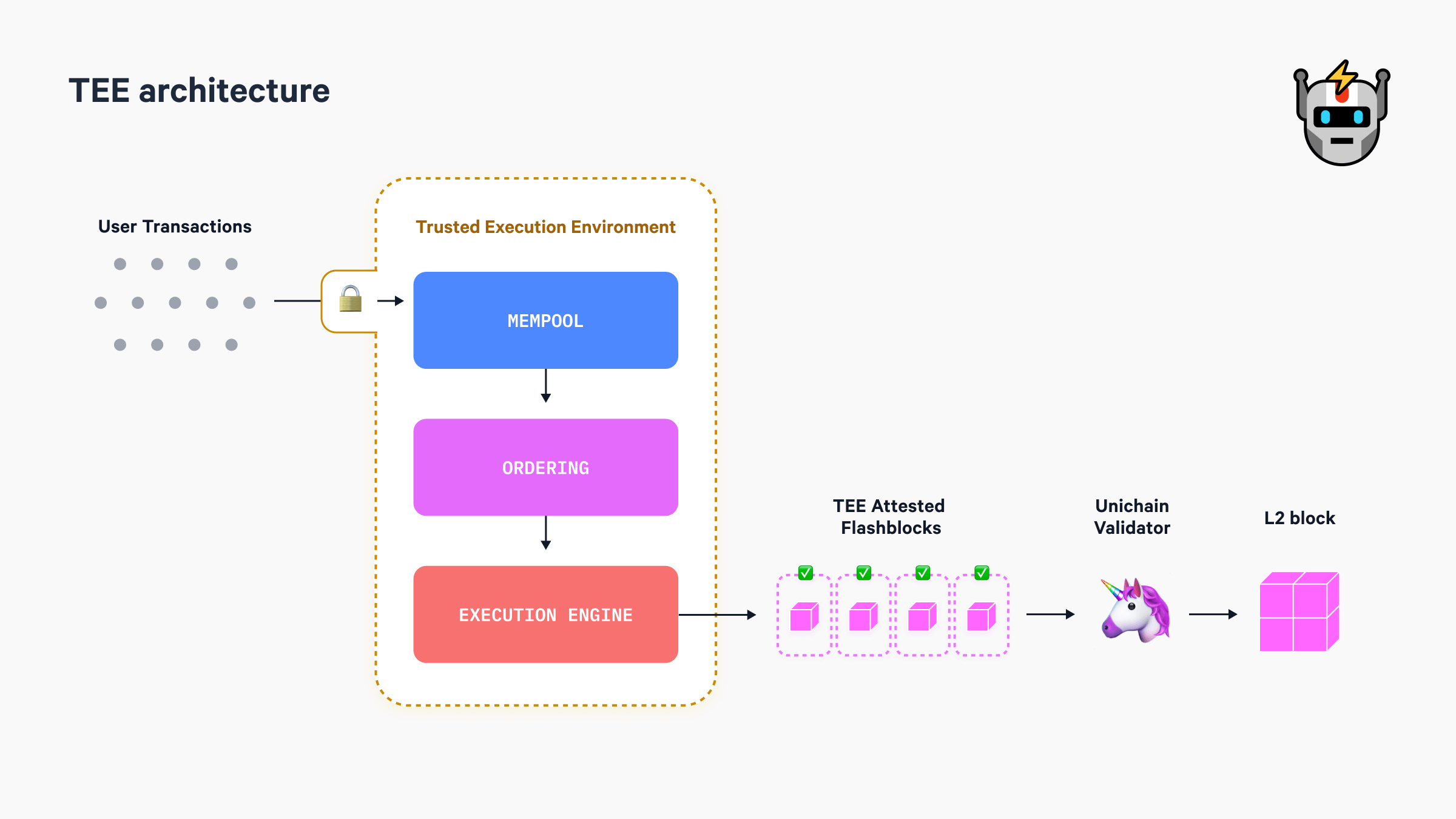
*(Source: https://writings.flashbots.net/introducing-rollup-boost)*
Flashblocks enhances user experience by supporting rapid confirmations and efficient transaction processing. It mitigates MEV issues by processing user transactions quickly via partial block generation. Integration with Ethereum's JSON-RPC standards ensures compatibility with front-end applications.
#### 3.2 Verifiable Priority Ordering
Verifiable Priority Ordering utilizes TEE security to validate the prioritization of transactions, allowing users to trust how their transactions are processed. This feature enables applications requiring transaction order guarantees to internalize MEV opportunities and ensures secure operations for those requiring specific orderings. Key features include:
1. TEE-based management of transaction ordering for verifiable priority handling.
2. Users can directly verify the prioritization of their transactions.
3. Applications can internalize MEV to distribute revenue to liquidity providers or dApps.
*[Reference] Private Ordering:
Private Ordering, proposed by Dan Robinson and Dave White of Paradigm, is a block construction mechanism where block proposers order transactions based on priority fees, assuming no censorship or delays during auctions.*
*[Reference] Internalizing MEV:
Rollup-Boost employs TEEs to internalize MEV by defining MEV as fees paid for transaction prioritization within blocks. TEEs transparently manage MEV profits, redistributing them via MEV taxes to entities contributing to the ecosystem, such as dApps or liquidity providers. This aligns with approaches proposed by Paradigm, focusing on sustainable ecosystem growth and ensuring MEV-derived revenue benefits applications and users.*
### 4. Unichain
In the Ethereum ecosystem, Uniswap has established itself as a leading AMM (Automated Market Maker)-based decentralized exchange (DEX), deployed across over 25 networks with approximately $4.5 billion in Total Value Locked (TVL). However, the Ethereum network faces scalability issues and vulnerability to malicious MEV (Miner Extractable Value) attacks.
Scalability and MEV vulnerabilities present critical challenges for large protocols like Uniswap. Ethereum and most rollup networks operate with a single sequencer, creating a single point of failure that threatens liveness and introduces censorship risks. Additionally, most Ethereum rollups feature open mempools, enabling MEV extraction during block-building, disproportionately benefiting proposers while degrading user experience.
To address these issues, Unichain was introduced as an OP Stack-based rollup solution co-designed by Uniswap, Flashbots, and OP Labs. By incorporating Flashblocks and Verifiable Priority Ordering, Unichain aims to significantly enhance user experience. Flashblocks provides rapid state updates, while Verifiable Priority Ordering ensures transaction order reliability, minimizing MEV-related user disadvantages.
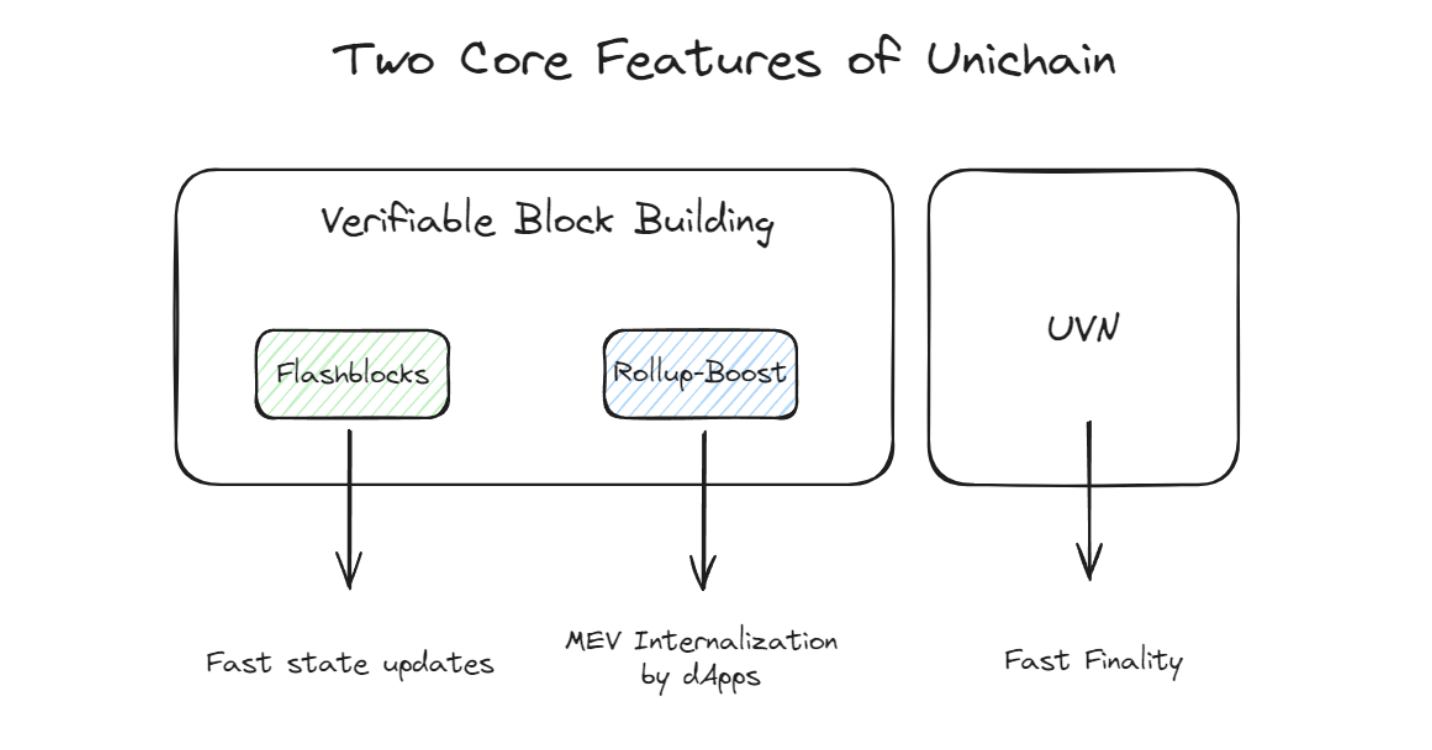
*(Source: https://mirror.xyz/100y.eth/zuxeQPCauDzu2geK-GmuQhkYZic0973wEMfjGKfUXUo)*
Unichain’s design supports predictable transaction processing speeds, emphasizing secure and reliable transaction handling for a user-centric rollup solution. It enhances the DeFi ecosystem by facilitating rapid state updates and efficient transaction ordering to support Uniswap’s extensive liquidity and user base.
Key features of Unichain include:
- **Rapid state updates**: Near-instant confirmations via Flashblocks.
- **Internalized MEV**: Guarantees transaction order while enabling dApps to extract some MEV revenue and redistribute it within the ecosystem.
- **Economic finality**: Supports secure payments with quick transaction processing.
Unichain addresses common rollup challenges with features like Flashblocks, TEE-based priority ordering, MEV tax models, the Unichain Validation Network (UVN), and integration with the Superchain, benefiting both users and the ecosystem.
#### 4.1 Solution 1: Rollup-Boost
Unichain actively leverages Rollup-Boost to improve transaction processing speed and reliability. Flashblocks facilitates rapid state updates by processing transactions at short intervals, providing users with near-real-time transaction confirmations. Verifiable Priority Ordering ensures trustworthy transaction ordering, minimizing MEV-related disadvantages and fostering fair trading environments. Through MEV tax models, dApps can extract or redistribute MEV value based on their economic models.
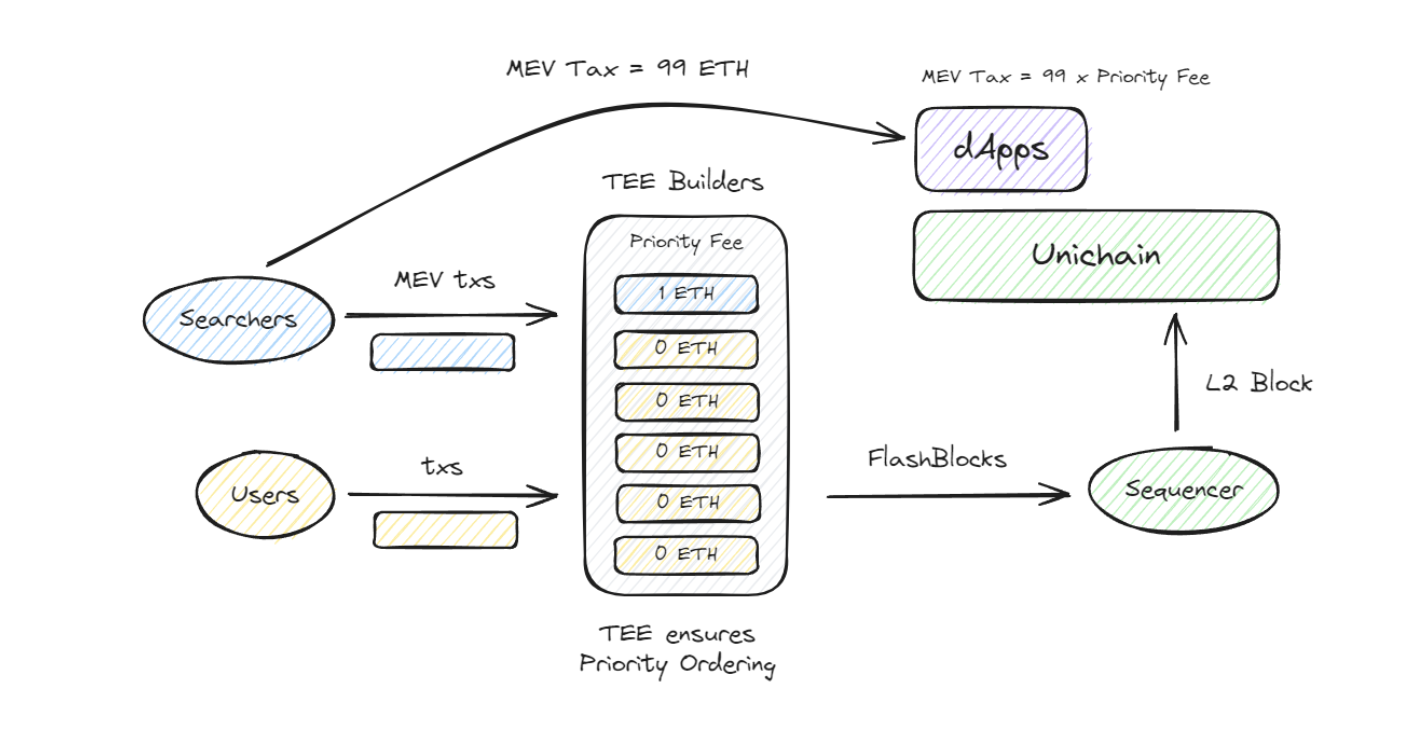
*(Source: https://mirror.xyz/100y.eth/zuxeQPCauDzu2geK-GmuQhkYZic0973wEMfjGKfUXUo)*
However, forcing block builders to use TEEs centralizes TEE operations. The process of selecting the transaction list for TEE input may not guarantee censorship resistance. While Unichain mentions Private Ordering through TEEs, it does not claim to prevent censorship. Rollup-Boost’s roadmap suggests plans for encrypted mempools, potentially addressing these concerns. Encrypted mempools could prevent censorship while applying Verifiable Priority Ordering, ultimately aiming to distribute MEV revenue fairly among users or liquidity-providing dApps.
#### 4.2 Solution 2: Unichain Validation Network
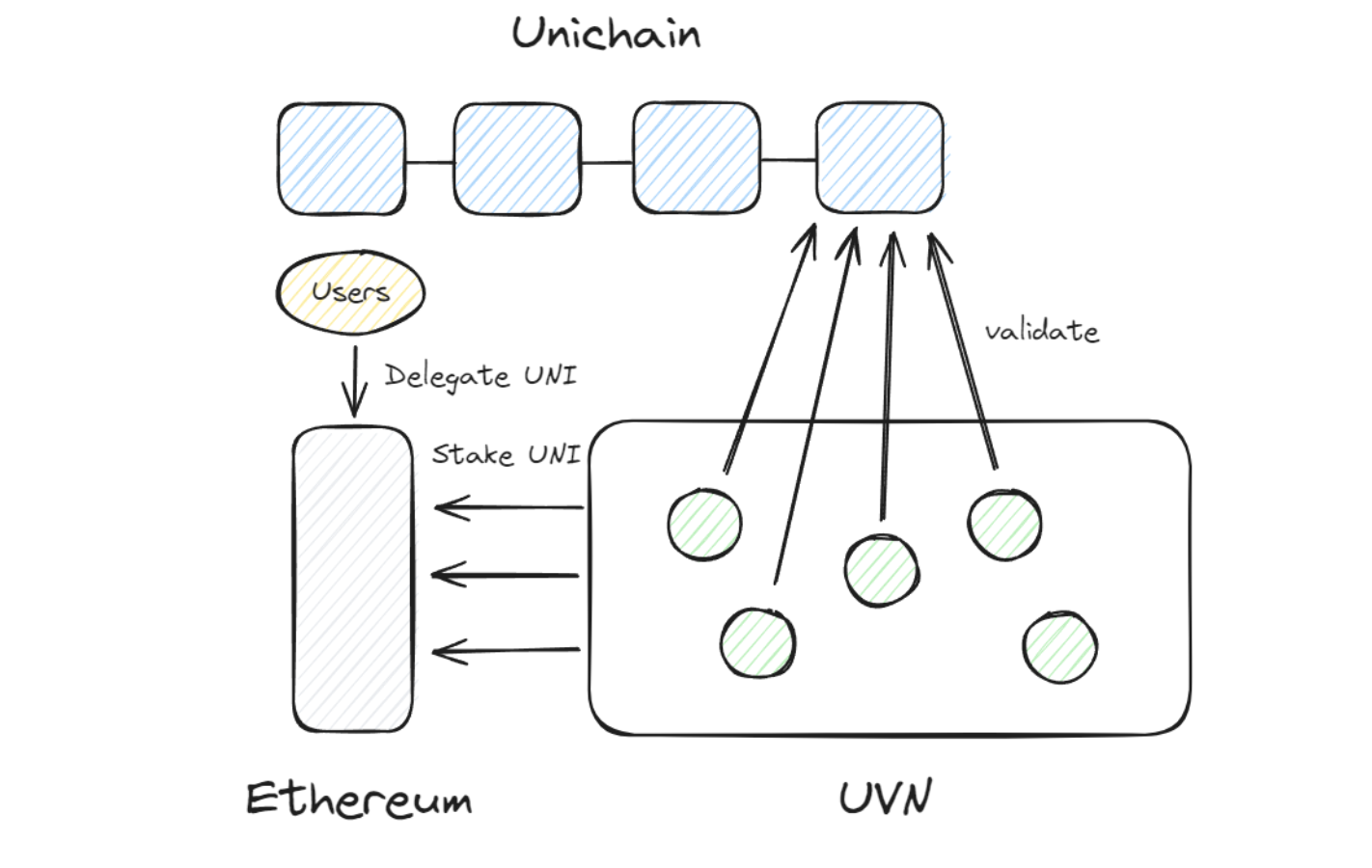
*(Source: https://mirror.xyz/100y.eth/zuxeQPCauDzu2geK-GmuQhkYZic0973wEMfjGKfUXUo)*
The Unichain Validation Network is a decentralized network of node operators that validate the latest state of Unichain, enabling fast finality and seamless cross-chain transactions with economic security. This concept resembles approaches like AltLayer’s MACH, EigenLayer’s fast finality mechanisms, Nuffle’s Fast Finality Layer, and recent proposals by Symbiotic.
To participate as a node operator in Unichain, participants must stake UNI on the Ethereum mainnet. Nodes with the highest UNI stakes are selected as active participants for each epoch, running Reth Unichain clients for validation tasks. Additionally, UNI holders can delegate their stakes, similar to other networks.
### 5. Rollup-Boost Roadmap
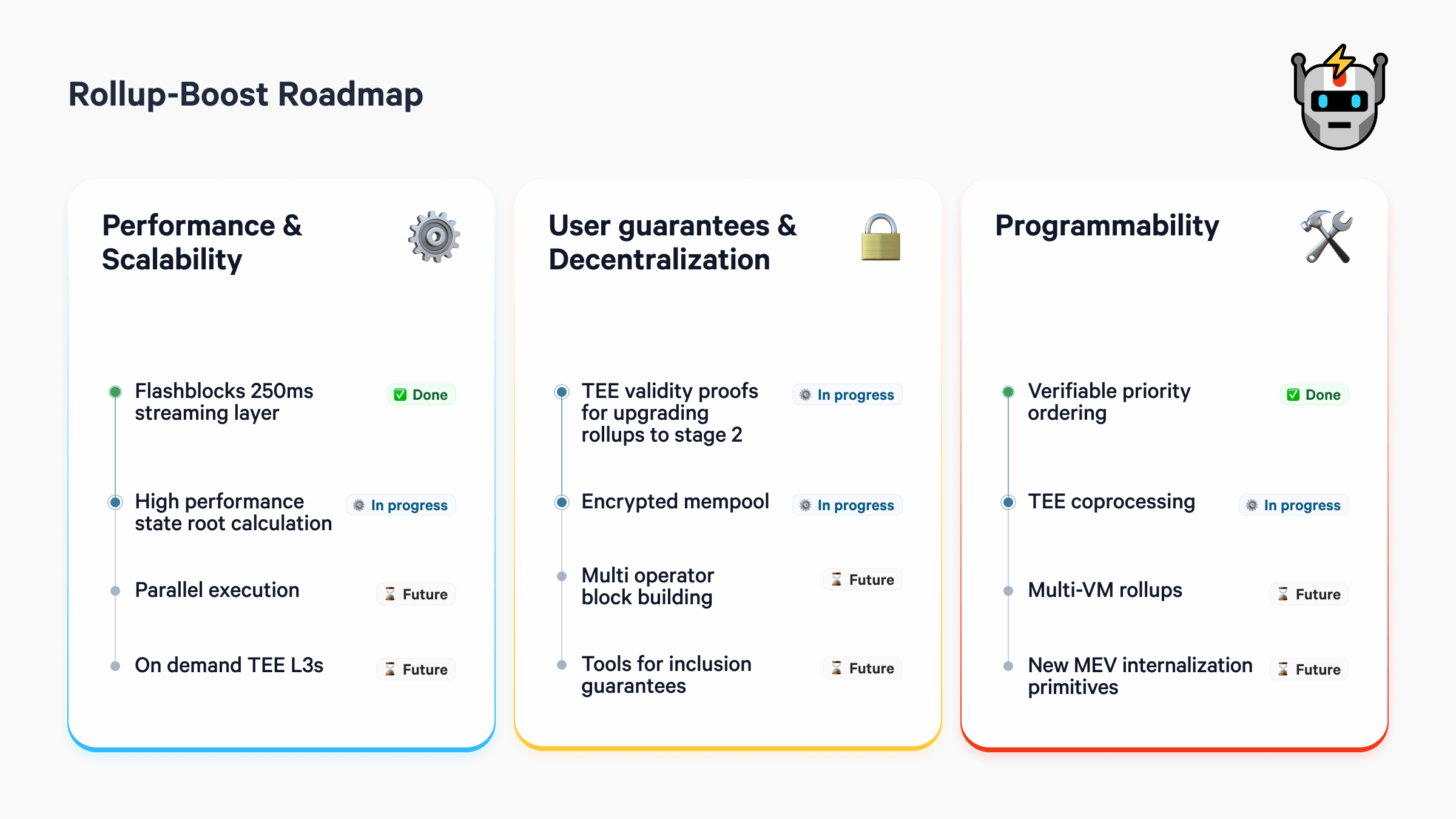
Rollup-Boost includes additional features in its roadmap beyond Flashblocks and Verifiable Priority Ordering. These enhancements play a crucial role in improving efficiency and decentralization in rollup networks. Key features include:
- **Encrypted Mempool**:
In the current structure, transactions are sent from centralized RPCs to TEE block builders and then to centralized sequencers. Implementing a TEE-based encrypted mempool would allow transactions to be encrypted and sent directly to the TEE environment, where decryption is performed internally. This approach replaces the roles of centralized RPCs and sequencers with internal TEE logic, ensuring that transactions remain protected from third parties outside the secure hardware until they are executed. While this provides an ideal security structure, the limitations of TEE technology must still be carefully considered.
- **TEE Proofing**:
Rollup proof systems like ZK-SNARKs, STARKs, and fraud-proof mechanisms are still in their early stages and lack stability across large-scale networks. To efficiently and swiftly verify transactions in rollups, TEEs can be introduced as supplementary verifiers. While multi-proof structures leveraging TEEs aim to reduce centralization and evolve into permissionless environments, the security vulnerabilities and instability of TEEs require careful evaluation to determine if they bring meaningful efficiency to existing proof systems.
*(Source: https://writings.flashbots.net/introducing-rollup-boost)*
Additionally, the Rollup-Boost roadmap includes:
- **High-Performance State Root Calculation**:
Accelerating the calculation of state roots in rollups to maximize network throughput and performance.
- **TEE Coprocessing**:
Supporting privacy protection and trusted computation to perform complex operations at a low cost, designed to reduce blockchain congestion. This lays the foundation for building secure and efficient networks capable of accommodating more users.
While specific methodologies for these features remain unclear in public documents, Rollup-Boost ultimately aims to build a safer and more efficient rollup network in a decentralized environment using various TEE-based approaches. If these enhancements are successfully implemented, Rollup-Boost could support more users while improving the security and user experience of Ethereum rollups.
### 6. Conclusion
Rollup-Boost and Unichain present approaches to enhance decentralization while improving the user experience in Ethereum rollups. These technologies enable efficient and user-friendly rollup networks through rapid state updates, MEV extraction and internalization support, and 250ms execution pre-confirmations. However, Flashbots’ extensive reliance on TEEs introduces challenges that require careful consideration:
- **First**, dependency on centralized hardware manufacturers poses a significant issue. TEE technologies, primarily provided by Intel’s SGX and AMD’s SEV, create a structural limitation by relying on external hardware manufacturers for the security backbone of decentralized blockchain systems. If vulnerabilities are discovered in the hardware, it could compromise the independent and secure operation of TEE-based applications, impacting the entire blockchain ecosystem adopting these technologies.
- **Second**, development complexity and technical barriers arise. Developing TEE-based applications requires advanced knowledge of secure hardware and environments, creating a high entry barrier. Maintaining compatibility with various blockchains and implementing TEE solutions demand additional time and resources, along with ongoing maintenance burdens. This could limit the accessibility of the development ecosystem.
Therefore, while recognizing the benefits and potential of TEEs, a cautious approach is needed to evaluate their limitations and risks comprehensively. Stakeholders adopting TEE technologies must carefully consider these risk factors and explore balanced strategies to ensure decentralization and security.
---
### References
- https://docs.unichain.org/whitepaper.pdf
- https://writings.flashbots.net/introducing-rollup-boost
- https://mirror.xyz/100y.eth/zuxeQPCauDzu2geK-GmuQhkYZic0973wEMfjGKfUXUo
 Sign in via Facebook
 Sign in via X(Twitter)
 Sign in via GitHub
 Sign in via Dropbox
 Sign in with Wallet
Connect another wallet
Sign in with Wallet
Connect another wallet