***
# Corehash: Hashpower liquidity provision protocol
### A decentralized mining liquidity protocol using an automated smart contract vault and market liquidity provision system to create a hashpower exchange directly based on the hash token staking demand for hashrate liquidity
[www.corehash.org](www.corehash.org)
## 1. Mining through Staked Liquidity ⛏️💧
Corehash is an automated smart contract protocol that creates an on-demand liquidity pool for hash power, buying hashpower directly from miners, through a custom mining pool protocol, that pays similar to PPS (Pay Per Share), but instead is based on the demand side of the market for their hash power through a vault system that provides liquidity for hashpower.
### 1.1 Direct yield-staking 🚩
cHASH is used to stake for yield from hashpower of multiple mining algorithms, stHASH gives you yield for being a liquidity provider by adding to the vault and providing liquidity. Enter in ETH, wBTC, or stablecoins into the vault to mint cHASH and LP cHASH and earn stHASH. Stake stHASH to generate additional cHASH.
### 1.1.1 cHASH & stHASH 💵
Users that mint cHASH and stake it earn stHASH + the hashrate yield, stHASH gets a small fee from the cHASH staking fee, protocol fees, lending/borrowing fees, etc., whereas cHASH is purely the value of the assets put into the vault and used to create the demand side liquidity for the hashpower market. By being a liquidity provider you can yield farm and earn stHASH. cHASH is ONLY minted directly from the vault.
### 1.1.2 Algorithm Pools 🏊
Users can stake cHASH into any algorithm pool to establish demand liquidity, which is then used to pay miners for their hashpower, and then the hashpower is routed through the mining pool protocol that has its own integrated smart contract wallet which pays the mining rewards to the cHASH stakers. Each time you stake cHASH to a particular algorithm, there is a staking fee, which is paid to the stHASH stakers. Once you stake cHASH for the hashrate of an algorithm, you start to yield from the mining income of that algorithm, based on the token hashrate calculated by the hashpower liquidity formula (see: Section 2). When cHASH hasn't been staked to an algorithm pool, it does not generate any yield, however, you can deposit the tokens into a vault and let it do the staking for you automatically, and start borrowing off your hashrate collateral w/ income generation for self-paying loans (see: Section 1.4).
### 1.1.3 cAssets from Mining Rewards 📦
cAssets are the wrapped version of the mining rewards from other blockchains, which the vault controls. This is the cross-chain integration for the protocol to mine on multiple hash networks outside of Ethereum, which are then held on-chain by the smart contracts to provide liquidity for the hashrate of multiple algorithm pools. Stakers of cHASH into each algorithm pool mining coins for that algorithm are paid in cAssets of the underlying block rewards of the native-chain. This can also act as an on-ramp to liquidity of these coins and their blockchain through Ethereum's blockchain and ecosystem; this binds other chains to Ethereum, and brings value to the native chains as well as driving the use-value of Ethereum.
### 1.1.4 Providing Liquidity for cAssets 💦
Once the miners sell their hashrate to the vault, it collects the mining rewards based on the algorithm pool's token hashrate and pays the stakers of cHASH based on the shares they collected. These rewards are wrapped onto the Ethereum blockchain as cAssets, and then they are exchanged for the corresponding assets within the vault used to buy the hashrate for the rewards, in order to maintain the vault's TVL. These assets require liquidity to be converted back into the underlying assets originally, therefore, liquidity providers can also earn stHASH by providing liquidity for these assets.
### 1.2 Hashrate supply/demand dynamic 📈📉
Stablecoins, ETH, and other assets are provided to the vault, which mints a corresponding value in cHASH; the initial value of cHASH is arbitrary, directly valued to the assets inside the vault. cHASH is then staked into an algorithm pool, for example, the 'SHA256 pool'. The vault will then calculate the maximum price (the 'Ask') for the hashrate of SHA256 to yield a profit based on the price of the coin mined with SHA256 with the highest profitability, and set the base price for hashpower. This creates the demand side of the market, and thus, miners that are connected to the Corehash mining pool will be paid directly from the vault, rather than from the actual block reward. Once the demand price has been set, then the miners can begin providing the supply, and thus create a supply price (the 'Bid'). This should mean the market price will be the most efficient price for hashpower of the algorithm, depending on the liquidity of both sides (supply/demand), which is fully scalable as a direct hashrate liquidity market making protocol.
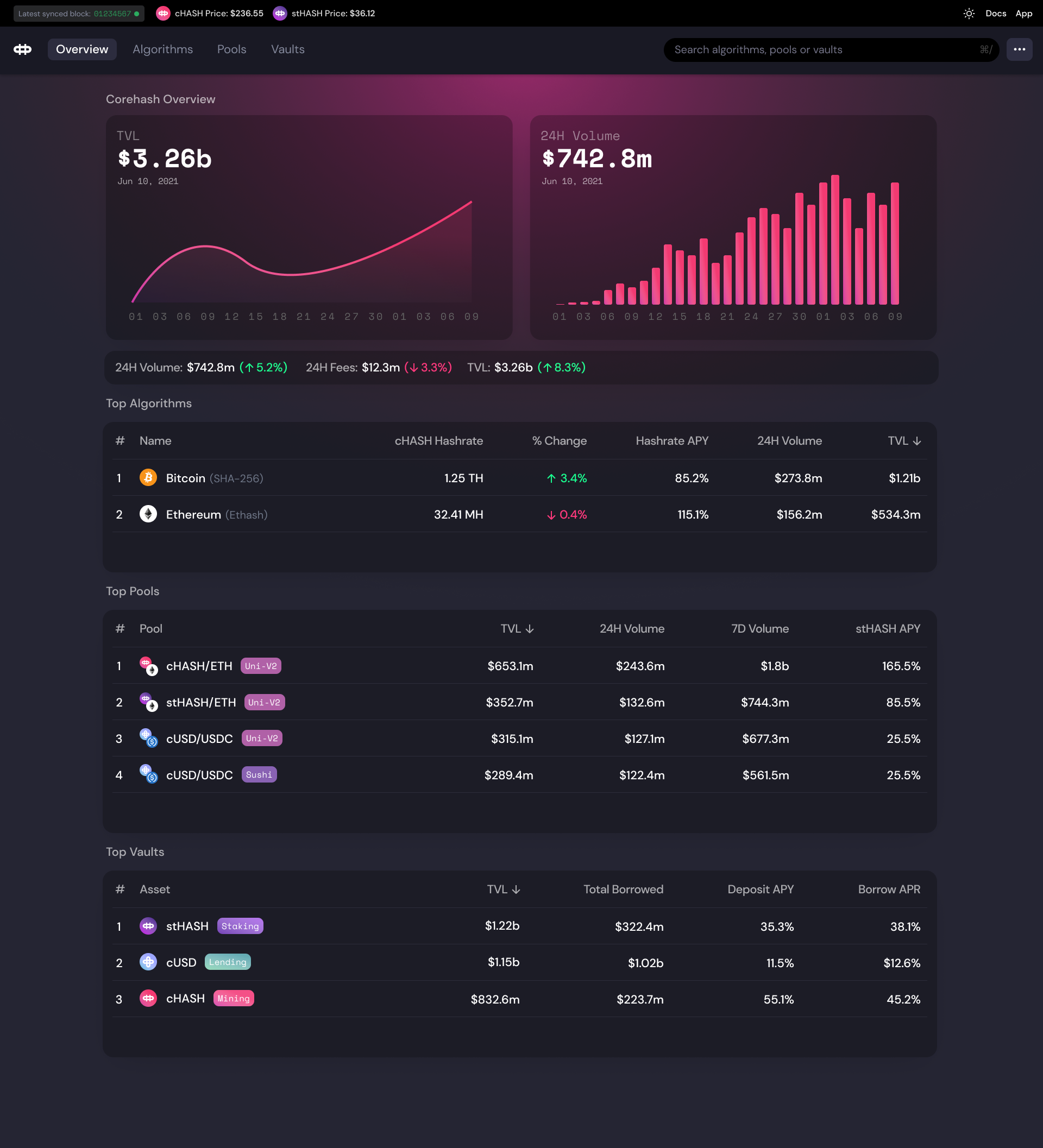
_Corehash Overview page - redesigned UI from Uniswap V3's overview page, for hashrate algorithms, pools and vaults_
### 1.3 Hashpower Vault ("Corehash Vault") 🏛️
The Corehash Vault is the smart contract automated core architecture in which the protocol operates; acting as the liquidity provider as well as the on-chain custody system and decentralized mining pool operator (on-chain Stratum integration; see: Section 3.1).
The way the vault works is that it acts as a perpetual (core) vault for hashpower demand, and the principal will always be paid back into the vault for the hashpower bought from the miners, and if somehow the cHASH's staked token hashrate for a given algorithm returns at a loss, it will simply burn a portion of the staked cHASH (for that algorithm; the equivalent value loss in tokens) in order to maintain the original value. But by the efficient market hypothesis, all the hashrate on the market supplied by the miners should have a profit margin of greater than zero, as that is what makes it worth anything in the first place, thus the maximum price of hashrate has to have some yield, and that's part of the job of the automated vault to ensure that's the case. Otherwise, if there's an overwhelming demand versus supply of hashrate, the yield will simply be diluted by the TVL ratio to the yield.
Once the principal value has been paid back into the vault, the remaining value becomes the yield to the stakers of cHASH, and a small portion of that is taken as the liquidity provider fee that goes back into the vault and generates additional cHASH for the stHASH stakers. In other words, cHASH is not exchanging for the hashrate value in full, but rather the income that the hashrate generates. This gives the value of cHASH the yield % of the TVL of the vault but with a premium for the liquidity available for market making, which also gives it very powerful properties, such as being used for DeFi products, like a credit line that pays itself off through mining income, which is much higher than passive yield of stablecoin strategy vaults and such. Providers of lending for such products would also generate stHASH rewards in addition to the interest that cHASH stakers pay for borrowing on their collateral.
Essentially, stHASH is the protocol and ecosystem token, whereas cHASH is the value of the TVL + mining yield from the hashpower liquidity, where a portion of all the direct mining income is paid to the various fees of the protocol driving its application use and adoption.
### 1.4 Lending for Self-paying Loans (Hashpower Credit Line) 💳
Simply provide stablecoins or other assets to lend to cHASH stakers that are taking out collateralized loans, and earn both stHASH (in rewards) and fixed-interest (from mining yield). Provide for overcollateralized loans or undercollateralized loans, earn greater interest for providing undercollateralized loans, with adjustable terms and earn massive (25–30%+ APR like credit cards) interest the lower the collateral ratio is.
Borrowers can deposit their cHASH into the vault and let the vault automatically choose the algorithm pools for you (like a robo-advisor), then borrow other assets with a fixed APR, depending on the collateral ratio, and take out a self-paying loan from the hashrate yield by locking into a fixed term.
This will be the first lending platform able to provide undercollateralized loans like a credit line using hashpower because the hashrate assets locked are self-generating income AND self-paying assets.
### 1.5 Hash-powered Interest bearing Stablecoin (the "Core Dollar") 💰
In addition, lenders can also issue stablecoins (cUSD; the "Core Dollar") by depositing other stablecoins (USDC, USDT, Dai) (term-locked for higher interest) and issuing stablecoins that have built-in interest from the collateralized debt paying interest, where a small percentage of that interest can go directly to the stablecoins issued, which is 1:1 backed against their stablecoins they put in. This allows the vault to have excess liquidity to boost the mining revenue even further or be lent out for undercollateralized loans earning high-interest, driving up the value of both cHASH and stHASH even higher, while providing stability for the overall assets within the vault when there is volatility for the non-stable assets locked inside.
This unlocks a whole new level of capital value and liquidity to the hashrate demand market, intersecting and interconnecting financial services and products with hashpower and mining growth.
### 1.6 Automated Hashrate Vault Strategies 🤖
Similar to Yearn Vaults, automated strategies come into play when you can seamlessly allocate tokenized liquidity into different hashrate algorithm pools, allowing automated vault strategies to be created that swaps between different hashrate algorithms based on predetermined factors and metrics, through market analysis, AI, data science, etc. With a wide array of possibilities, the algorithm mining pools allow for strategic capital deployment onto a liquid hashrate market running on the Corehash protocol.
When depositing your cHASH into a vault, you can choose various different strategies for your tokens to be staked and depending on the different vaults, earn higher stHASH rewards.
---
## 2. Hashrate liquidity provision AMM & token protocol ⛏️🌀

Hashrate algorithm swap UI - swap from any algorithm to another using hashrate tokens
Similar to the AMM (Uniswap) protocol formula, x*y=k, hashrate liquidity comes from a simple yet elegant formula, but divided by instead of multiplied. This automates market making through a wholly different approach via internalized tokenized pricing, by achieving market equilibrium through the token price, where x=total hashrate, y=tokens staked, k=token hashrate, which then becomes:
`x/y=k`
Where y and k are interchangeable, the token hashrate k is the total hashrate x divided by y tokens staked, and the price of each token is based on k, which creates a token with a dynamic hashrate based on the supply/demand of total hashrate vs tokens staked.
Each of the variables can be substituted for it's own subvalue, representing the different algorithms available, which are the algorithm pools; x₂/y₂=k₂, for any algorithm's hashrate. Therefore, the same formula can be used across all the algorithms available with a liquidity pool, using the same token, each with a different token hashrate for that algorithm.
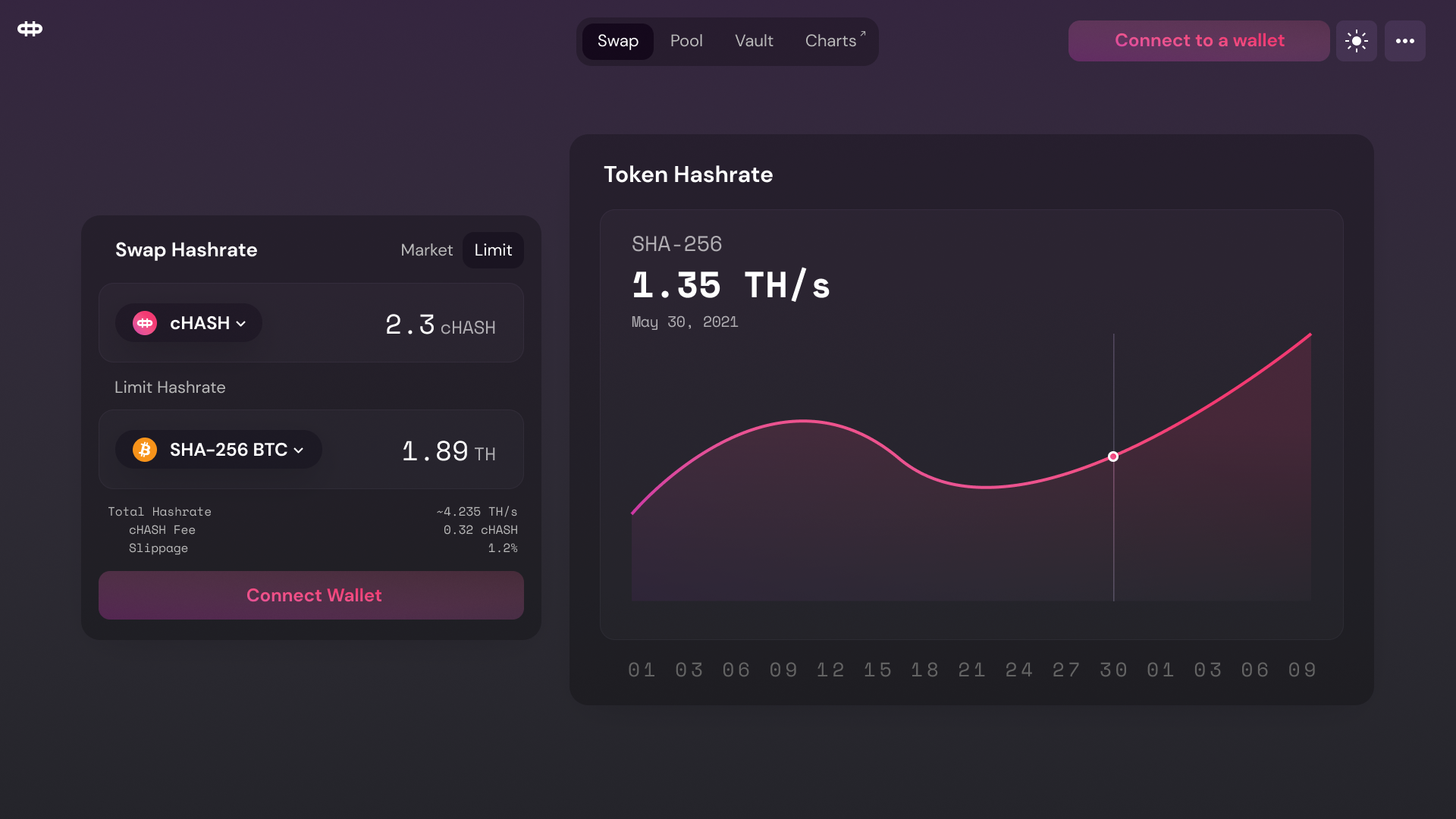
_Swapping hashrate - showing the token hashrate for SHA-256 algorithm_
The same token (cHASH) is then essentially able to stake (also considered swapping) for hashrate of one algorithm then swap between any algorithm's liquidity and hashrate. This is what makes it possible to do mining through staked liquidity. This means by staking your hashrate token, you are receiving hashrate based on the price of the token and the algorithm's token hashrate.
It is important to note, this AMM liquidity provision model is specially designed for the pricing of hashrate liquidity using the vault staking system via the hashrate token, and is not meant for a general purpose AMM like Uniswap used for a DEX. It still uses the current AMM model as an exchange, but by internalizing the hashrate algorithm swapping into the token utility, and adding a liquidity pool for that token on a standard AMM (listed on Uniswap or the like), allows it to perform all the various unique functions of the protocol (‘HashFi’) and enabling a 2-tier ecosystem token system : with requiring a standard AMM for liquidity providers to earn fees from the protocol through a separate token (stHASH) which is what completes the system.
---
## 3. Stratum Protocol Layer-0 🔗
### 3.1 Next-gen Decentralized Pool Architecture 🛸
The Corehash protocol is essentially the bridge between the miner's hashrate supply, and the mining pool, by inserting a decentralized exchange in the middle, where the mining pool becomes the payment provider of the block rewards to the hashrate market demand liquidity.
> Miners -> Corehash -> Stratum
It is an integration of a smart contract liquidity provision model into the mining stack, by underlying the Stratum protocol for standard mining pools, miners are not mining directly to a pool, but rather through a vault then the vault to the pool, where the share rewards are then routed from the stratum protocol directly to the buyers through the vault itself.
So the vault becomes a fully-decentralized liquidity pool-miner with all the hashpower controlled via a smart contract tokenized AMM-hashrate staking system, which then is able to mine through any mining pool it's connected to. This is a completely novel mining pool protocol architecture (which adds on-chain capability onto the Stratum protocol) that builds itself on top of smart contracts and oracles, and becomes a decentralized hashpower liquidity provision directly from miners to buyers.
### 3.1.1 Cross-chain smart wallets ⛓️🧠👛
Like mining pools have wallets for all the block rewards being mined from different blockchains, the Corehash Vault holds these assets in smart wallets on-chain using smart contracts. The protocol uses a smart wallet system that the vault controls, and sends/receives all the rewards to/from, that then the users connect to for their payout. This will be the first usage of a mining protocol that is connected directly to the blockchain itself and interacting with smart contracts, using oracles for price feeds as well as hashrate feeds, blockfeeds, etc., and where the miners are also connected to the vault to be paid for the hashpower. The vault also controls wallets that the pool pays to, in the native blockchain, which is then wrapped onto the Ethereum blockchain and paid to the users. This means that all the coins mined are wrapped can be redeemed for the coins through the vault's wallets which are controlled by the smart contracts on Ethereum.
### 3.2 Pool Fees -> Liquidity Providers 💸🤲
By creating a completely independent mining provision of liquidity for hashpower, mining fees are directly fed into the ecosystem for the buyers of hashpower, and for those that provide the liquidity for the vault and hashrate market. This effectively becomes the first publicly-owned and operated mining pool that in itself is a global liquidity pool for hashpower. It perpetually grows and feeds itself. In addition, the fees from interest financing also flow into the market for hashpower.
Mining pools can also become embedded into the decentralized protocol of the vault and liquidity pool, offering complete control over the pools by the liquidity providers themselves, allowing more control over the pool fees. Just like Stratum V2 allows for greater control from the miners, it can be tailored the same way towards the liquidity providers instead, where anyone with control of the staking of the tokens can replace the miners as the controller of the block template, and in a fully decentralized approach form their own mining pool using Stratum V2.
### 3.3 On-Chain MEV Protection Market & Decentralized MEV Protocol ⚡🤖🛡️
By creating a hashrate liquidity provision market protocol on the blockchain and enabling decentralized financial applications to be built on top of it - HashFi, we can also address and provide a solution to the problem of MEV and frontrunning bots. Corehash is uniquely positioned to be able to directly influence and affect the basis of Miner Extractable Value at its core, bringing a whole new market to the world, by enabling the payment for hashpower to have transactions protected from attackers - ensuring their transactions are not frontrun, directly sequencing transactions on the miner-level using the Corehash Protocol.
> The automated hashpower vault system ("Corehash Vault") can offer the potential for MEV to be captured by Corehash, or offered as a way to prevent trades from being front-run on the protocol level, by directing hashrate through a liquidity market system to bid for hashrate value through a direct on-chain supply and demand system.
The original core vision for Corehash was for hashrate liquidity and financial applications to be enabled through an internalized AMM token system as described thus far, but along with all the benefits that it brings, from lending to staking, hash-backed stablecoins, credit lines, self-paying loans, and more, another issue that has surfaced and been widely debated with controversy is MEV, "Miner Extractable Value", in which, directly ties to the hashrate directed to a mining pool protocol system (mining pools and mining firms using Stratum Protocol to produce blocks) that creates the block templates and orders the transactions. If there are no widely available means to control the miners (in a decentralized manner), or route hashpower to a protected (or 'safe') miner/block producer; as opposed to a selfish miner, where they can be paid or bribed, extract the value for themselves, even sell access to private mempools, or just left unchecked for frontrunners to take advantage of the retail users using frontrunning bots, this becomes a very problematic issue for blockchains.
Corehash offers a solution to protect the users from this, by giving control of hashpower and block production directly to the market liquidity providers and hashrate stakers/buyers of the protocol. By making anyone able to pay for hashrate on-chain, on-demand, there could be a huge market for "premium hashrate" that's 'MEV-protected', bought through Corehash's MEV Protection Market, and ensure that trading for a certain pair, transaction, or wallet, cannot be frontrun by Market Makers or malicious miners. Although this doesn't eliminate the problem (which is likely impossible, and can only be mitigated to a certain extent at some extrinsic cost), as arbitrage is by nature of the trade system and game theory; by creating a market for such a product, we can lower the cost of capital overall being paid to frontrunners and MEV or these centralized parties, by creating a core-layer protection and a protocol that can capture its value and feed it back into the market economy, to a more diverse and transparent pool of people on the open market (thus cycling back the 'extracted' value), and normalize its effect on very exclusive/high-value transactions or micro-scale occurrences by dispersing the cost amongst all transactions which run through an open miner-sequencer protocol.
The market premium or auction rate is fed directly back into the ecosystem and to the protocol, further empowering the protocol providers. Suddenly, we have turned a disincentive to use the blockchain for finance and markets into a new incentive which attracts a new kind of market makers and participants. As the liquidity or TVL of Corehash increases, the 'MEV-protection' hashrate premium will decrease over time, combating MEV becoming a widespread problem for decentralized markets on blockchains, while on the other hand, Corehash will benefit from MEV that happens elsewhere 'unprotected', through it's very own Decentralized MEV Protocol System, which reverses the role of MEV being a privately-controlled, secretive, "dark forest", by giving the reign of frontrunning and MEV extracting miners to a fully decentralized protocol, driving up protocol fees and revenue by another factor of growth.
Much like Payment for Order Flow (i.e. Robinhood) on the stock market, MEV is similar, except on the blockchain, there's no need to pay for the order flow because it's inherently exposed/free, which creates the problem of MEV and trading bots, as they are taking advantage of the 'free order flow'; and thus, we have a uniquely blockchain-inherent problem, but therefore, also the opportunity of bringing a solution to the market; by turning it into its own market - to essentially create the opposite of PFOF; 'Payment for Protected Order Flow'; it's still publicly on-chain, but it cannot be frontrun; this can be achieved through some kind of protocol for miners; like Corehash, acting as a protection agency or a protocol-layer miner market which can extract or counteract (but thus extracting the value in which it's being protected from it) MEV at its users' behest as a protocol use-case.
The current proposed (scaling) solution to address MEV is with Layer-2 Rollups (or Centralized MEV Sequencers, which is a cause for concern), but that would be only limited to the transactions done on the second layer through a gateway/aggregator, by limiting on-chain transaction information/data. This also creates segmented markets/liquidity, weakening the overall economic system and markets. This is still subject to ongoing research within the Ethereum community. Another solution being researched and developed, which is in line with ours, is Flashbots, where they've created an auction system for bidding up MEV extraction and tools for bringing transparency to MEV metrics and data. This is the basis of our system, but with Corehash, our protocol creates the core market for hashrate itself, which allows for on-chain sequencing directly on the miner level and Layer-1 chain through our hashrate liquidity protocol, able to sequence any transaction done on the blockchain with the hashrate liquidity available on the open market, so the protocol and its users can benefit directly from both the MEV extraction as well as protection from it. This is why it is so important for Corehash's mission to decentralize mining through a liquidity market protocol that enables access and control of hashrate to the masses.
---
## 4. A Fully Decentralized Mining Protocol & HashFi ⛏️🌐
A fully decentralized mining protocol is the missing link between the blockchain network as the network providers and operators (which are at risk of being overly centralized) and the applications running on it being used to enable financial systems on the blockchain. With the two combined, we can create a fully open and inclusive financial system from the ground up, plugging in the mining stack and its resource production/usage to be wholly integrated as part of the decentralized financial system with the most robust and market-driven infrastructural architecture, which includes the future market-driven research and development into sustainable and renewable energy production on a global economic scale.
> This becomes the first vertically integrated global economic system of humankind [blockchains] that converts raw energy production directly into a provable, computational work-based, mathematically sound, digital currency and a decentralized monetary network, which furthermore, incorporates the coinbase of the network itself and other networks, and its own network hashrate (and other networks) as a market, directly into the capitalization of the financial systems and economies running on top of an interchain network.
Unlike other mining services and providers built on DeFi/blockchain, Corehash is a fully open protocol that isn't backed by centralized hosting providers like other DeFi mining projects (Mars or BTCST), that are run by a centralized mining pool or group of mining companies. These run into the problem of being shut down if the company is no longer in operation or the operations experience any downtime. Recently, with China shutting down mining, one of these hashrate tokens' yields were suspended due to this. This is a major problem. Since the source of their hashrate is on a fixed-rate per unit of hashrate basis, each token is backed by a certain amount of hashrate, which is issued based on a total amount of hashrate tokenized by these providers.
This is completely reliant upon trust over these mining providers to upkeep the hashrate behind these tokens, which has already been violated with the mining suspension which occurred through a central entity service outage. It is not fully decentralized. It merely uses the blockchain and smart contracts to automate mining payout and give transparency of hashrate and provide exchange liquidity for a fixed amount of hashrate from a centralized source, not a fully open market for hashrate liquidity from any source of hashrate supply. Corehash's hashrate tokens are backed by the vault, which creates demand for hashrate liquidity, not setting a fixed unit of hashrate per token (so it has a market based on a dynamic token hashrate), which scales with its TVL, with a dynamic hashrate liquidity pool; a tokenized hashrate AMM model. With a network protocol for market liquidity between these parties and liquidity providers, it is not at risk of being shut down; hashrate liquidity can flow in and out of the protocol freely from unbounded sources, geographically, like the internet - determined by the free market; it is fully inclusive and open, therefore completely public and a free market of hashpower liquidity. It is uniquely structured so that the protocol is located at the core of the blockchain infrastructure, connected directly to the miners, like a hybrid, decentralized mining pool + exchange.
This provides the greatest accessibility and hashrate neutrality, and the highest level of financial inclusivity from the root, base-layer, through the core hashpower of any hash network, distributing the coinbase to anyone without miner centralization being able to affect the network decentralization, as miners relinquish their control of hashpower to anyone, allowing the liquidity providers to become a participant of the network via the liquidity provision protocol; so even if miners are physically centralized and controlled by large-scale industrialized facilities, colocation data centers, energy producers/power grids, they are merely providing the physical infrastructure and computing power, at a neutral state, for the market and liquidity providers to then seize control over it before it even reaches the mining pool block production layer, in which then mining pools also lose control over hosting the hashrate pools, because they become detached from the necessity of the market to mine through them, giving freedom of choice and incentive for pools to be chosen by the liquidity providers instead.
For the first time miners can connect to a completely decentralized, automated smart contract liquidity provision protocol, and be paid in either stablecoins or ETH, set their price of hashpower, and be paid on the basis of the market demand, rather than the block reward margin. For the first time users can easily mine through an asset staking system, using a liquidity vault for their stablecoin or ETH-assets, and directly yield and have the liquidity for hashpower on-demand, providing a stable growth and passive yield from mining directly, while still having the liquidity to sell, and also merging the benefits and value of DeFi with hashpower productive assets; HashFi.
HashFi extends beyond the current possibilities of DeFi, backed by real-utility, value-generating rewards of the PoW mining directly connected the the financial stack, extending beyond stablecoin yields, towards a revenue-based yield product that can enable a parallel between and a replacement to the current centralized bank credit systems that requires proof of income and employment for payments; instead it's replaced by the native coinbase rewards and transaction fees for being part of the hash network, and then being able to borrow off it: a self-paying loan protocol paid using mining yield, and where the loans pay interest to the liquidity providers from the mining yields, which in turn increases the potential premium of the hashpower paid to the miners. This would increase the inherent value of hashpower liquidity from an additional factor of the total asset value of hashpower collateralized for loans, credit lines, HashFi, stablecoins, and all of the applications of the protocol, while simultaneously increasing the supply and hashpower capabilities of mining producers to meet the demand of the newly injected hashrate market liquidity into the industry.
---
## 5. stHASH Distribution & Governance 🌌🗳️
Since stHASH is the protocol & ecosystem token that will benefit from the fees generated through providing liquidity, it is able to be distributed before the liquidity provision and vault assets have been deployed to mint cHASH. It is initially worthless, but gains value as traction and usage of the protocol increases upon launch through the fee generation. Thus, it can be distributed through an IDO for the initial development funding, or from private investors & firms, whom then retains ownership and governance initially through a 'pre-mine' of the token that is valued off the protocol growth, while the hashrate tokens are separate and unaffected in value by any kind of dilution of the protocol token distribution. This allows cHASH to be the core TVL hashpower staking tokens of the vault, as the hashrate liquidity provided for the mining revenue directly from miners.
Once the liquidity mining program begins, the remaining supply of tokens will slowly be distributed to the liquidity providers, giving ownership and governance of the protocol over to its users, becoming an open protocol. This is an opportunity for the community to be built off the initial discussion on an open forum, as to how to structure and secure initial vested interest in the development and future governance of the protocol from its inception.
### 5.1 stHASH Tokenomics 🚀
Open to discussion and feedback from the Corehash community, I will initiate the proposed tokenomics of the stHASH token; the basics of the tokenomics will be a capped supply of 3,210,000,000 tokens, with a 35% initial distribution subject to a 3-tranche vesting term schedule after launch: 6-months, 1.5-year, and 4-year unlock; 5%, 10%, 20% respectively, and the remaining 65% will be mined through the liquidity mining program's scheduled rate (likely a 30-year emission curve, with a halving every 3.5 years), which is yet to be determined - all of which can be coordinated with the participating investors. This is through a private raise. However, if we were to do a public offering through an IDO, then it would be similar, but with an open participation through the liquidity pool of the initial supply of tokens. The initial funds will be managed through the Corehash treasury, which would be setup as a DAO for the purposes of the founding governance of the protocol and funding of its operations and development.
The funding round will be $1.5M with a $7,500,000 pre-money valuation for 20%, which should be enough to develop the MVP & Alpha (in 6–12 months) for launch and a 1.5-year runway. The potential valuation of the protocol TVL is anywhere from $10–100b within 2–3 years after launch, and a fully saturated market for HashFi with a TAM of over $3T in 10 years. So the fee-based protocol valuation will be a fraction of that (possibly 10-15%; around $400b). The $1.5M will be clearly divided amongst each part of the development team (3-4 core members, excluding myself) and cycle that allows for a part salary (~$100k per member), part token equity plan (10% distribution overall). The founder (myself) will receive the remaining 5% of the tokens and receive a base annual salary of $50k for 2 years with a possible options package. I am only taking a small starting salary of $50k because I am a solo founder who believes in the project, and only just needs to be paid enough for a basic living; and with 5% of the tokens, I am vested in the protocol's success. The rest of the money will be kept in the Corehash treasury for other expenses, such as additional payouts, talent recruitment, marketing, partnerships, and bonuses for successful milestones, audits, etc., which will be approved by the DAO through voting with tokens distributed from the initial funding round, and subsequently the liquidity mining program.
Seeking advisory on further details or adjustments, also feedback on everything else. This would be the first objective of the community, to have an open discussion and determination of the ideal tokenomics for the long-term interests of the Corehash protocol.
---
## 6. About Me 👋
I am a solo founder with no team, no formal background, I was a game designer that focused on MMO game economies and gameplay design (I am also working on a game project based on blockchain game assets and a novel consensus mechanism based on gaming), product development, UI/UX design, and then got into crypto/blockchain research in Proof of Work, the mining industry and DeFi, having worked on this since the beginning of 2018, before Uniswap or many of these new mining projects with tokens, and before I learned about DeFi, I was the first to conceptualize a hashrate network protocol through a staking network platform for colocation mining providers early on when colocation just became a thing in early 2019, before Compass Mining now is essentially doing but without the staking and token model, which I have applied to Corehash instead. I also came up with the x/y=k formula years ago myself back in 2018, where I researched and developed the idea all on my own. But I am actively seeking a relevant team from successful companies/projects like Ethereum, Uniswap, Compound, Aave, Blockstream, Slushpool (Braiins Systems), and senior developers with background in any of the related fields of DeFi, mining pools, Ethereum (Solidity).
I attended the Berkeley Blockchain Xcelerator in 2019 by myself (my only formal reference point) with the initial PoC, named MtHash at the time, but ran out of funding (partly due to Covid-19) and just worked on further developing a more complete implementation of the protocol myself for the past 2 years, reiterating and integrating the concepts of DeFi by learning about how Uniswap and liquidity provision AMMs worked and applying it to mining and the original concept; pivoting from a semi-centralized staking blockchain network (like THORChain but for hashpower) for colocation mining providers (data center infrastructure) running above the mining pool stack into a fully decentralized liquidity pool vault staking system and HashFi (a term which I coined) protocol running below the pool stack directly with any miners supplying hashpower, renaming it Corehash.
I have been working on this for over two years, completely on my own, doing my own research and basis for work. I have not been paid at all for this; this is truly what I'm passionate about, and my work as a missionary is not about the money, but the value I can bring in innovating the industry with deeply thought out problems and solutions for blockchain technology.
I hope to connect with anyone interested in this niche gap between mining and finance looking to combine mining protocols with DeFi and liquidity pools, staking, vaults, MEV, etc., realizing a shared vision. I think it has massive disruptive potential to merge Bitcoin mining and other PoW networks together (for crypto[energy]-asset production and network adoption; medium of transfer/SoV) with Ethereum (for decentralized financial systems) smart-contracts for essentially a cross-chain hashrate network liquidity provision-swap protocol and next-generation financial system built on mining to decentralize mining and finance at the same time.
Although I am not a technical founder that can build this project on my own (I do have a background in engineering, but I am still learning), I am a strong leader with a technical mindset, with the skills, insight, and understanding of the industry, technology, and business to execute the plans. I have experience in managing and organizing communities when I ran a RuneScape private server when I was 12. I was the co-owner, and with my partner, we built one of the most influential and infamously copied (forked) server bases in the community, pioneering the original PvP server called Z508. So I do have experience with server (backend) programming and clients (frontend); it was actually what sparked my interest in mining, as running a server is very similar to mining. That is why I think I am fit for leading this project based on my vision, which I've tried my best to lay out fully structured systems and mechanics that can be feasibly, unambiguously developed by the right developer(s) / team. I am not the CEO, just the founder, because this is a decentralized protocol and not a company/corporation; in the spirit of decentralization, I am only leading this project from its inception because I believe in it to change the future of the financial system. The goal of this protocol is to become fully autonomous, I am not its sole leader, just the originator. My goal as a leader is to build a community and a fully autonomous governing body that will be able to make decisions as an organization with the same ideals and principles which I have laid out in this post.
---
**Disclaimer:**
The final sections of this post in regards to the distribution, governance, and tokenomics are purely informational and may be incomplete or completely changed, are not in any way investment advice or any statement of future performance, promise, or legal agreement between any parties; they are forward-looking statements and generalized prospects. The sections prior are merely describing the concepts of a system that aims to achieve its purpose therein, and does not in any way guarantee it without potential risks or issues. The values shown in the images are not actual numbers, they are an example representation for a mock-up display. In regards to my background information, I am self-describing my past experiences to the relevant aspects of what's been put forth wherein I have my past knowledge and insight to back up my work.
Please do your own research and due diligence before making any of your own judgements or conclusions.
---
## Join the Community 👏👏👏
Take part in the discussion and learn more through the community; let's build together and help others. Share your thoughts and ideas. We'd love to hear from you.
**[Twitter](https://twitter.com/corehashfi)**
**[Discord](https://discord.gg/MefJywQ)**
**[Reddit](https://www.reddit.com/r/CoreHash/)**
**[Website](http://www.corehash.org/)**
For any contact, email to **[contact@corehash.org](contact@corehash.org)**.
 Sign in with Wallet
Connect another wallet
Sign in with Wallet
Connect another wallet