# Spike - Gio, Cam, Joe & Het
---

Look at Grammy's pearls!
---
# Presentation :frog:
- The two sum problem
- Brute force
- How data structures can help us reduce the time complexity
- What we learned today
---
### Things to note before we start :frog:
- Every line of code has a big O complexity
- We refer to the big O in terms of the complexity of the highest order or least efficient
- This is because each order of complexity is so much bigger than the lesser one the lesser one is negligible
- Big Ω notation describes the best case scenario. Ω may be more valuable when the algorithim's worst case is very unlikely.
---
- Every variable has a space complexity
- N.B integers always take up the same amount of space
- Space complexity seems to come second to time complexity but they are usually interconnected
---

---
### The Two Sum Problem :bear:
Given an array of integers, return indices of the two numbers such that they add up to a specific target.
You may assume that each input would have exactly one solution, and you may not use the same element twice.
---
```
Example:
Given nums = [2, 7, 11, 15], target = 9,
Because nums[0] + nums[1] = 2 + 7 = 9,
return [0, 1].
```
---
### What NOT to do
#### Brute (Bruce) Force Solution :whale:
A common solution would be to use two for loops
```javascript=1
function(nums, target) {
for(let i=0; i < nums.length; i++ ) {
for(let j=i+1; j < nums.length; j++) {
if(nums[i] + nums[j] === target) {
return [i, j]
}
}
}
return []
};
```
---

---
### A slightly different variation of what also NOT to do :whale:
```javascript=1
var twoSum = function(nums, target) {
for (let i = 0; i < nums.length; i++) {
let required = target - nums[i];
let j = nums.indexOf(required)
if (j > -1 && j !== i) return [i,j]
}
};
```
---
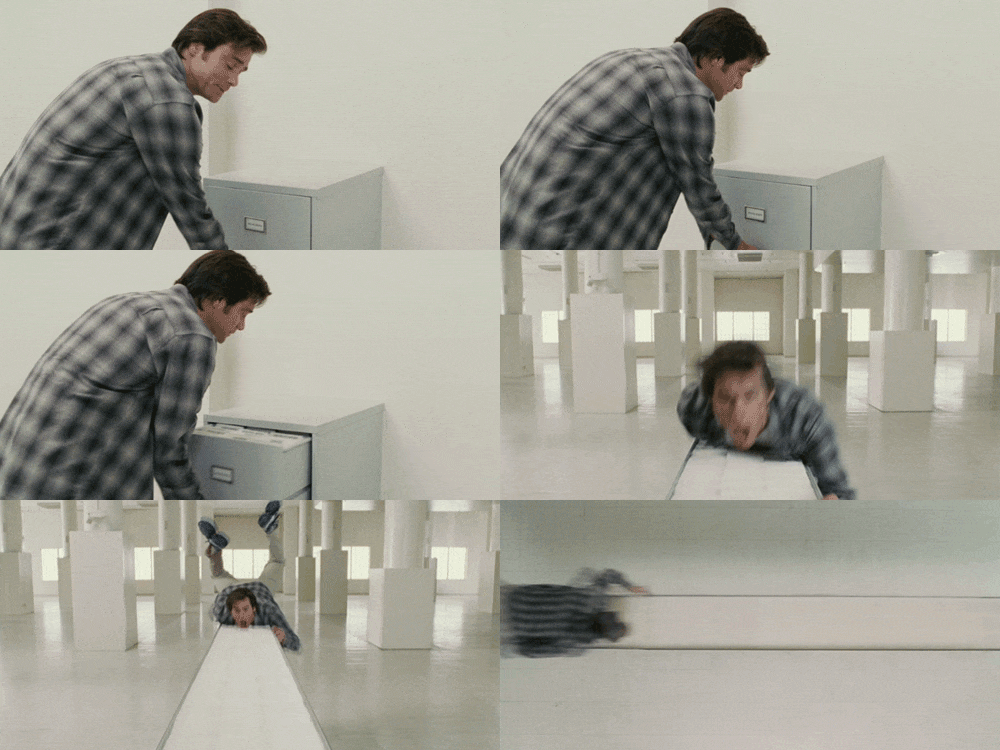
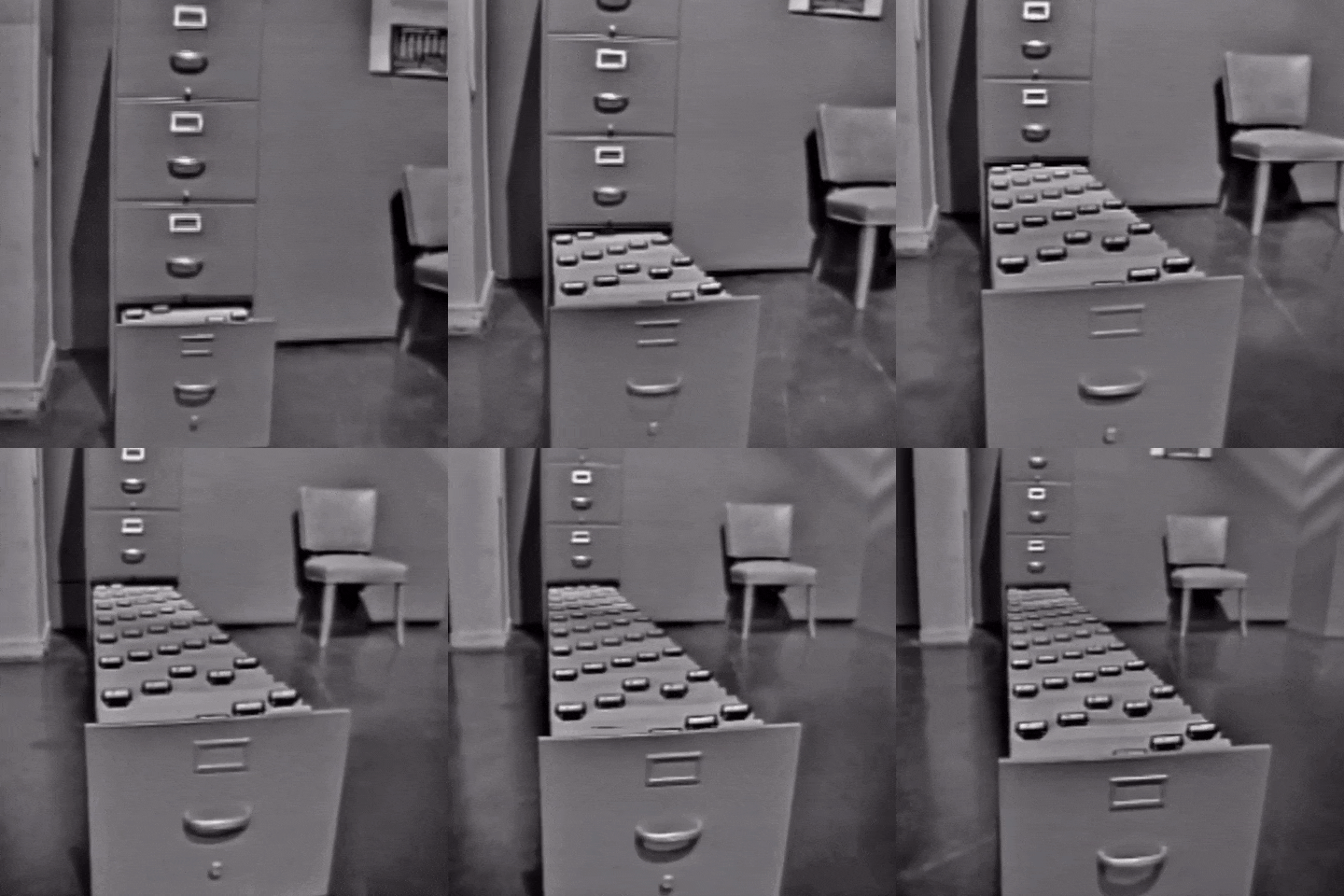
- Filing cabinet :whale:
---
### Why does it matter? :frog:
- O(n^2) Exponential - for each iteration of the first loop (potential length n), another loop of potential length n takes place
- It doesn't matter too much when dealing with small inputs but beyond that it is very beneficial to increase the efficiency of our code
----
- Compare O(n^2) with O(n):
- Array of 3: 9 vs. 3 = not so bad
- Array of 100: 10,000 vs. 100 = pretty bad huh?
---
### The good stuff - what to do: :pig:
```javascript=1
var twoSum = function(nums, target) {
let obj = {};
for (let i = 0; i < nums.length; i++) {
let required = target - nums[i];
if (obj[required]) return [i, obj[required]];
else obj[nums[i]] = i;
};
};
eg twoSum([1,2,3,4,5,6], 10) = [5, 3]
obj = {1:0, 2:1, 3:2, 4:3, 5:4, 6:5}
```
obj pair = (arrayValue: arrayIndex)
---
### :pig:
for nums array values 1-5, stores values as keys with indexes as values
for num array value 6, searches object for a key of 4, returns value which is nums index.
---
### Why do dat? :bear:
- We now have a for loop and a hash table
- Worst case a hash table has time complexity of O(n)
- We now only need one for loop with a time complexity of O(n)
- Changed time complexity from O(n^2) to O(n).
---
### How do hash tables help us? :bear:
---
- The location in the table is generated based on the value (given a hash).
- Given that value again, you can calculate the same hash as before. Based on the hash, we know where to look in the table
- So you don't need to loop through the whole thing like an array
---
## Questions?

---
## Resources
- [Hash table - why is it faster than arrays?](https://stackoverflow.com/questions/12020984/hash-table-why-is-it-faster-than-arrays)
- [leet code two sum](https://leetcode.com/problems/two-sum/)
{"metaMigratedAt":"2023-06-15T09:55:41.206Z","metaMigratedFrom":"Content","title":"Spike - Gio, Cam, Joe & Het","breaks":true,"contributors":"[{\"id\":\"b6a31e78-07d2-4282-beaf-ce34bf42c9b2\",\"add\":3045,\"del\":959},{\"id\":\"fc28ac9f-05b4-4c0c-ba0f-978abbf9d995\",\"add\":1060,\"del\":1396},{\"id\":\"11eba2be-5fbb-4639-85ec-7ad40264d41d\",\"add\":1180,\"del\":437},{\"id\":\"bd6764bd-ae37-4f90-bb83-98f8266bf1dd\",\"add\":1948,\"del\":301}]"}