:::spoiler UPDATE 2026-05-17 — v5 Dense Qwen3.6-27B vs MoE+MTP same-hardware A/B
The MTP recommendation from v3/v4 above held up against a new comparator: the dense sibling **Qwen3.6-27B**, which fits TP=1 on a single 24 GB 3090 and was hypothesised as a possible cheaper-to-serve alternative for a voice agent.
**Falsified.** On the same s1 (2× RTX 3090 PCIe, vLLM 0.19.1, AWQ-Marlin), 10 prompts × 3 trials × 2 models = 60 streaming SSE samples:
| metric | MoE 35B-A3B + MTP k=3 + TP=2 (production) | Dense 27B no-spec TP=1 | MoE win |
|---|---:|---:|---:|
| TTFT mean (ms) | **178** | 771 | **4.34×** |
| e2e mean (ms) | **274** | 1684 | **6.13×** |
| tok/s mean | **88.0** | 16.2 | **5.42×** |
| tool accuracy | **30/30 (100 %)** | 23/30 (77 %) | +23.3 pp |
No production swap. The dense sibling is not a free upgrade on this hardware for this workload.
**Same-day ERRATA on the v5 release** (transparency): an audit pass after publication surfaced (1) a zh-TW classifier bug that collapsed SIMP into shared — corrected MoE chat-reply counts are 6 TRAD / 3 SIMP (all c1 "你好" trials) / 3 MIX, Dense 5/5 TRAD on its 5 chat replies; (2) the bench SYSTEM_PROMPT is a 4-line stub, not the actual production `robot_brain.py:1292` SYSTEM_PROMPT (60 lines, 8 tools, JSON schema, explicit "你好 → speech only, use greet animation" guidance) — so the 77 % vs 100 % tool-accuracy gap is partly a bench-prompt-under-specification artifact; (3) additional vLLM-config confounds (prefix-caching, `--enforce-eager` / CUDA-graphs differential, `max-num-seqs` 4 vs 1) were not originally disclosed. **Latency findings (TTFT 4.34×, tok/s 5.42×, e2e 6.13×) are compute-bound and remain robust**; tool-accuracy + zh-TW purity need a prompt-matched retest.
Full writeup: [vllm-2x3090 v5_2026_05_17/](https://github.com/thc1006/qwen3.6-vllm-2x3090/tree/master/v5_2026_05_17) · GitHub release with ERRATA: [v5.0](https://github.com/thc1006/qwen3.6-vllm-2x3090/releases/tag/v5.0) · Zenodo DOI: [10.5281/zenodo.20247229](https://doi.org/10.5281/zenodo.20247229)
:::
:::spoiler UPDATE 2026-05-08 — v3 DFlash datapoint + retraction of "hardware-class-independent" framing
Two updates that refine and partly correct the 2026-04-26 banner immediately below.
**1. DFlash via llama.cpp PR #22105 — first public RTX 3090 + DFlash + Q4 datapoint.** Same hardware/model/quant as v2.3, drafter `z-lab/Qwen3.6-35B-A3B-DFlash` (BF16 safetensors → GGUF via the PR's modified `convert_hf_to_gguf.py` with `--target-model-dir`). 5 prompts × 1 trial × 3 draft-max configs.
| method | mean tok/s | vs baseline (138.9) |
|---|---:|---:|
| no spec (baseline) | 138.9 | reference |
| **DFlash `--draft-max=8`** ⭐ | **77.0** | **−44.6 %** ❌ (best DFlash) |
| DFlash `--draft-max=16` | 65.8 | −52.6 % |
| DFlash `--draft-max=4` | 74.9 | −46.1 % |
| (v2.3 reference) Oleg `--draft-min 2 --draft-max 32` | 65.5 | −52.8 % |
DFlash on consumer Ampere with Q4 target is **NET LOSS −44.6 %** at best — slightly less bad than Oleg draft-spec but still net negative. Likely root cause: the BF16-trained drafter conditions on FP16/BF16 target hidden states, which shift subtly under Q4 quantization, breaking drafter–verifier alignment. PR #22105's author already notes the MoE+hybrid path "is currently not optimal" for Qwen3.5/3.6 — our −44.6 % sits inside that envelope. Confirms: **no llama.cpp speculative-decoding method tested gives a positive yield on consumer Ampere with Q4 quantized target.**
Full data + reproducer: [`v3_dflash_2026_05_07/`](https://github.com/thc1006/qwen3.6-speculative-decoding-rtx3090/tree/master/v3_dflash_2026_05_07).
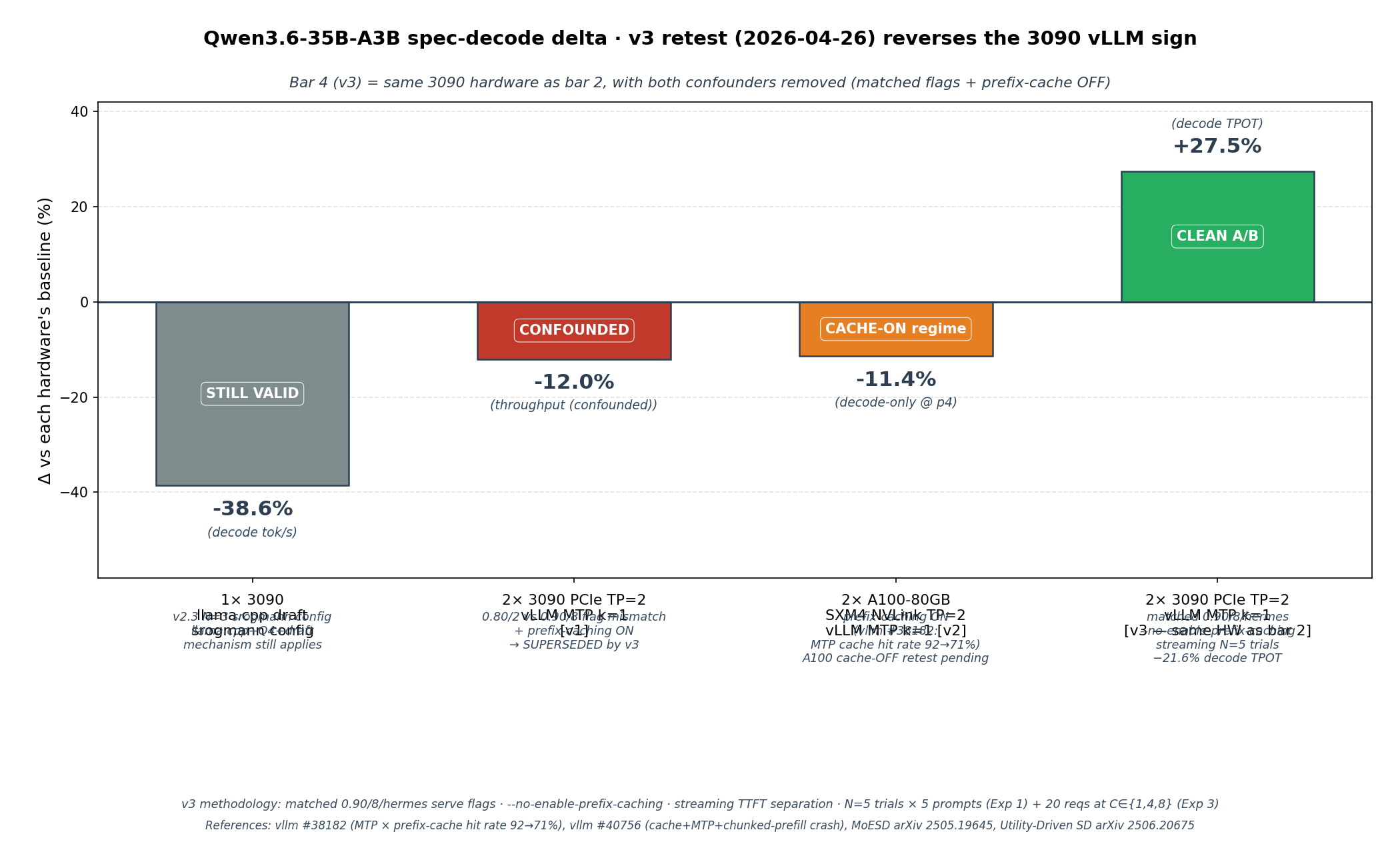
**2. Cross-engine reframe — the regression is NOT "hardware-class-independent".** The 2026-04-26 banner below claims the regression is "hardware-class-independent at single-stream batch=1", based on the A100 NVLink datapoint (−11.4 %) matching the 3090 sign. **That framing is now retracted.** A v3 clean A/B retest on the same 2× RTX 3090 hardware, with matched serve flags AND `--no-enable-prefix-caching` (vLLM 0.19.1 MTP k=1), shows **+27.5 % decode TPOT** vs no-MTP — i.e. MTP *wins* on the same 3090 box once the prefix-cache × MTP interaction ([vllm #38182](https://github.com/vllm-project/vllm/issues/38182), MTP cache hit rate 92 → 71 %) is removed. The original v1 vLLM −12 % was a flag-mismatch confound (`--gpu-memory-utilization 0.80 --max-num-seqs 2` vs `0.90 / 8`); the A100 NVLink −11.4 % is in the cache-ON regime where vllm #38182 still applies. v4 (2026-05-07) confirms +27.5 % holds across k∈{1, 2, 3} and across vLLM 0.19.1 vs 0.20.1 (k=3 is the new TTFT-optimised production setting **on our 2× 3090 PCIe + AWQ + vLLM 0.19.1 stack** — TTFT −33 % / tok/s +8 % vs k=2; [vLLM Recipes](https://docs.vllm.ai/projects/recipes/en/latest/Qwen/Qwen3.5.html)' k=2 default remains the safer cross-hardware starting point, single-card / NVLink / HBM regimes unbenched).
**Corrected framing: the negative finding in this article is engine + spec-method specific to `llama.cpp draft-spec` / `DFlash` on consumer Ampere with Q4 target — NOT hardware-class-independent.** The MoE expert-saturation argument (MoESD / Utility-Driven SD) still explains why llama.cpp's K=5–64 draft-then-verify path loses on consumer Ampere, but does **not** generalise to vLLM MTP k=1 which uses structurally smaller K + a lighter verify path that reuses target hidden states.
Full v3 / v4 vLLM data: [thc1006/qwen3.6-vllm-2x3090](https://github.com/thc1006/qwen3.6-vllm-2x3090).
**Attribution note (2026-05-10 audit)**: the `--no-enable-prefix-caching` recommendation for latency-focused MTP serving was already documented by [vLLM Recipes](https://docs.vllm.ai/projects/recipes/en/latest/Qwen/Qwen3.5.html) in its 2026-04-24 revision — two days before our v3 publication — citing a KV-capacity argument ("speculative tokens consume KV cache capacity, reducing effective batch size"). Our v3 contribution is **quantification** (+27.5 % decode rate vs cache-ON baseline on dual 3090 PCIe + AWQ + Qwen3.6-35B-A3B), **confound decomposition** (matched-flag fix ≈ 30 pp + cache-OFF ≈ 10 pp), and **mechanism link** to vllm #38182's `single_type_kv_cache_manager.py:L457` force-drop bug (a different mechanism than the KV-capacity one Recipes cites; not addressed by Recipes). The cache-OFF preference appears A3B-class specific — Qwen3.6-27B dense + cache-ON + MTP k=3 has been [independently reported working at 97/95/91 % per-position acceptance](https://medium.com/@fzbcwvv/an-overnight-stack-for-qwen3-6-27b-85-tps-125k-context-vision-on-one-rtx-3090-0d95c6291914), so #38182 is best read as a Qwen3.5/3.6 A3B issue, not a Qwen3-family-wide rule.
:::
:::spoiler UPDATE 2026-04-26 — cross-hardware A100 NVLink clean A/B + N=3 replication
Two follow-ups today:
**1. A100 NVLink clean A/B (Modal)** — `vllm/vllm-openai:v0.19.1`, identical serve flags between no-MTP and MTP runs (`--gpu-memory-utilization 0.90 --max-num-seqs 8 --tool-call-parser hermes`). Same 5-prompt set, max_tokens=200, temperature=0.5, seed=42. Prompt-4 decode-only delta **−11.4 %** (TTFT-adjusted; varies <0.2 pp across TTFT ∈ [0, 200 ms] because both arms share the same TTFT for the same prompt content). This rules out two natural-sounding hypotheses:
- ❌ "GDDR6X memory bandwidth is the bottleneck" — HBM2e 2 TB/s shows the same magnitude regression
- ❌ "PCIe Gen4 x8 allreduce is the bottleneck" — NVLink ~600 GB/s shows the same magnitude regression
The mechanism is therefore **hardware-class-independent at single-stream batch=1**, consistent across consumer Ampere + datacenter Ampere (and Hopper H20-3e per [vllm #38182](https://github.com/vllm-project/vllm/issues/38182), Qwen3.5-35B-A3B-FP8 + MTP drops prefix-cache hit rate ~92 % → ~71 %).
**2. N=3 trial replication on a fresh standalone 3090** — addresses the N=1 caveat from v2 limitations. Numbers:
| Config | mean tok/s | run-to-run stdev | v2 published | match |
|---|---:|---:|---:|---|
| baseline | 139.19 | 0.105 | 139.9 | <0.5 pp |
| Oleg `--draft-min 2 --draft-max 32` | 65.24 | 0.057 | 65.0 | <0.3 pp |
| srogmann `--draft-min 48 --draft-max 64` | 85.50 | 0.086 | 85.6 | <0.2 pp |
→ v2 numbers are **N=3 reproducible**, not single-trial flukes.
**Cross-engine corroboration on DGX Spark GB10 forum threads** (April 2026, multiple users on `developer.nvidia.com`): same negative direction reported across vLLM FP8 + MTP-2, SGLang EAGLE3 (−48 % to −58 %), and DFlash spec-decode. The exceptions where spec-decode wins on Spark are batched serving (multi-user concurrency) or structured workloads (code/JSON/Q&A) where prompt entropy is low enough for high acceptance + small expert union — both of which are outside this bench's single-stream voice-dialog scope.
Full data: [thc1006/qwen3.6-vllm-2x3090](https://github.com/thc1006/qwen3.6-vllm-2x3090) (`results/modal_2x_a100_v2.json`, `analysis/plot_cross_hardware.png`).
The v1/v2 conclusions stand and now span more hardware than originally claimed: **single-stream spec-decode for ~3 B-active MoE is a net loss across hardware classes (consumer Ampere, datacenter Ampere with NVLink, Hopper, datacenter Blackwell on Spark per cross-engine forum reports), engines (llama.cpp, vLLM, SGLang), and quantisations (Q4_K_M, AWQ-Marlin Q4, FP8, NVFP4) tested**. The mechanism tracks MoE-Spec / Utility-Driven SD theory: K (1–32) ≪ T_thres ≈ 94, so verify pass loads expert-union with no amortization vs autoregressive — independent of memory bandwidth class.
:::
:::spoiler UPDATE 2026-04-22 — v2 follow-up bench
In response to [Oleg-dM's comment on the HF discussion](https://huggingface.co/unsloth/Qwen3.6-35B-A3B-GGUF/discussions/14), I re-ran the draft-model sweep on a fresh single-3090 box, plus a cross-check on current llama.cpp master `bcb5eeb64`. Short version:
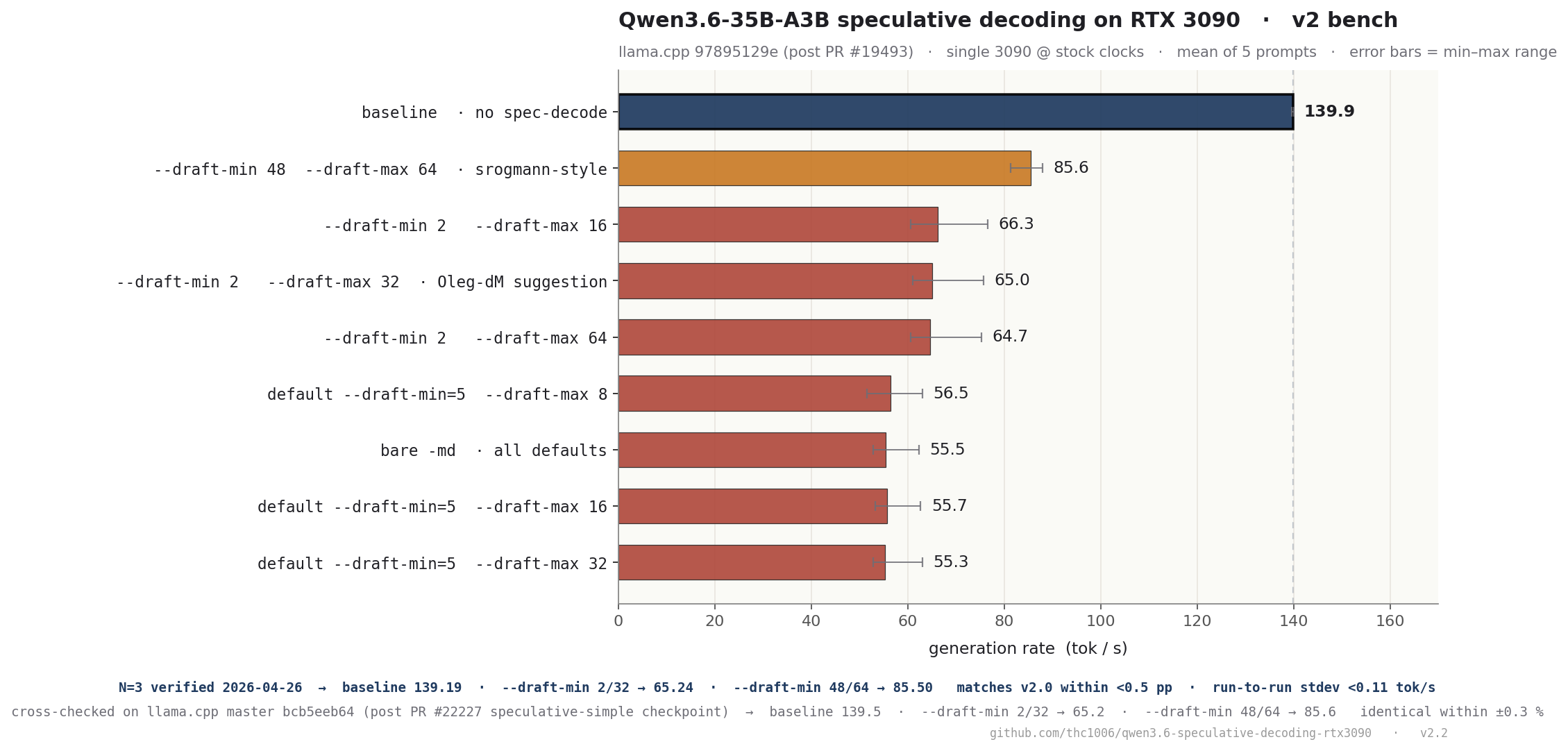
- Oleg's `--draft-min 2 --draft-max 32` does beat the `--draft-min=5` defaults (65 vs 55 tok/s) but is still **−54 %** vs baseline 139.9.
- Aggressive `--draft-min 48 --draft-max 64` is the **least bad** recipe at **−39 %** — counter-intuitively the "wasteful" config amortises overhead better.
- 100 % acceptance is genuine (source read + `--verbose` confirm).
- Master gives same results ±0.3 % — not a stale-commit issue.
- Bottom line of the original post holds: **no spec-decode configuration on consumer 3090 beats baseline for this model+quant.**
Full v2 data + logs + master cross-check: [[Link](https://github.com/thc1006/qwen3.6-speculative-decoding-rtx3090/tree/master/v2_3090_followup)]
Read on for the original writeup; the v2 appendix at the bottom has the full result table.
:::
# Tested every llama.cpp speculative-decode mode on Qwen3.6-35B-A3B + RTX 3090 — none of them are faster than baseline
**TL;DR** — I ran a 19-configuration matrix of speculative decoding on Qwen3.6-35B-A3B (UD-Q4_K_XL, via llama.cpp commit 9789512, post PR #19493 merge) on a single RTX 3090. **None of the spec-decode modes — ngram-cache, ngram-mod (including srogmann's recommended n=24 --draft-min 48 --draft-max 64), or classic `--model-draft` with the vocab-matched Qwen3.5-0.8B — achieves net speedup over baseline.** Mean decode drops 3–12 %, with a bimodal tail of 59–67 tok/s on reasoning / code prompts *despite 100 % draft acceptance*.
### Numbers (single 3090, 24 GB, SM 8.6, Q8_0 KV, greedy, batch=1)
| config | mean | min | std | draft_accept |
|--------------------------|--------|--------|-------|------------------|
| **baseline** | 135.7 | 135.3 | 0.3 | — |
| ngmod-n32 | 133.7 | 133.5 | 0.1 | 0 %(never hits) |
| ngmod-n{8,12,16,20,24} | 129–131| 120–130| 2–5 | 100 % |
| **ngcache-kv-fp16** | 121.3 | 67.3 | 27.6 | 100 % |
| **draft-q35-08b-max{8,16,32}** | 120–121 | **59–65** | **~30** | 100 % |
| draft-q35-08b-1000tok | 120.2 | 64.8 | 28.3 | 100 % |
| ngram-cache | 119.1 | 65.3 | 27.8 | 100 % |
| ngcache-1000tok | 115.9 | 60.0 | 28.7 | 100 % |
### Controls (ruled out)
- Reproduction: baseline-rerun 135.5, ngcache-rerun 118.8 — std within a config ≤ 0.4, so the regression isn't jitter.
- **KV quant is not the cause** — switching `-ctk q8_0 -ctv q8_0` → fp16 KV leaves `ngram-cache` at 121.3 tok/s mean.
- **Output length is not the cause** — 300 → 1000 tokens keeps every ratio.
- **Draft-model vocab** — I initially tried `qwen3:0.6b` (vocab 151936) which silently failed (`failed to create draft context`). The correct draft is **Qwen3.5-0.8B** (vocab 248320, matching the target). That one *loads* and drafts and still loses.
### Why
The pattern matches [MoESD (arXiv 2505.19645)](https://arxiv.org/html/2505.19645) and [Utility-Driven SD for MoE (arXiv 2506.20675)](https://arxiv.org/pdf/2506.20675). With A3B (3 B active, 8-of-256 routed, sparsity 0.031), the expert-saturation threshold `T_thres ≈ 94` is well above any realistic draft K. Each drafted token pulls a fresh expert slice through the memory hierarchy, and on a bandwidth-bound 3090 the verification pass pays for the union. 100 % acceptance cannot rescue it.
**Counter-evidence**: srogmann's own benchmark on Qwen3.5-**122B-A10B** (10 B active) in PR #20075 gets +15–45 % from the same machinery. The issue is class-specific to A3B / small-active MoE, not a general regression of PR #19493.
### Practical takeaway
If you run Qwen3.6-35B-A3B on a consumer 3090 today: **don't enable spec-decode**. Just `llama-server -m Qwen3.6-35B-A3B-UD-Q4_K_XL.gguf -ngl 999 -c 16384 -fa on -ctk q8_0 -ctv q8_0` gives you 135.7 tok/s, which is already +27 % vs Ollama 0.20.7 (107 tok/s) on the same hardware.
### Reproducibility
Full raw JSON per request, 3 plots, aggregated CSV, `BENCHMARK_ENV.md` (hardware / driver / CUDA / commit / model SHA256), and the exact `run_*_matrix.sh` — everything at:
**https://github.com/thc1006/qwen3.6-speculative-decoding-rtx3090**
PR #19493 comment with the same data: https://github.com/ggml-org/llama.cpp/pull/19493#issuecomment-4285150166
If you're on a different Ampere card (3060 Ti / 3080 / A4000 / A5000) — would love a replication, happy to merge your JSON into the repo.
---
# v2 Appendix · Follow-up bench (2026-04-22)
Context: two days after the original writeup, Oleg-dM raised three critiques in [HF discussion #14](https://huggingface.co/unsloth/Qwen3.6-35B-A3B-GGUF/discussions/14):
1. `n_acc_tokens / n_gen_tokens` = 100 % looks off
2. `--draft-min 48` is too aggressive, try `--draft-min 2 --draft-max 32`
3. "failed to create draft context" is probably OOM
Instead of arguing, I re-ran on a fresh single-3090 box.
## Setup
- llama.cpp `97895129e` (original) AND cross-check on master `bcb5eeb64` (post PR #22227 speculative-simple checkpoint)
- RTX 3090 24 GB, single GPU, driver 580.126, CUDA 12.0
- **Stock clocks**, no OC (graphics 1965 MHz current / 2100 max; memory 9751 MHz; power limit 350 W)
- `-ngl 999 -c 16384 -fa on -ctk q8_0 -ctv q8_0 -n 200 --temp 0.5 --seed 42 -no-cnv -st`
- 5 prompts, `/no_think` appended
- Draft model: `unsloth/Qwen3.5-0.8B-Q4_K_M.gguf` (vocab-matched)
## Result chart

## Results on `97895129e` (tok/s, N=5)
| Config | mean | min | max | Δ baseline |
|---|---:|---:|---:|---:|
| **baseline** | **139.9** | 139.7 | 140.0 | — |
| `-md --draft-max 8` (default min=5) | 56.5 | 51.5 | 63.0 | −60 % |
| `-md --draft-max 16` (default min=5) | 55.7 | 53.3 | 62.7 | −60 % |
| `-md --draft-max 32` (default min=5) | 55.3 | 52.9 | 63.1 | −60 % |
| `-md` (full defaults) | 55.5 | 52.8 | 62.3 | −60 % |
| **`--draft-min 2 --draft-max 32` (Oleg)** | **65.0** | 61.0 | 75.8 | **−54 %** |
| `--draft-min 2 --draft-max 16` | 66.3 | 60.6 | 76.6 | −53 % |
| `--draft-min 2 --draft-max 64` | 64.7 | 60.6 | 75.3 | −54 % |
| `--draft-min 48 --draft-max 64` (srogmann) | **85.6** | 81.3 | 88.0 | **−39 %** |
## Cross-check on master `bcb5eeb64`
| Config | `97895129e` | master | Δ |
|---|---:|---:|---:|
| baseline | 139.9 | 139.5 | −0.3 % (noise) |
| Oleg 2/32 | 65.0 | 65.2 | +0.3 % (noise) |
| srogmann 48/64 | 85.6 | 85.6 | 0 % |
## Key findings
### 1. 100 % acceptance is real
`common/speculative.cpp` line ~1194: `impl->n_acc_tokens += n_accepted;` — counter is post-verify. `--verbose` run emits `draft acceptance rate = 1.00000 (115 accepted / 115 generated)`. The 0.8B vocab-matched draft genuinely matches the 35B target on low-entropy prompts.
### 2. Oleg's suggestion beats defaults, still loses to baseline
`--draft-min 2 --draft-max 32` at 65 tok/s is +18 % over the default `--draft-min=5` at 55 tok/s. But -54 % vs no-spec-decode 139.9.
### 3. Counter-intuitive: aggressive wins
`--draft-min 48 --draft-max 64` is the LEAST bad at 85.6 tok/s (-39 %). The large draft window amortises per-verify overhead enough to hide part of the cost.
### 4. Why v1 showed mean 120 and v2 shows mean 55-85
v1's 12-prompt set included chat prompts that exhausted the draft cache quickly, falling back to normal decode (~140 tok/s) — the observed tail at 59-67 is the always-active regime, the baseline-like numbers come from the skipped-spec-decode regime. v1's mean 120 is the mixture.
v2's 5 structured prompts keep spec-decode active throughout, isolating the always-on regime.
### 5. Not a stale-commit artefact
Master `bcb5eeb64` includes PR #22227 speculative-simple checkpoint support — gives same numbers. The regression is architectural.
## Conclusion (v1 + v2 combined)
**Consumer RTX 3090 + Qwen3.6-35B-A3B Q4_K_M: no speculative decoding configuration is a net win**, regardless of commit, regardless of draft-min/max settings, regardless of which regime you measure. The memory-bandwidth × MoE expert-loading math doesn't work on this hardware tier.
H100 / H200 / NVLinked pairs may flip the sign; dual-3090 with PCIe crossing between main-GPU and draft-GPU makes it worse (per Oleg's 80 → 25 tok/s observation in the same discussion).
Full artefacts (per-prompt llama-cli logs, GPU state, verbose dump, master cross-check):
→ https://github.com/thc1006/qwen3.6-speculative-decoding-rtx3090/tree/master/v2_3090_followup
 Sign in via Google
 Sign in via Facebook
 Sign in via X(Twitter)
 Sign in via GitHub
 Sign in via Dropbox
 Sign in with Wallet
Connect another wallet
Sign in with Wallet
Connect another wallet