# Spending bitcoin with non-custodial EMV
Abusing the Visa&Mastercard protocol to sign UTXOs with no privkey exposure
---
### [silur@hcpp.cz ~]$ whoami
- Hacker @ 0.0.0.0/0
- Cryptographer @ QANPlatform, CasperLabs, MTA Wigner and others
- Blockchain architect&consultant
- Bug bounty hunter
- Malware analyst
---
## Agenda
- An ancient problem - credit cards & bitcoin
- HW wallets and compatibility
- EMV history
- EMV Protocol overview
- Attack assumptions
- Abuse of protocol for BTC
---
## Only 1% of the population own coins
- Most end-users are dumb for new tech
- UX of btc is **great**, decentralized thinking is the hard part
- Backward-compatibility usually helps with tech but not so easy with crypto
---
## Not so clever plays (personal bias alert)
- Stablecoins :poop:
- App-only banks "supporting" crypto
- Spend-fiat, exchange crypto after settlement interval
- Real-time fiat exchange in custodial wallets
---
## More clever plays
- HW wallets like Trezor, Ledger
- But they need separate apps, APIs
- (e)Commerce can't keep up with new stuff
- Some HW hacks have been introduced recently
- Exotic operations are not possible (no monero stealth support)
---
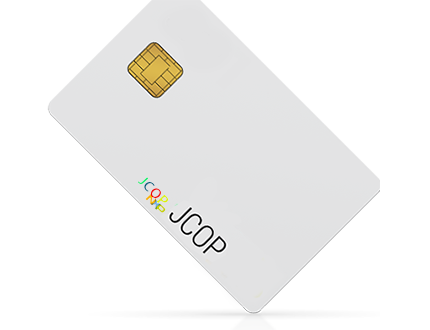
## My favorite hardware for security:
---
## Why?
- I don't know of any recent CC hacks on hardware level
- Backward-compatible
- Intuitive to most people (2.5 Billion cards out there.. excluding the US!)
- Affordable compared to Ledger and friends
- Support fun crypto like AES256, SHA256, and EC arithmetics generalized to GFp (support curve25519), stealth addrs, maybe even bulletproofs
---
## Requirements of this talk
- Standard, commercially available JCOP card
- Private key stays on the card, signs in place
- Reader/terminal is unmodified
- The tech does not imply fiat in the process (legal part might do)
---
## Equipment?

---
## Remember Max Butler & Friends?
- After CardingForums, Ic3man, Script and other carding gods, EMV came into play
- Europay + Mastercard + Visa
- Flexible, secure protocol for payment
- Channel-agnostic (physical reader or NFC)
- Carding came to a halt (or at least slowed down)
---
## TL;DR EMV - important fields
- Most fields use ASN.1 BER format
- ATC - 16bit counter that the card and the issuer both increment with every TX
- AID = RID + PIX app id
- PDOL - processing options data list
- Issuer certificate & "contact info" in x509
- TVR - 8-bit end result of the transaction
---
## TL;DR EMV - communication
- Uses standard T0 APDU format:
```ascii
[CLA][INS][P1][P2][P3]
| |
class instruction
```
---
## Step 1 - Select app
- ... not really useful because 99% of banks issue only one app (that you actually use)
- We can make coin/wallet-specific slots here, each with their own files
---
## Step 2 - getProcessingOptions
- This is the first operation that increments the ATC so take care when testing
- Provides the PDOL to the reader which will determine our processing decision tree later
---
## Step 3 - read app data
- Interestingly you cannot specify which files to read, it's all-or-nothing so encrypt well...
- Which we thankfully support on the card (AES256, even ECIES)
---
## Step 4 - check 1
- based on the provided app data (expiry, app versions) mask (binary OR) some TRV bits
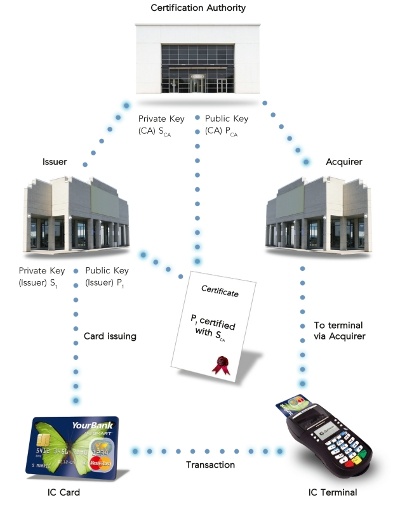
- ODA auth - shortly verify the certificate chain and crypto signature of the card issuer
---
## CA you say?
---
## Not only banks can self-sign certs
- Several airline loyalty cards - https://cards.barclaycardus.com/cards/barclaycard-arrival-plus-world-elite-mastercard.html
- Disney - https://creditcards.chase.com/credit-cards/disney-premier
- Travel agencies - https://www.citi.com/credit-cards/credit-card-details/citi.action?ID=expedia-rewards
- Sports events & programs - https://www.discover.com/credit-cards/cash-back/nhl-card.html
---
## Step 5 - check 2
Cardholder verification either with:
- Cryptographic Signature
- Offline plaintext PIN
- Offline enciphered PIN ( EU )
- Offline plaintext PIN + signature
- Offline enciphered PIN + signature
---
## Step 6 risk management
- Reader & card must aggree on whether continue online or offline
- Reader has more power
- only a small number of offline ATC increments can be made
- This is the part where ATC mismatch result in card blocks and fraud response
---
## Step 7 - send transaction online
- Thankfully the send endpoint is stored on the card as an AFL - we can set up our own backend
- Transactions are packed into a so-called ARQC which is basically the description what we pay for and how much
- **ARQC has no specified format**
- ... so it can be an UTXO!
---
## Step 8 - optional second card action
... basically callbacks with AFL fields to send back to the bank
---
## Step 9 - process scripts
- The ARPC (ARQC response) can have arbitrary, encrypted script to be run on the chip card, undreadable to the reader
---
## The attack:
Assumptions:
- We are signed by a CA (otherwise you are committing CC fraud :)
- We have a synced full node
- We'll use online auth to support ATMs too
- We don't care how the settlement interval is closed (for legal reasons :)
---
- Issuer info is stored on the card
- Acquirer communicates with this issuer
- No technical restriction to make your backend
---
- The card stores the xpub + the UTXO list (these cards have 144kb memory)
- Meanin spends outside of the card breaks it (just like the standard ATC)
- getProcessingOptions should return an Online verification + PIN
- the ARQC is formatted as the signed UTXO which the acquirer forwards to the issuer (us)
- We validate the signature and the transaction sanity
- Forward ARPC trough the acquirer with the new UTXOs as a script
- **Whatever the issuer claims here is unquestioned truth**
---
- At this point, both the card and the reader/terminal have done it's risk management steps, the issuer have the final say on the TX validity.
- Scripts can be arbitrary javacard code, we can store our UTXOs or even replace keys
---
## Settlement?
- Usually a 5-7 day interval
- .. but banks use legacy software, it's much more chaotic
- You don't get a CA signature without due diligence
- But self-signing is not that hard (much easier than getting money transmit etc licenses)
---
## An extra assumption
IF we modify the reader side we can eliminate the settlement issue with mastercard with a separate app besides the unmodified MC AID.
---
## Thanks
Also thanks for Max Hillebrand for pointing out some issues with this attack \o
 silur@cryptall.co
 @Huohuli
{"metaMigratedAt":"2023-06-15T13:34:59.074Z","metaMigratedFrom":"Content","title":"Spending bitcoin with non-custodial EMV","breaks":true,"contributors":"[{\"id\":\"f4d4af67-750e-4c99-b33e-c04b6d99a6c6\",\"add\":7054,\"del\":69}]"}