LinuxOS Project1
=
###### tags: `Course - Linux OS`
## 小組名單 - 第20組
108502532 丁麒源
108502533 廖宥霖
108502530 曹鈞翔
## 補交內容
### SYSCALL_DEFINEx 與 asmlinkage
SYSCALL_DEFINEx 與 asmlinkage都是讓function call與底層溝通的syscall
asmlinkage代表 此函式需遵從 C 語言在此平台下的呼叫慣例,例如x86-32核心中,c function就會從stack而不是register取參數
而SYSCALL_DEFINEx則包含了一個重要的功能,就是讓64 位元的kernel中,32 位元長的值有正確的符號擴展(sign-extended),這是為了防止Linux CVE-2009-0029漏洞被利用。
## Target

- Text (code) Segment: `start_code`(低), `end_code`(高)
- Data Segment : `start_data`(低), `end_data`(高)
- Bss Segment : `end_data`之上
- Heap Segment : `start_brk`(低), `brk`(高)
- Stack Segment : `start_stack`(高),
- mmap Segment(share libraries, thread stack...) : `mmap_base`(高)
## ==執行結果==

* ?代表不確定該處是否存在segment分界
```
thread: main (pid 2707)
virtual addresses of variables:
<code()>: '0x555555555249'
<data>: '0x555555558010'
<bss>: '0x555555558018'
<heap>: '0x5555555592a0'
<mmmap>: '0x7ffff7ffa000'
<stack>: '0x7fffffffddb2'
virtual addresses of segment pointers:
Code Segment:
<start_code>: '0x555555555000'
<end_code>: '0x555555555629'
Data Segment:
<start_data>: '0x555555557d78'
<end_data>: '0x555555558015'
Heap Segment:
<start_brk>: '0x555555559000'
<brk>: '0x55555557a000'
Stack Segment:
<start_stack>: '0x7fffffffdf00'
mmap Segment:
<mmap_base>: '0x7ffff7fff000'
===========================================
thread: t1 (pid 2708)
virtual addresses of variables:
<code()>: '0x555555555249'
<data>: '0x555555558010'
<bss>: '0x555555558018'
<heap>: '0x7ffff0000b70'
<mmmap>: '0x7ffff7fbb000'
<stack>: '0x7ffff7d88e42'
virtual addresses of segment pointers:
Code Segment:
<start_code>: '0x555555555000'
<end_code>: '0x555555555629'
Data Segment:
<start_data>: '0x555555557d78'
<end_data>: '0x555555558015'
Heap Segment:
<start_brk>: '0x555555559000'
<brk>: '0x55555557a000'
Stack Segment:
<start_stack>: '0x7fffffffdf00'
mmap Segment:
<mmap_base>: '0x7ffff7fff000'
===========================================
thread: t2 (pid 2709)
virtual addresses of variables:
<code()>: '0x555555555249'
<data>: '0x555555558010'
<bss>: '0x555555558018'
<heap>: '0x7fffe8000b70'
<mmmap>: '0x7ffff7fba000'
<stack>: '0x7ffff7587e42'
virtual addresses of segment pointers:
Code Segment:
<start_code>: '0x555555555000'
<end_code>: '0x555555555629'
Data Segment:
<start_data>: '0x555555557d78'
<end_data>: '0x555555558015'
Heap Segment:
<start_brk>: '0x555555559000'
<brk>: '0x55555557a000'
Stack Segment:
<start_stack>: '0x7fffffffdf00'
mmap Segment:
<mmap_base>: '0x7ffff7fff000'
===========================================
```
### Variables' address
`code` : __all the same, between `start_code` and `end_code`__
`data` : __all the same, between `start_data` and `end_data`__
`bss ` : __all the same, above `end_data`__
`heap` : __3 different address, only main heap between `start_brk` and `brk`, the others below `mmap_base`__
`mmmap`: __3 different address, all below `mmap_base`__
`stack`: __3 different address, only main stack above `mmap_base`, the others below `mmap_base`__
### Segment pointers' address
:::info
listed from low address to high address
:::
Code segment:
- `start_code`: __all the same__
- `end_code`: __all the same__
Data segment:
- `start_data`: __all the same__
- `end_data`: __all the same__
Heap segment:
- `start_brk`: __all the same__
- `brk`: __all the same__
mmap segment:
- `mmap_base`: __all the same__
Stack segment:
- `start_stack`: __all the same__
### 說明&分析
:::success
From above result, we can know that threads share the code, data, BSS, heap segments and mmap segment. But they each has their own stack.
:::
***1. Why the results from variable `stack` and `start_stack` are different?***
- Because `start_stack` is pointer to the main thread's stack segment, and `stack` is ponter to address in each thread's stack segment. The thread's stack segment is in the mmap segment.
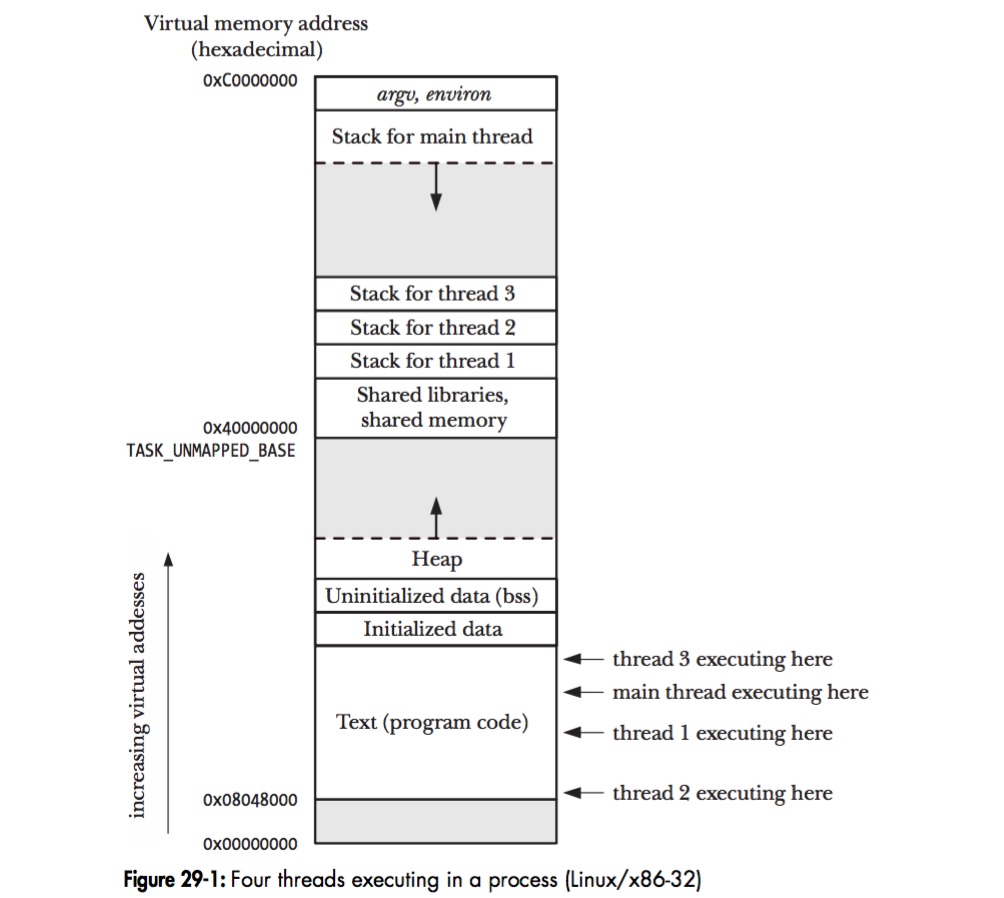
***2. Address is distribed the same as the following image***
- **increasing** in the order of **code->data->Bss->heap->mmap->stack**
***3. `task_struct & mm_struct`***

- Linux processes are implemented in the kernel as instances of task_struct, the process descriptor.
- The mm field in task_struct points to the memory descriptor, mm_struct, which is a summary of a program's memory.
- Within the memory descriptor we can find the set of virtual memory areas and the page tables.
- We can find each segment's start and end virtual address using virtual memory area.
***4. `mmap()` (user mode function)***
- The dynamic linker uses mmap() *with NULL as the addr argument to load pages of the shared library.
The address that the library gets mapped to depends on factors such as:
- mmap_base (below stack by default on x86-64, with 28 bits of randomness):
see `arch/x86/mm/mmap.c`
- the size of the file and previous mappings
- Stack space for a new thread is also created by the parent thread with mmap(MAP_ANONYMOUS|MAP_STACK).
So they're in the "memory map segment", as we see in our result.
- When a thread use malloc(), OS will use mmap() to allocate memory to it. As we see in heap viriable's pointer.
***5. `current` (kernel mode function)***
/include/asm-generic/current.h

/arch/alpha/include/asm/thread_info.h

## Kernel and OS version
:::success
kernel: Linux-5.15.68
OS: Ubuntu-22.04 64bit (WSL)
:::
## Add new system call and Compile kernel
### Download WSL kernel
```bash=
wget https://github.com/microsoft/WSL2-Linux-Kernel/archive/refs/tags/rolling-lts/wsl/5.15.68.1.tar.gz
tar -xvf WSL2-Linux-Kernel-rolling-lts-wsl-5.15.68.1.tar.gz -C ~/
```
### Define new system call
```bash=
cd WSL2-Linux-Kernel
mkdir get_segment_info
nano get_segment_info/get_segment_info.c
```
### ==Kernel space code==
#### `get_segment_info.c`
```c=
#include <linux/types.h>
#include <linux/syscalls.h>
#include <linux/kernel.h>
#include <linux/sched.h>
#include <linux/ptrace.h>
#include <linux/thread_info.h>
#include <asm/current.h>
struct segment_info
{
unsigned long start_code, end_code;
unsigned long start_data, end_data;
unsigned long start_brk, brk;
unsigned long start_stack;
unsigned long mmap_base;
};
SYSCALL_DEFINE1(get_segment_info, void *, dsi)
{
struct segment_info si = {
.start_code = current->mm->start_code,
.end_code = current->mm->end_code,
.start_data = current->mm->start_data,
.end_data = current->mm->end_data,
.start_brk = current->mm->start_brk,
.brk = current->mm->brk,
.start_stack = current->mm->start_stack,
.mmap_base = current->mm->mmap_base,
};
if (copy_to_user((struct segment_info *)dsi, &si, sizeof(si)))
return -1;
return current->pid;
}
```
### Create Makefile for your system call
```bash=
nano get_segment_info/Makefile
```
write the following code
```Makefile=
obj-y := get_segment_info.o
```
### Add the home directory of your system call to the main Makefile of the kernel
```bash=
nano Makefile
```
Search for `core-y`. In the second result, you will see a series of directories.
```
kernel/ certs/ mm/ fs/ ipc/ security/ crypto/ block/
```
add ` get_segment_info/` in the end of it
```Makefile=
kernel/ certs/ mm/ fs/ ipc/ security/ crypto/ block/ get_segment_info/
```
### Add a corresponding function prototype for your system call to the header file of system calls
```bash=
nano include/linux/syscalls.h
```
Navigate to the bottom of it and write the following code just above `#endif`.
```c=
asmlinkage long sys_get_segment_info(void *);
```
### Add new system call to kernel's system call table
```
nano arch/x86/entry/syscalls/syscall_64.tbl
```
Add the following code at the end 0f 64-bit system calls (use tab for spacing).
```
449 common get_segment_info sys_get_segment_info
```
### Compile and change WSL kernel
```bash=
sudo apt install build-essential flex bison dwarves libssl-dev libelf-dev
make -j$(nproc) KCONFIG_CONFIG=Microsoft/config-wsl
```
Keep pressing enter to use default config.
After compiling, return to host and type the following text in `%USERPROFILE%\.wslconfig` (remember to move the image file to host's directory first):
```
[wsl2]
kernel=<path_of_vmlinux>
```
Then reboot WSL.
```powershell=
wsl --shutdown && sleep 10 && wsl
```
## ==User space code==
### `main.c`
```c=
#include <stdio.h>
#include <stdlib.h>
#include <string.h>
#include <sys/mman.h>
#include <sys/types.h>
#include <sys/syscall.h>
#include <pthread.h>
#define __NR_get_segment_info 449
struct segment_info
{
unsigned long start_code, end_code;
unsigned long start_data, end_data;
unsigned long start_brk, brk;
unsigned long start_stack;
unsigned long mmap_base;
};
char isT1Done = 0;
char isT2Done = 0;
char *code() { return "code"; }
void print_segment_info(char *thread_name)
{
if (thread_name[1] == '2')
{
while (!isT1Done)
;
}
static char data[5] = "data";
static char bss[4];
char *heap = (char *)malloc(sizeof(char) * 5);
char *mmmap = mmap(NULL, 5 * sizeof(char), PROT_READ | PROT_WRITE, MAP_PRIVATE | MAP_ANONYMOUS, 0, 0);
char stack[6] = "stack";
struct segment_info si;
printf("thread: %s (pid %d)\n", thread_name, syscall(__NR_get_segment_info, &si));
printf("virtual addresses of variables:\n");
printf("<code()>:\t'%p'\n", code);
printf("<data>:\t\t'%p'\n", data);
printf("<bss>:\t\t'%p'\n", bss);
printf("<heap>:\t\t'%p'\n", heap);
printf("<mmmap>:\t'%p'\n", mmmap);
printf("<stack>:\t'%p'\n", stack);
printf("virtual addresses of segment pointers:\n");
printf("Code Segment:\n");
printf("<start_code>:\t'%p'\n", si.start_code);
printf("<end_code>:\t'%p'\n", si.end_code);
printf("Data Segment:\n");
printf("<start_data>:\t'%p'\n", si.start_data);
printf("<end_data>:\t'%p'\n", si.end_data);
printf("Heap Segment:\n");
printf("<start_brk>:\t'%p'\n", si.start_brk);
printf("<brk>:\t\t'%p'\n", si.brk);
printf("Stack Segment:\n");
printf("<start_stack>:\t'%p'\n", si.start_stack);
printf("mmap Segment:\n");
printf("<mmap_base>:\t'%p'\n", si.mmap_base);
printf("===========================================\n");
if (thread_name[1] == '1')
{
isT1Done = 1;
while (!isT2Done)
;
}
else if (thread_name[1] == '2')
{
isT2Done = 1;
}
free(heap);
}
int main()
{
print_segment_info("main");
pthread_t t1, t2;
pthread_create(&t1, NULL, print_segment_info, "t1");
pthread_create(&t2, NULL, print_segment_info, "t2");
pthread_join(t1, NULL);
pthread_join(t2, NULL);
}
```
## 參考資料
Add new system call:
https://dev.to/jasper/adding-a-system-call-to-the-linux-kernel-5-8-1-in-ubuntu-20-04-lts-2ga8
Replacing the WSL Kernel:
https://blog.dan.drown.org/replacing-the-wsl-kernel/
problems and solutions:
https://blog.csdn.net/qq_36393978/article/details/124274364
https://blog.csdn.net/m0_48958478/article/details/121620449
https://blog.csdn.net/bby1987/article/details/104264285
Others:
奔跑吧 CH 3.1 進程的誕生
https://hackmd.io/@PIFOPlfSS3W_CehLxS3hBQ/S14tx4MqP?fbclid=IwAR2yZqy4A92NegOZUj5frnDXKr_8XG_Y8mXJZXq5lboJG2S3OodFTSmACXg
OS Process & Thread (user/kernel) 筆記
https://medium.com/@yovan/os-process-thread-user-kernel-%E7%AD%86%E8%A8%98-aa6e04d35002
linux 内存管理(8) —内存描述符(mm_struct)
https://blog.csdn.net/weixin_41028621/article/details/104455327
Linux进程地址管理之mm_struct
https://www.cnblogs.com/rofael/archive/2013/04/13/3019153.html
Do memory mapping segment and heap grow until they meet each other?
https://unix.stackexchange.com/questions/466443/do-memory-mapping-segment-and-heap-grow-until-they-meet-each-other
mmap()
https://unix.stackexchange.com/questions/466443/do-memory-mapping-segment-and-heap-grow-until-they-meet-each-other
https://ithelp.ithome.com.tw/articles/10187260?sc=rss.iron
https://www.quora.com/What-factors-decides-the-load-address-of-shared-libraries-like-libc
setvbut()
https://stackoverflow.com/questions/5876373/using-setvbuf-with-stdin-stream
How The Kernel Manages Your Memory
https://manybutfinite.com/post/how-the-kernel-manages-your-memory/
malloc() in multi-thread program
https://hackmd.io/@ljP_AG30SzmQE5qO-cjcpQ/HkICAjeJg?type=view#%E8%83%8C%E6%99%AF%E7%9F%A5%E8%AD%98%E8%88%87gblic-Malloc%E5%8E%9F%E7%90%86
系統呼叫(system call)的剖析(上)
https://alittleresearcher.blogspot.com/2015/02/anatomy-of-a-system-call-part-1.html
什麼是 "asmlinkage"?
https://www.jollen.org/blog/2006/10/_asmlinkage.html
Linux CVE-2009-0029 漏洞解析
https://blog.csdn.net/hxmhyp/article/details/22619729
Linux 筆記 3
https://hackmd.io/@combo-tw/Linux-%E8%AE%80%E6%9B%B8%E6%9C%83/%2F%40a29654068%2FHyD4Lu_Dr
 Sign in via Google
 Sign in via Facebook
 Sign in via X(Twitter)
 Sign in via GitHub
 Sign in via Dropbox
 Sign in with Wallet
Connect another wallet
Sign in with Wallet
Connect another wallet