# Tendermint: Byzantine Fault Tolerance in the Age of Blockchains
* Link:: https://atrium.lib.uoguelph.ca/xmlui/bitstream/handle/10214/9769/Buchman_Ethan_201606_MAsc.pdf
* # Background
* Replicated State Machine
* is a deterministic distributed calculation
* It is the responsibility of the consensus protocol to order the transactions so that the resulting state is replicated by every process (node)
* Asynchrony
* Safety
* Nothing bad happens
* Liveliness
* Something good will eventually happen
* Even tough synchronous communications works they still costs a lot to keep "in synch". Such as using atomic clocks in data centers.
* Broadcast Consensus
* RBC
* validity
* message<span> </span>**m**<span> </span>will eventually get delivered
* agreement
* all processes will eventually deliver<span> </span>**m**
* integrity
* **m**<span> </span>is only delivered once and only broadcasted by its sender
* Raft was developed in 2013.
* Byzantine Fault Tolerance
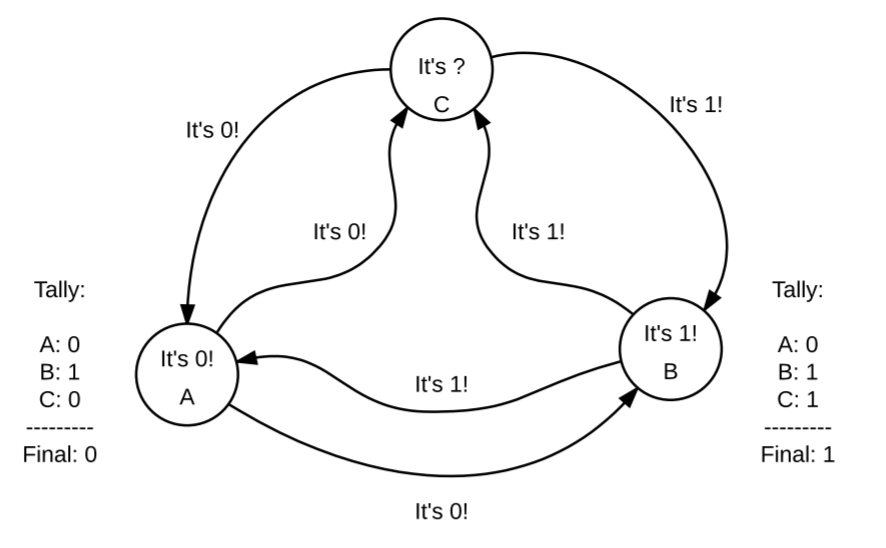
* The number of failures<span> </span>**f**<span> </span>that a Byzantine system can handle is<span style="box-sizing: border-box;"><span class="katex-display" style="box-sizing: border-box; display: block; margin: 1em 0px; text-align: center;"><span class="katex" style="box-sizing: border-box; font: 1.21em / 1.2 KaTeX_Main, "Times New Roman", serif; text-indent: 0px; text-rendering: auto; display: block; text-align: center; white-space: nowrap;"><span class="katex-mathml" style="box-sizing: border-box; border: 0px; clip: rect(1px, 1px, 1px, 1px); height: 1px; overflow: hidden; padding: 0px; position: absolute; width: 1px;"><math><semantics><annotation encoding="application/x-tex">2f+1</annotation></semantics></math></span><span class="katex-html" aria-hidden="true" style="box-sizing: border-box; display: block; position: relative;"><span class="base" style="box-sizing: border-box; position: relative; white-space: nowrap; width: min-content; display: inline-block;"><span class="strut" style="box-sizing: border-box; display: inline-block; height: 0.88888em; vertical-align: -0.19444em;"></span><span class="mord" style="box-sizing: border-box;">2</span><span class="mord mathdefault" style="box-sizing: border-box; font-family: KaTeX_Math; font-style: italic; margin-right: 0.10764em;">f</span><span class="mspace" style="box-sizing: border-box; display: inline-block; margin-right: 0.222222em;"></span><span class="mbin" style="box-sizing: border-box;">+</span><span class="mspace" style="box-sizing: border-box; display: inline-block; margin-right: 0.222222em;"></span></span><span class="base" style="box-sizing: border-box; position: relative; white-space: nowrap; width: min-content; display: inline-block;"><span class="strut" style="box-sizing: border-box; display: inline-block; height: 0.64444em; vertical-align: 0em;"></span><span class="mord" style="box-sizing: border-box;">1</span></span></span></span></span></span>
* The upper bound of faulty process tolerated by Byzantine system is lower than a none byzantine one. This means less process need to fail to break the system. Increasing the number of total processes reduces this fault chance.
* 
* Cryptography, Trust, and Economics
* "It is well known that civilizations that have greater forms of institutional trust, such as the rule-of-law, have higher productivity and more vibrant economies. This is like [[Markets are Eating the World]].
* Cryptography can form the basis of a new form of trust
* Blockchain
* Tendermint was the first proposal to update Byzantine Fault Tolerance algorithm from the 80s
* Process Calculus
* ??
* # Tendermint Consensus
* Consensus is divided in
* Proposals
* A proposed block must be broadcasted to all processes though gossip.
* Proposers are ordered through a deterministic round robin. Because of this every validator knows the correct proposer.
* Liveliness is maintained through cycling of proposers, since others can pick up the dropper proposal.
* Votes
* There are two votes
1. pre-vote
2. pre-commit
1. pre-commits more thatn 2/3rds of majority in the same block is equal to a<span> </span>**commit**
* IF validator does not receive a proposal before<span> </span>**ProposalTimeout**, that validator votes for<span> </span>**nil**
* Voting on<span> </span>**nil**<span> </span>indicates the network that it should move to the next proposer.
* "polka" is a set of more than 2/3rds of prevotes for a single block at a given round
* polka
* nil-polka
* Pre-commit "polka" is a sign to the nextwork that is ready with the current block of the round.
* Locks
* Ensures that now two validators commit a different block at the same height. There is a locking mechanism in the "pre-vote" and "pre-commit" phases.
* Rules:
* Prevote-the-Lock
* the proposer locks on to the block it will proposer. This prevents voting on different blocks on the pre-vote and on a diffrent polka of pre-commit
* Unlock-on-Polka
* This means that a validator is free to vote on new blocks one it has seen its propose block have a polka at a round greater than the lock round.
* The core of the consensus is two messages:
* ProposalMsg
* A proposal for a block
* VoteMsg
* Blockchain
* Why Blocks?
* Bandwidth optimizaitons
* Validators only have to check the block for all of the votes and commits
* Integrity optimizations
* The block hash and the previous block hash helps with integrity
* Increase the minimum latency. Set a time cadence for when the votes and commits should occur.
* Safety
* Atomic broadcast of Tendermint:
* validity
* broadcast of message m eventually delivers m
* agreement
* if m is delivered, eventually all correct processes will deliver m
* integrity
* m is only delivered once and only broadcast by its sender
* total order
* the order of the messages is respected across all correct processes.
* Accountability
* Validators are held accountable
* One is when they propose two blocks within a round
* One is that they vote for conflicting blocks at the same height and commit phases
* By collecting all votes a violaton of the Prevote-the-Lock will be seen.
* Faults and Availability
* clocks of validators do not to be in sync since the clocks<span> </span>**reset**<span> </span>after a validator sees a votes of a polka.
* If 1/3 + 1 vlaidators go down the networks halt since 2/3rds majority cannot be reached.
* # Tendermint Subprotocols
* P2P Networking
* Connects to all peers from an initial list of peers
* Consensus Gossip
* Broadcasts the node's state to all of its peers
* A cheap way to gossip data is using [[Merkle Trees]]
* The proof is small compared to the data size
* The signed proposal includes just the merkle root hash
* Mempool
* Transactions are gossiped using multicast algorithm once they are validated
* Syncing the Blockchain
* When a node connects to a new peer the peer shares its current height
* # Building Applications
* Communication is done with the "Tendermint Socket Protocol (TMSP)")
* Tendermint Socket Protocol (TMSP)
* Applications usually have two components
* Engine
* handles core security, networking, replication
* State-machine
* "Tendermint Socket Protocol (TMSP)"
* This is the interface that connects the consensus engine to the application state machine
* At it is core the two important messages are
* AppendTx
* Commit
* 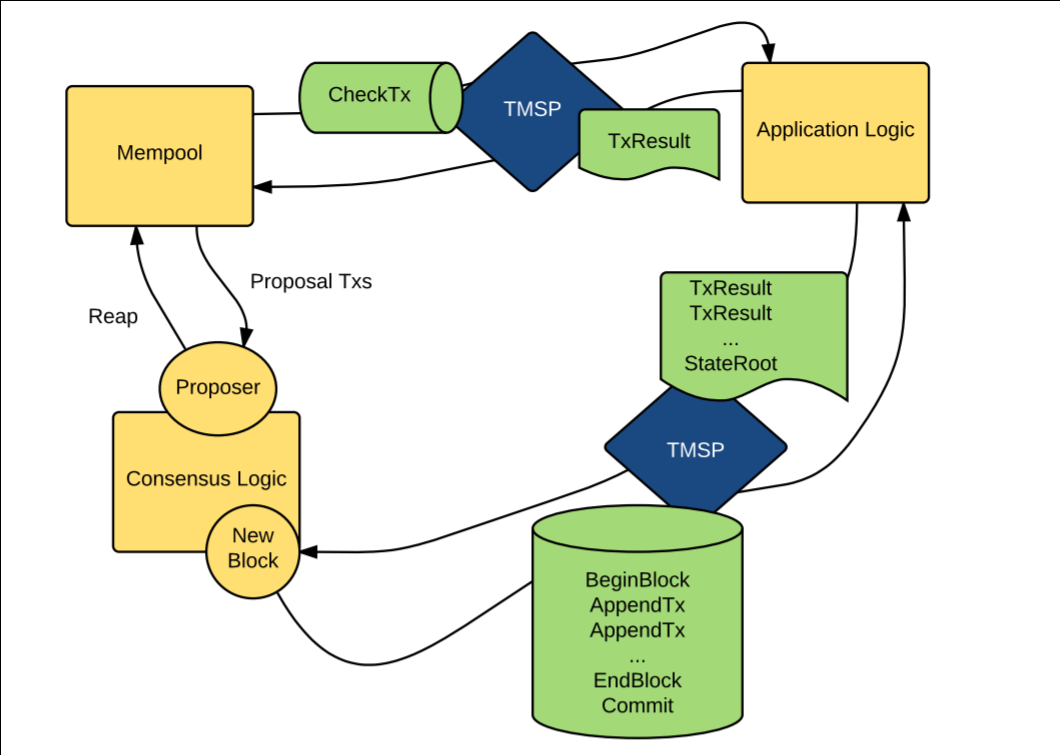
* The AppendTx TMSP call allows the conensus engine to proceed into the commit phase
* Separating Agreement and Execution
* Using the TMSP affords us an explicit separation between consensus, or agreement on the order of transactions, and their actual execution in the state-machine. In particular, we achieve consensus on the
* order first
* then execute the ordered transactions.
* CheckTx can be used as an optimistic execution returning a result to the transaction sender with the caveat that the result may be wrong if a block is committed with a conflicting transaction before the transaction of interest is committed
* Microservice Architecture
* Applications running ontop of "Tendermint Socket Protocol (TMSP)" will propably use microservices.
* "In fact, one might even build an application which can launch sub-applications using data sent in transactions. For instance, including the hash of a docker image in a transaction, such that the image could be pulled from some file-storage backend and run as a sub-application where future transactions in the consensus could cause it to execute."
* Determinism
* All ABCI applications must be deterministic.
* That is, every node must reach the same result
* Using functional programming languages can help
* Using proof methods also helps
* Termination
* The application must stop executing.
* Examples of ABCIs
* Merkleyes
* Basecoin
* Ethereum
* # Governance
* Governmint
* Allows for upgrading of validators sets
* Uses "Quadratic Voting"
* Quadratic Voting
* Validator Set Changes
* Voting power of a validator gets forced to Zero
* If the block at height H returns an updated validator set, then the block at height H + 1 will reflect the update.
* Punishing Byzantine Validators
* Basically slashing
* Software Upgrades
* Crisis Recovery
* Tendermint assures that the misbehaving validators can be identified
* Since 1/3 or more validators violated a lock rule, the network cannot commit for the next block.
* # Client Considerations
* Discovery
* The genesis will always have to be out of band
* Another tendermint protocol could bootstrap the genesis of a new network
* Broadcasting Transactions
* Clients just proxy to validator nodes until the transaction gets added to a block
* ## Mempool
* # Implementation
* Crypography
* RIPEMD160 is the hashing algorithm
* Schorr signatures for signing instead of ED25519
 Sign in via Google
 Sign in via Facebook
 Sign in via X(Twitter)
 Sign in via GitHub
 Sign in via Dropbox
 Sign in with Wallet
Connect another wallet
Sign in with Wallet
Connect another wallet