# Some Research about the Linux Heap
###### tags: `Linux` `security` `project`
<!-- ## 全文連結
> [2022 NCU ADL CTF project2 - 第-1組](https://hackmd.io/@cy023/ByqYfv2vo) -->
## References
> [Heap Exploitation](https://guyinatuxedo.github.io/25-heap/index.html)
[heap-exploitation](https://heap-exploitation.dhavalkapil.com/)
[MallocInternals - glibc wiki](https://sourceware.org/glibc/wiki/MallocInternals)
[Heap Exploit 學習筆記](https://medium.com/@b3rm1nG/heap-exploit-%E5%AD%B8%E7%BF%92%E7%AD%86%E8%A8%98-d724d0afa59b)
[Bins and Chunks - heap-exploitation](https://heap-exploitation.dhavalkapil.com/diving_into_glibc_heap/bins_chunks#unsorted-bin)
[House of Force - heap-exploitation](https://heap-exploitation.dhavalkapil.com/attacks/house_of_force)
[TCACHE exploitation](https://medium.com/@b3rm1nG/tcache-exploitation-871044f8b210
)
[how2heap](https://github.com/shellphish/how2heap)
[opp556687 - Linux heap exploit](https://hackmd.io/@opp556687/BkAm4kiyD)
## Terminologies in the linux heap
### arena
每一個 heap 都屬於一個 arena,一個 arena 可能包含多個 references to heaps 以及 heaps 裡的 linked lists of chunks,也稱為 free lists。被指派至某個 arena 的 thread 就會從此 arena 的 free lists 裡動態配置記憶體。
main arena 使用程式一開始就有的 heap (right after .bss),其餘的則透過 `mmap()` 來分配記憶體給他們的 heap(s)。
### heap
動態分配的 memory (eg: `malloc()` / `new`),為一連續的虛擬記憶體區塊,被細分為許多的 chunks
### chunk
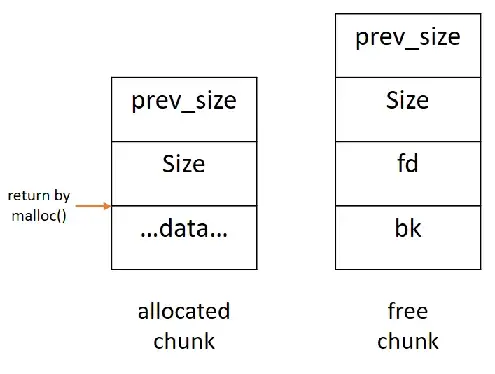
一塊可以被 allocated, freed 或是與鄰近 chunks 結合起來的記憶體區塊,minimum size = `4*sizeof(void*)` (32 bytes in x86_64)
```c
struct malloc_chunk {
INTERNAL_SIZE_T mchunk_prev_size; /* Size of previous chunk, if it is free. */
INTERNAL_SIZE_T mchunk_size; /* Size in bytes, including overhead. */
struct malloc_chunk* fd; /* double links -- used only if this chunk is free. */
struct malloc_chunk* bk;
/* Only used for large blocks: pointer to next larger size. */
struct malloc_chunk* fd_nextsize; /* double links -- used only if this chunk is free. */
struct malloc_chunk* bk_nextsize;
};
typedef struct malloc_chunk* mchunkptr;
```
Free chunks 會以 `fd`, `bk` 串成一個 doubly linked list,allocated chunks 則不會用到這兩個指標,`malloc()` 會回傳原本 `fd` 的位址
Chunk size 恆為 8 的倍數,因此原本 size field 的 3 LSBs 恆為 0不需要儲存,可以當成 flags 來用,其中最後一個位元表示 previous chunk is in use (by the application)
x86_64 系統而言,chunk header 占了 0x10 (16) bytes,因此 data (`malloc()` return 的位址) 是從 `(void *) mchunkptr + 0x10` 的地方開始儲存
### bin
free (available) chunks 會根據大小以不同的串列連結起來,以便 library 可以快速的找到適合的 chunk 以滿足需求,bins 指的就是這些串列
- fast bins: 較小 (64-bit 系統而言貌似是指 size <= 160 bytes, **MAX_FAST_SIZE: 160** in 64-bit system) 的 chunks 會被存在 fast bins 裡面,也就是一個元素為 singly-linked list 的陣列,每個 list/bin 負責維護固定大小的 chunks。被加入 fast bins 的 chunks 不會被與鄰近的 chunk 合併
- unsorted bin: heap 裡僅有一個 unsorted bin,原先屬於 small bins, large bins 的 chunks 被釋放後會被放至此處。之後在 `malloc` 中這些 chunks 才會被排序並被移動至 small, large bins
- small bins: 類似 fast bins 但 small bins chunks 在被加入到 small bins 時會先與鄰近 chunks 結合以合併 (coalesce) 成更大的 chunks,small bins 為雙向鏈結
- large bins: 當一個 chunk 所在的 bin (就是 large bin) 包含了不同大小的 chunks 時 (**MIN_LARGE_SIZE: 1024** in 64-bit system),此 chunk 就被稱為 "large" chunk。與 small bins 一樣,chunks 在被加入到 large bins 時會先與鄰近 chunks 結合以合併 (coalesce) 成更大的 chunks,large bins 為雙向鏈結
- top chunk: 每個 arena 都會紀錄一個 "top" chunk,通常為最大的 available chunk。此為**鄰近 unmapped memory 的 chunk,也就表示其位於 arena 當中最上方 (記憶體位址最大)** 且 top chunk 不屬於任何 bin。**House of force** 攻擊就是透過修改 top chunk 的內容以做到隨機任意記憶體讀寫 ([opp556687 - Linux heap exploit#House-of-Force](https://hackmd.io/@opp556687/BkAm4kiyD#House-of-Force))
### Thread Local Cache (**tcache**)
`malloc` 能夠知道有多個 threads 的存在,但也就僅此而已。`malloc` 中並沒有針對多執行緒的優化,它認定 kernel 會以有效率的方法來處理這些議題
每個執行緒會有一個 thread-local variable ([> Thread-Local Storage](https://web.mit.edu/rhel-doc/3/rhel-gcc-en-3/thread-local.html)) 來表示它最後使用的 arena,若該 arena 正在被使用的話則當另一執行緒需要使用該 arena 時 (為避免 [race condition](https://en.wikipedia.org/wiki/Race_condition)) 此執行緒會被 blocked 直到該 arena 變成 available。
每個執行緒還會有一個稱為 **tcache** 的快取,其中包含了一些不需要 lock 任何 arena 就能直接存取的 chunks,他們以一個元素為 singly-linked list 的陣列來儲存 (像是 fastbins),每個元素連結了單一大小的 chunks,也就是陣列的 index 表示 chunks size。`free()` 的時候會先看看 tcache 有無空間存放目標 chunk,沒有的話才會放到其他 bins
```c
/* We overlay this structure on the user-data portion of a chunk when
the chunk is stored in the per-thread cache. */
typedef struct tcache_entry
{
struct tcache_entry *next;
} tcache_entry;
/* There is one of these for each thread, which contains the
per-thread cache (hence "tcache_perthread_struct"). Keeping
overall size low is mildly important. Note that COUNTS and ENTRIES
are redundant (we could have just counted the linked list each
time), this is for performance reasons. */
typedef struct tcache_perthread_struct
{
char counts[TCACHE_MAX_BINS];
tcache_entry *entries[TCACHE_MAX_BINS];
} tcache_perthread_struct;
```
- `TCACHE_MAX_BINS` 應該是 64
- `tcache_entry` 為單向鏈結串列的節點,`next` 指向下一塊 chunk 的 payload
- `tcache_perthread_struct` 用來維護 thread local cache
- `counts` 表示 bin 裡面的 chunks counts,同個 bin 裡面最多只能放 7 塊,超過的話會被放到 fastbins, unsorted bin 裡面
- `entries` 相當於 tcache 裡面的 bins,也就是共有 64 個 bin
---
> 底下演算法主要來自 [MallocInternals - glibc wiki](https://sourceware.org/glibc/wiki/MallocInternals)
## Malloc Algorithm (abstract explanation)
- 如果在 tcache 中可以找到合適的 chunk 就將其回傳
- 如果要求的空間夠大則使用 `mmap()` 以直接向 OS 要求記憶體空間。此空間大小的門檻是動態決定的,且這樣分配的空間數量是有限制的
- 如果與要求空間大小適合的 fastbin 裡找的到 chunk 就使用它。若有其他的 availbable chunks 就將他們填到 tcache 裡面
- 如果與要求空間大小適合的 smallbin 裡找的到 chunk 就使用它。若有其他的 availbable chunks 就將他們填到 tcache 裡面
- 如果要求的空間夠大 (>= 1024 in 64-bit system) 則將 fastbins 的全部 chunks 移至 unsorted bin 並進行合併 (coalesce)
- 開始將 chunks 由 unsorted bin 移到 small / large bins 並進行合併 (coalesce),在過程中如果有發現大小合適的 chunk 就使用它
- 接著搜尋適合的 large bin,沒發現夠大的 chunk 就著搜尋更大的 large bins 直至發現一塊夠大的 chunk
- 如果 fastbins 裡面還有 chunks (在要求的空間較小 (<= 1024 in 64-bit system) 時會發生) 就進行合併 (consolidate) 並重複前兩步
- 分離一部分的 top chunk (?)
> 不確定這邊是甚麼意思,**原文 `Split off part of the "top" chunk, possibly enlarging "top" beforehand.`**
>
> [Core Functions - heap-exploitation](https://heap-exploitation.dhavalkapil.com/diving_into_glibc_heap/core_functions#void-_int_malloc-mstate-av-size_t-bytes)
根據上面的文章,這邊應該是指如果到最後還沒有回傳適合的 chunk,會在最後把 top chunk 分為兩塊,remainder chunk 成為新的 top chunk 而另一塊將被回傳給使用者
## Free Algorithm (abstract explanation)
實際上的釋放 (freeing) 一塊記憶體並不是將其還給 OS,`free()` 事實上是將 a chunk of memory 標記為 "free to be reused",在 OS 看來此空間依舊屬於該 process。
如果 "top" chunk 足夠大的話,其一部分的記憶體區塊可能會被 unmapped 並還給 OS。
- 如果 tcache 有足夠空間便將 chunk (`free()` 的目標) 存在 tcache 並 return
- 如果 chunk 夠小的話則將其放在適合的 fastbins 裡面 (該 chunk 不會被合併 (coalesce))
- 如果該 chunk 之前是透過 `mmap()` 配置的話即將其 `munmap()`
- 確認該 chunk 是否與另一 available chunk 相鄰,是的話就將它們合併 (coalesce)
- 如果合併後的 chunk 不是 top chunk 的話將其放到 unsorted bin
- 如果該 chunk 夠大就將任何的 fastbins 合併 (coalesce) (?),再確認 top chunk 是否足夠大,能夠將其一部分的記憶體區塊 unmapped 並還給 OS
> 這邊也不確定是甚麼意思,**原文 `coalesce any fastbins`**
## Linux Heap Exploitation
### double free
- 即對同一塊 chunk 進行兩次 free 的呼叫,會使 bin 裡面出現兩塊同樣的 chunk,一般而言 glibc 會檢查但僅會檢查上一次 free 的對象與這次是否相同,而不會對整個 bin 甚至是所有 free lists 的 chunks 都進行檢查
- 因此可以在 double free 中間穿插對另一塊 chunk 的 `free()` 來通過上述檢查,使同一個 bin 中有兩塊同樣的 free chunks
### House of Force (top chunk related)
1. 根據上方 malloc algorithm 可知如果到最後還沒有回傳適合的 chunk,會在最後把 top chunk 分為兩塊,remainder chunk 成為新的 top chunk 而另一塊將被回傳給使用者
2. 在此前提下若能透過 overflow 來控制 top chunk size 為一個非常大的數字 (64 個 1, 0xff...f),就能不透過 `mmap()` 來分配空間
3. 透過 malloc 分配一個接近任意大小的 chunk (`malloc(evil_size)`),能使我們得到一塊緊鄰目標 (接近任意位址) 的空間
把這個大小定義為 evil_size,新的 top chunk 位址、舊的 top chunk 位址分別定義為 new_top、old_top,目標位址定義為 dest,可以由以下式子得出 evil_size 的值 (**2*sizeof(long) == 0x10** 為 chunk header size)
1. new_top = old_top + evil_size + 2*sizeof(long)
2. evil_size + 2*sizeof(long) = new_top - old_top
3. evil_size = new_top - old_top - 2*sizeof(long)
4. evil_size = dest - 2\*sizeof(long) - old_top - 2*sizeof(long)
5. evil_size = dest - old_top - 4*sizeof(long)
Reference: [shellphish/how2heap/house_of_force](https://github.com/shellphish/how2heap/blob/master/glibc_2.27/house_of_force.c)
4. 最後我們就能讓 `malloc()` 回傳一個接近任意的位址,也就能達到接近任意位址的讀寫
- CTF: HITCON-Training-Lab11 (解法1 bamboobox1.py)
- [Write up](https://github.com/sShaAanGg/ADC-projects/tree/main/project2/house-of-force)
### fastbin attack
1. 在 tcache 已滿的情況下,最後一個 `free()` 的目標 chunk 會被放到對應大小的 fastbin 的最前面
2. 如果連續呼叫 `free()` 並傳入同一塊 chunk 的話,在第二次的時候由於同樣的 chunk 還是該 fastbin 的第一個節點因此會偵測到有 double free 的出現,程式會被終止執行
3. 假如我們先 malloc 3 塊大小為 8 的 chunk,就可以利用上述兩點,先 free chunk 1 接著 free chunk 2 再 free chunk 1,這樣就會使存著 chunk 大小為 8 的 fastbin 前三個 available chunks 變成 chunk 1, chunk 2, chunk 1
4. 現在呼叫 `malloc(8)` 兩次會產生一個奇特的狀況,即我們擁有 chunk1 的讀寫存取權限而 chunk1 卻也同時位於對應的 fastbin 的 head,此時只要修改 chunk1 的前 8 bytes (free chunk 中的 `fd` 欄位) 為我們想要偽造的 chunk address 再呼叫 malloc(8) 即可拿到一塊偽造的 chunk,但為通過對 chunk size 的檢查,需要先把偽造的 chunk 的 size 也設定為 8
 Sign in via Google
 Sign in via Facebook
 Sign in via X(Twitter)
 Sign in via GitHub
 Sign in via Dropbox
 Sign in with Wallet
Connect another wallet
Sign in with Wallet
Connect another wallet