# 機器學習基礎
By. RoyChuang
<!-- Special Thanks to [**lucasw**](https://slides.com/lucasw) and [**NTUEE李宏毅教授**](https://speech.ee.ntu.edu.tw/~hylee/ml/2016-fall.php) ~~因為大部分的圖都是這邊偷來的~~
-->
## 背景
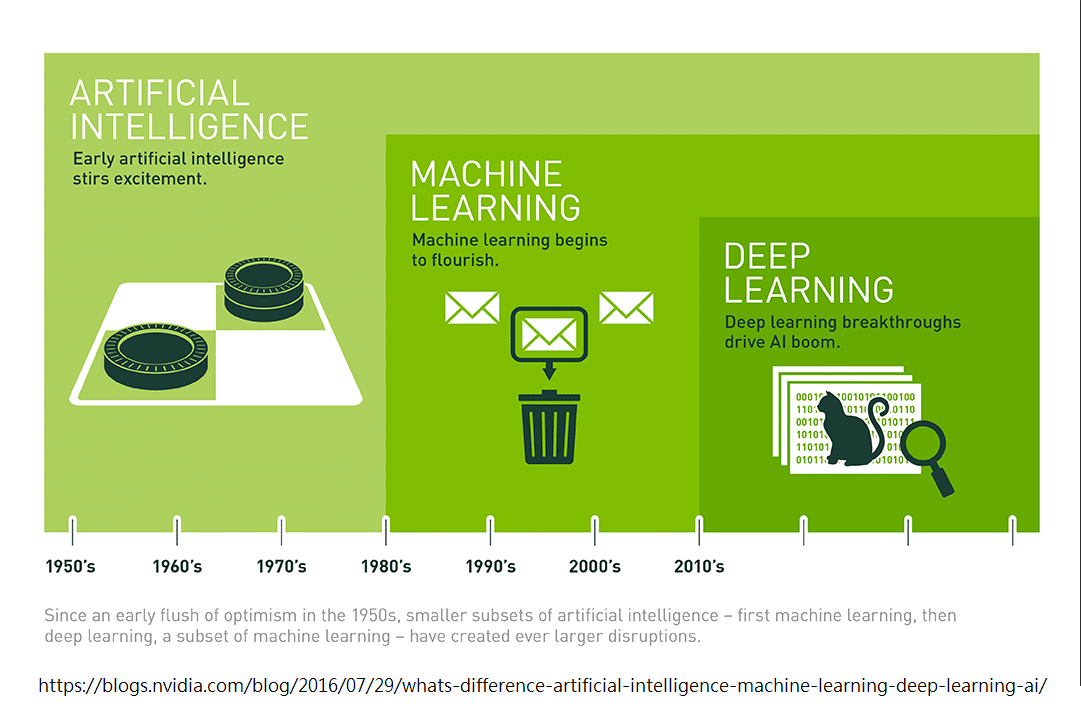
**人工智慧 (artificial intelligence, AI)** ,由**愛倫·圖靈 (Alan Turing)** 所提出的概念,代表使用電腦去模擬人類具有智慧的行為,例如**語言、學習、思考、論證、創造**等等。
**機器學習 (Machine Learning, ML)**,1959 年被 IBM 員工 **Arthur Samuel** 提出,代表透過統計學,讓機器自己做學習,而並非用一條指令一個動作的方式,來製造人工智慧。
**深度學習 (Deep Learning)**,一種機器學習的方法,我們模擬人類大腦神經元的運作模式,由許多神經細胞構成神經網路,經歴學習的過程,藉此訓練一個 AI。
深度學習又可以分為 **Multilayer perceptron (MLP)**, **Recurrent neural network (RNN)**, **convolutional neural network (CNN)** 等等。
今天會講最基礎的 MLP。
## 深度學習的原理
### 人類大腦的運作原理
<blockquote>
大腦裡有大約 860 億個神經元。每個神經元都像一個小小的訊號處理器,負責「接收 → 判斷 → 傳送」訊息。
神經元彼此不是直接黏在一起,而是隔著一點點縫隙,這個縫隙叫做突觸。
當你看到、聽到、想到某件事時,神經元會先用**電訊號**在自己體內傳遞;到了突觸,就改用**化學物質(神經傳導物質)** 把訊息丟給下一個神經元。
一個神經元通常同時接收「很多」其他神經元的訊號,它會把這些訊號加總、比較,如果強度夠大,就觸發下一次放電。這個「是否觸發」的過程,就是最基本的「判斷」。
所謂的「思考」,不是單一神經元在想事情,而是:
- 大量神經元同時活動
- 訊號在特定路徑中反覆流動
某些連線被用得越多,突觸就會變得越強(這就是學習與記憶的基礎)
所以:
- 想一個數學題 → 某些神經網路被啟動
- 回憶一段音樂 → 另一組神經連線被重播
- 情緒影響判斷 → 情緒相關的神經區域改變訊號權重
一句話總結:
**人類的思考,是神經元用電與化學訊號,在不斷變化的連線網路中進行大規模「加權傳遞」的結果。**
-- ChatGPT
</blockquote>
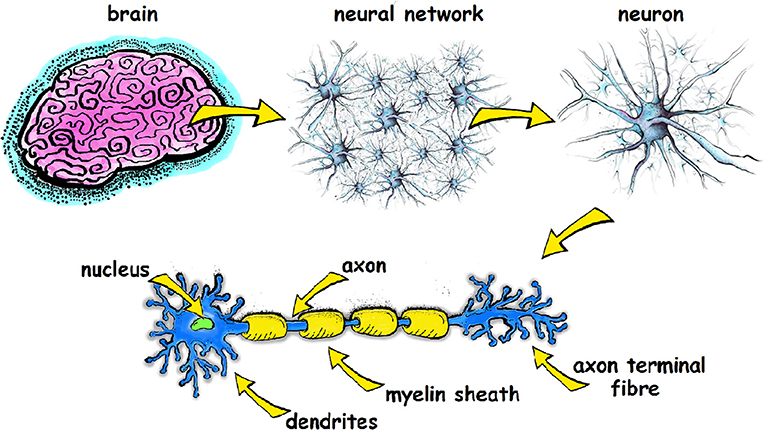
<center><small> 圖取自frontiersin.org </small></center>
---
### 類神經網路
<!--  -->
我們可以用電腦和數學運算來模擬大腦神經網路的運作
先轉換一下神經網路的模型,變成以下這樣

這裡把輸入的資料記為 $\vec{X}$,而整個神經網路中,每一條突觸 (**Synapse**) 連結都帶有一個權重 (**Weight**) $W_i$,每個神經元也都帶有偏差 (**Bias**) $b$

先計算每一組突觸連接過後的結果 $X_i \cdot W_i$ ,加上偏差 $b$,每個神經元得到結果 $z = \sum (X_i \cdot W_i) + b$

接下來,把 $z$ 帶入一個啟動函數 (**Activation Funciton**, 例如 $\sigma(z) = \frac{1}{1+e^{-z}}$ 稱為 **Sigmoid**),得到輸出訊號 $y$,再透過神經網路一層層往下傳,得到我們想要的結果。這樣就可以用電腦模擬神經元的運算了!

例如上圖,先計算 $1 \cdot 1 + (-1) \cdot (-2) + 1 = 4$,再帶入 Sigmoid 得到 $\sigma(4) = 0.98$ 作為神經元的輸出,再藉由突觸往下連接

一路計算完的結果就是這個模型的輸出

---
### Training
接下來,要訓練我們的模型,目標是**希望在給定輸入之後,可以得到期望的輸出。**
先隨機給定一些權重 $\vec{W}$ 和輸入 $\vec{X}$ ,接著透過誤差函數 (**Loss Function**) 比較輸出 ($\hat{y}$) 和正解 ($y$) 的差距 (**Loss**),最後**根據 Loss 去調整各個 Weight 和 Bias**。
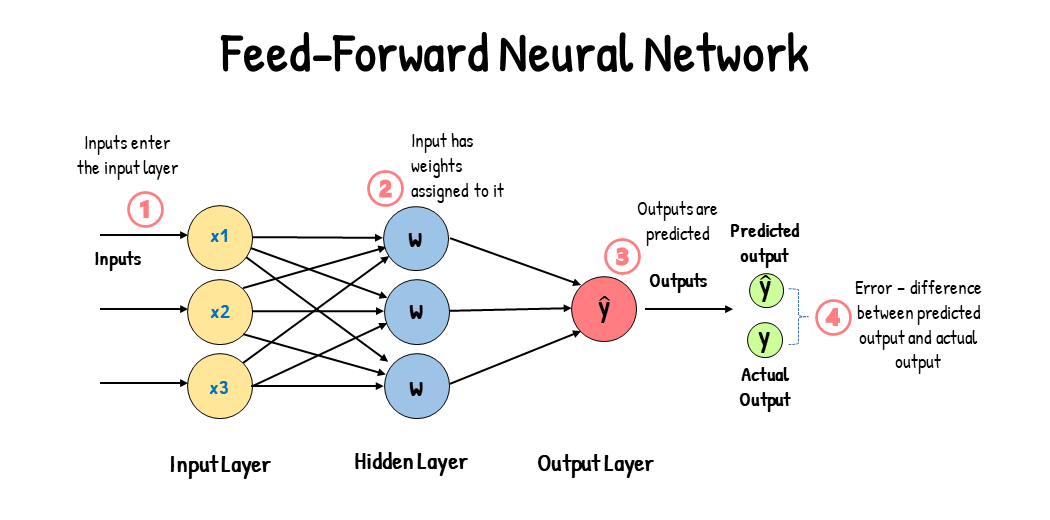
調整 Weight 和 Bias 的過程稱為最佳化 (**Optimization**, 最常用的方法是梯度下降 **Gradient Descent**)。
**Gradient Descent 指的是,把誤差畫成函數圖形以後,根據斜坡的方向,朝著更低的那個點走,以此來更新 Weights**
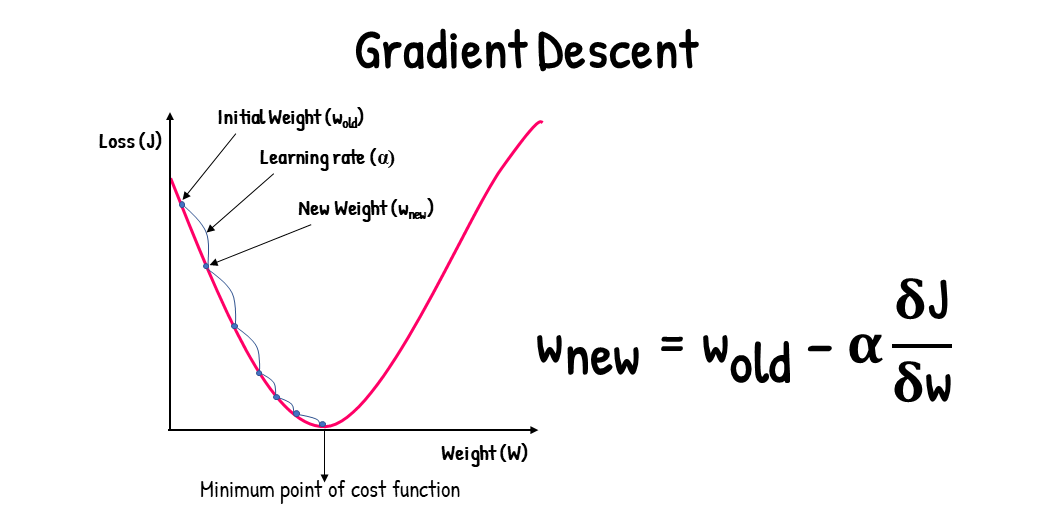
**反向傳播 (Backpropagation) 是一種加速 optimization 的過程,方法是在我得到其中一個 Weight 的 Gradient 以後透過一層層回推的方式快速反推所有其他 Weight 的 Gradient**
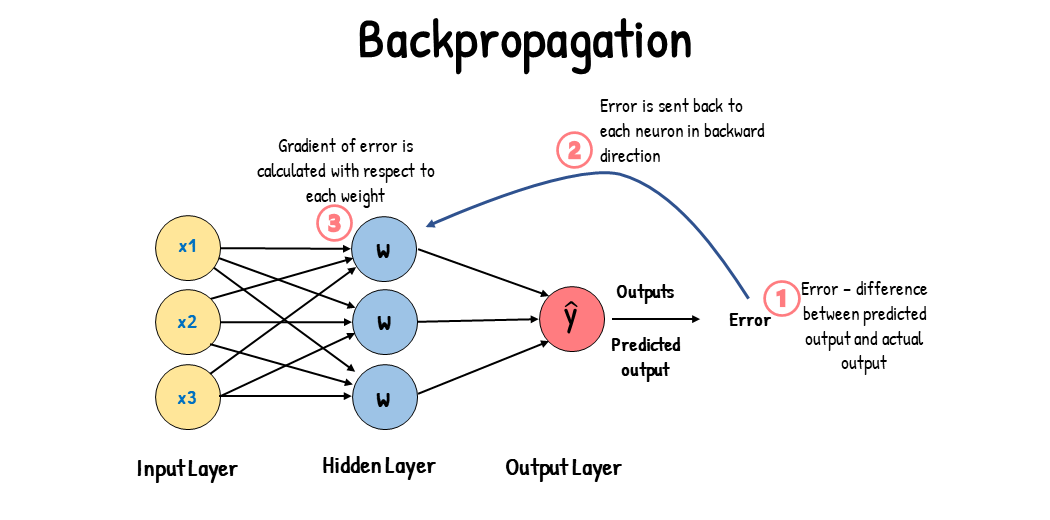
<center><small> 圖取自 analyticsvidhya.com. Gradient Descent vs. Backpropagation: What’s the Difference? </small></center>
## 實作 : MNIST 手寫辨識 (使用 Keras)
**MNIST database**(Modified National Institute of Standards and Technology database) 是來自美國國家標準技術研究所的**手寫數字資料集**
裡面包含的是 **70000 組 (60000組訓練資料 + 10000組考試資料) 圖片 (黑底白字的手寫數字) 和對應的數字**
**Keras** 是一個開源的神經網路前端,後端通常使用 tensorflow,而透過 keras 我們可以用類似拼積木的方式來建構神經網路
我們會使用這個資料集來訓練一個辨識手寫數字的 AI
**Google Colab : https://colab.research.google.com/drive/1fBz7MFxz8MJ977_qCA6zvLBw5fL3U5a2?usp=sharing**
---
安裝 **CUDA & cuDNN** (linux 可以直接用指令安裝)
CUDA: https://developer.nvidia.com/cuda/toolkit
cuDNN: https://developer.nvidia.com/cudnn
安裝相關模組 : 使用 `conda` (`miniforge`) 管理器 (推薦,可以避免許多 python 特有的怪版本問題)
```bash
conda install cudatoolkit cudnn python tensorflow-gpu keras numpy pandas matplotlib pillow scikit-learn jupyterlab
```
如果沒有 Nvidia GPU,那就不用安裝 cuda 和 cudnn,`tensorflow` 改為 `tensorflow-cpu`
---
```python=
import keras
import numpy as np
import pandas as pd
import matplotlib.pyplot as plt
```
引入相關模組
---
```python=
from keras.datasets import mnist
from keras.utils import to_categorical
# 輸入: x 輸出: y
(x_train_image, y_train_label), (x_test_image, y_test_label) = mnist.load_data()
x_trains = np.array(x_train_image).reshape(len(x_train_image), 784).astype("float64") / 255
x_tests = np.array(x_test_image).reshape(len(x_test_image), 784).astype("float64") / 255
y_trains = to_categorical(y_train_label, num_classes=10)
y_tests = to_categorical(y_test_label, num_classes=10)
```
先導入 mnist 手寫資料集
每張圖片大小是 `28*28`,所以圖集 `x` 是個三維陣列,分別是第 N 筆跟圖片的二維資料
`x.reshape` 把二維的圖片資料壓成一條一維陣列,這樣才可以對應到 784 個輸入神經元
`/ 255` 是因為每個(黑白)像素都被表示成 `0~255` 的亮度,把他轉成 `0~1` 的數值
而 `y` 代表數字資料,如果 `x[i]` 是那張圖,那麼 `y[i]` 就是數字資料
---
```python=
from keras.models import Sequential
from keras.layers import Dense, Input
layers = [
Input(shape=(784,)), # Input Layer
Dense(units=256, activation="sigmoid"), # Hidden Layer 1
Dense(units=128, activation="sigmoid"), # Hidden Layer 2
Dense(units=64, activation="sigmoid"), # Hidden Layer 3
Dense(units=10, activation="softmax"), # Output Layer
]
model = Sequential(layers)
model.summary()
```
輸入層、隱藏層、輸出層
`Sequential` 代表我們使用 $\sum x_i \cdot w_i + b$ 這樣的模型
`Dense` 代表兩兩神經元之間都有連結
分類模型的最後一層我們用 `softmax`,其他層用 `sigmoid`

---
```python=
model.compile(
optimizer=keras.optimizers.Adam(learning_rate=1e-3),
loss=keras.losses.CategoricalCrossentropy(),
metrics=[
keras.metrics.CategoricalAccuracy(),
],
)
```
建構神經網路
optimizer 使用 **Adam**
loss funcion 使用 **cross-entropy**
`metrics` 單純是 keras 如何計算誤差,不會用於訓練
---
```python=
from keras.callbacks import ModelCheckpoint, EarlyStopping
callbacks = [
EarlyStopping(patience=5, restore_best_weights=True),
ModelCheckpoint("mlp.keras", save_best_only=True)
# 某些版本要改成 mlp.tf
]
model.fit(
x=x_trains,
y=y_trains,
validation_split=0.1,
batch_size=54,
epochs=1000,
callbacks=callbacks
)
```
開始訓練模型
`callbacks` 中的 `EarlyStopping` 代表我要在模型準度沒有顯著提升後提早停止,`ModelCheckpoint` 是我把目前模型的各個參數 (Weights 和 Biases) 存下來成檔案
`validation_split=0.1` 我把 10% 的訓練資料用來計算模型的準度
`batch_size=54` 我每次觀察 54 組資料後再跑 optimization
`epoches=1000` 重複訓練 1000 次
---
```python=
from PIL import Image
fn = input("Input Filename: ")
img = Image.open(fn).resize((28, 28)).convert("L")
# Grayscale, L = R * 299/1000 + G * 587/1000 + B * 114/1000
img_proc = np.array(img).reshape(1, 784) / 255
proba = model.predict(img_proc)[0]
for cls in range(10):
print(f"{cls} with probability of {proba[cls]:.3f}")
ans = np.argmax(proba)
print("The handwritten number is:", ans)
plt.imshow(img)
```
用 `model.predict` 計算結果

---
```python=
from sklearn.metrics import confusion_matrix
y_prob = model.predict(x_tests)
y_pred = np.argmax(y_prob, axis=1)
accuracy = np.mean(y_pred == y_test_label)
print("Accuracy:", accuracy)
# Confusion matrix
cm = confusion_matrix(y_test_label, y_pred)
df_cm = pd.DataFrame(
cm,
index=[f"{i}(E)" for i in range(10)], # Expected
columns=[f"{i}(P)" for i in range(10)] # Predicted
)
df_cm
```
計算測試資料的精準度,並且作圖

---
```python=
idx = np.nonzero(y_pred != y_test_label)[0][:200]
false_pred = y_pred[idx]
false_epct = y_test_label[idx]
false_img = x_test_image[idx]
plt.figure(figsize=(14, 42))
width = 10
height = 21
for i in range(len(idx)):
plt.subplot(height, width, i+1)
t = "[E]:{}\n[P]:{}".format(false_epct[i], false_pred[i])
plt.title(t)
plt.axis("off")
plt.imshow(false_img[i])
```
列出前 200 組輸出和答案不符

---
## Appendix (Math Warning)
### Derivative & Partial
#### 微分公式 Derivative
函數 $f(x) = a_1x^n + a_2x^{n-1} + ... + a_{n-1}x^1 + a_n$ 微分後結果
$$\frac{df(x)}{dx} = (a_1 \cdot n) x^{n-1} + (a_2 \cdot (n-1))x^{n-2} + ... + (a_{n-1})x^0$$ **(次方前提次方$-1$,稱為 power rule)**
#### 偏微分 Partial Derivative
例如函數 $f(x, y) = x^2 + xy + y^2$,而 $f$ 對 $x$ 偏微代表我**只想要觀察 $x$ 的影響**,結果
$$\frac{\partial f(x, y)}{\partial x} = \frac{\partial (x^2 + yx^1 + y^2x^0)}{\partial x} = 2x + y + 0y^2 = 2x + y$$ **(Power Rule)**
#### Chain Rule
- $y = g(x) \quad z = h(y)$
$$\frac{dz}{dx} = \frac{dz}{dy} \cdot \frac{dy}{dx}$$
proof: https://math.stackexchange.com/a/1180716
- $x = g(t) \quad y = h(t) \quad z = f(x, y)$
$$\frac{dz}{dt} = \frac{\partial z}{\partial x} \cdot \frac{dx}{dt} + \frac{\partial z}{\partial y} \cdot \frac{dy}{dt}$$
proof: https://sites.und.edu/timothy.prescott/apex/web/apex.Ch13.S5.html#Thmtheorem1
圖解:
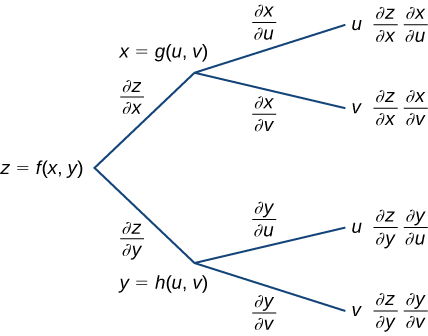
<small> 取自 math.libretexts.org. 14.5: The Chain Rule for Multivariable Functions </small>
---
### List of Activation Functions
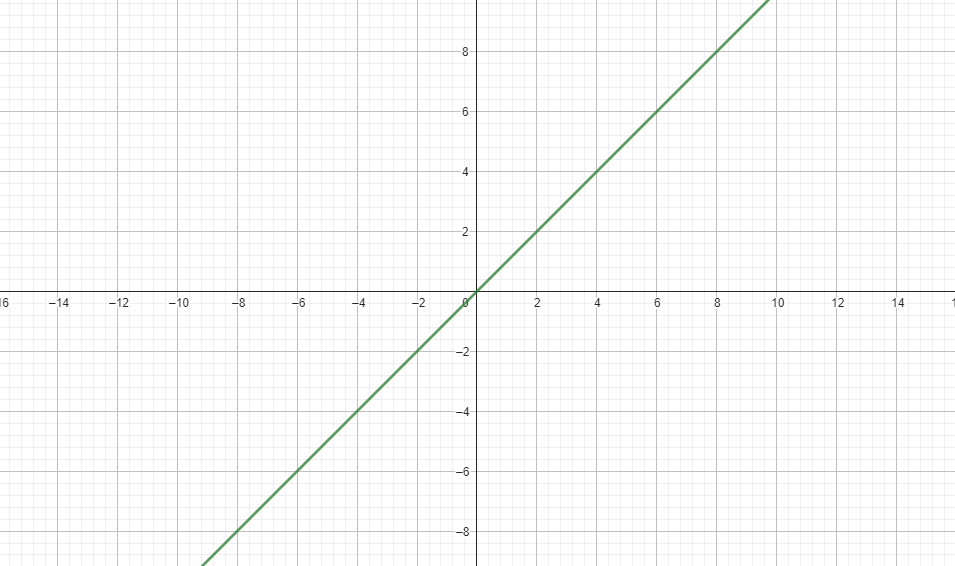
#### Indentity
$$\sigma(x) = x$$
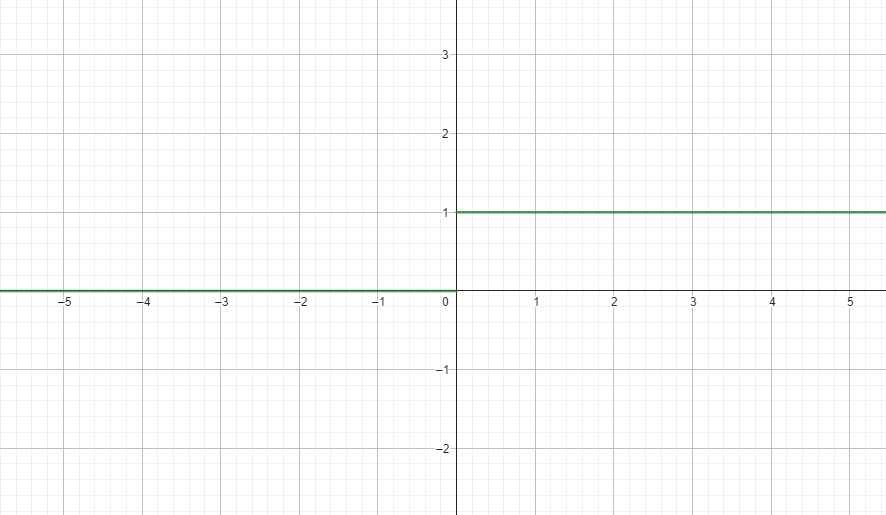
#### Binary Step / Sign
$$\sigma(x) = {\begin{cases}0&{\text{if }}x<0\\1&{\text{if }}x\geq 0\end{cases}}$$
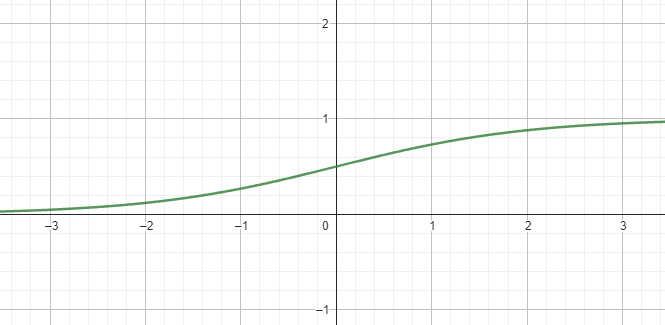
#### Sigmoid
$$\sigma(x) = \frac{1}{1+e^{-x}}$$
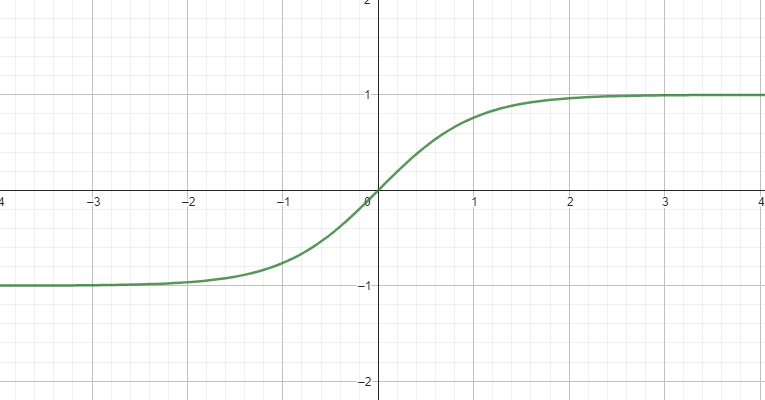
#### tanh
$$\sigma(x) = \tanh(x) = \frac{e^{x} - e^{-x}}{e^{x} + e^{-x}}$$
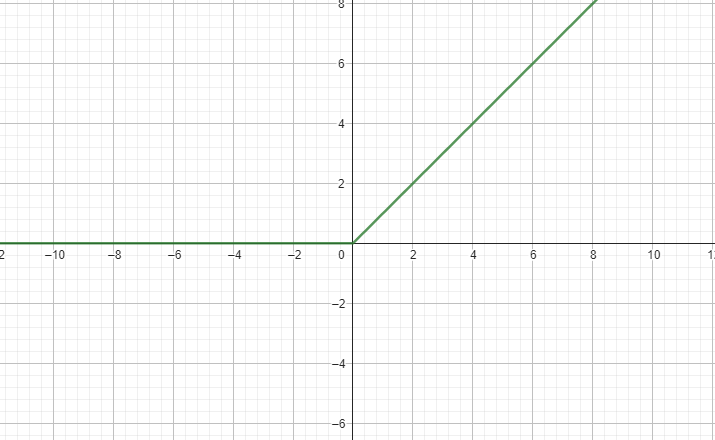
#### ReLU
$$\sigma(x) = \operatorname {max}(0, x)$$
#### Softmax
吃進一個 array 然後回傳一個 array 的 function,通常套在分類模型的 output 層之後
假設我原本有個 array $\vec{x} = (1, 4, 5, 1)$
我計算歐拉常數 $e \approx 2.718$ 的 $\vec{x}$ 次方 $e^{\vec{x}} = (2.72, 54.60, 148.41, 2.72)$
最後把每項分別除以總和 $s = \sum e^{x_i} = 208.45$
得到 $\sigma(\vec{x}) = (0.013, 0.26, 0.71, 0.013)$
寫成公式就是 $$\sigma_i(\vec{x}) = \frac{e^{x_i}}{\sum e^{x_j}}$$
套用了 softmax 後,我們的模型會畫成這樣

會用在分類型 AI 的 output layer,用處是把所有的數值轉成 0 ~ 1 的 fraction,而且總和會是 1

<center><small> 圖取自 000 機器學習簡報 </small></center>
---
### Loss Function
常見的有平均絕對值誤差 (**Mean Absolute Error**), 均方誤差 (**Mean Square Error**) 和交叉熵 (**Cross-Entropy**) 等等
#### Mean Absolute Error
$$\operatorname {MAE} = \frac{1}{N} \sum_{i=1}^N |y_i - \hat{y}_i|$$
#### Mean Square Error
$$\operatorname {MSE} = \frac{1}{N} \sum_{i=1}^N (y_i - \hat{y}_i)^2$$
#### Cross-Entropy
把模型輸出記為 $\hat{y}$, 解答記為 $y$
這裡的 $\hat{y}$ 和 $y$ 都要是機率的分布 (就是 Softmax 出來的結果)
$$\operatorname {CE} = -\sum_i \hat{y}_i \log_2 y_i$$
主要可以用在分類模型,例如以下是一個分辨動物的模型
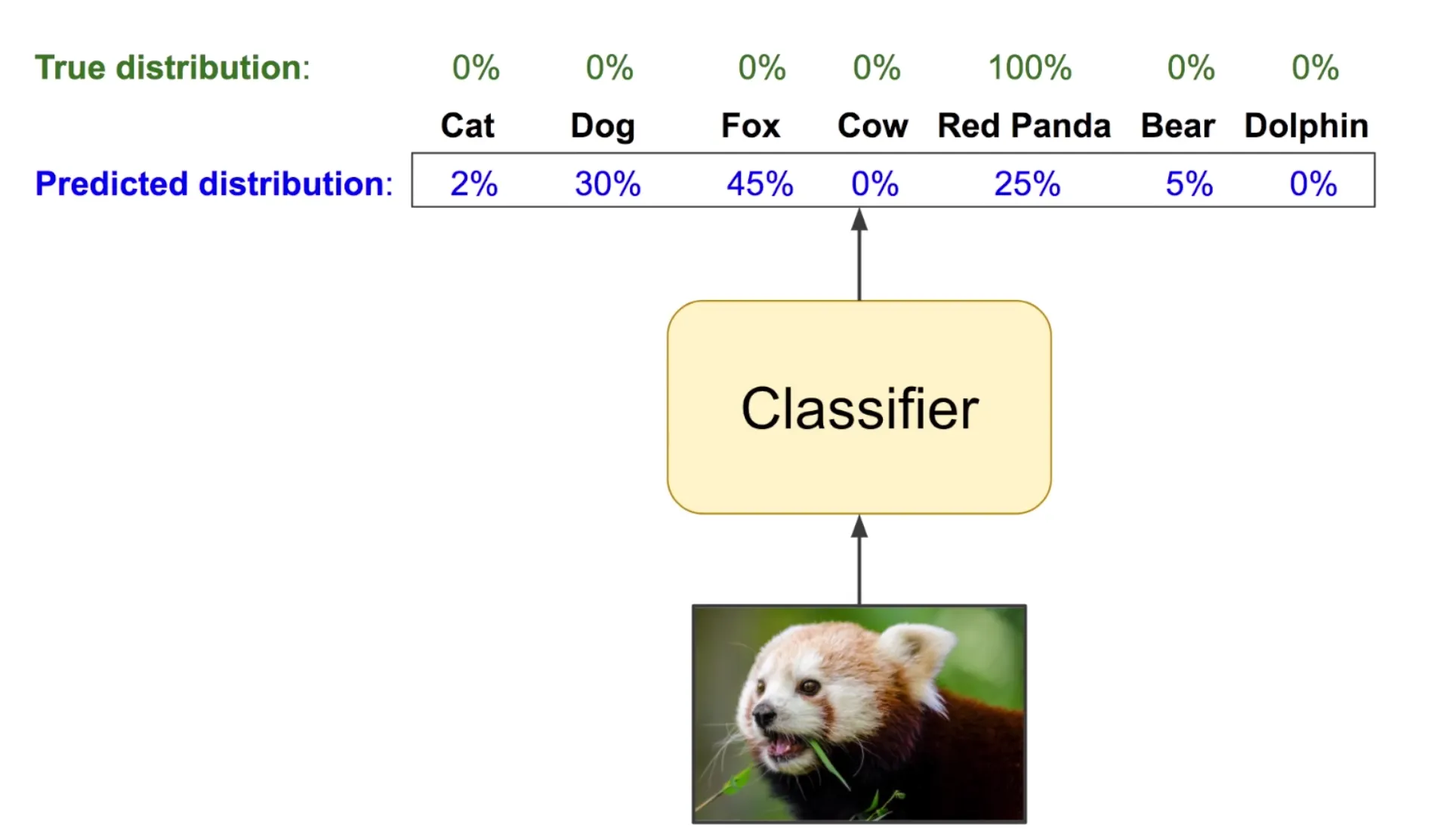
透過模型的輸出,我們可以計算 cross-entropy 作為 loss
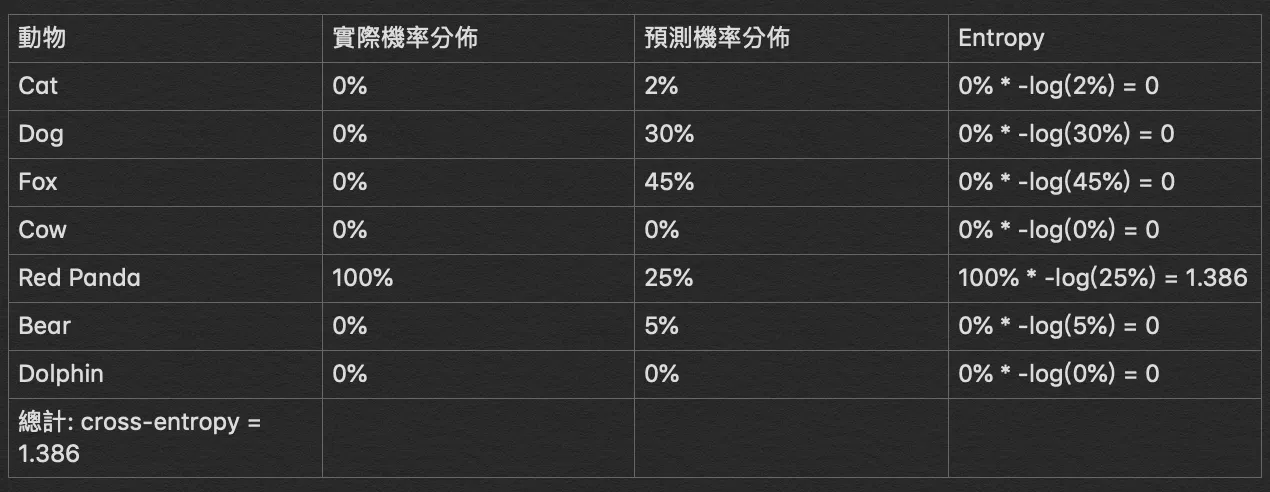
如果有一筆較精準的輸出解,cross-entropy 就會比較小
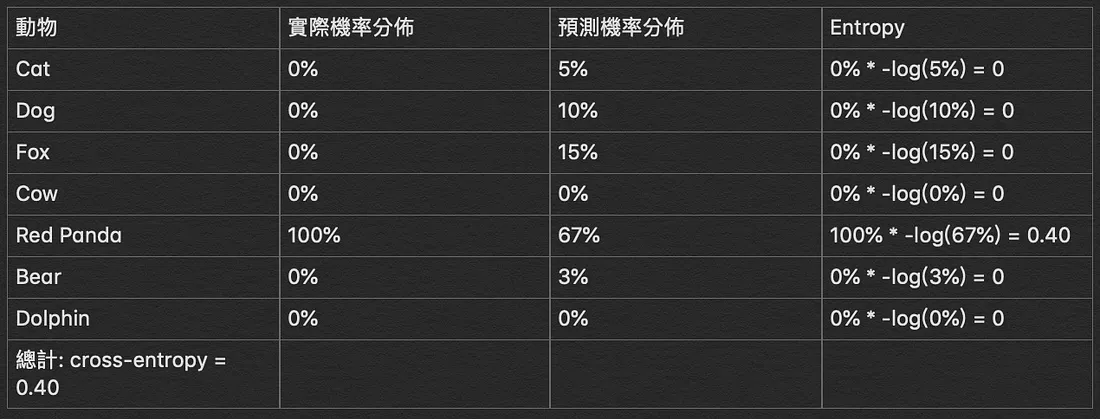
<center><small> 取自 r23456999.medium.com. 何謂 Cross-Entropy </small></center>
---
### Optimizer
#### Gradient Descent

先講梯度 (**Gradient**) 的定義
$$ \nabla f(p)={\begin{bmatrix}{\frac {\partial f}{\partial x_{1}}}(p)\\\vdots \\{\frac {\partial f}{\partial x_{n}}}(p)\end{bmatrix}}$$
而 Gradient Descent 的過程可以寫成 $$a_{t+1} = a_t - \eta \nabla f(a_t)$$ 其中 $\eta \in \mathbb {R}_{+}$ 代表學習率 (**Learning Rate**),$\eta \nabla f$ 就是我延著切線根據斜率和學習率的大小,決定 $a_{n+1}$ 要跳多少
#### Momentum
$$v_t = {\begin{cases} \eta g_t&{\text{if }}t = 0 \\ \beta v_{t-1} + \eta g_t &{\text{if }}t > 0 \end{cases}}$$
<center>
$\theta_{t+1} = \theta_t - v_t$
$g_t = \nabla f(\theta_t)$
</center>
我們把參數 (Weights and Biases) 記為 $\theta$
第一次操作就是一般的梯度下降
後面的下降速度都會加上前一個速度乘以一個阻力係數 $\beta: 0 \leq \beta < 1$
#### AdaGrad (Adaptive Gradient)
<center>
$g_t = \nabla f(\theta_t)$
$$\theta_t = \theta_{t-1} - \frac{\eta}{\sqrt{\sum_{i=1}^{t}g_i^2 + \epsilon}} \cdot g_t$$
</center>
$\epsilon$ 只是一個為了避免除以零錯誤的小數字
透過 $\sqrt{\sum_{i=1}^{t}g_i^2}$ ,我們可以做到:如果這次/前幾次 gradient 越大,學習率越小,反之則是越大,若 gradient 沒有明顯變化趨勢學習率則會慢慢變小
#### Adam
<center>
$m_t = \beta_1 \cdot m_{t-1} + (1 - \beta_1) \cdot g_{t}$
$v_t = \beta_2 \cdot m_{t-1} + (1 - \beta_1) \cdot g_{t}^2$
$\hat{m_t} = \frac{m_t}{1 - \beta_1^t} \quad \hat{v_t} = \frac{v_t}{1 - \beta_2^t}$
$$\theta_t = \theta_{t-1} - \frac{\eta}{\sqrt{\hat{v_i}} + \epsilon} \cdot \hat{m_t}$$
</center>
$\beta_1$ $\beta_2$ 是兩個介於 $[0, 1)$ 的阻尼係數
前面兩種 optimizer 的結合體,同時把 momentum 的概念套上 gradient 和 root mean square
目前使用率最高的 optimizer
他的論文 https://arxiv.org/pdf/1412.6980
---
### Backpropagation
令 loss function 為 C
$\nabla C$ 就是對於每個參數 (weights and biases) 都對 C 偏微
先觀察某個 $w$ (例如 $w_1$),目標是要算出 $\partial C / \partial w_1$
chain rule 拆解
$$\frac{\partial C}{\partial w_1} = \frac{\partial C}{\partial z} \cdot \frac{\partial z}{\partial w_1}$$

#### Forward Pass
計算 $\partial z / \partial w_1$
而 $z = x_1 w_1 + x_2 w_2 + b$
偏微結果 $= x_1$
所以 forward pass 的做法就是存前一層的輸出

#### Backward Pass
計算 $\partial C / \partial z$ 的部份比較複雜
再往下一步觀察
也就是 $\sigma(z)$,令他 $= a$
chain rule 拆成 $(\partial a / \partial z) \cdot (\partial C / \partial a )$
前項是 $\partial (\sigma(z)) / \partial z$ (Activation Function 的微分)

後項再往下拆一層
$$\frac{\partial C}{\partial a} = \frac{\partial z'}{\partial a}\frac{\partial C}{\partial z'} + \frac{\partial z''}{\partial a}\frac{\partial C}{\partial z''}$$
又 $z' = aw_3 + ...$
$\partial z' / \partial a = w_3$,同理 $\partial z'' / \partial a = w_4$
計算 $\partial C / \partial z'$

如果**下一層是輸出層**
$\partial C / \partial z'$ 是 sofmax + cross-entropy 的微分
如果不是,那麼再再繼續 chain rule 往下拆
再根據遞迴關係 (假設我已經算完 $\partial C / \partial z'$ 和 $\partial C / \partial z''$) 回來求出 $\partial C / \partial z$
backward pass 就是我從後往前 一層層推出 $\partial C / \partial z$ 的過程

#### Bias
$$\frac{\partial C}{\partial b} = \frac{\partial z}{\partial b} \frac{\partial C}{\partial z}$$
而 $z = x_1 w_1 + x_2 w_2 + b$ 可得 $\partial z / \partial b = 1$
$\partial C / \partial z$ 同上
---
### Derivative of functions
#### Sigmoid
$$\frac{d}{dx}\sigma(x) = \sigma(x)\cdot(1-\sigma(x))$$
參考 https://math.stackexchange.com/questions/78575/derivative-of-sigmoid-function-sigma-x-frac11e-x
#### Softmax + Cross-Entropy
$$\frac{\partial C}{\partial z_i} = \hat{y_i} - y_i$$
參考 https://medium.com/hoskiss-stand/backpropagation-with-softmax-cross-entropy-d60983b7b245
## References
- **000 的簡報**
https://slides.com/lucasw/machine-learning
- **000 的手刻 Neural Network**
https://github.com/lucasw0908/Neural-Network/blob/main/Neural-Network(Adam)/nn.py
- **Gradient Descent vs. Backpropagation: What’s the Difference?**
https://www.analyticsvidhya.com/blog/2023/01/gradient-descent-vs-backpropagation-whats-the-difference/
- **何謂 Cross-Entropy (交叉熵)**
https://r23456999.medium.com/%E4%BD%95%E8%AC%82-cross-entropy-%E4%BA%A4%E5%8F%89%E7%86%B5-b6d4cef9189d
- **Machine Learning 2016 Fall**
https://speech.ee.ntu.edu.tw/~hylee/ml/2016-fall.php
- **ML Lecture 3-1: Gradient Descent**
https://www.youtube.com/watch?v=yKKNr-QKz2Q&list=PLJV_el3uVTsPy9oCRY30oBPNLCo89yu49&index=7
- **ML Lecture 6: Brief Introduction of Deep Learning**
https://www.youtube.com/watch?v=Dr-WRlEFefw&list=PLJV_el3uVTsPy9oCRY30oBPNLCo89yu49&index=11
- **ML Lecture 7: Backpropagation**
https://www.youtube.com/watch?v=ibJpTrp5mcE
- **ML Lecture 8-1: “Hello world” of deep learning**
https://www.youtube.com/watch?v=Lx3l4lOrquw
## What's Next
### CNN (Covolutional Neural Network, ConvNets)
- **Breaking News, Latest News and Videos | CNN**
https://cnn.com/
- **Simple MNIST convnet**
https://keras.io/examples/vision/mnist_convnet/
- **Image classification**
https://deeplearningwithpython.io/chapters/chapter08_image-classification/
- **Convolutional Neural Networks (CNNs / ConvNets)**
https://cs231n.github.io/convolutional-networks/
### Transformer
- **Transformer: A Novel Neural Network Architecture for Language Understanding**
https://research.google/blog/transformer-a-novel-neural-network-architecture-for-language-understanding/

- **Transformer — Attention Is All You Need Easily Explained With Illustrations**
https://luv-bansal.medium.com/transformer-attention-is-all-you-need-easily-explained-with-illustrations-d38fdb06d7db
- **TRANSFORMER EXPLAINER**
https://poloclub.github.io/transformer-explainer/
- **Neural machine translation with a Transformer and Keras**
https://www.tensorflow.org/text/tutorials/transformer
- **Attention Is All You Need**
https://arxiv.org/pdf/1706.03762v7
 Sign in via Facebook
 Sign in via X(Twitter)
 Sign in via GitHub
 Sign in via Dropbox
 Sign in with Wallet
Connect another wallet
Sign in with Wallet
Connect another wallet