# O-RAN Introductions
## What is O-RAN and its Characteristics
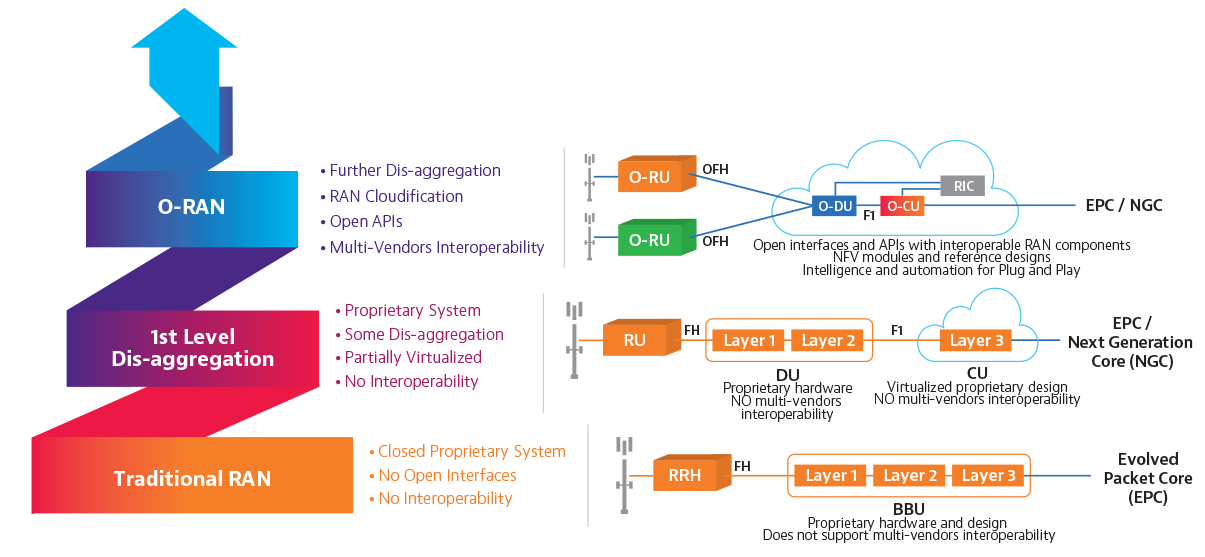
O RAN (Open RAN) refers to industry-wide standards for RAN (Radio Access Network) interfaces; it supports interoperation between vendors’ equipment. As a result, the technology offers network flexibility at a lower cost.
:::info
It is a disaggregated approach to deploying mobile fronthaul and midhaul networks built entirely on cloud native principles.
:::
O-RAN technology decomposed the existing Baseband Unit (BBU) into two functional components, a **Distributed Unit (DU)** and **Central Unit (CU)**. Conforming to modern control user plane separation (CUPS) constructs, the Central Unit can be further decoupled into distinct **control plane (CU-CP)** and **user plane (CU-UP)** functions, replacing the monolithic BBU with the CU/DU allows for new deployment models.
### Key Components of O-RAN
* **Open Interfaces**: O-RAN defines open, standardized interfaces between various components of the RAN, such as between the radio unit (RU), distributed unit (DU), centralized unit (CU), and the core network.
* **Virtualization**: O-RAN promotes the virtualization of RAN functions, allowing them to run on standard, off-the-shelf hardware using virtualized network functions (VNFs) or containerized microservices.
* **Software-Defined Networking (SDN)**: O-RAN leverages SDN principles to enable centralized control and programmability of the RAN which allows operators to dynamically allocate resources and optimize network performance and new use cases.
* **Intelligence and Automation**: O-RAN introduces intelligence and automation into the RAN through advanced analytics, machine learning, and AI technologies to enable autonomous network management, predictive maintenance, and efficient resource utilization.
* **Cloud-Native Architecture:** O-RAN embraces cloud-native principles, such as microservices, containerization, and orchestration, to build a more agile, scalable, and resilient RAN infrastructure. This approach aligns with the broader industry trend towards cloud-native and edge computing technologies.
## O-RAN Architecture

### Service Management and Orchestration Framework (SMO)
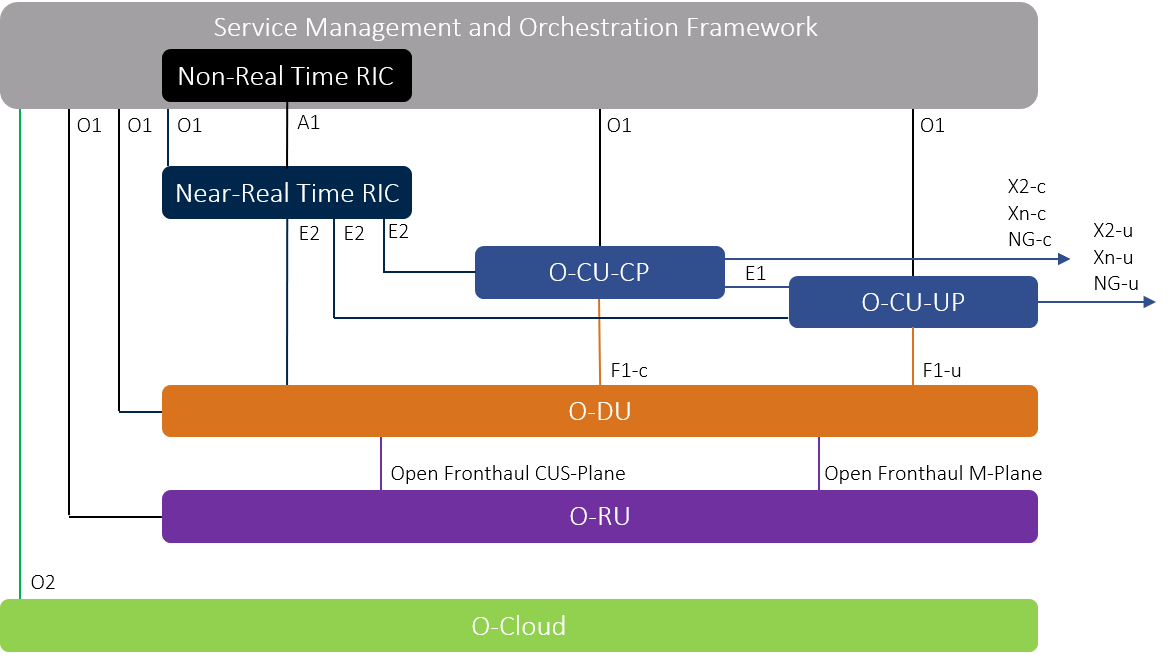
Includes an integration fabric and data services for the functions it manages. **It allows managed functions to interoperate and communicate** within the O-RAN. The SMO connects to and manages the RICs, O-Cloud, the O-CU, and O-DU.
### RAN Intelligent Controller (RIC)
There are two types of RICs
* non-real-time
* near-real-time.
Both are logical functions for **controlling and optimizing the elements and resources** of an O-RAN. A near-real-time RIC controls and optimizes elements and resources with granular data collection and communication over the E2 interface.
### O-Cloud
A cloud computing platform made up of the physical infrastructure nodes using the O-RAN architecture.
### O-RAN central unit (O-CU)
Logical node that hosts protocols:
* Radio Resource Control (RRC)
* Service data adaptation protocol (SDAP)
* Packet data convergence protocol (PDCP).
### O-RAN distributed unit (O-DU)
A logical node that hosts protocols
* Radio Link Control (RLC) protocol,
* Medium Access Control (MAC) protocol,
* Physical Interface (PHY).
### O-RAN Radio unit (O-RU)
It processes radio frequencies received by the physical layer of the network. The processed radio frequencies are sent to the O-DU through a front haul interface.
## O-RAN and 5G
5G defines the overall framework and capabilities of next-generation wireless networks, while O-RAN focuses specifically on redefining the architecture of the **RAN component** to be more open and flexible, aligning with the broader industry trends towards virtualization, open interfaces, and software-defined networking.
### 5G
5G only refers to the **fifth generation of wireless technology**, it encompasses a broad range of technologies, standards, and use cases. While 5G defines the overall framework and capabilities of the next-generation wireless network, it **does not specify the detailed architecture of the radio access network (RAN)** or the implementation of specific network components.
### O-RAN
While 5G defines the overall framework and capabilities of next-generation wireless networks, O-RAN focuses specifically on **redefining the architecture of the RAN component** to be more open and flexible, aligning with the broader industry trends towards virtualization, open interfaces, and software-defined networking.
Also O-RAN principles and concepts can be applied to 4G networks as well, not just 5G. While O-RAN was initially developed to address challenges in 5G network deployments, its principles of open interfaces, virtualization, and standardized hardware and software can also benefit 4G LTE networks.
 Sign in with Wallet
Connect another wallet
Sign in with Wallet
Connect another wallet