# On The Taxonomy Of Hot Dogs
So. Is a hot dog a sandwich? This is a popular subject to debate on the Internet, for reasons that escape understanding. It turns out that whether or not a hot dog is a sandwich is actually kind of a boring debate, the way it's being carried out. Understanding why it's a debate at all is really kind of fascinating, though.
So here's the thing, what we all have to agree upon at the outset: it's really, really difficult to construct a formal definition of sandwich that excludes the hot dog but does not also include things that are unambiguously sandwiches. Here's [Merriam-Webster on the subject](https://www.merriam-webster.com/words-at-play/to-chew-on-10-kinds-of-sandwiches):
```
The word hot dog refers either to the sausage that you buy squeezed in a plastic package with 7 or so of its kind, or to the same sausage heated and served in a long split roll.
When it's served in the roll, it's also a sandwich.
We know: the idea that a hot dog is a sandwich is heresy to some of you. But given that the definition of sandwich is "two or more slices of bread or a split roll having a filling in between," there is no sensible way around it. If you want a meatball sandwich on a split roll to be a kind of sandwich, then you have to accept that a hot dog is also a kind of sandwich.
You could hinge your anti-hot-dog-as-sandwich argument on whether the hot dog sausage qualifies as a "filling," but if you choose to interpret filling narrowly as only "a food mixture used to fill pastry or sandwiches," rather than broadly as "something used to fill a cavity, container, or depression," then you're not going to allow any single-item filling to qualify a food item as a sandwich—which means there can be no thing as a peanut butter sandwich or a bologna (or even baloney) sandwich.
Hence, a hot dog is a sandwich.
```
Now, probably the most controversial part of the Merriam-Webster definition is the inclusion of a split roll. In the context of the discussion of hot dogs as sandwiches, the point is often raised that a hot dog doesn't qualify because the bun is a single piece of bread, not two pieces for it to be sandwiched between.
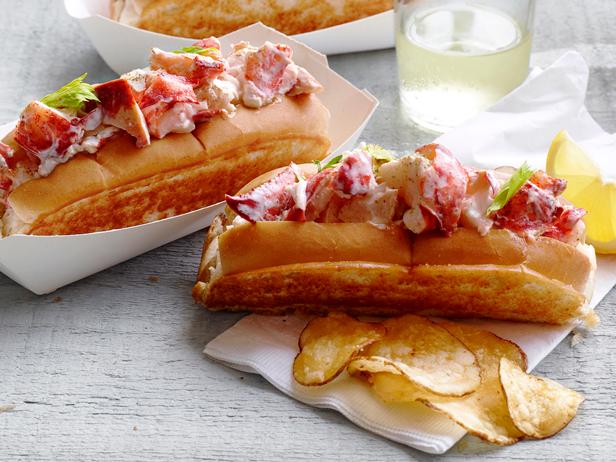
Does this mean that a lobster roll isn't a sandwich?
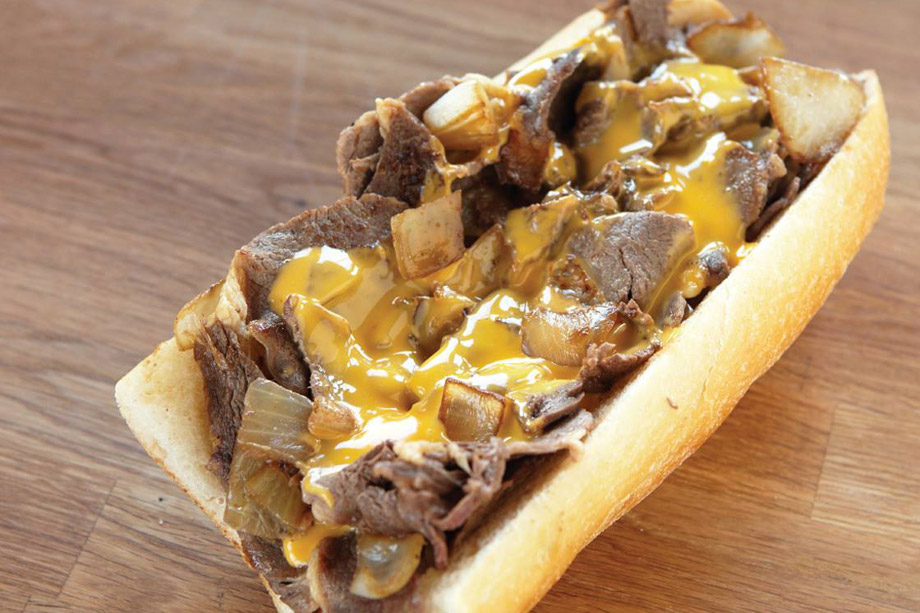
What about a Philly cheesesteak?
What about a hoagie?

An Italian beef?
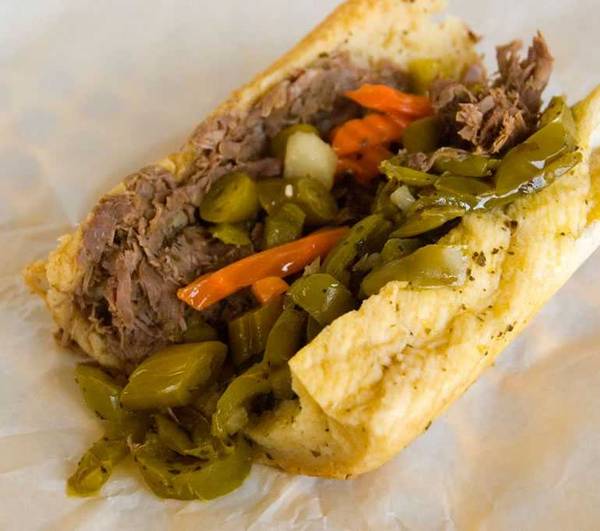
In other words (and pictures!), we all understand that things on split buns can be sandwiches. It's only when hot dogs come up that we forget this. On the flip side, a hamburger comes between two distinct pieces of bread, and I will bet you dollars to Shake Shack burgers that the "a hot dog isn't a sandwich" crowd strongly tends to agree with the "a hamburger is not a sandwich" proposition as well.
Another definition we could proffer is that cased meats don't count as a filling for a sandwich. Okay, so, that would mean that an Italian sausage on a bun is also not a sandwich. I suspect that most "a hot dog is not a sandwich" people would agree with that proposition. Most people would agree that the Italian beef pictured above is a sandwich, however. There is a Chicago-based restaraunt chain called Portillos that serves both Italian beef sandwiches and Italian sausage on the same bread. Okay, so you can draw a line that divides those, I guess. What do you do about the Combo?

An Italian beef and an Italian sausage combined into a single food item. Is it a sandwich? A non-sandwich? Is it in gastronomical superposition, both sandwich and not at once?
Let's ask a different question. Is lemonade a soda?
The answer would seem to be pretty unambiguously no, right? I can't imagine someone agrees with the idea that lemonade is a soda. And yet:
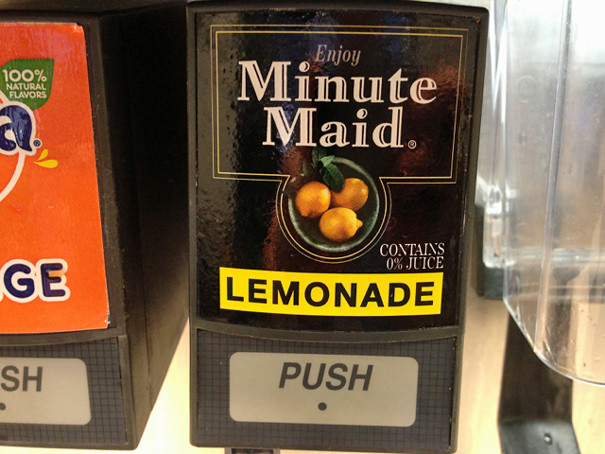
There are soda fountains that serve lemonade. Nobody says "I'm going to restock the soda and also the lemonade" when refilling them. If the waitress says "we have milk, tea and sodas" nobody is going to correct her about lemonade not being a soda. (At least, I really hope not.) But the existence of soda fountain lemonade raises questions about what we know. Maybe being a soda or not isn't an absolute property that something has, but a function of context? (You can run the same exercise through with sweetened ice tea, if you like.)
So then -- is the sandwichness of the hot dog contextual as well? Consider. If you ask what's being served at a catered lunch and someone says "sandwiches," would you be surprised if they offered nothing but hot dogs? Probably, yeah. If you say to your caterer, "People are going to be eating while walking around and so we want to serve something self-contained, like sandwiches," are hot dogs an acceptable offer there? Also probably, yeah. If we adopt a contextual view of sandwichhood, where things are not either sandwich or not-sandwich, but live on a sandwich spectrum, then the example of the Portillo's combo stops being an absurd, Lovecraftian horror that is banging on the walls of our reality and threatens to tear apart the idea of rational thought and starts being a good idea for lunch. (Seriously, go out of your way to try one if you have to, they're fantastic.)
Humans are okay at operating in a world full of ambiguity so long as they aren't confronted with this ambiguity. When they are, you get knock-down, drag-out fights over "is a hot dog a sandwich?" It's a question best answered with a "kind of" and a shrug that instead inspires heated debates. Formal definitions are not meant to proscribe anything -- they are meant to describe the world as it is, not define how the world should be. And yet both sides engage in the same style of arguing! The hot-dogs-are-sandwiches argument boils down to "there is no reasonable formal definition of sandwich that excludes hot dogs," and yet the hot-dogs-are-not-sandwiches argument so frequently comes down to "there has to be, because hot dogs aren't sandwiches." Neither side seems ready to recognize either ambiguity or the failure of binary rule-based classification to map well onto the real world.
In the case of sandwich classification, you could view this as "pointless" or "amusing" based on your point of view, but even the fiercest partisan has problems articulating the harms posed by being wrong on the subject. But this isn't some sort of a lacuna where human classification ability stops working -- this is how humans really function. And so you can generalize from this to all sorts of things. And one interesting thing you start to realize is how much of what we call "science" education in our schools is really learning about taxonomy and classification, and how much of that learning is _wrong_.
Raise your hand if you were taught that there's seven colors of light in the spectrum, and that Issac Newton figured this out by looking at a prism. Now, of course, a simple look around can disabuse the notion that there's only seven colors. A company called Pantone has named over 1,000 colors for use in printing. The human eye can distinguish between man, many more colors -- millions of them. But Newton identified seven colors on the spectrum, and that's what's taught to children. Except [Newton's naming was rather arbitrary](https://web.archive.org/web/20140929225102/http://www1.umn.edu/ships/updates/newton1.htm):
```
Newton's color-mixing circle had transformed the linear spectrum into a circle. Newton may have seen colors as cyclical. He certainly saw them as musical, much as Aristotle had. At first, Newton split his spectrum into five principal colors. But the number did not fit his conception that colors, like notes of music, expressed harmonies. A spectrum of colors, like a musical scale, he imagined, must have seven steps to make a full octave. (Note, here, the converse use of the color term 'chromatic' applied to musical scales that include all their accidentals, or half-steps.) To arrive at the requisite seven "notes," then, Newton inserted orange and indigo into his initial scheme, each addition representing a narrow "half-step" appropriately spaced in the spectral "scale." The roygbiv designation so familiar today thus not only reflects an arbitrary division of the spectrum, but also one shaped by a musical notion of octaves and the diatonic scale.
```
In other words, we have seven colors of the spectrum because there are seven pitches in a musical octave. Or at least, there's seven pitches in an octave in the predominate scale in use in Western music at the time. Because of course musical scales are not universal facts but cultural constructs.
Or you might have learned elsewhere in school about the three primary colors -- red, yellow and blue. Those are complimented by the three secondary colors -- green, orange and purple. And again, these classifications are contextual -- you learn one in science class when learning about the prism and the spectrum of light, and you learn another in art class, when you have to mix paints to produce colors.
If you continue pursuing color as you grow older, you'll learn yet another way of looking at it. The three primary colors of light are red, green and blue. RGB color forms the basis of your television, your computer screen, your smartphone screen. These are the primary colors of an additive color model, one where different colors of light are added together to produce any color the human eye can discern. When you deal with printing, inks and paints, you need a subtractive color model, one where inks _subtract_ color from available white light as it bounces off the material and towards the eye. The modern printing process has three subtractive primary colors -- cyan, magenta and yellow. Now, no school child learns about cyan or magenta as a primary color, but any professional printer does. And this is not a particularly modern discovery -- our modern three-color printing processes owe much to the work of Jacob Christoph Le Blon, who published his major work on the subject, _Coloritto_, in 1725.
You could imagine teaching Newton's prism and Le Blon's three-color printing model and a bunch of things before, between and after besides in a history of science class. You could imagine teaching none of that and just teaching the modern theories that, between them, powers every screen and printed piece of paper today's students will ever come across -- RGB additive and CMY subtractive color. Instead we teach old ideas about color with no context and no way to correlate them to modern ideas or even each other -- what do we provide the student who wonders how to reconcile the notion of color taught in science class with that taught in art class?
It's not just the grade-school students trying to tell their indigo from their violets from their magentas that have problems with this (but spare a thought for the student who has to deal with the Schrodinger's dinosaur, where [the Brontosaurus is just an apatosaurus until it isn't again](https://www.scientificamerican.com/article/the-brontosaurus-is-back1/), or who has to [interogate the debate between astronomers over whether or not Pluto is a planet in time to make their dioramas](https://www.usatoday.com/story/tech/2014/10/02/pluto-planet-solar-system/16578959/)). Our "modern" practice of classifying species of plants and animals is Linnaean taxonomy, developed in Carl Linnaeus' tenth edition of the _Systema Naturae_, published in 1758 and 1759. 1759, as it turns out, is exactly a century before Charles Darwin's _On the Origin of Species_ was published. Understanding evolution, as it turns out, has impacts on how species are classified. So does being able to actually measure genetic differences. In the 1950s, a German scientist named Willi Hennig devised a method to determine ancestral relations through things such as phylogenetics. And it is swamping many fields of biology with the discovery of new species and other changes to the established order. Formerly distinct groups of plants are [now being merged based on empirical genetic evidence](https://florabase.dpaw.wa.gov.au/articles/dryandra-banksia/why_names_change). In the study of herpatology, [so-called "taxonomic vandals" are using phylogenic trees to try and name new species of reptiles at a rapid pace](https://www.smithsonianmag.com/science-nature/the-big-ugly-problem-heart-of-taxonomy-180964629/?no-ist), prompting an editorial where two herpatologists assert "Decisions about how to partition life are as much a concern of politics and ethics as of biology." In the past 17 years, [the number of recognized bird species in South America has grown by 160](https://www.theatlantic.com/science/archive/2017/02/to-name-a-mockingbird/518013/) with very few actually new discoveries. The ability to get higher-quality microphones into the jungle means that we're able to better tell the differences between bird songs. And that's causing all kinds of controversies, down to whether or not certain birds have hyphens in their names. It's making nobody happy:
```
“We’re just trying to make the best of a bad situation. That’s all taxonomy is,” says James “Van” Remsen, the SACC’s chairman. Of the various “species concepts” in taxonomy that attempt to answer these questions, the SACC relies most heavily on the “biological species concept,” which basically defines a species as a group of things that only breed with each other. “We’re trying to apply artificial barriers on a continuum,” Remsen acknowledges. “It’s all kind of silly. … The emotions that are involved in some of these decisions are really kind of out of proportion.”
```
Artificial barriers on a continuum. All kind of silly. Emotions that are involved are really kind of out of proportion. Remind you of a certain debate over hot dogs?
Both sides of the debate are fatally flawed. The of-course-hot-dogs-are-sandwiches crowd creates a formal definition of sandwich that maps as well as possible to the popular concept of the sandwich and assumes that all things that meet that definition must be sandwiches. The hots-dogs-aren't-sandwiches-are-you-crazy assumes a single truth as to what a sandwich is and that this truth holds universally without care to context or audience. And so, without a single authority capable of imposing a side upon all parties, they are doomed to speak past each other. But you can break free of the cycle. You can bypass such arguements in favor of the richer, fuller complexity of a lived life. You can accept that hot dogs are _sometimes_ sandwiches.
 Sign in with Wallet
Connect another wallet
Sign in with Wallet
Connect another wallet