---
title: Ready for changes with Hexagonal Architecture - my notes
disqus: pierodibello
---
###### tags: `architecture` `hexagonal`
_(notes taken from [Ready for changes with Hexagonal Architecture](https://netflixtechblog.com/ready-for-changes-with-hexagonal-architecture-b315ec967749))_
# Hexagonal Architecture
puts inputs and outputs at the edges of the domain
- swappable data sources
- ability to easily swap data sources without impacting business logic and need to rewrite the codebase
- easily testable in isolation
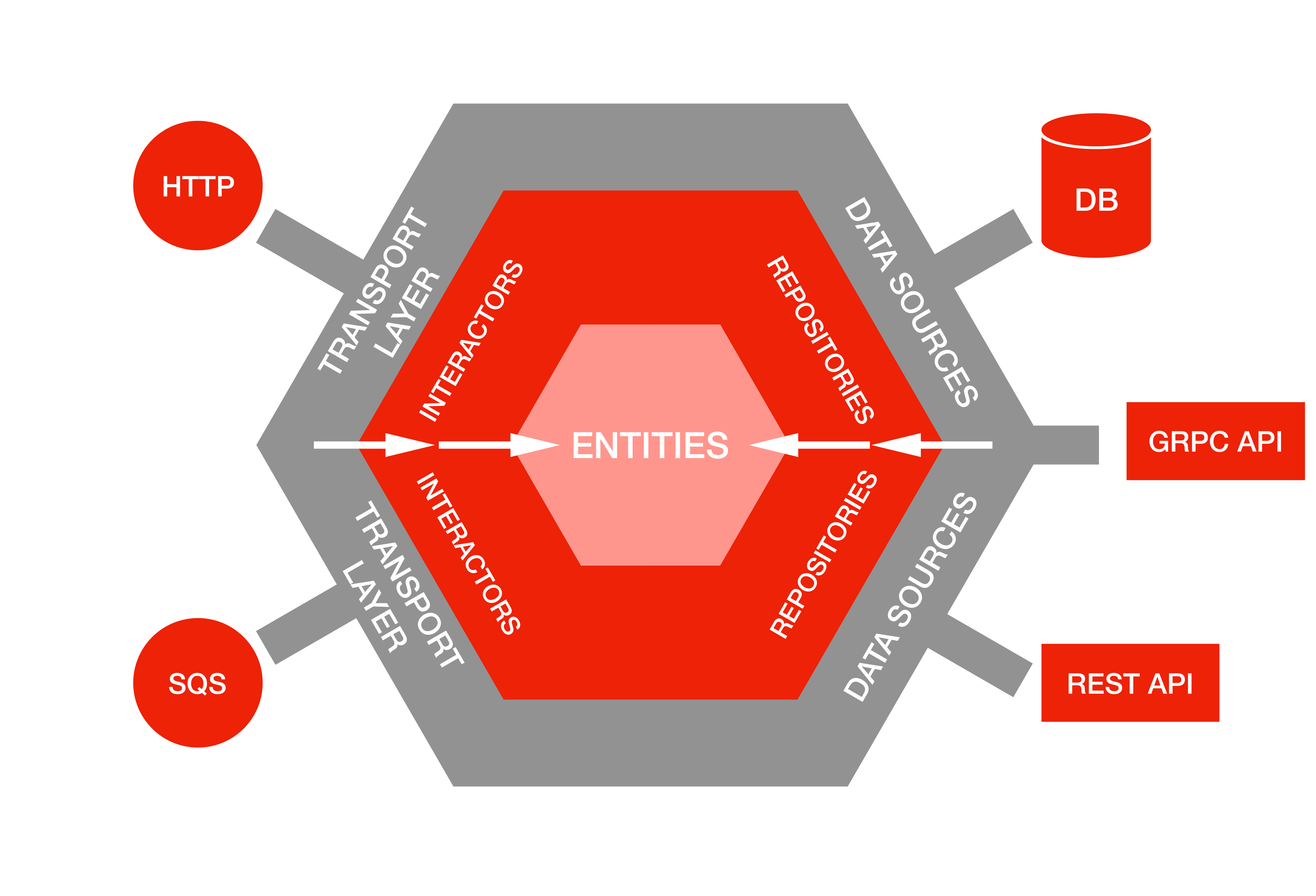
Elements:
* **entities** - core domain objects
* **repositories** - contains all the entitites and create / change them (interfaces for the actual adapters / data sources)
* **interactors** (aka *Service Objects* or *Use Case Objects*) - orchestrate the domain objects to perform domain actions
How business logic is triggered?
* **transport layer** - triggers an interactor to perform business logic. Inputs for the system. ("Inbound ports"). The most common transport layer is the HTTP API Layer
* **data sources** - adapters to different storage implementations. ("Outbound ports"). A data source implements methods defined on the repository for fetching and pushing the data.
### Testing strategy
have a test suite that is reliable and super fast
3 kind of tests:
* **test of interactors** ("unit" tests) - where the core of our business logic lives but is independent of any type of persistence or transportation => tests with mock instead of the real data sources, and without the transport layer (which is a layer above the interactors BTW)
* this is where our business logic is tested in detail, and these are the tests we strive to have most of.
* **test of data sources** (integration tests) - to determine if they integrate correctly with other services, whether they conform to the repository interface, and check how they behave upon errors.
* we try to minimize the amount of these tests.
* **integration specs** (end-to-end tests) - go through the whole stack, from our **transport** / API layer, through the **interactors**, **repositories**, **data sources**, and hit downstream services.
* to test if we "wired" everything correctly
* no extensive test coverage on this layer -> usually just one success scenario and one failure scenario per domain action
 Sign in via Google
 Sign in via Facebook
 Sign in via X(Twitter)
 Sign in via GitHub
 Sign in via Dropbox
 Sign in with Wallet
Connect another wallet
Sign in with Wallet
Connect another wallet