---
title: Phala Airdrop Program Wave I
tags: Phala
---
# KSM Stakedrop: Phala Airdrop Program Wave I
Phala will hold the airdrop program in 3 waves for KSM holders, DOT holders, and FIL holders respectively. The first round – KSM × PHA StakeDrop – will be started on 15th May.
- [I. What Is Stakedrop](##I.-What-Is-Stakedrop)
- [II. To Participate](##II.-To-Participate)
- [2.1 Prize Giving](###2.1-Prize-Giving)
- [III. Why StakeDrop](##III.-Why-StakeDrop)
- [IV. Stakedrop Model](##IV.-Stakedrop-Model)
- [4.1 The Weight of Reward](###4.1-The-Weight-of-Reward)
- [V. FAQ](##V.-FAQ)
## I. What Is Stakedrop
Stakedrop is a new type of Lockdrop proposed by Phala team. To participate, one could stake KSM and nominate whitelisted validators, claiming additional PHA returns besides original KSM returns according to the stakedrop score he or she gained in the event.
- **Total amount of PHA reward**: Expected 2.7% of PHA’s initial supply (27 million PHA). If the amount of staked KSM exceeds the expectation, the reward of FIL LockDrop will be reduced accordingly.
- **Target**: KSM holders (participants of Polkadot community and Kusama Network)
**Highlights:**
1. Receive NPoS KSM returns and PHA returns in the event at the same time;
2. Few efforts to pay other than stake and wait;
3. Contributing to the stability of Kusama Network while attending;
4. Safe and governance-friendly as all whitelisted validators are verified and nominated by original Kusama users.
## II. To Participate
**When**: 15th May 2020 ~ 15th August 2020
**How**:
- Hold KSM ([How to claim KSM →](https://guide.kusama.network/en/latest/start/claims/))
- Learn the rules, instructions and the validators whitelist
- Access Phala Stakedrop web page and start staking
**Requirements**:
- The minimum staking amount: 10KSM
- at least 30 days
### 2.1 Prize Giving
To distribute PHA before our mainnet launch, we will deliver PHA as an ERC20 token. An open-source script will be published to monitor the staking activities on Kusama Network. If a participant met the requirements, he or she would be able to claim PHA with an Etherum address once his or her staking period completed.
## III. Why StakeDrop
When it comes to the airdrop program, "Lockdrop" is a fair and common-to-see token distribution mechanism in which users may lock their tokens for a certain period to receive airdrop rewards.
Inspired by Edgeware and Plasm which fruit decent growth by ETH LockDrop, hoping to build a better connection with Polkadot community, we decided to hold similar programs for KSM & DOT holders in wave I and wave II and came out with this brand-new plan -- Stakedrop -- as Lockdrop based on a smart contract can’t be implemented on Kusama Network.
## IV. Stakedrop Model
**User Parameter**:
KSM lock amount
$$Lock_{KSM} \in [10, +\infty)$$
Lock period
$$Days \in [30, 90]$$
**Rules of distribution**:
1. The ideal supply
$$Q_{ideal} = 27,000,000\ \text{PHA}$$
2. PHA is distributed according to the stakedrop score $P$
$$P = Rank(Days) \cdot Lock_{KSM}$$
3. where $Rank(d)$ is the weighted staking time $d$, which is exponentially increasing
$$Rank(d) = d \cdot 1.01^{(d-30)}$$
4. $Q_{ideal}$ will be proportionally devided according to $P$ hold by each participant; If the sum exceeds the threshold $P_{max}$, the exchange rate to PHA will be fixed
$$Drop = \frac{P_i}{min(P_{max}, \sum{P_i})} \cdot Q_{ideal}$$
5. where the threshold $P_{max}$ equals to the total score when 2.7 million KSM were staked for 90 days
$$P_{max} = Rank(90) \cdot 2.7\times10^6$$
## V. Prize Pool And Threshold Score
In Stakedrop, all participants will share the PHA prize pool according to the stakedrop score he or she gains. The baseline of PHA generating is 1 PHA/1KSM. There would be two distribution mechanisms given the final total score added from all participants:
- **threshold score**: `4,374,000,000` score (2.7 million KSM staked for 90 days)
- **Situation A**: the final score ≤ the threshold score: all participants would share the 27 million PHA proportionally;
- **Situation B**: the final score > the threshold score: PHA reward will be given according to the baseline exchange rate: 1PHA/1KSM. Prize pool of wave III airdrop will be reduced.
### 4.1 The Weight of Reward
Normally, staking reward is linearly related to the lock period (R-Linear in the figure). Given that participants can still receive KSM returns in Stakedrop, we apply an exponential function (R-Time in the figure).
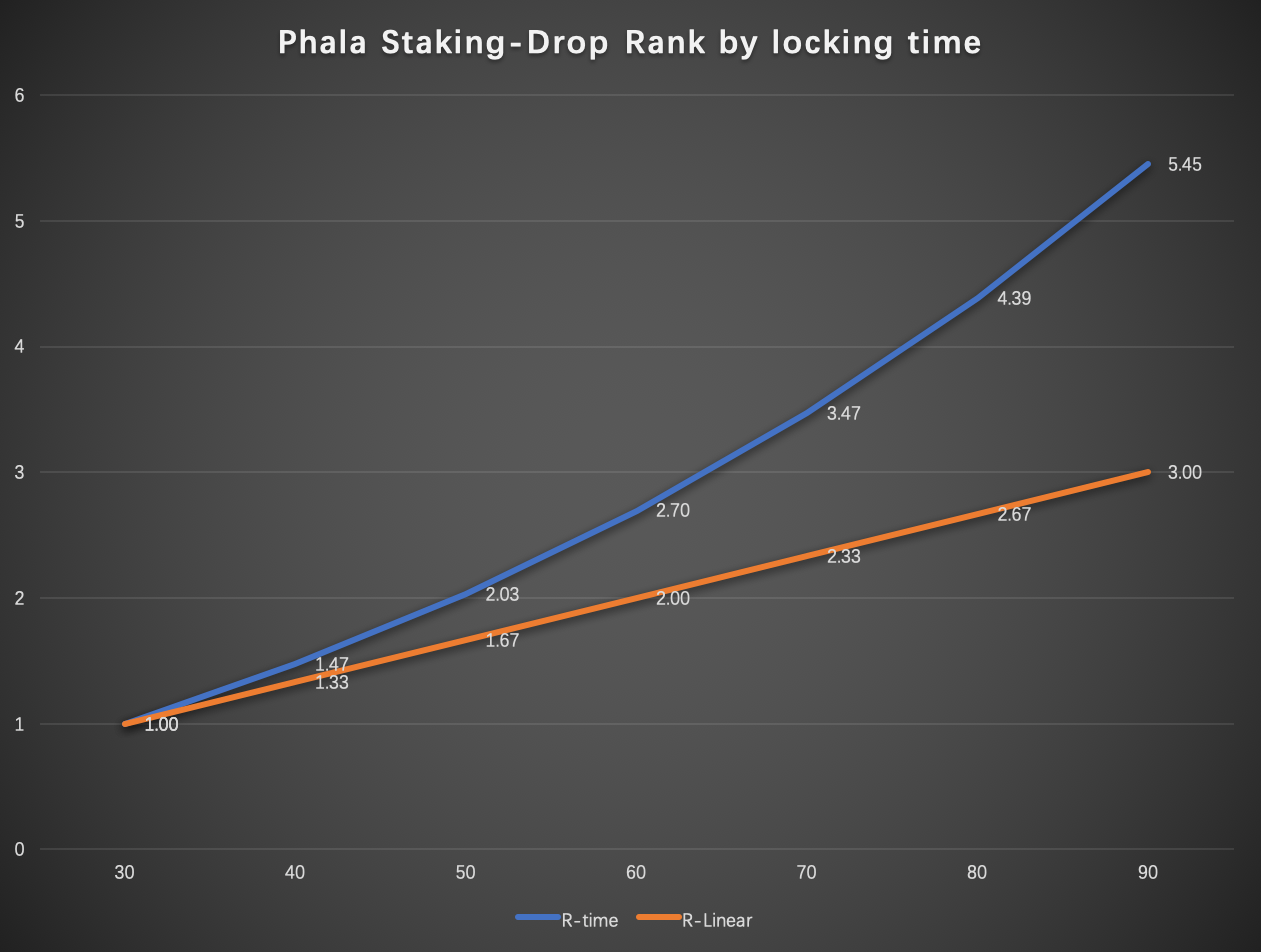
As it shows, Rank is more encouraging to extend the staking period.
#### Example
Here is a table of the estimated PHA return per 100 KSM:
| Cap reached when close | 30 days | 60 days | 90 days |
|-|-|-|-|
| 20% | 91.74 | 247.31 | 500.00|
| 50% | 36.70 | 98.92 | 200.00|
| 100% | 18.35 | 49.46 | 100.00|
| 150% | 18.35 | 49.46 | 100.00|
Assuming a participant Gavin staked 100 KSM:
- If he stopped staking at day 30:
- His return:
- In situation A: 100 * 30 * (27M / 4.4B) = 18.41 PHA
* In situation B: 100 * 30 * (27M / 491.4M) = 164.8 PHA
- When to claim: wait until 30th July
- If he staked for 90 days:
- His return: a minimal of 100.5 PHA
- When to claim: 30th July
## V. FAQ
### 1. What Is Kusama Nominator?
Kusama adopts NPoS (Nominated Proof-of-Stake) to elect validators. Nominators secure the relay chain by selecting good validators and staking DOTs. Nominators shall share both the return and the risk of their validators. To learn how to nominate and obtain staking return, please refer to [Nominator Manual](https://wiki.polkadot.network/docs/en/maintain-nominator).
### 2. Who Shall I Nominate?
[The whitelisted validators](https://docs.google.com/spreadsheets/d/1rHByHRy-YYYrBzFUY27N99wNI4r-YH97gVoS8i2wJMA/edit?usp=sharing). **Please be aware that only by nominating whitelisted validators can you receive PHA returns**. Copy the address of the one you want to vote for and start.
To better support Phala, nominate Phala’s validators in the list. :)
### 3. Can I Change My Validators In The Middle?
Yes. You can change your validators at any time as you wish. The effective stake score will be automatically calculated by the monitor script.
Also, Polkadot encourages nominators to vote for less-supported validators by NPoS mechanism. Learn more at [Polkadot Wiki](https://wiki.polkadot.network/docs/en/learn-staking).
### 4. How Is The Effective Staking Amount Calculated?
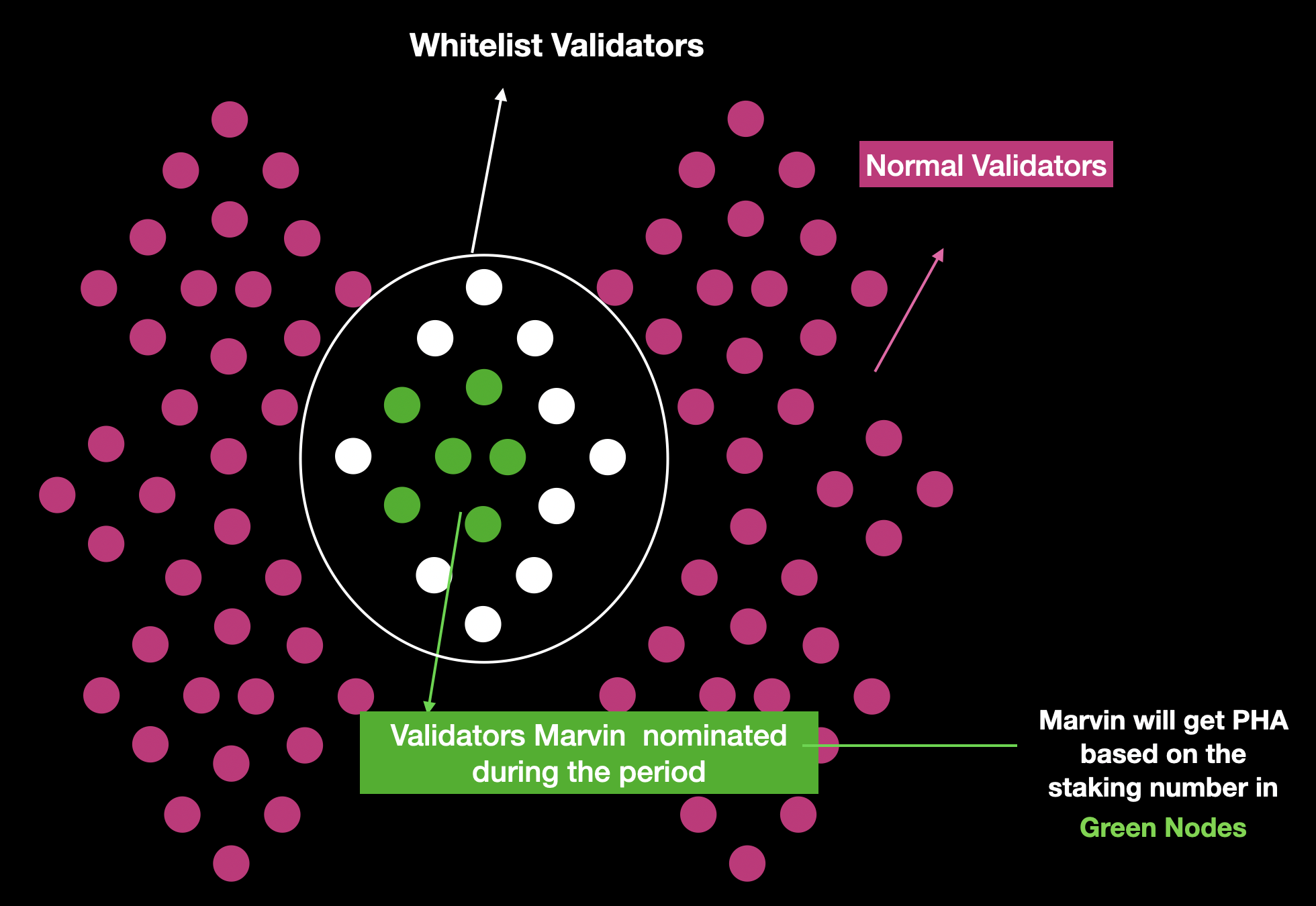
It differs based on **the number of whitelisted validators** and the continuity of staking.
[](https://imgchr.com/i/JR1xxS)
Suppose the pink dots are normal validators, the white dots are whitelisted validators, and the green dots are the ones being nominated. In a case that one staked 100 KSM for 30 days:
* Type of validators:
* If all the chosen validators are whitelisted, effective staking amount = 100 KSM * 30 days.
* If only part of the chosen validators are whitelisted, and you only staked 90 KSM for whitelisted ones, effective staking amount = 90 KSM * 30 days.
* If you change from a whitelisted validator to another whitelisted validator, effective staking amount = 100 KSM * 30 days.
* Continuity of staking:
* If you continue staking until the 40th day, effective staking amount = 100 KSM * 40 days
* If you accidentally stopped staking at day 29 but restarted at day 30 until 2 days after, effective staking amount = 100 KSM * (29+2) days.
### 5. How to execute the rules
Don’t trust, verify.
We can’t implement Lockdrop on Kusama though, our statistics scripts and reward-claiming contract on Etherum will be open-source and verifiable by anyone.
Besides, we will also provide a toolkit for your convenience including:
- a Stakedrop App on which you can stake to participate in the stakedrop by one click, and a calculator showing real-time staking amount and reward amount.
- the Stakedrop App will have whitelist validator and the introduction automatically updated
- the ERC20 contract address and reward-claiming contract address on Etherum.
- one can enter his or her ETH address on the Stakedrop app and receive PHA on Etherum.
 Sign in with Wallet
Connect another wallet
Sign in with Wallet
Connect another wallet