<style>
:root {
--light: hsl(180, 20%, 50%);
}
.reveal {
font-family: Georgia, georgia, serif;
color: hsl(180, 20%, 10%);
}
.reveal .slides {
text-align: left;
}
.reveal h1,
.reveal h2,
.reveal h3,
.reveal h4,
.reveal h5,
.reveal h6 {
font-family: -apple-system, BlinkMacSystemFont, "Segoe UI", "Helvetica Neue", Helvetica, Roboto, Arial, sans-serif, "Apple Color Emoji", "Segoe UI Emoji", "Segoe UI Symbol";
font-size: 0.6em;
font-weight: bold;
text-transform: uppercase;
letter-spacing: 0.1px;
color: var(--light);
}
.reveal h1,
.reveal h2:only-child,
.reveal h3:only-child,
.reveal h4:only-child,
.reveal h5:only-child,
.reveal h6:only-child {
text-align: center;
font-size: 2em;
font-weight: 900;
letter-spacing: 0.8px;
}
.reveal blockquote {
width: auto;
box-shadow: none;
border-left: 0.25em solid hsl(180, 20%, 50%);
padding-left: 0.5em;
font-style: normal;
background: none;
}
.reveal blockquote p:first-child {
margin: 0;
}
.reveal section img {
margin: 0;
background: none;
border: 0;
box-shadow: none;
}
.reveal small {
display: inline;
font-size: 0.6em;
line-height: inherit;
vertical-align: initial;
}
.reveal a {
color: inherit;
text-decoration: underline;
}
.reveal a:hover {
color: inherit;
}
.reveal ul {
margin: 0;
}
.reveal li::marker {
color: var(--light);
}
</style>
# How to be an ally
---
## Why this talk
---
We haven't done a great job of communicating our values in the past.
---
One of our primary goals is to make the tech industry more diverse.
Note:
Tech can be a shitty industry. It's not very diverse, exemplififes some of the worst traits of capitalism, and dumps huge amounts of money on emotionally immature nerds.
On the flipside there's a rejection of traditionalism, or arbitrary certification. The barriers to entry can be low (although higher for some).
---
It's irresponsible for us to focus on getting marginalised people into tech without working hard to make our programme safe.
---
We have a code of conduct highlighting unacceptable behaviour, but nothing _positive_ on what good behaviour looks like.
---
We spend months teaching you to code, but no time on how to be a better teammate.
---
We're a tiny non-profit. Each cohort largely shapes their own experience.
We hope to guide you towards an experience that's great for _everyone_ in the cohort.
---
## Bethnal Green, 2017
---
I got so much out of FAC. It was one of the best experiences of my life.
Note:
I want to give you an example of a relatively usual cohort. Nothing went catastrophically wrong. There have definitely been worse.
---
But with hindsight lots of people on my cohort didn't have as much fun.
That was partly an unintended consequence of my (and others') behaviour.
---
I don't think I was a great ally on my cohort.
Note:
The men generally had a lot more coding experience. Several of us had written some React before the course even started.
---
There were lots of loud voices.
Mostly male ones.
Note:
SGCs were dominated by well-meaning men with lots of strong opinions. This shut out the women who were unwilling to jump into a loud debate.
---
I formed a group with 3 guys to build a React project because we were excited by it.
We didn't even consider those we were excluding.
Note:
We were so lost in the fun and possibility that we forgot to bring others along with us.
---
No one is perfect, you just have to be moving in the right direction.
---
## Zoom, 2021
---
> _Prioritise marginalised people’s safety over privileged people’s comfort_
> \- paraphrased from afrotechfest.co.uk/coc
Both FAC's official position _and_ something we would like you to try and do.
---
## Feminism 101
---
## Marginalised
> _To be denied involvement in mainstream economic, political, cultural and social activities_
belittled / diminished / dismissed / discounted / excluded / disenfranchised
---
### Macro level marginalisation
Denied access to official power structures.
E.g. voting, education, marriage, employment.
Note:
You sometimes see people who claim "not to see race", or that we don't need feminism anymore. They say that women got the vote, schools are desegregated, gay marriage is legal, so our society is equal, stop complaining. Ignoring the fact that there are plenty of legal struggles (for example trans people currently face enormous legal barriers), they're using the wrong definition of equality.
---
### Micro level marginalisation
Legally surface-level _opportunities_ are equal, but _outcomes_ are not.
E.g. income discrepancy, social networking, unconscious hiring bias.
Note:
Societies have centuries of social conditioning, generational impact and unconscious biases to unlearn and overcome to be truly equal. You can't just remove the immediate legal barriers to equality and immediately question why marginalised people are still struggling.
---
## Harm
Harm doesn't have to be physical.
Harm doesn't have to be deliberate.
Note:
For example if someone is made to feel excluded and uncomfortable at work that will impact their professional development and performance.
---
## Microaggressions
Instances of harm that seem small in isolation but add up over time.
Can lead to a perceived "overreaction" if you only see the final thing that tips the scales.
Note:
For example in some professional settings women are at least 50% more likely to be interrupted while speaking. Being interrupted once is annoying, but to an outside observer doesn’t warrant an overt angry reaction. However from the woman’s perspective this might be the 10th time they’ve been interrupted that week. The otherwise innocuous events add up to a greater whole, and can lead to a (justified) complaint.
---
## Privilege
---
An unearned benefit or advantage someone receives because of their identity.
Note:
For example in a historically patriarchal society where men occupied most positions of power and authority being male confers a certain amount of (unearned) privilege.
---
### Macro vs micro privilege
You may have explicit legal privileges.
E.g. the right to marry or donate blood.
---
### Macro vs micro privilege
You may also have "smaller" privileges.
E.g. not having your technical knowledge questioned at work.
---
It’s important to note that it’s possible (and likely) to have one kind of privilege but lack it in other areas.
Note:
This is why intersectionality is important.
---
## Intersectionality
Different parts of an individual’s identity overlap and lead to specific types of systemic oppression and discrimination.
Note:
For example a lot of mainstream feminism centres white women because people forget race and gender intersect to cause different kinds of marginalisation.
---
### Intersectional privilege
You may be privileged in some aspects of your identity but not in others.
E.g. white and working class.
Note:
This lack of nuance is often used against us. For example white supremacists deliberately use race to divide the working class and drum up support for racist/nationalist policy.
---
## Intent
Intent doesn't really matter.
Unintentionally harming someone still hurts them.
You should want to make amends.
Note:
---
### Everyone makes mistakes
It can be hard to learn that behaviour you thought was fine was harmful to someone.
Note:
We’re asking you to work against strongly ingrained cultural programming. It’s not your fault if you have an inclination to confidently speak your mind and expect to get your way in group settings. However you are still responsible for the harm that may cause to others in the group.
---
### Educate yourself
Don't place this responsibility on marginalised people.
"I didn't know it was harmful" isn't an excuse.
Note:
If you can teach yourself React you can research how to be a better ally.
---
### ...but listen
If a marginalised person does labour on your behalf, **listen**.
If they thought you were beyond saving they wouldn't bother.
Note:
It’s important to work against your natural inclinations. Try not to react negatively to criticism.
---
## Allyship
It's easier to _say_ you're an ally than to actually be one. It's an _active_ role.
Holding the right beliefs isn't enough—you have to put in the hard work and introspection.
Note:
For example just "not being racist" isn't enough. "I don't personally discriminate" isn't the same as "I work to counter the ingrained racism in our social systems, other people and my own unconscious".
---
## An analogy
Quoted from guidetoallyship.com
---
<span style="font-size: 8rem">🥾</span>
Imagine you step on someone's foot...
You're wearing big protective boots and they only have sandals.
---
> _"Ow! You stepped on my foot"_
---
### How not to respond
---
Centring yourself:
> _“I can’t believe you think I’m a toe-stepper! I’m a good person!”_
Note:
Pointing out harmful behaviour is not an attack on your character.
---
Denial that others’ experiences are different from your own:
> _“I don’t mind when people step on my toes.”_
Note:
Remember you're wearing chunky boots
---
Derailing:
> _“Some people don’t even have toes, why aren’t we talking about them instead?”_
Note:
There are plenty of other problems in the world, but they're not being caused by you right now.
---
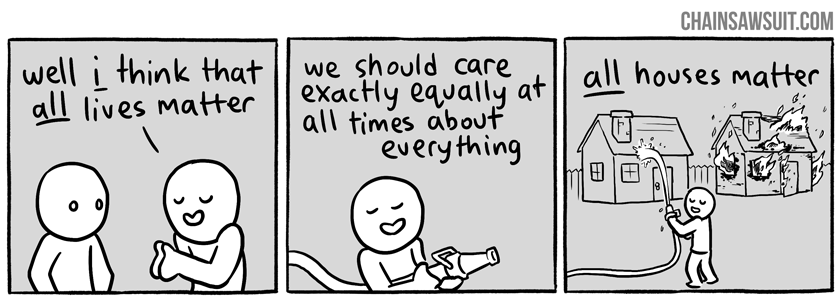
Refusal to centre the impacted:
> _“All toes matter!”_
Note:
Again this is deflection from the most pressing issue at hand.
---
---
Tone policing:
> _“I’d move my foot if you asked nicely.”_
Note:
This allows privileged people to dismiss valid arguments by moving the goalposts of a discussion.
---
Denial that the problem is fixable:
> _“Toes getting stepped on is a fact of life. You’ll be better off when you accept that.”_
---
Victim blaming:
> _“You shouldn’t have been walking around people with boots!”_
---
### Helpful responses
---
Stop the instance of harm: move your foot.
---
Centre the impacted:
> _“Are you okay?”_
---
Listen to their response and learn.
---
Apologize for the impact, even though you didn’t intend it:
> _“I’m sorry!”_
Note:
Not one of those fake "I'm sorry you felt like that" apologies.
---
Stop the pattern of harm: be careful where you step in the future.
Note:
Do some research on why some people have heavy boots and some only sandals.
---
Practice being grateful for the opportunity to learn, rather than embarrassed or angry that someone pointed out that you hurt them.
---
## Practical advice
---
Do not expect to be taught or shown.
Note:
Take it upon yourself to use the tools around you to learn and answer your questions
---
Do not behave as though you know best.
Note:
Confidence is good but always be open to the idea that you're wrong.
---
Do be aware of your implicit biases.
Note:
Examine whose voices you tend to hear, and whose ideas you tend to support and whose you dismiss.
---
Do amplify the voices of those without your privilege.
Note:
For example if you see someone interrupted or their idea ignored bring it back up, support the idea and credit the person who originally said it.
---
## Handling conflict
---
If someone violates the Code of Conduct tell the core team immediately
---
If someone says or does something small that offends or upsets you, or makes you feel excluded try to handle it straight away
---
<div style="font-size: 0.75em">
> **Oli**: hey guys, how are you all doing?
>
> **Yvonne**: good thanks! FYI would you mind not using gendered terms to refer to the group? Thanks!
>
> **Oli**: Sorry my mistake!
</div>
---
If you don't feel comfortable addressing it yourself, ask your CF or a core team member
---
<div style="font-size: 0.75em">
> **Oli**: hey guys, how are you all doing?
>
> **Yvonne** (to course facilitator): hey would you mind reminding Oli not to call everyone “guys”?
>
> **CF** (to everyone): hey Oli, just a reminder to try not to use gendered terms for the group!
>
> **Oli**: Oh whoops, I’m sorry everyone!
</div>
---
Remember if someone points out that you made a mistake, try not to take it personally.
They aren't saying you're a terrible person.
---
Apologise, take a moment to reflect, and try not to do it again
---
## Resources
<div style="font-size: 0.75em">
- Our "social rules"
<small>[learn.foundersandcoders.com/course/handbook/course-rules](https://learn.foundersandcoders.com/course/handbook/course-rules/)</small>
- An open source starter guide to help you become a more thoughtful and effective ally
<small>[guidetoallyship.com](https://guidetoallyship.com)</small>
- No, We Won’t Calm Down – Tone Policing Is Just Another Way to Protect Privilege
<small>everydayfeminism.com/2015/12/tone-policing-and-privilege</small>
- White Guyde To The Galaxy
<small>tatianamac.com/posts/white-guyde</small>
- Save the Tears: White Woman's Guide
<small>tatianamac.com/posts/save-the-tears</small>
</div>
{"metaMigratedAt":"2023-06-15T08:19:26.173Z","metaMigratedFrom":"YAML","title":"How to be an ally","breaks":true,"slideOptions":"{\"theme\":\"simple\"}","contributors":"[{\"id\":\"95766997-b355-49e6-8c38-077c6a7ebb3b\",\"add\":18722,\"del\":5656},{\"id\":\"8719d6dc-d98a-4680-91f3-8a21fcb8ec84\",\"add\":12,\"del\":11},{\"id\":\"0a41ac21-00a5-4d59-b808-37a29c6f6c98\",\"add\":36,\"del\":1}]"}