# HeteroCL: A Multi-Paradigm Programming Infrastructure for Software-Defined Reconfigurable Computing
##### link: [Paper](https://vast.cs.ucla.edu/~chiyuze/pub/fpga19-heterocl.pdf), [Github](https://github.com/cornell-zhang/heterocl), [Website](https://heterocl.csl.cornell.edu/web/index.html), [Docs](https://cornell-zhang.github.io/heterocl/index.html)
###### paper origin: FPGA '19
- Problem:
It is difficut to Write hardware by **hardware description language** (verilog, VHDL) due to too many specialized hardware knowledge.
- Proposal:
HeteroCL, a programming infrastructure composed of a ==Python-based domain-specific language== (DSL) and an FPGA-targeted compilation flow (CPU+FPGA).
## Introduction
Heterogeneous computing platforms are becoming widely available such as CPU with GPU or FPGAs. FPGAs is especially difficult to be programmed. As a result, the use of such platforms has been limited to a small subset of programmers with ==specialized hardware knowledge==.
HeteroCL, a ==programming infrastructure== composed of a ==Python-based== domain-specific language (DSL) and an ==FPGA-targeted compilation flow== (CPU+FPGA). HeteroCL framework produces highly efficient hardware implementations such as **systolic arrays** and **stencil with dataflow architectures**. The HeteroCL DSL provides a clean programming abstraction that **decouples** algorithm specification from three important types of hardware customization in
1. compute,
2. data types, and
3. memory architectures.
HeteroCL is a Python-based DSL extended from ==TVM==, and incorporats state-of-the-art ==HLS optimizations==: ==PolySA== for systolic arrays and ==SODA== for stencil with dataflow architectures. And ==Merlin compiler== is as one of back-end tools. This compiler generates ==LLVM code on CPUs== and ==HLS code for FPGA== targets.

### Why choose TVM?
1. Python-based DSL provides programmers with a rich set of productive language features such as introspection and dynamic type system.
2. TVM is a tensor-oriented declarative DSL.
3. TVM inherits the idea of decoupling the algorithm specification from the temporal schedule, which is first proposed by Halide
### Compute Customization
performing loop transformations and executing the computation in parallel.
Table 1 lists compute customization primitives currently supported by HeteroCL. The primitives prevent programmers from using ==vendor-specific pragmas==, which makes HeteroCL programs **portable** to different back ends.

### Data Type Customization
**Quantized computation** using low-bitwidth integers and/or ==fixed-point types== is an essential technique to achieve efficient execution on FPGAs.


### Memory Customization
Accelerating applications on FPGAs usually requires a high on-chip memory bandwidth to match the throughput of massively parallel compute units.

Example: reuse_at function with CNN:

### Mapping to Spatial Architecture Templates

## Back-End code Generation and Optimization
- General Back End

### Why choose Merlin compiler?
1. Merlin compiler leverages a small set of OpenMP-like pragmas to apply certain architecture structures by source-to-source C code transformation.
2. Merlin compiler generates both HLS C kernels and OpenCL kernels for FPGAs.
- Stencil Back End
- Systolic Array Back End
## Evaluation


## Related Work
- TVM is a **Python-based DSL** and a ==deep learning compiler== that enables access to high-performance machine learning anywhere. TVM significantly improves code portability across different CPU and GPU architectures[^1].

- HLS (High-level synthesis)
HLS referred to as **C synthesis, electronic system-level (ESL) synthesis, algorithmic synthesis, or behavioral synthesis**, is an ==automated design process== that takes an abstract behavioral specification of a digital system and finds a ==register-transfer level (RTL)== structure that realizes the given behavior.
- PolySA: Polyhedral-Based Systolic Array Auto-Compilation
PolySA leverages the power of the **polyhedral model** to achieve the end-to-end compilation for systolic array architecture on FPGAs. PolySA is the first ==fully automated compilation framework== for generating high-performance ==systolic array architectures== on the **FPGA** leveraging recent advances in **high-level synthesis**.

- SODA (SODA Open Data Autonomy)
SODA Architecture is getting evolved to realize a challenging goal of building a unified framework for ==data and storage management==.
- Merlin compiler
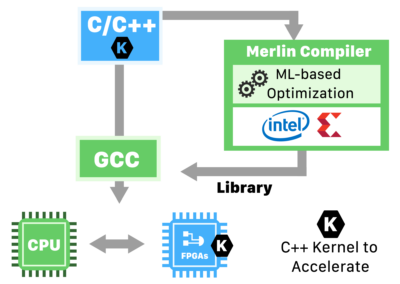
Merlin Compiler takes **C/C++ code** as an input and generates an executable that includes the **CPU host-code & the FPGA bitstream**.
- Halide
Halide is a ==programming language== designed to make it easier to write high-performance ==image and array processing code== on modern machines. ==Halide is embedded in C++.==
[^1]: [TVM introduction](https://tvm.apache.org/docs/tutorial/introduction.html#sphx-glr-tutorial-introduction-py)
 Sign in via Google
 Sign in via Facebook
 Sign in via X(Twitter)
 Sign in via GitHub
 Sign in via Dropbox
 Sign in with Wallet
Connect another wallet
Sign in with Wallet
Connect another wallet