# 1.2 - Developments In Dar al-Islam
> Dar al-Islam - Literally house/abode of Islam or Dar al-Tawhid
> Note: The islamic empire tends to mean multiple empires that were prodimently Islam.
## Territory
From china all the way to the atlantic
### Trade
Lot's of trading, have access to goods from Asia to the Atlantic Ocean.
## Essential Question
In the period from c. 1200 to c.1450
## Arab Traditions
- Arabian Peninsula is a very difficult place to live in
- Only ways to survive
- TRADE
- Culture of violence - must be strong to survive in the harsh climate
- - There is scarcity in resources, you must fight them to keep control over it
- Family Clans and Tribes
- Camels
- Adapted to last long distances, hold water for long periods of time, able to eat things other animals wouldn't be able to eat. Ate thorny bushes.
- Water
- Muhammad and Islam was the first time all of ;these differnt bedouin groups were tied together under onec ommeon idea
- It was very difficult to achieve and took well past his lifetime.
> Behouden group - These Arab people that were living in the peninsula. Many farmers were just trying to survive. They didn't identify as Arabian, they identified as their own tribes
Prior to this, these groups had natural deities
Even Muhhamad couldn't bring them together in his lifetime.
## Invasions and Shifts
By 1200 we were at the end of the Abbasid Empire. Very strong, wealthy and influential Empire in the Middle East.
### How did the Abbasids grow so strong?
- Based on Conquest and Trade
- Dhimmi - people of the book
- Tolerance towards the other monotheistic religions.
- People who prayed to the same god were considered "People of the book."
- Were often paid less or exempted from taxes.
- Tolerant to these people
- Mamluk - Egypt
- Enslaved and often ethnically turn who served as elite soldiers
- Seized control in 1250 - Mamluk Sultanate
- Declined when Europe found other sea routes.
### Also from central Asia (Turkic)
- Took control over the Abbasid from the inside, becoming the leader.
- Became in charge of the politics of their people but not the religion.
- Some separation between church and state.
## Scholarly Works
They were lost during the dark ages but due to the Muslims they were able to rewrite and archive things such as:
- Map Info
- Medical Info
- Math from india
- Later introduced to Europe.
- Triginomitry was found by an Islam scholar who took concepts and turned them into their own concept.
### Baghdad
Had this great library of scholarly wisdom. It became one of the centers of the Islamic World. It was in lots of trade routes so lots of people would go through it.
## Cultural Life
The main problem with the muslimw world was that they tried to control a castle divers population. While they conquered , they allowed people to keep their cultures.
The fact that they could keep they're own means it lead to individual identities being formed
Within islam during this time, ther were spereate classes
- Arab
- High up since they were seen as closer to muhammed
- Persians
- Converted to islam
- Weren't Arab
- Slowly managed to gain control over more of the empire until they became leaders of the dynasty.
The scholars adopted a great deal from around Afro Eurasia
- Maths from India
- Greek literature
- Paper working from china
## Commerce, Class & Diversity
Merchants were viewed here better than anywhere else
> Compared to China where they weren't viewed too highly due to a lack of physical work or creativity.
Muhhamad was a merchant, So was his wife, they were
Islam allowed for slavery, but they had a couple terms
- Could not be muslims
- Dhimmis(People of the book)
Slavery was different from how it's viewed in America. If you had a slave child they would be free. You could also end up paying and freeing yourself from slavery in a somewhat easy manner. You could also convery people to islam.
Slave form:
- Africa
- Kievan Rus'
- Russia
- Central Asia
Slave women (girlfriends) were given more freedom than married wifes. It wasn't okay for a woman to be around non-family males. Married women couldn't read around non-family men. Enslaved women would end up having these rights. They could "dance" and earn money for non-family men.
## Free woman in Islam
Many customs associated with Islam & women were adopted from the earlier socitetes
- Veiling
- Greek, Byzantine & Central Asian.
- Men often would wear head coverings as well.
- Women could study and read just not around non-family males.
- Women could own their own business.
Muhhamed raised the social status for women, Mushammad's first wife was a successful merchant. Women had more social status than many christians and Jewish women in this time period.
Muhammad made it so you couldn't kill female children with Islam. Could inherit property and sometimes initiate divorce themselves.
> Urbanization - The growth of cities meant that there were more and more limitations for women with things such as veiling.
> The reason for this is because you would be interacting with more non-family men.
>Harem - A spot in the house where all the wives and female slaves would be found.
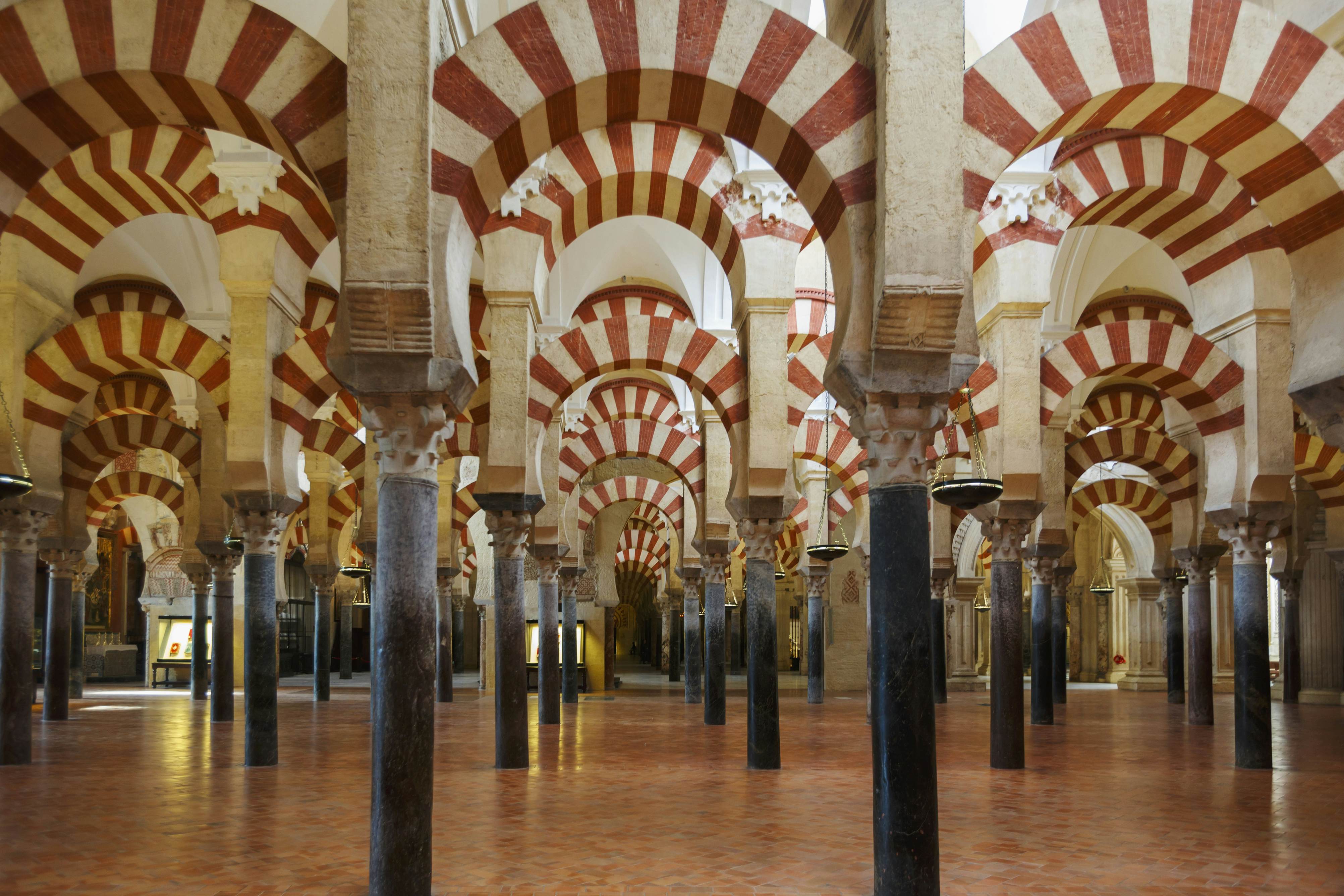
## Islamic Rule in Spain
The islamic state in spain was focused in Cordoba and became the center of islamc rule in the west. They retained their connection to Umayyad as they fled there in it's fall
- Biggest library in the world at the time
- Allowed for lots of trade from all over including China
- East Asian products were introduced to Europe through this trade route.
- Tolerant - Muslims, Christians, & Jews coexisting peacefully.
- Influenced each other to an extent like in the image below
## Good info to know (From Freemanpedia)
- The Golden Age of the Islamic Caliphates is over by 1200. The Islamic world has fractured into smaller sultanates/dynasties by 1200.
- The Islamic World is one of the MOST affected by the arrival of the Mongols and the creation of the Ilkhanate.
- Stop thinking of Mecca or Medina or Baghdad as the center of Islamic influence. From here on, it will be Cairo (and in 1453), Istanbul.
- If the Mongols are the muscle of this period, the Muslims and Chinese share the “brains” title. Although politically fractured; culturally, scientifically, medically, philosophically, and in the fields of poetry and literature; the Islamic World remains the center of Earth’s innovation from 1200-1450.
- By 1450 the Islamic world had reached its geographic peak by 1450. With a few exceptions (Constantinople), the extent to which the Islamic World will expand after this period is minimal. In the next period, expansion is dominated by the Europeans.
---
{%hackmd H17XoUBZt %}
###### tags: `AP World` `Unit 1`
 Sign in with Wallet
Connect another wallet
Sign in with Wallet
Connect another wallet