# Causes of the American Revolution
> Period 3 - 1754 to 1850
## Things to Know
> To what extent did the French and Indian War maintain continuity and foster change in the relationship between Great Britain and the 13 Colonies?
> To what extent did colonial politics, economics, and culture from 1607 to 1754 influence the development of the American independence movement?
## Salutary Neglect
England and America and quite a while away apparently, this means that it would be very difficult to see if laws we're enforced or not. Basically as long as each country was mostly doing what they we're supposed to do everyone would get along.
Along with this there would be a lot of fighting in Britain which would make it harder to enforce.
- English Civil War
- Glourious Civil War
Along with that Colonies would practically be running themselves, stuff like developing unique economies based on region and just having a lot of economic growth such as:
- Colonial GNP was 25 million pounds ($2.25 billion)
- 1/3 of the Great Britain’s GNP
- GDP per capita was highest in the world by 1775
There would also in general just be very high life expectancy and literacy rates.
## Britain Exerts More Control
Navigation Acts would be strengthened, this would lead to things like an increase in mercantilism and a move to vice-admiralty courts, which basically meant there would be a military running the coury and less burden or proof for each respective case.
THere would also be the Molasses Act, which would Tax on non-British import of sugar.
> This act would be in 1733.
## Parliment Acts
- **Sugar Act of 1764**
- Revenue tax
- Quartering Act of 1765
- **Stamp Act of 1765**
- First direct tax
- Declaratory Act of 1766
- Parliament’s right to tax whatsoever
- **Townshend Acts of 1767**
- Pay royal colonial officials
- Writs of assistance
- **Tea Act of 1773**
- Support British East India Company
- **“Intolerable Acts”**
- Coercive Acts of 1774
- Massachusetts Government Act (royal appointments)
- Port Act (Boston closed)
- Administration of Justice Act (trial of royal officials - moved)
- Quebec Act of 1774
- Appointed government; Catholicism recognized
- Prohibitory Act of 1775
- Colonies in open rebellion
### Acts in Detail
#### The Sugar Act(1764)
- Purpose
- Increased regulation of colonial trade
- Raise revenue for war debt
- Sugar, spices, lumber
- Vice-admiralty courts
- Colonial Reaction
- Colonial merchants and shippers
- Boycotts
- Repealed in 1766
#### Stamp Act(1765)
- Purpose
- First direct tax
- Generate revenue for troops in America
- Colonial Reaction
- “No taxation without representation.” - James Otis
- Stamp Act Congress
- Sons and Daughters of Liberty
- Committees of Correspondence
#### Townshend Acts (1767)
- Purpose
- Raise revenue for administration of colonies
- Glass, tea, paper, lead, paint
##### Colonial Reaction
> “If they may be legally deprived… of the privilege of legislation, why may they not, with equal reason, be deprived of every other privilege? Or why may not every colony be treated in the same manner, when any of them shall dare to deny their assent to any impositions that shall be directed?”
> [name=Letters from a Farmer in Pennsylvania - John Dickinson]
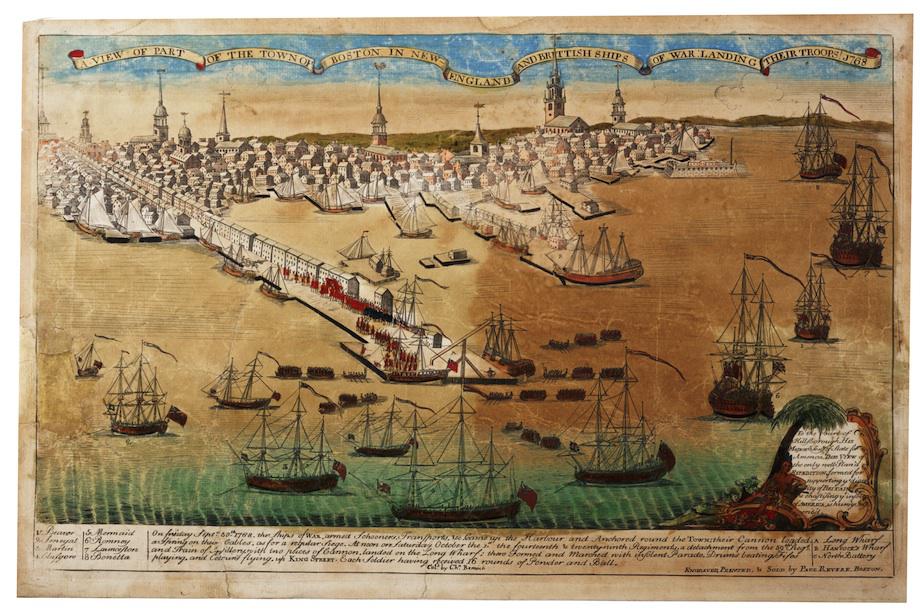
> Funny Paul Revere Engraving
#### Boston Massacare
There are basically 5 guys talking about how they don't really like the British Taxing the colonies. People working in menial task and soldiers walking all around places like boston enforcing the new laws and taxes.
> First major act of violence
### Tea Act
The purpose of this would be to support the British East India Company, a reaction to this would be the Boston Tea Party, in which, well you probably know this.
### “Intolerable” Acts (1774)
- Purpose
- Boston Port Act
- Would shut down Boston Harbor
- Quartering Act
- Would force people to stay inside
- Administration of Justice Act
- Tries all trials to be under the government and not the Jury
- Massachusetts Gov’t Act
- Would shut down the Massachusetts Goverment ability to - govern themselves.
- Quebec Act
- Would change the official the protestant *and* catholic.
- Colonial Reaction
- Suffolk Resolves
- First Continental Congress
## lexington and concord(grape juice)
King George III, would appoint a royal governor to massachusets, him being Governor Gage. During his first act he would send 2 spies out to look at the colonist, and they notice that the colonist are stockpiling guns and ammunition in Lexington.
As a result, gage sends out 700 british soldiers.
One of the Riders would be Paul Revere, who would travel the shortest distance than get arrested for a night.
8 Minutemen would die and 1 redcoat would be wounded at lexington.
there would also be the "shot heard 'round the world'", which would start the revoultion, basically the colonist we're told to like retreat but some random shot would be set off and revolution would start.
> british soldiers are called regulars for some reason
## 2nd continental congress
at this point all 13 colonies would come, but they wouldn't be ready to declare independence. there would be the olive branch petition, which would [?], and would try to get the king to hear it but he would lock them out and pass the proclamatino of rebellino which would keep them out legally.
they would go and elect george washington to be the leader of everything ig, since they would already have support from everyone in massachusets, so they would get someone from virginia.
there would also be the declaration of independence which would be a declaration of independence or something.
thomas paine common sense - this would basically make it so the declaration of independence since most people would be illeterate and really stupid
## declaration of independence
it would basically list all of the reasons that the colonies should be able to split off from great britain.
(me when me)
---
{%hackmd H17XoUBZt %}
###### tags: `APUSH` `Period 3`
 Sign in with Wallet
Connect another wallet
Sign in with Wallet
Connect another wallet