---
tags: meeting notes
---
# MDF MEETING NOTES 20211022
completely in-person! (and next week will be virtual)
## AGENDA
1. Updates
2. Show and Tell
- Xiaomeng
- Tica
## UPDATES
### Expanding Harvard Horizons
- The LL is working on expanding a program we run for graduate students each spring called [Harvard Horizons](https://gsas.harvard.edu/academics/professional-development/harvard-horizons). We would like to support students in creating high quality multimedia presentations of their research.
- To this end, we'll be running an initial workshop in J-Term for interested students, then a series of 3 workshops throughout the term on Story, Visuals, and Voice.
## SHOW + TELL
### Xiaomeng
Notes
### Tica
- **Virtual Gallery project**
- Tica shared a virtual gallery that she created. The desire was to create a place that students could share their artwork pretty quickly and easily. The hope is that students can just input an artwork and description and it can populate into the gallery.
- Benefits include:
- Can use Tica's template to get people started quickly using Unity
- For courses can quickly spin up a gallery of students work
- You can record a show and tell/gallery walkthrough to present your work
- If anyone is interested in learning more about this, get in touch with Marlon! We have models of the Learning Lab studio that you can play around with.
- Also here is the open-sourced repository to the VR gallery project! https://github.com/ticahere/ll_virtual_gallery
- **Intro to Unity tutorial**
- General outline ([Slides](https://docs.google.com/presentation/d/1KF3giG94M3bvd54hdqesugrsnMmX1VkIfQkW9lD_yUQ/edit#slide=id.p))
- 1. Create an empty scene
- 2. Sreate an object
- 3. Create a plane
- 4. 3D objects have meshes, materials, textures, shaders
- 5. Apply physics, rigidbody
- 6. Add a first person character
- VFX apps vs. Game engines = VFX applications allow you to create really complex physics simulations, etc. but it takes hours or days to render a scene (like for The Avengers). Game engines do similar things but you have to render in 60 frames per second, so the models, textures, and simultions have to be *much* less complex. This is why The Avengers looks so much better than The Sims.
- It would be really cool to do a workflow together from Airtable to VR/AR.
- UnityMARS
- 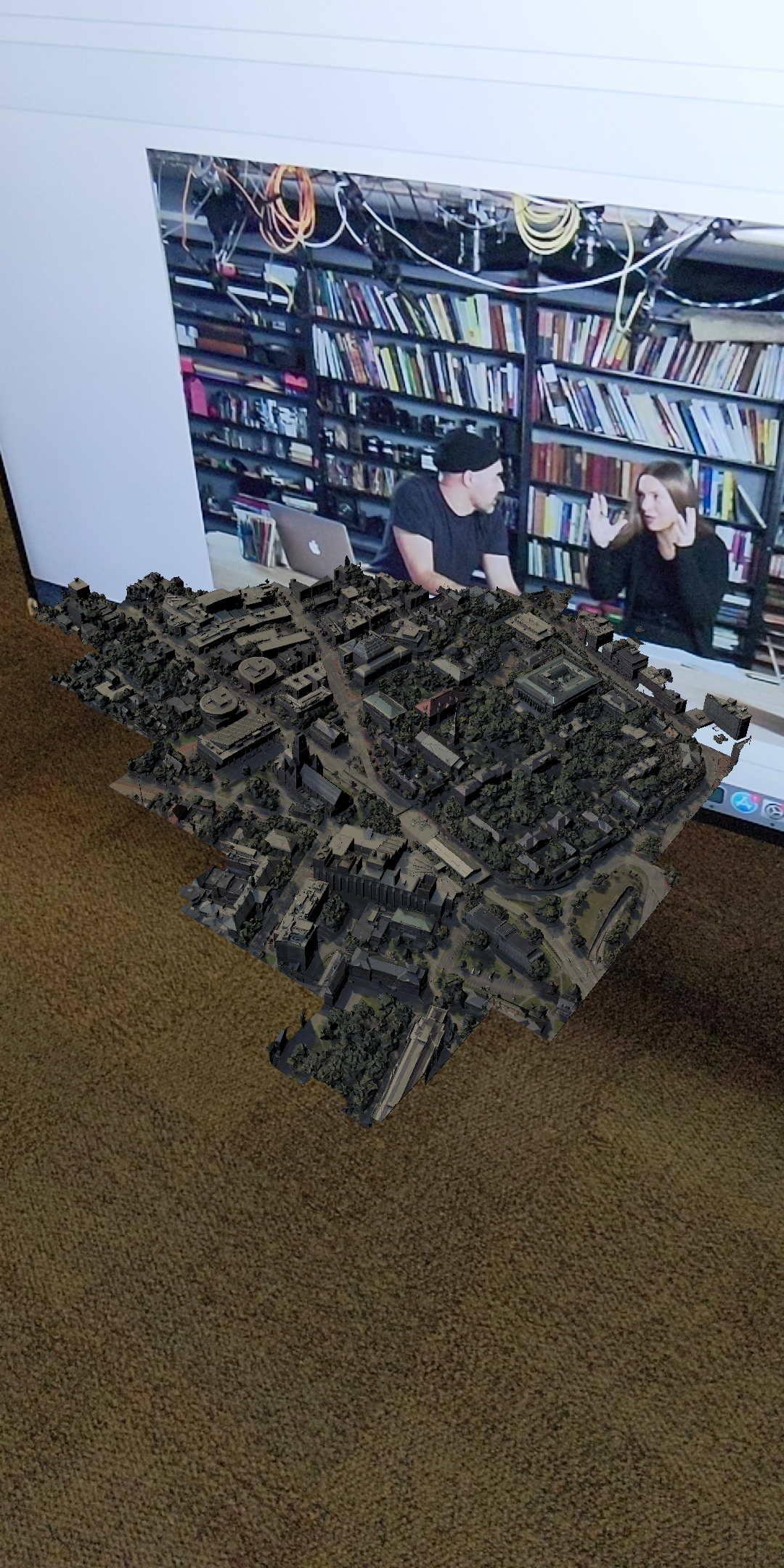
- This image is a screenshot showing how you can pin 3D models to images in AR. Tica has pinned a model of Harvard's campus that will appear any time Marlon is on screen.
- **SEAS Datavis Project**
- [Project Proposal](https://docs.google.com/document/d/1vFqCUo2oLfNSgmHIz5CJ6UsPfugY8jr4DdLbu2KhLtI/edit#)
- Summary:
- Eliza Grinnell is working with Prof. Hanspeter Pfister on a set of three interactive visualizations that represent faculty teaching, research, and collaboration at SEAS. These visualizations are intended to serve as 1) course support tools for Hanspeter’s dataviz classes; 2) reference for undergraduates interested in research opportunities; 3) reference for current/future grad students; 4) new faculty orientation; 4) a guide for potential academic collaborators at Harvard; 5) a tool for industry partners. They are already partially developed, but they need additional conceptualization and development and time in order to reach their potential and be ready for public launch.
- CHECK OUT THE VISUALIZATIONS HERE: https://seasvis.github.io/
* 1. Faculty-Faculty Collaborations
* 2. Faculty + initiatives and connections to other schools -- good for administrators and new faculty
* 3. Research interests comparison tool -- prospective grads, trying to figure out which faculty member would be best as a PI
 Sign in with Wallet
Connect another wallet
Sign in with Wallet
Connect another wallet