---
tags: Alexa
---
# MCB197 Scientific Illustration Resource Guide
## Workshop Recap
In this session, we worked on how to create visually compelling scientific illustrations and graphics.
We started by exploring the fundamentals of scientific illustration and graphic design, focusing on how spatial arrangement can enhance the understanding of complex scientific concepts.
We broadly talked the principles of graphic design, including hierarchy, balance, and contrast, which are essential for creating effective scientific illustrations.
You also had the opportunity to use Biorender, a powerful tool for creating scientific illustrations. Step by step, you learned how to create your own illustrations during the workshop.
By the end of the workshop, you had gained the skills and knowledge to create visually appealing and informative scientific figures. Well done, everyone!
## Graphic Design Considerations
- **Contrast or Color:** Contrast can be used to create visual interest, guide the viewer's attention, and communicate hierarchy. Contrast can be achieved through differences in color, size, shape, texture, or style.
- **Alignment:** Proper alignment helps create a sense of order and organization in a design. It can also be used to create visual connections between elements and establish a visual hierarchy.
- **Repetition:** Repetition involves using the same or similar elements throughout a design. Repetition can help create a sense of unity, consistency, and rhythm in a design. It can also be used to reinforce branding elements or highlight important information.
- **Proximity:** Proximity refers to the grouping of related elements together. By placing related elements close to each other, designers can create visual relationships and communicate that those elements are connected. Proximity helps organize information and improve readability.
## Spatial Arrangements
Diagrams visually represent relationships between elements or concepts, illustrating connections, hierarchies, sequences, and dependencies to simplify complex relationships. Effective spatial arrangement in diagrams ensures clarity, prevents confusion, and communicates the intended message. Spatial organization can also indicate hierarchy, with elements placed higher or to the left perceived as more important or occurring earlier. Grouping elements together spatially indicates relatedness, helping viewers understand which elements belong together. The sequence of elements can be shown through spatial arrangement, suggesting a specific flow or progression. Additionally, spatial arrangement can emphasize certain elements or relationships, drawing attention to key points and aiding understanding of complex concepts.
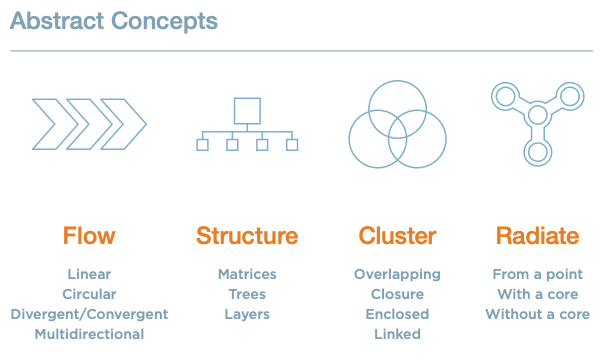
Here's the [Duarte Slideology Book](https://drive.google.com/drive/folders/1-NKdsT-gpIwQNvYwKk_49h_hwfElU7vc?usp=sharing) so you can take a look at all the different types of diagrams for inspiration.
## General Tools for Illustration Making
Various tools are available for scientists to create academic posters or scientific illustrations generally, each offering unique features and capabilities. Adobe Illustrator and InDesign are popular choices, providing professional-grade tools for precise layout and graphics. PowerPoint, widely used for presentations, offers a user-friendly interface and compatibility. Canva, known for its templates and design tools, is suitable for quick and stylish posters. Inkscape, a free and open-source software, offers a versatile platform for vector graphics. These tools cater to different skill levels and design preferences, allowing scientists to create visually appealing posters to effectively communicate their research. Below are some tutorials linked for each tool.
- [Adobe Illustrator ](https://helpx.adobe.com/illustrator/tutorials.html)
- [Powerpoint](https://www.youtube.com/watch?v=_WnhoIbfcoM)
- [Canva](https://www.canva.com/designschool/tutorials/)
- [InDesign](https://helpx.adobe.com/indesign/view-all-tutorials.html)
- [Inkscape](https://inkscape.org/learn/tutorials/)
### Check out the Biorender and Poster Resources here!
#### [Biorender resource guide](https://hackmd.io/@mdf-23-24/HJa97sPAT)
#### [Poster resource guide](https://hackmd.io/@mdf-23-24/r1ll2MURp)
#### [Google Drive with Media](https://drive.google.com/drive/folders/1-NKdsT-gpIwQNvYwKk_49h_hwfElU7vc?usp=share_link)
 Sign in with Wallet
Connect another wallet
Sign in with Wallet
Connect another wallet