---
tags: kevin
---
# Design Labs: Summaries
## Friday, 9/16
### Doing and Interviewing
#### (imminent / immediate / immanent ***reflection***)
In this Design Lab, the students participated in three activities and then were immediately interviewed and asked to reflect on what they had just done (or not done).
The three stations/activities though which they rotated were:
• Clay (at the main table)
• Dance (on the stage)
• Newspaper (at the other tall table)
*[The first two of these were pre-designed activities; the third was made in the moment (more on that below)]*
The sudden shift to interview allowed an unusal form of reflection to emerge — moving the students to make sense not only of what they had done but of why they had done it.
This push to articulate enabled a reorganization of concepts and of their relation and relevance (or irrelevance)
The **Newspaper** activity was a bit different. In it, the students were asked not only to do an activity but also to *come up* with one first. It was, therefore, a kind of meta-activity. The students were given copies of *The New York Times* and *The Wall Street Journal*, along with colored cards. As an example, one of the activities a group of students designed was to compare and contrast the ways in which the different publications presented the same stories visually (in font, in page placement, with images, etc.); they then did the activity using cards to indicate, delineate, and describe that content and form
.
.
## Friday, 9/23
### Animation!
protoype / troubleshooting
Design Lab animation class
4 Stations
Troubleshooting
Stop motion
filters
THE ANIMATION WORKSHOP
Stop motion – with LLUFS
Filters and projection
After Effects with Casey
.
.
## Friday, 9/30
.
.
## Friday, 10/7
### Music
.
.
## Friday, 10/14:
.
.
## Friday, 10/21:
.
.
## Friday, 10/28:
.
.
## Friday, 11/4:
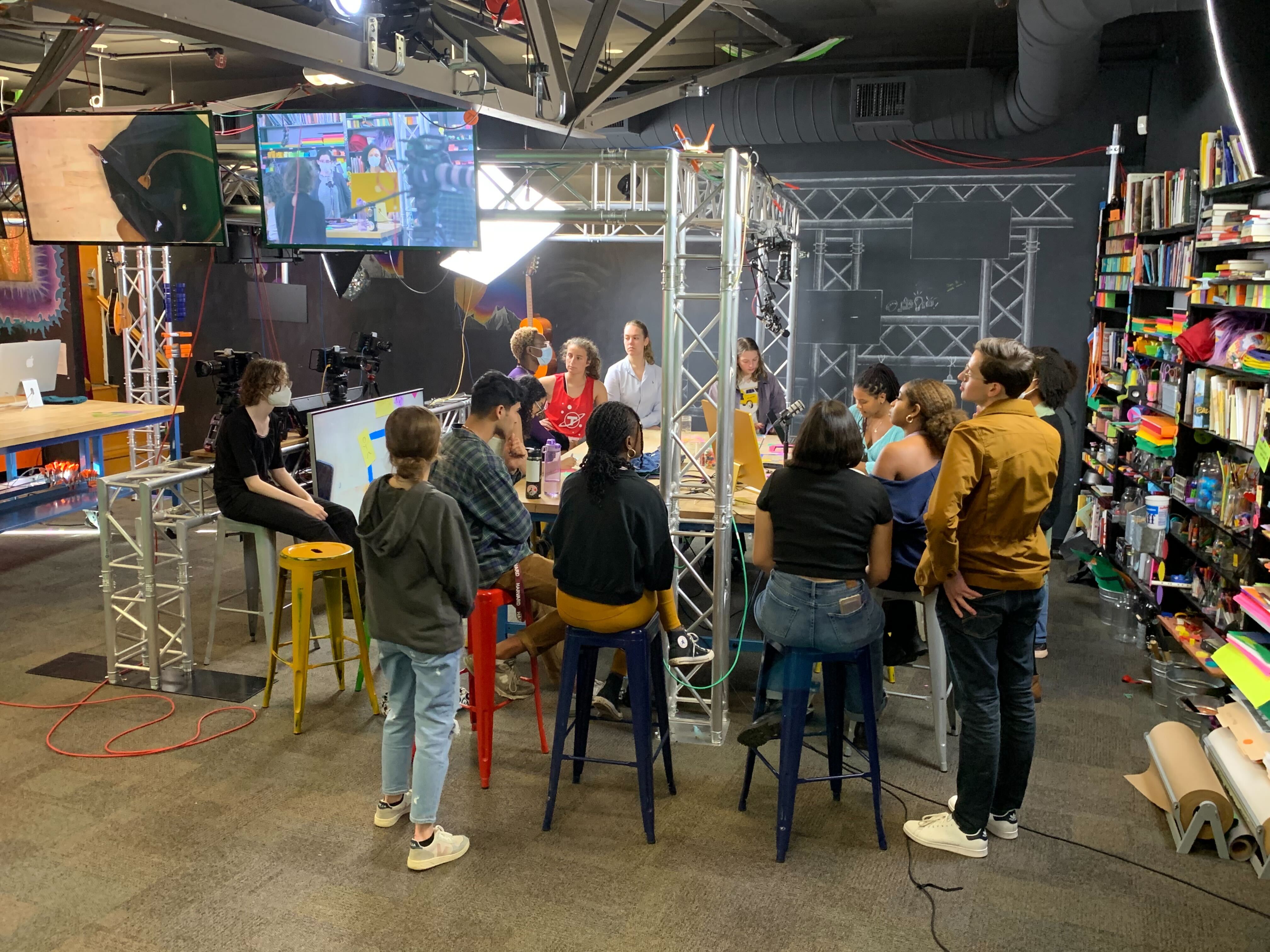
### w/ avLab
#### Three Stations
- Audio
– Using Logic to make loops to accompany description and explanation of a topic
– Microphone to project and record
– Video to record
- Overhead Camera
– Using visual representation / physical objects to convey ideas
– Illustration with cards
– Materials; engagement of the senses
- Small Studio
– Multimodal presentation
– Text-based display/description of information
– Speaking to camera
– Projection on cloth screen
Imagine how these forms would be best suited to variety of content AND to variety of audience — in particular, audiences of range of knowledge and ability — (stations were broken down by novice and expert)
.
##### Some Reflections:
- "content" was generally meta
- the multiform mode (w/ overhead camera, in particular) might be especially useful for teaching or explaining complex topics with moving pieces [llufs gave critical theory as an example]
- the Logic loop might work best as holistic *narrative*, perhaps as general overview or as review of topic (and as final project)
- narration can help synthesize — and REnarration also helps with content "retention" (particularly, in, say, a history course; causality and sequential dates)
- the Small Studio activity (perhaps unsurprisingly...) contains both — it unites particularity of complex content with linear and spacious *story*
___
.
.
 Sign in with Wallet
Connect another wallet
Sign in with Wallet
Connect another wallet