# Neuro 101 Scientific Communication Workshop
###### tags: `emily`
## Course
NEURO101: Neurobiology of Emotions and Mood Disorders
Instructor: Alen Juginović
## Event
Location: Learning Lab Main Studio
Time: Wednesday, October 5, 6:00pm - 7:15pm
Number of students: 7
## Purpose
This was a workshop helping students to develop scientific communication skills. In the session, we discussed how to utilize visual content to help increase audience understanding and to convey concepts in a different format than written content. These skills are highly relevant to the course's objectives to teach students how to read primary literature and share what they have learned with a broad audience using PowerPoint and video presentations.
## Room and Tech Layout
* Computer at main bench sharing to screen
* Overhead cameras at 4 benches projecting to one screen
* Stage/green screen projecting to the center of the same screen
* Paper frames and art supplies on each bench
* Copies of the article being discussed at each bench
* Additional cameras operated by LLUFs to capture the students at work on their visuals
## Outline of Workshop
* Emily and Christine introduced themselves and had a short discussion about why visuals are so important in scientific communication.
* Emily shared a model of an [article](https://royalsocietypublishing.org/doi/10.1098/rspb.2021.0150) with several interesting figures under the overhead camera. Students discussed features of the article they found either effective or weak, and they discussed how they might change the figures to make them more clear and/or accessible.
* Christine shared a short [clip](https://www.youtube.com/watch?v=6Fk1V5NqoD4) of Steve Jobs introducing the iPad. Students discussed the aspects of the presentation they found successful and ways in which these ideas translate to the types of presentations they are giving in class.
* Christine gave an overview of a few graphic design principles, using colored cards in her demonstration.
* Students conducted an activity in which they prototyped a slide using paper visuals.
* Students at each of the four tables were assigned a different section of the [paper](https://jamanetwork.com/journals/jamanetworkopen/fullarticle/2786464) they read for this week's class (introduction, methods, results, discussion).
* A paper frame served as the boundary around the slide, mimicking the idea that each slide is limited in space so that space needs to be used effectively.
* Students spent time preparing paper visual interpretations of the data/text in the article using crafting materials from around the room.
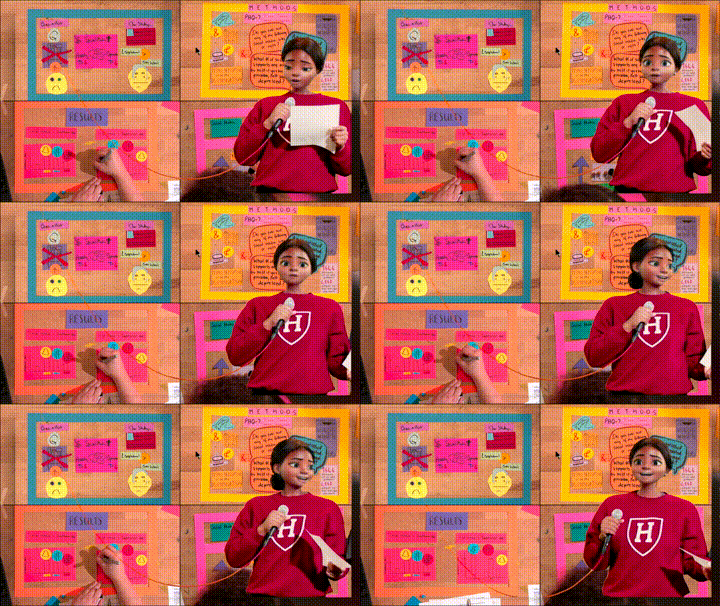
* Students went up to the stage and explained their section of the paper and what their visuals represented (the visuals were projected behind them throughout the presentation and filters were used to animate the students).
* Alen gave feedback on the content of the student presentations and emphasized parts of the paper that were important for the students to remember throughout the semester.
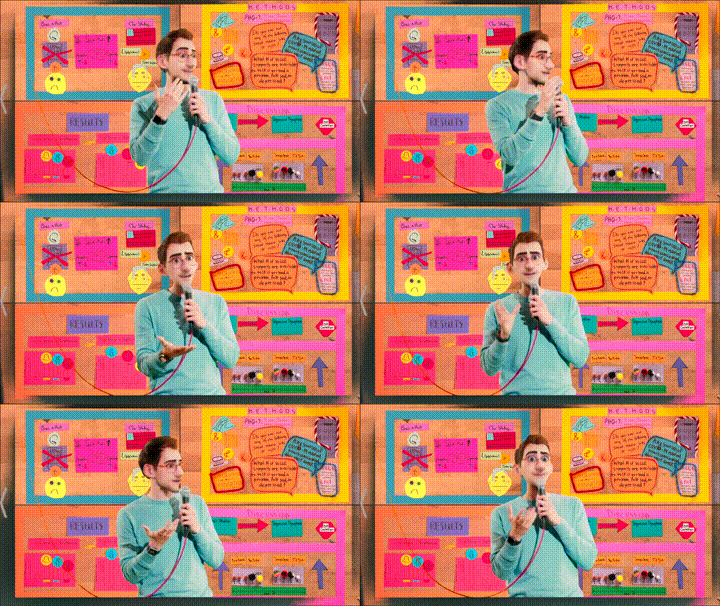
* At the end of the student presentations, Alen summarized the article and its key takeaways.
## Reflections
The workshop was a fun opportunity for the students to take a break from their typical class routine and think about useful visual communication principles they can implement in their presentations. The students were eager to contribute to all of the discussions. The paper "slides" designed by the students were creative and innovative. The students were thoughtful about their use of icons, text, and color, and they seemed proud to present their work to their classmates. This activity effectively allowed students to practice 1) implementing design principles and 2) presenting scientific principles orally.
## Media
<figcaption align = "center"><b>Figure 1: Student presenting the methods of the paper</b></figcaption>
<figcaption align = "center"><b>Figure 2: Instructor summarizing the takeaways from the article </b></figcaption>
 Sign in with Wallet
Connect another wallet
Sign in with Wallet
Connect another wallet