---
tags: sarah
---
# Minis LookBook ideas
## Pedagogical Justification
Micro assignments, or "Mini-s" are short, low stakes activities that can help students track their learning progress, work on new skills, hone specific techniques, and help them become more aware of their own learning process. Minis are great activities for in class/ section. They can also be manageable homework assignments that are more creative than traditional "response paragraph" assessments. By taking a form other than a writing prompt, minis seem less intimidating to students, and can prompt the students to view material in a different way. Further, minis can be scaffolded over the semester in a way that can build toward a final capstone or project.
## Minis for language classes
### Read out Loud x 2
Using voice notes or some other simple tool, have the student read and record the passage in latin/greek before they work on translation. then the student can read/translate the passage, do their homework, etc. Afterward, have the student re-record the latin/greek. Does the flow change based on understanding? does the emphasis change? is it easier?
This mini no only forces the student to come back to the text after the "translation" is done, which encourages fluency in the primary language, but it also ensure the student has read the whole text through at least 3 times. Repetition is an effective tool for competency. Further, this assignment placement emphasis beyond pure translation, which will give the students a more holistic experience of the text.
### Annotate a close reading
this is a primarily text or reading/writing based activity, but it also used shapes, colors and interventions. This can be done in translation or in the original context, or side by side
* Assign a passage for analysis
* Have students highlight, underline, circle, and bracket things they notice, based on guidelines provided (e.g., circle all the passive verbs)
* have them write questions
* have them select the more relevant or interesting part
### Draw for grammar
Give you students a sentence that illustrates a grammatical concept they are learning. In some way, they must make an image (it can be figural, a graph, a matrix, abstract, etc.) that highlights the function of that grammar structure. The image should not be purely narrative, but somehow relate to the actions and functions of each sentence structure. Students can work on this on their own or in pairs. After, students will present their drawing to the rest of the class and explain how the image represents grammatical concepts. If this is assigned as a take home activity, students will write a paragraph annotation of the drawings. The idea is that by taking a sentence (word/text based learning) and by turning it into an image (visual based learning), the student not only hits on multi-modal comprehension, which helps with long term retention, but they also must dwell on the sentence and grammar component for a long time (longer than in pure translation), as they decide how to represent it visually. This slow-looking/ slow-thinking process will not only help them better understand the nuances of the grammatical construction, but also teach them the fundamental techniques of philology.
## Drawing prompts
Drawing has long been acknowledged as a valid pedagogical technique to hone close looking skills, aid in analysis, and prompt students to see new things. When using a drawing prompt or activity, the teacher should be clear with their students about objectives. For example, you might want your student to pause every 5 minute and write a one sentence response about the process, or an adjective that comes to mind. You might ask your student to be aware of curves, lines, or scale. You might ask them to focus on one particular detail.
Kai Kee et al.(Drawing in the Museum) argue that drawing to learn is a method that uses more than just the eyes, as it engages all the senses, including the body and mind. It can help you become more aware of details and see new observations.
Drawing is also a fundamental part of archaeological practice, on the basis that it allows you to comprehend both minutia and big picture ideas in a more embodied way. We can bring field drawing into the classroom to gain many of its benefits.
### Observation drawing
In a classroom, you can ask students to look at an object or image and draw what they see. This is "observation based" drawing, which does not require any background knowledge or interpretation. This can also help students learn the different between observation and interpretation, two related but distinct steps for academic writing.
### Outline Drawing
Students look at an object and place their pencil on a piece of paper. They continually look at the object, not the paper, as they sketch the outline and contours of the object. This gives them a better feel for the object as a whole, rather than on composite parts. To follow up on this activity, you can ask students to annotate parts of their drawing with words after the line drawing is complete.
### Line Drawing/ Tracing
Print out an image and have students copy the image with tracing paper and pencils. The act of copying something out will allow students to comprehend a lot more detail than they would notice with mere looking. This could be a particularly good activity for an epigraphy classes, where transcription is usually part of the process. By tracing, students cannot miss details, lettering, and are naturally invited to dwell on hard to decipher parts.
### Line drawing (at home on Illustrator)
students all have access to adobe illustrator. Introduce them to the basics of Illustrator needed for tracing. They can practice the skills and getting used to Illustrator in class, and complete a final assignment at home. In addition to the image they produce, have they write a short response about their process. WHat was difficult? WHat did they discover? Did they notice new things about the object they were working on by doing this tracing process?
* Create a new document
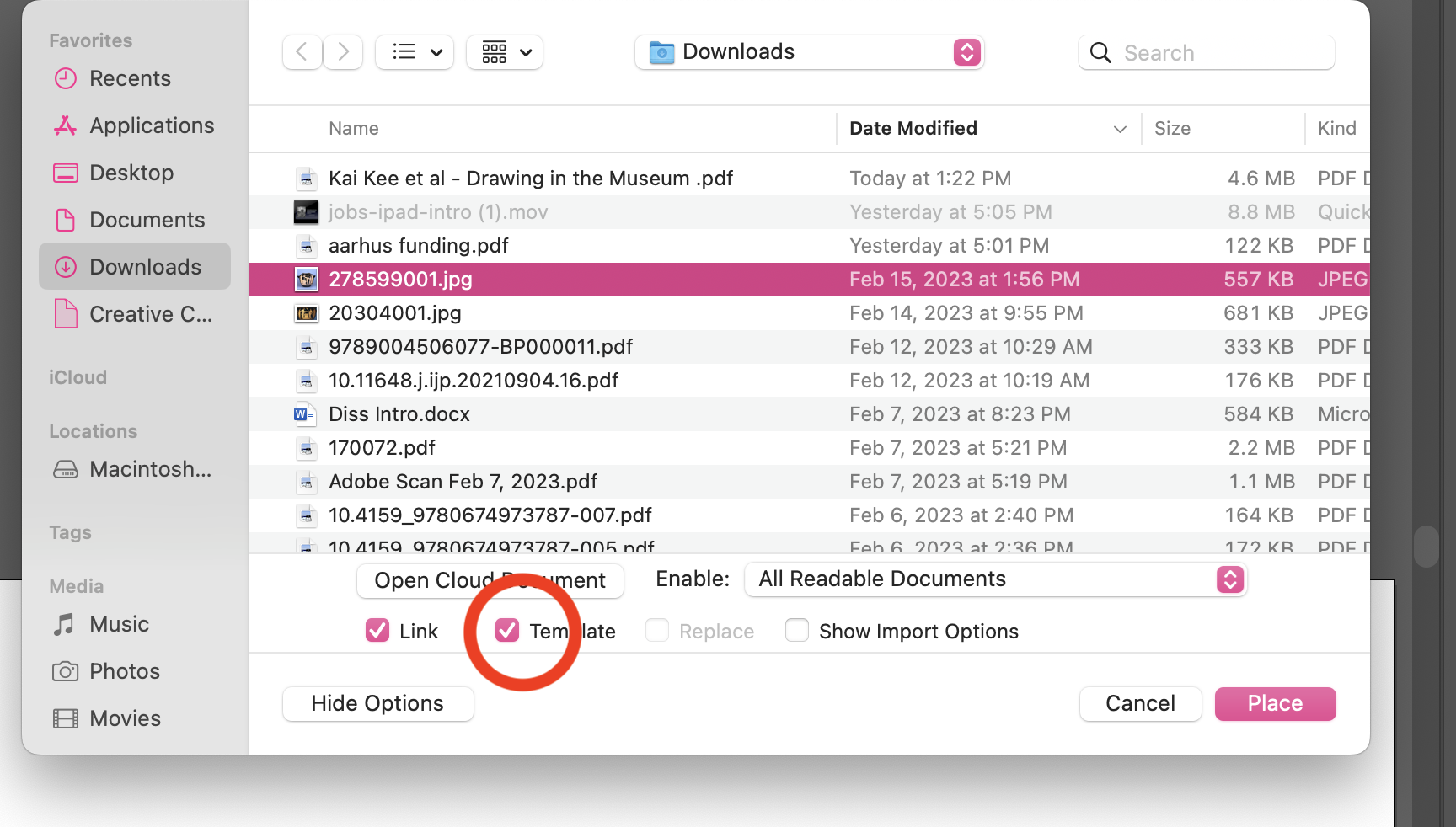
* File --> place --> select document and make sure you check template--> place
* 
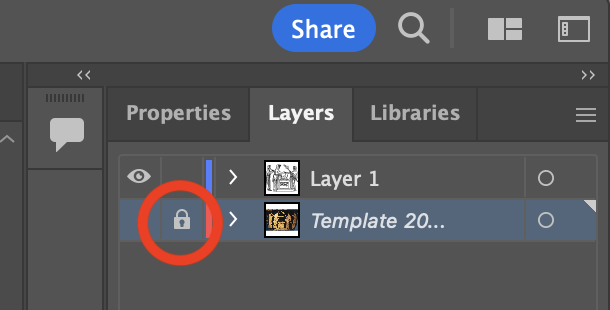
* to move the image around, you must unlock the template layer (layers column on right). relock this layer when you are finished, then select the blank layer 1
* 
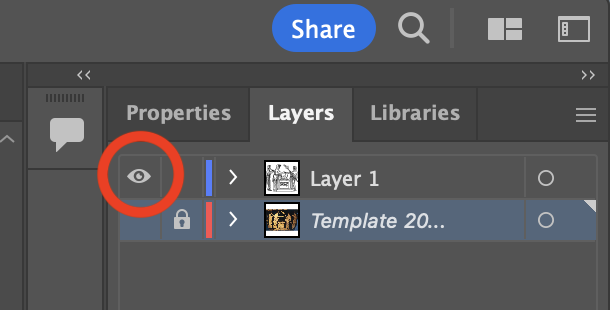
* for drawing, select the pencil, adjust your settings, and make sure auto fill it turned off. trace over the image, zooming in and out when needed. You can toggle off the template layer by clicking the eye icon next to that layer on the right bar.
* 
* A good tutorial can be found here (esp. 7:42-12:28 for setting up a template to draw from):
* <iframe width="560" height="315" src="https://www.youtube.com/embed/Ib8UBwu3yGA" title="YouTube video player" frameborder="0" allow="accelerometer; autoplay; clipboard-write; encrypted-media; gyroscope; picture-in-picture; web-share" allowfullscreen></iframe>
## Alternatives to a written reflection
### Word Cloud
Instead of writing a response to a reading, students will make a word cloud. By being more selective with their words, students will need to put more thought into what is really important. They will follow up on their word cloud with a 1-3 minute oral presentation to the class on the meaning behind their words and the process of their selection.
### Information layering
In information layering, give you students a prompt about a course topic that is still relatively new. Have them write a short answer to a question. Then, give them information about the topic/object/ theory etc. they are considering. After they have new information, ask them to re-respond to the same prompt, or give them a slightly different question to respond. How has their thought process changed or stayed the same? What is the result of having new information?
While still a written reflection, information layering is a 2 (or more) part activity that may encourage students to engage more deeply in the actual reflection aspect of this assignment. This might also have the result that responses and answers are more varied, which can them lead to richer in class discussion. By having students return to the question, the repetition also forces a deeper engagement. This helps students develop critical analysis skills.
This can be done as a take home prompt or in class as a discussion. This works well with articles, thematic concepts, and images.
## Color Based Activities
Color based mini-activities rely on the basic principle that color and patterns hold meaning. You use and manipulate color in various ways to highlight and emphasize certain things, as well as make meaningful statements that do not rely on words
### Color your Essay
The activity uses color as a tool to analyze your own writing, whether in a the form of a paper draft, a short response, or even discussion post. This will make for a great section activity!
1. The TF assigns colors to basic “moves” that should be made in the paper. This might change depending on what the paper is, or the discipline that the class is in. For example, in a humanities course, you might pick the moves: thesis, primary sources, interpretation, conclusion. Alternately for a science course, your moves might include: background information, data, graphs, conclusion.
2. The students will read through their paper and highlight every part of their paper that corresponds with one of these moves. As a result, they can analyze their structure for logical or illogical organization, as well as address how much of a color (length/ volume) is dedicated to each move.
3. This allows for a zoomed out approach for student to see what they are doing in their work that is divorced from the actual content, and may allow for fresh perspectives. It will also enable them to notice if they are using a lot of “uncolored” writing, and see if that content is necessary.
## Misc
### Personal response "tour"
this assignment gives more agency to the students and invites them to tap into their creativity and interests. After covering a unit on a class, ask the student to focus on something (e.g., an object, a theme, a reading, a grammatical construction) that was most interesting to them. Have them highlight this, describe why it was interesting to them, and ask them to write down further questions they have. These can be questions of clarification, to further application, and beyond.
You can take a see-think-wonder approach here.
The see = identify the subject of interest
the think = the description and reflection
the wonder = further questions
### Write a review
Assign your students and article to read, and instead of them writing a response, have them write a review. While academics are used to reading book reviews, this concept might be strange for a student, so be sure to introduce and explain this concept to the class together. By writing a review, the student must consider and paraphrase the overall argument of a book or article, consider the sources used, and take a stance on if the work is effective or not. This mini will be helpful for teaching critical reading skills and for building research skills.
 Sign in with Wallet
Connect another wallet
Sign in with Wallet
Connect another wallet