# Filtering and fake news
## Fake news
We live in a world with so much information at our fingertips, but how much of it is trustworthy? This is the dilemma that has arisen with the advent of fake news and disinformation, which have been growing exponentially.
</br>
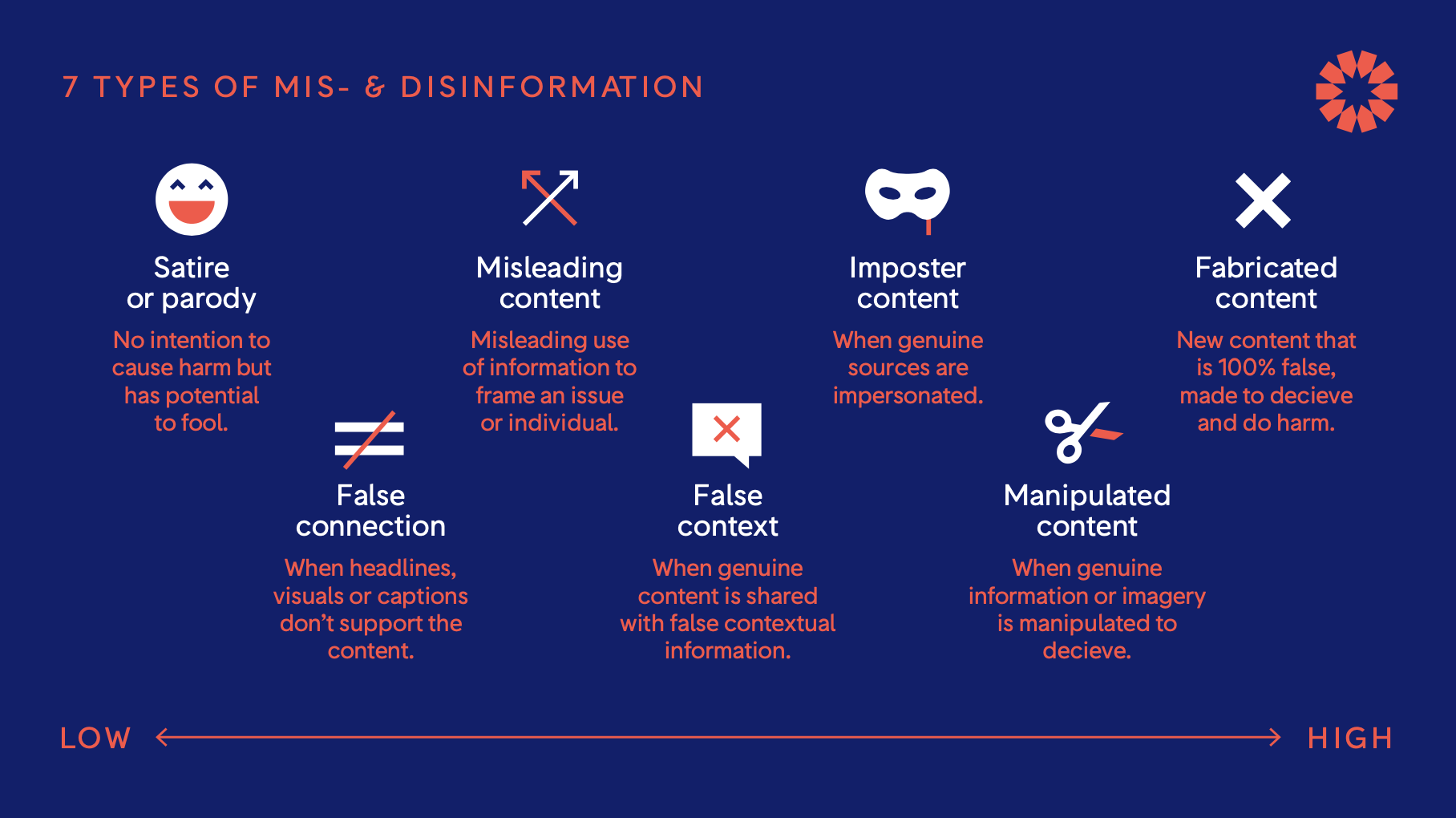
We were led to believe that being constantly connected would only lead to positive changes because of the promises of the digital age. But we have come to realize that our information ecosystem is dangerously polluted. Claire Warlde's '*[Understanding Information Disorder](https://firstdraftnews.org/long-form-article/understanding-information-disorder/)*' discusses how misinformation, deliberate manipulation, and digital distortion have infiltrated the media landscape, further complicating an already complex situation. With fake websites pumping out misleading content, accounts posting outrage memes, and click farms manipulating the content that is recommended to users, the seemingly endless cycle of information pollution has become an epidemic.
</br>
</br>
Along with this endless cycle of misinformation and manipulation, there are also the filter bubbles we create ourselves. Everything online is becoming too filtered for the individual. As we use the internet, we only see content that we enjoy and agree with, making us forget that there are things we may not agree with. resulting in more and more polarizing perspectives and opinions.
</br>
With so much information out there, we have been told to seek out what is true and factual. But how can we do that? One might say "check the sources," while another says to "look for inspiring ideas," but that can go wrong. Danah boyd's '*[Did media literacy backfire?](https://points.datasociety.net/did-media-literacy-backfire-7418c084d88d#.d46kox6e1)*' discusses how we cannot fall back on standard educational approaches to the information and media landscapes. This is due to a change in the societal context. We must think outside the box and create the social infrastructure required for people to interact meaningfully and substantively across current structural divides. We must concentrate on the underlying issues at hand if we want to address problems like propaganda, hate speech, fake news, and biased content.
</br>
## Filtering mail
#### The NU news rule

</br>
#### A few rules I had already created

 Sign in with Wallet
Connect another wallet
Sign in with Wallet
Connect another wallet