# 0. wenet
> Production First and Production Ready End-to-End Speech Recognition Toolkit
- 以 wenet 為始的理由
- 開發簡單,有容易參考的 recipe,cf.:
- espnet: 環境很難 build (在研發雲),樣板很多但有點太多,
- k2(next-gen kaldi): 環境很難 build (在研發雲),門檻稍高
- speechbrain: research 取向
- nemo: 範例有點少
- fairseq/flashlight: 很 hardcore;都在解大問題
- 
- 社群接近
- 有比較多 runtime support 可以參考
- (2021 interspeech) WeNet: Production Oriented Streaming and Non-streaming End-to-End Speech Recognition Toolkit
- Production first and production ready (JIT)
- Unified solution for streaming and non-streaming ASR (U2)
- Portable runtime
- light weight
- (2022 interspeech) WeNet 2.0: More Productive End-to-End Speech Recognition Toolkit
- U2++
- Production language model solution
- Context biasing
- Unified IO (UIO)
# 1. ASR: review
## 1.1 Some seq2seq models
- 大類
1. Transformer
2. CTC
3. RNN-t
4. Neural transducer
- some references
- https://speech.ee.ntu.edu.tw/~tlkagk/courses/DLHLP20/ASR%20(v12).pdf
- https://lorenlugosch.github.io/posts/2020/11/transducer/
- https://docs.nvidia.com/deeplearning/nemo/user-guide/docs/en/main/asr/intro.
- https://www.youtube.com/watch?v=N6aRv06iv2g&t=15s&ab_channel=Hung-yiLee
### 1.1.1 Attention model
- (2016 icassp) "Listen, Attend and Spell" Chan, et al.
- 
- https://github.com/Alexander-H-Liu/End-to-end-ASR-Pytorch/blob/master/tests/sample_data/demo.png
<!-- #### 1.1.1.1 Listen

#### 1.1.1.2 Attention

#### 1.1.1.3 Spell
 -->
### 1.1.2 CTC model
- (2006 icml) "Connectionist Temporal Classification: Labelling Unsegmented Sequence Data with Recurrent Neural Networks". Alex Graves, et al.
#### 1.1.2.1 CTC

#### 1.1.2.2 CTC prediction

### 1.1.3 Transducer model
- (2012 icml) "Sequence Transduction with Recurrent Neural Networks". Alex Graves, et al.
- (2016 nips) "A Neural Transducer". Navdeep Jaitly, et al.
#### 1.1.3.1 RNN transducer

#### 1.1.3.2 Neural transducer

### 1.1.4 比較

- 優劣分析
- attention: 可看到完整上下文;無法 offline;長音檔attention 耗費 memory (O(TU));較難收斂
- CTC: 架構簡單;有 len(T)>len(U) 的假設;假設每個 frame 獨立不太合理
- transducers: 架構天生可以解決 CTC 的 frame 間獨立的假設與 attention 要看上下文無法 online 的問題;訓練更耗費 memory (O(BTUV))
## 1.2 streaming vs non-streaming
- streaming: 對整段聲音訊號進行辨識
- non-streaming: 一邊看訊號一邊辨識
# 2. e2e ASR: wenet
- model architecture
- decoding
- unified model
- language model
- contextual biasing
- UIO
- runtime
## 2.1 model architecture
- shared encoder:
- transformer
- conformer
- decoder:
- ctc
- transformer
- rnn-t
- 主要使用 joint CTC/AED 架構,加速與穩定訓練
### 2.1.1 joint CTC/attention training
- (2017 icassp) JOINT CTC-ATTENTION BASED END-TO-END SPEECH RECOGNITION USING MULTI-TASK LEARNING
- shared encoder 可使用基本的 transformer 或 conformer
- architecture of joint CTC/AED
- 
- loss of joint CTC/AED
- 
### 2.2 decoding
- modes:
- attention: transformer decode
- ctc_greedy_search: ctc 1best
- ctc_prefix_beam_search: 對 ctc 結果進行 beam search
- attention_rescoring: 根據 ctc prefix beam search 結果與 encoder output 做 attention rescoring
- rnn-t
- 可用 causal convolution 減少 right context dependency
### 2.3 U2 model
- U: unify streaming and non-streaming training,達到一個模型可以應用在 streaming 與 non streaming。dynamic chunk training:
- > We adopt a dynamic chunk training technique to unify the non-streaming and streaming model. Firstly, the input is split into several chunks by a fixed chunk size C with inputs [t + 1, t + 2, ..., t + C ] and every chunk attends on itself and all the previous chunk"
- 透過調整 chunk size 調整 latency,當 chunk size = 1 時為純 streaming;chunk size 不設定則等價於 non streaming
- 
- 藉由調整 chunk size 取得速度與準確度的平衡
- chunk size = -1 : non streaming
- chunk size = 4/8/16 : streaming
- 
#### 2.3.1 U2++
- decoder 改成雙向 attention
- 
- 
### 2.4 Language model
- ngram for fast domain adaption
- 有 in-domain training data 的話
- cf. rnn-t lm
- decoding graph: TLG
- cf. kaldi HCLG
- 
- 
### 2.5 Contexual biasing
- much faster domain adaption
- 提升特定名詞辨識率
- on the fly WFST
- w/o LM: 把 phrase list 分解成 decoder output units
- w/ LM: 把 phrase list 分解成 LM 的 vocabulary
- 
- 
### 2.6 UIO
- Unified IO
- 克服 production level training data 存取問題
- random access x 1000000+小檔案index = OOM
- 就算沒 oom 也很慢
- 通用 IO 介面,後端可為 local file system 或 cloud (S3/OSS/HDFS/...)
- 把所有檔案 load 完連同 metadata 包成 shards
- which is actually done by gnu tar
- 開發環境需要足夠的空間存 shard
- on the fly feature extraction
- 
- 
### 2.7 runtime
- system design:
- 
- 提供多種程度之支援
- 支援之 architecture: arm(andrdoid) / intel x86
- library
- 支援之 runtime platform: onnx / libtorch
- model
- 支援之語言: python/c++
- python: wenetruntime
- i.e. pip install wenetruntime
- 提供多個範例
- python
- command line
- websocket (python/c++)
### 2.7.1 quantization performance
- 
### 2.7.2 runtime rtf
- 
### 2.7.3 runtime latency
- 
- L1: model latency, waiting time introduced by model structure
- L2: rescoring latency, time spent on attention rescoring
- L3: final latency, user perceived latency
- L3 部分來自於 L2
## 2.8 conclusion
- 使用 joint CTC/AED 架構,提升速度與準確度
- 使用 dynamic chunk training,達到一個模型可以同時進行 streaming 與 non-streaming
- 提供多種 runtime 方案供使用與參考
- 提供 LM 與 context bias 等可快速處理 production ASR domain adaption 議題的方案
- 提供 UIO 解決大量資料訓練時可能產生的問題
# 3. others
## 3.1 furure works: wenet 3.0
- 
## 3.2 其他功能
- tts
- speaker
- kws
# 4. wenet in esun
|model|MER(att_res)|
|:--:|:--:|
|cnn-tdnnf| 11.32 |
|cnn-tdnnf-a-lstm| 10.97 |
|conformer CTC/AED| 9.83 |
|conformer CTC/AED U2++| 10.34 |
- training 語料未完全對齊
- training epoch 時間 (v100 16GB * 8)
- conformer ctc/aed: ~45 min
- u2++: ~55 min
# 5. 會後 qa
#### Q: dynamic chunk training 的 label?
A:
參考 http://placebokkk.github.io/wenet/2021/06/04/asr-wenet-nn-1.html#chunk-based-mask:
中的:第3節-問題3,conformer ctc/aed 的 attention 有:
1. encoder 中的 self attention
2. decoder 中的 self attention
3. encoder 與 decoder 間的 cross attention
dynamic chunk 是針對 encoder 中的 self attention 進行。
主要可以參考連結中的圖:
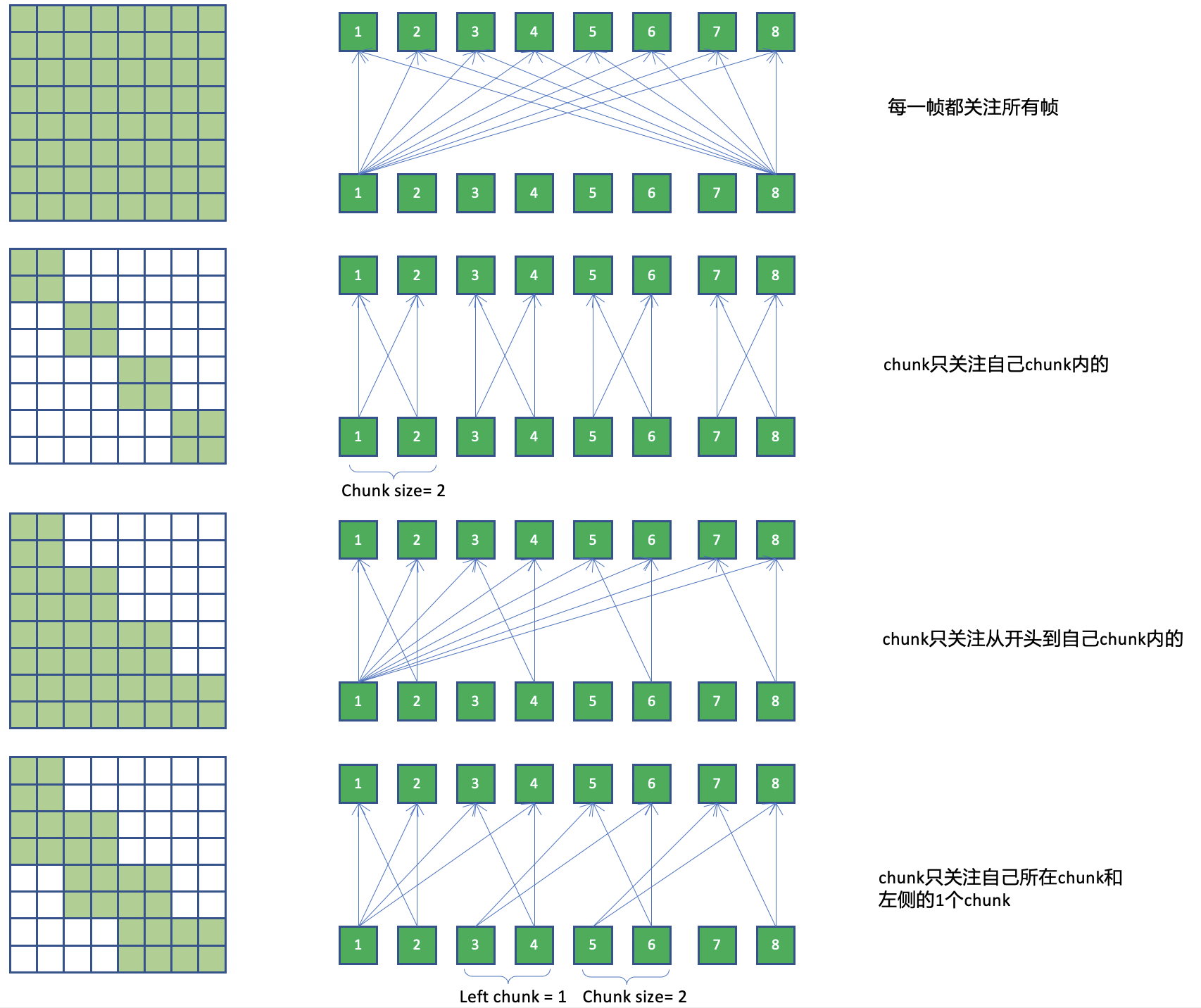
dynamic chunk 為 2,3,4 列。以圖片中 8 個 input 為例:
1. 如果是第一列 full attention,每個時間點都會看到所有 input 計算 attention,i.e.
- encoder t1 的 output 會看過 t1~t8
- encoder t2 的 output 會看過 t2~t8
- encoder t5 的 output 會看過 t1~t8
- encoder t8 的 output 會看過 t1~t8
2. 如果是第二列 chunk based attention,每個時間點只看 chunk 內的 input,i.e.
- encoder t1 的 output 會看過 t1~t2
- encoder t2 的 output 會看過 t1~t2
- encoder t5 的 output 會看過 t5~t6
- encoder t8 的 output 會看過 t7~t8
第三列的不看 right context 與第四列只看 limited left context 道理亦同。
#### Q: context bais 發生的時間點?是對 embedding 嗎?
#### Q: chunk size 跟 latency 的關係?
 Sign in via Google
 Sign in via Facebook
 Sign in via X(Twitter)
 Sign in via GitHub
 Sign in via Dropbox
 Sign in with Wallet
Connect another wallet
Sign in with Wallet
Connect another wallet