# (2) Projections
###### tags: `session-2-chunkified`
* Map **projection** describes how a given map has warped the earth's curved surface into a flat image.
* There are many different projections, and while none is perfect, some distort the earth less than others.
<aside>
Can you think of how ways in which projections relate to power? Why might certain countries or people prefer one projection to another?
</aside>
###### Goode Homolosine projection

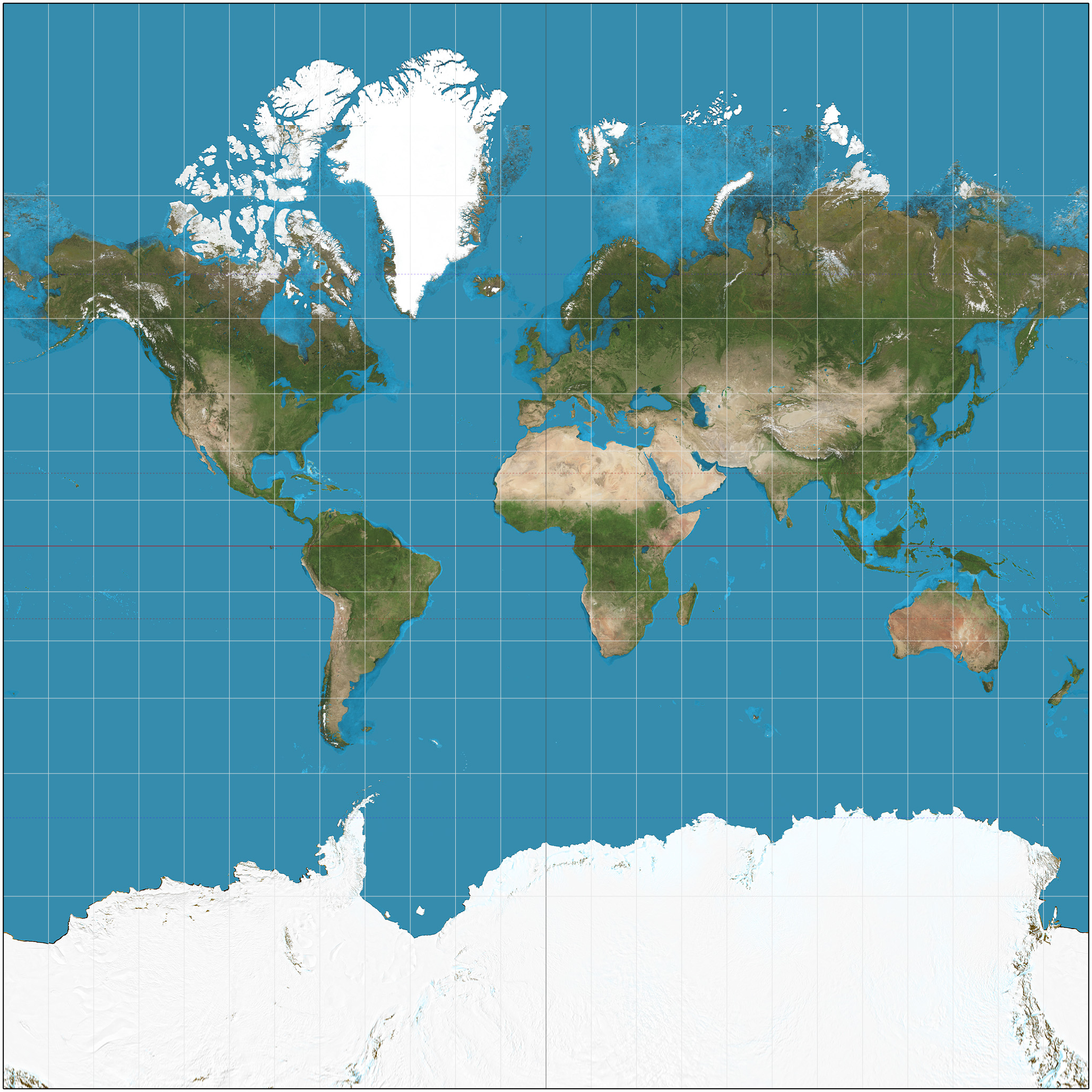
###### Mercator projection
<hideable>
Another key cartographic ingredient to get to know is the world of **projections**. When we take Earth, a spherical object, and represent it on a flat piece of paper, we have to distort its proportions. Different projections distort the Earth in different ways. The process can intentionally or unintentionally perpetuate pre-existing power structures and even construct new ones.
Many times we think about projections of the entire globe. A classic [controversy](https://www.theguardian.com/education/2017/mar/19/boston-public-schools-world-map-mercator-peters-projection) has to do with the Mercator projection, which is notorious for distorting the relative sizes of various land masses and making North America and Europe look proportionally much larger than they are. This distortion can perpetuate colonialist ideas of superiority. One of the most interesting aspects of this is that the original intention was that the map be used for navigation, yet it is now commonly used in schools and even on Google Maps.
<aside>
New digital applications like [The True Size Of...](https://thetruesize.com) show how much the Mercator projection distorts the size of landmasses.
</aside>
The story of the Mercator projection demonstrates that unintended consequences abound in the world of cartography, and understanding the origins of maps can help avoid disaster later on.
A common replacement many are turning to is the Galls-Peter projection, which does display relative size more accurately. There are also many more projections to check out, some of which are mentioned [here](https://www.visualcapitalist.com/problem-with-our-maps/). Every projection, though, comes with tradeoffs, which is why different projections are useful in different contexts.
Projection don't just have to do with how we look at the globe as a whole. Projections can be developed to look at a specific city with more accuracy than zooming in from a global projection would provide. GIS software allows you to choose what projection to use for your project.
</hideable>
 Sign in with Wallet
Connect another wallet
Sign in with Wallet
Connect another wallet