# 20250902-ai-tasks
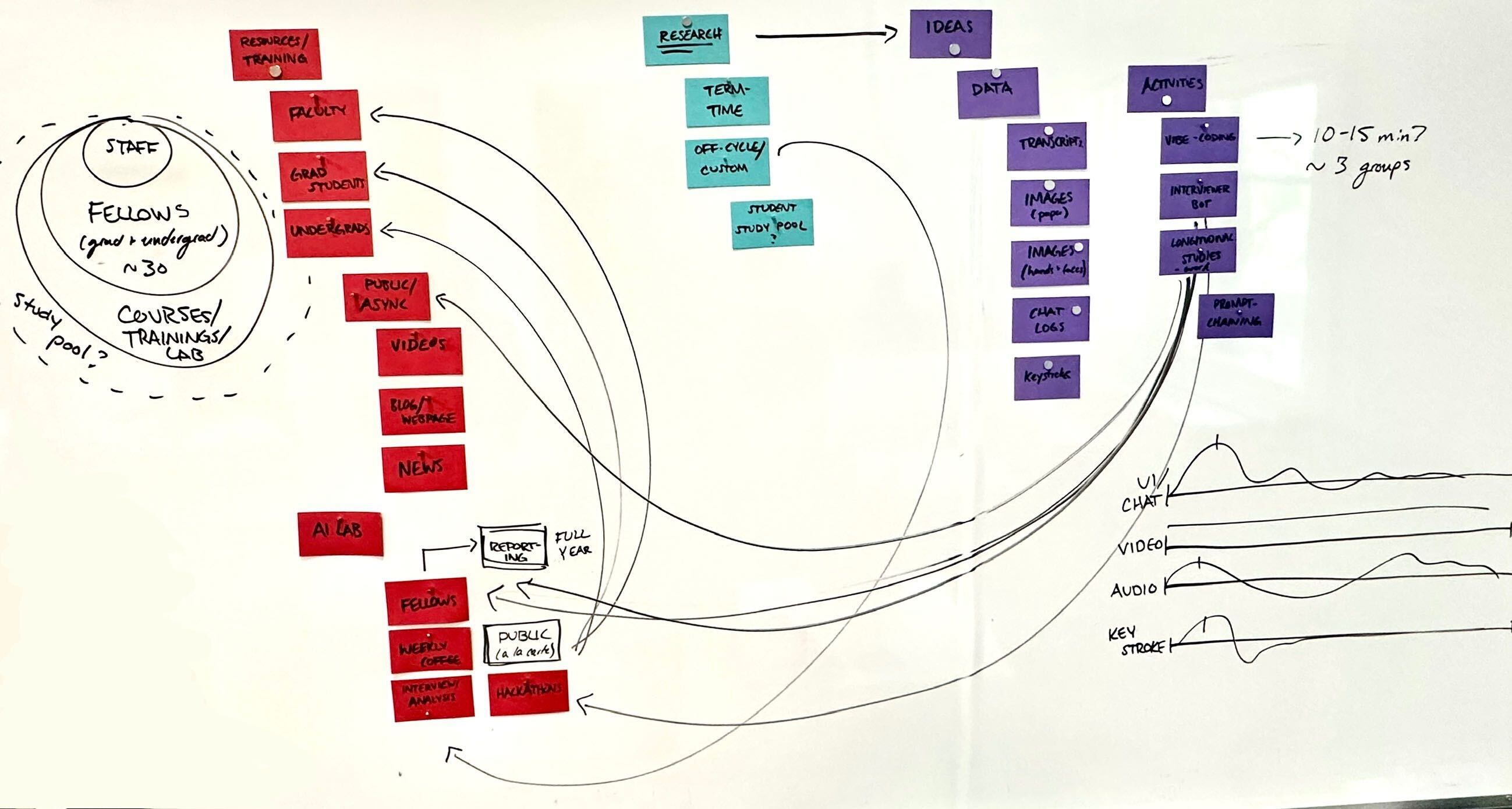
## Resources/Training
* audiences
* faculty
* grad students
* undergrads
* public/async
* video/socials
* "textbooks"/web sources
* news summaries/substack/mailer
* AI Lab
* AI Lab
* Schedule
* weekly coffee
* weekly secret-ai-lab meeting
* weekly hackathon?
* Workshops
* a la carte events
* DARTH
* Language Center
* Fellows
* meetings
* research
## Research
[IRB draft-classroom](https://docs.google.com/document/d/1nq0bvm_CNwS1lHUgVzI9jsqa421gP47N/edit)
[IRB draft-experiment](https://docs.google.com/document/d/1tPHsuvh_xIuHHCVBJlxyKsfMBqLrJ4Vj/edit?usp=sharing&ouid=102058092808585804535&rtpof=true&sd=true)
### Projects:
* course-length
* ASTRO 17
* GENED 1196
* SCRB 11
* one-shot
* vibe coding
* prompt chaining (as an assignment alternative)
* longitudinal
* fellow reporting w/ interviewer bot
* work productivity
### Data collected:
* Audio
* transcripts
* Video
* videos and stills
* front-facing and overhead
* materials:
* drawings, text, notes
* body language:
* hands, group clustering, faces, etc.
* Interface
* chat logs
* text, but also:
* emojis, likes, replies, etc.
* keystrokes
---
## Old projects:
2023:
---
> ## three types of summer activity
>
> - processing the ways in which generative AI tools will impact the courses, projects and assignments we already support
> - multimodal academic communication for teachers and scholars
> - multimodal assignments for students
> - thinking about how these AI tools will render new modes of academic creation possible for faculty, grads and undergrads
> - using AI tools to improve our own work (consultation, media production, workshop and event facilitation)
> - open ai api research and proofs of concept
> - now 80% of the staff capable of writing basic python and js scripts
>
>
> ## some bullets
>
> - started to support innovations, and the bulk of the work ended up taking the form of multimodal assignments. The basic idea being that what it means to communicate is shifting rapidly, and moving beyond text alone. So what comes next?
> - much of what we used to do is now way easier. So much easier that's it's not clear we should still get paid for doing it.
> - so what can we do instead?
> - we've always worked with faculty to think of ways at getting to what really matters to them, removing unnecessary technical difficulty (do they reallyl need to know video editing? or can they show two photos and talk?)
---
> #### easy things to stay on top, that we can count on being consistent
> * tool reports (mk)
> * tested out tool reports and stuff being made from it + reflecting
> * weekly news round up
> * lesson plans/teacher explorations
> * here's what i did or made last year, vs. what i can do this year now with the tools that we have now
---
> ## rhetorical moves
> * democratizing technical skills (e.g., coding/webdev)
> * AI challenges the idea of the single-authored work in visual realm esp. (long-held as an important critical intervention from humanists)
> * helping students do more ambitious multimedia projects
> * helping students get into the content of those projects rather than getting hung up on technical stuff
> * help students prepare for careers that will integrate AI tools and workflows (future workforce stuff)
> * should know how to interpret AI results (i.e., learn how to fact check, how to use it in an ethical and professional manner - like learning how to use research generally!)
>
> ## models
> * [Berkeley Artificial Intelligence Research blog](https://bair.berkeley.edu/blog/)
> * [distill blog](https://distill.pub/)
>
> ## notes
> * blogs a good place to:
> * create static representations of visual data (e.g., explaining what the AI applied from a literary text to a visual in Midjourney)
> * create + unpack new data visualizations that synthesize what was learned from an AI experiment captured on film/that's otherwise visual in nature
> * report on what's happening in the AI space
> * which could then maybe link to short videos that show how some tool works
> * like a roundup
> * reflect on our individual learning journeys using AI tools/metacognitive reflections on a specific project or something we can do now that we couldn't before
> * or maybe even something we couldn't get AI to do that shows its limitations
> * lean into the storytelling aspect of blogging/like features writing in a mag or newspaper
> * really lean into the public-facing component, foregrounding our lack of technical/engineering/coding expertise as a value-add in the space of AI tool exploration and using it as a tool for thinking and learning
> * most of the blogs I've seen so far are very technical, very much foregrounding the work a lab is doing to develop AI capabilities
---
> ### social-post/blog/encyclopedia concept
>
> can we be ready by the summer solstice to
> - post once or more per day
> - tool of the day
> - work of the day
> - thought/reflection/theorist of the day
> - random
> - mk responsible for expos-ish approach to assignment design, multimodal literacy, that whole ll-approach thing
> - typical forms
> - tool-centric how-tos, tutorials
> - updates on news
> - unpacking an object
> - tips and tricks and hacks
---
game ideas for content:
> ## some mechanics (with whats, hows and whys)
>
> For any given mechanic in the LL, there will be at least one core intellectual move (and probably more than one). It could help to name this move and describe it as best we can, and perhaps to give an example of how it might look in a couple of different disciplinary contexts.
>
> It's also probably the case that it's difficult think of absolutely discrete, "atomic" mechanics that can't be broken down further; likewise there is probably much to be gained by defining a few standard configurations of multiple related mechanics, so let's not slow ourselves down **too** much by trying to get all atomic about it.
>
>
> ### guessing
> #### what and why
> Guessing is fun. So it has that going for it. The one challenge is that it is alignment with a mental model of knowledge that is actually something we try to get AWAY from in teaching and learning centers (the basic idea that to know is to be the possessor of a bunch of facts--the sorts of facts you might memorize before an exam so that you can "ace the test" by regurgitating true facts).
>
> That said, if we think of guessing as involving the sorts of intellectual activities we might in other contexts deploy to generate knowledge (conceived of as a "knowing how" and "knowing why" rather than "knowing that"), then we can probably use it to create activities that are in alignment with a given course's learning objectives. The guessing might be evidence-based, perhaps involving the interpretation and analysis of the sorts of evidence and datasets that students are interpreting in the course.
>
> Of course, if we are designing a quick activity that actually has an objective that is tangential to the guessing operation, quiz-show-style guessing can for sure be a great way to hold an activity together, giving it a clear destination and structure. (And your goal may be as simple as "creating classroom community" through some sort of icebreaker activity--but if so, you'd probably be designing a 10-minute guessing game rather than a 60-minute one)
>
> #### technologies for guessing games (how)
>
> - quiz/question/data/clue displays
> - computer graphic-to-screen (holding words, computer-generated images, datasets, artworks)
> - paper or object under overhead on large screens
> - physical objects/clues at table
> - answer holders
> - cards (classic tools for distributing information asymmetrically)
> - overturned buttons
> - ll-folded-boxes to hold cards, buttons or other
> - closed books
> - ll-studio-isolation with ATEM switching to hide and reveal
> - ll-studio-isolation with veiled TVs to hide and reveal
> - yellow pelican cases to give each of 4 tables a surprise box
> - guessing mechanics
> - discuss in pairs or small groups, decide on one guess and share
> - single guess on card
> - multiple guesses on cards
> - placing a token in a location
> - matching (placing word card next to image card, say)
> - guess at micro-presentation on stage (perhaps with the reveal happening behind or around you through realtime production techniques)
---
more content ideas:
> * old school vs. new school
> * marlon v madeleine
> * traditional tools versus ai tools
>
> * AI detection
> * a paper written by ai, a paper written by ai then tweaked, a paper written by kevin, a paper written by MPAs
> * graded by marlon.
> * marlon trying to figure out which paper is which
---
 Sign in with Wallet
Connect another wallet
Sign in with Wallet
Connect another wallet