"
"
# Google Expands AI Mode with Enhanced Features
Google is expanding access to AI Mode, its experimental feature that allows users to ask complex, multipart questions and follow-ups to dig deeper on a topic directly within Search. The tech giant is also adding more functionality to the feature, including the ability to pick up where you left off on a search.
Google launched AI Mode back in March as a way to take on popular services like Perplexity AI and OpenAI’s ChatGPT Search. The updates announced aim to better compete with these services.
With this expansion, Google is getting rid of the waitlist for AI Mode. Now anyone in the U.S. who is at least 18 years old can access the feature if they’re enrolled in Labs, Google’s experimental arm.
Google is also testing an AI Mode tab in Google Search that will be visible to a small percentage of people in the U.S.
As for the new functionality, Google is making it possible to go a step beyond asking detailed questions about places and products. Users can now utilize AI mode to find new restaurants or plan trips more effectively. Visual place and product cards in AI Mode provide details like ratings, reviews, real-time prices, and local inventory.
For example, searching for vintage shops with midcentury modern furniture will now yield nearby stores with real-time details. Similarly, AI Mode can provide a breakdown of recommended products for specific needs, such as foldable camping chairs.
Google is also making it possible to resume previous searches, beneficial for longer-running tasks. Users can click a new left-side panel to revisit past searches and follow up as needed.
*Aisha is a consumer news reporter at TechCrunch specializing in tech advancements.*
---
Learn more about Google's AI Mode and its expanded features on [TechCrunch](https://techcrunch.com/2025/05/01/googles-ai-mode-gets-expanded-access-and-additional-functionality/)."
"
## Microsoft's Phi 4 AI Model Rivals Larger Systems
Microsoft has unveiled its new Phi 4 AI models, designed for reasoning tasks and competitive with larger systems like OpenAI’s o3-mini. These models, including Phi 4 mini reasoning, Phi 4 reasoning, and Phi 4 reasoning plus, offer advanced problem-solving capabilities despite their smaller sizes, using only a fraction of the parameters. The models are available on the AI dev platform Hugging Face, providing a resource-efficient solution for applications in math, science, and coding.
All of the new models are ""reasoning"" models, which are programmed to spend more time fact-checking solutions to complex problems. Phi 4 mini reasoning was trained on roughly 1 million synthetic math problems and designed for educational applications such as ""embedded tutoring"" on lightweight devices.
Phi 4 reasoning, a 14-billion-parameter model trained on high-quality web data, is suitable for math and coding tasks. Meanwhile, Phi 4 reasoning plus is adapted from the previously released Phi 4 model to improve accuracy, rivaling the performance of far larger models. Microsoft utilizes techniques like distillation and reinforcement learning to balance size and performance, making these models efficient for even resource-limited devices.
""Using distillation, reinforcement learning, and high-quality data, these [new] models balance size and performance,"" Microsoft wrote in a blog post. ""They are small enough for low-latency environments yet maintain strong reasoning capabilities that rival much bigger models. This blend allows even resource-limited devices to perform complex reasoning tasks efficiently.""
The full range of Phi 4 reasoning models and their technical reports can be accessed on Hugging Face, facilitating further development and application in diverse contexts."
"
Meta made a prediction last year its generative AI products would rake in $2 billion to $3 billion in revenue in 2025, and between $460 billion and $1.4 trillion by 2035, according to court documents unsealed Wednesday.
The documents, submitted by attorneys for book authors suing Meta for what they claim is unauthorized training of the company’s AI on their works, don’t indicate what exactly Meta considers to be a “generative AI product.” But it’s public knowledge that the tech giant makes money — and stands to make more money — from generative AI in a number of flavors.
Meta has revenue-sharing agreements with certain companies that host its open Llama collection of models. The company recently launched an API for customizing and evaluating Llama models. And Meta AI, the company’s AI assistant, may eventually show ads and offer a subscription option with additional features, CEO Mark Zuckerberg said during the company’s Q1 earnings call Wednesday.
The court documents also reveal Meta is spending an enormous amount on its AI product groups.
In 2024, the company’s “GenAI” budget was over $900 million, and this year, it could exceed $1 billion, according to the documents. That’s not including the infrastructure needed to run and train AI models. Meta previously said it plans to spend $60 billion to $80 billion on capital expenditures in 2025, primarily on expansive new data centers.
Those budgets might have been higher had they included deals to license books from the authors suing Meta. For instance, Meta discussed in 2023 spending upwards of $200 million to acquire training data for Llama, around $100 million of which would have gone toward books alone, per the documents. But the company allegedly decided to pursue other options: pirating ebooks on a massive scale.
A Meta spokesperson sent TechCrunch the following statement:
“Meta has developed transformational [open] AI models that are powering incredible innovation, productivity, and creativity for individuals and companies. Fair use of copyrighted materials is vital to this. We disagree with [the authors’] assertions, and the full record tells a different story. We will continue to vigorously defend ourselves and to protect the development of generative AI for the benefit of all.”
---
Kyle Wiggers is TechCrunch’s AI Editor. His writing has appeared in VentureBeat and Digital Trends, as well as a range of gadget blogs including Android Police, Android Authority, Droid-Life, and XDA-Developers. He lives in Manhattan with his partner, a music therapist."
"
Amazon on Wednesday released what the company claims is the most capable AI model in its Nova family, Nova Premier. Nova Premier, which can process text, images, and videos (but not audio), is available in Amazon Bedrock, the company’s AI model development platform. Amazon says that Premier excels at “complex tasks” that “require deep understanding of context, multi-step planning, and precise execution across multiple tools and data sources.”
Amazon announced its Nova lineup of models in December at its annual AWS re:Invent conference. Over the last few months, the company has expanded the collection with image- and video-generating models as well as with audio understanding and agentic, task-performing releases.
Nova Premier, which has a context length of 1 million tokens, meaning it can analyze around 750,000 words in one go, is weaker on certain benchmarks than flagship models from rival AI companies such as Google. On SWE-Bench Verified, a coding test, Premier is behind Google’s Gemini 2.5 Pro, and it also performs poorly on benchmarks measuring math and science knowledge, GPQA Diamond and AIME 2025. However, in bright spots for Premier, the model does well on tests for knowledge retrieval and visual understanding, SimpleQA and MMMU, according to Amazon’s internal benchmarking.
In Bedrock, Premier is priced at $2.50 per 1 million tokens fed into the model and $12.50 per 1 million tokens generated by the model. That’s around the same price as Gemini 2.5 Pro, which costs $2.50 per million input tokens and $15 per million output tokens.
Importantly, Premier isn’t a “reasoning” model. As opposed to models like OpenAI’s o4-mini and DeepSeek’s R1, it can’t take additional time and computing to carefully consider and fact-check its answers to questions.
Amazon is pitching Premier as best for “teaching” smaller models via distillation — in other words, transferring its capabilities for a specific use case into a faster, more efficient package.
Amazon sees AI as increasingly core to its overall growth strategy. CEO Andy Jassy recently said the company is building more than 1,000 generative AI applications and that Amazon’s AI revenue is growing at “triple-digit” year-over-year percentages and represents a “multi-billion-dollar annual revenue run rate.”
*Kyle Wiggers is TechCrunch’s AI Editor. His writing has appeared in VentureBeat and Digital Trends, as well as a range of gadget blogs including Android Police, Android Authority, Droid-Life, and XDA-Developers. He lives in Manhattan with his partner, a music therapist.*
[View Bio](https://techcrunch.com/author/kyle-wiggers/)"
"
Google's Gemini Chatbot Receives Advanced Image Creation Tools
Google’s Gemini chatbot app now enables users to modify both AI-generated images and those uploaded from personal devices. Initially rolled out gradually, this feature will expand globally, supporting over 45 languages in the coming weeks.
The enhanced image editing capabilities within Gemini follow Google’s earlier pilot on the AI Studio platform, known for its controversial watermark removal. Gemini’s new editing features aim to provide richer and more contextual responses, integrating text and images seamlessly.
**Key Features:**
- **Multi-step Editing:** Users can change image backgrounds, replace objects, and add new elements within the Gemini chatbot.
- **Practical Usage:** Example applications include modifying personal photos, like changing hair color, or generating illustrations for stories.
- **Security Measures:** All images edited through Gemini will contain invisible watermarks to prevent misuse, with experiments for visible watermarks underway.
Google provides these extensive new tools while ensuring intellectual property protection, responding to the rising concerns around deepfake technology.
*Written by Kyle Wiggers, TechCrunch’s AI Editor, who has previously contributed to multiple technology outlets.*"
"
## Mark Zuckerberg's Bold AI Vision for Advertising
It’s not really a secret that the advertising industry is about to get upended by AI — one reason big platform companies like Google and Meta have been so deeply invested in photo and video generation is because they know the first heavy users of those tools will be advertisers on their platforms. But no one’s ever really just come right out and said it — until today, when Meta CEO Mark Zuckerberg sat down with Stratechery’s Ben Thompson and basically said his plan was to more or less eliminate the entire advertising ecosystem, from creative on down.
Here’s the quote — Zuck was talking about how AI has already improved ad targeting, but now Meta is thinking about the ads themselves:
**Zuckerberg:** But there’s still the creative piece, which is basically businesses come to us and they have a sense of what their message is or what their video is or their image, and that’s pretty hard to produce and I think we’re pretty close.
And the more they produce, the better. Because then, you can test it, see what works. Well, what if you could just produce an infinite number?
**Zuckerberg:** Yeah, or we just make it for them. I mean, obviously, it’ll always be the case that they can come with a suggestion or here’s the creative that they want, especially if they really want to dial it in. But in general, we’re going to get to a point where you’re a business, you come to us, you tell us what your objective is, you connect to your bank account, you don’t need any creative, you don’t need any targeting demographic, you don’t need any measurement, except to be able to read the results that we spit out. I think that’s going to be huge, I think it is a redefinition of the category of advertising.
What Mark is describing here is a vision where a client comes to Meta and says “I want customers for my product,” and Meta does everything else. It generates photos and videos of those products using AI, writes copy about those products with AI, assembles that into an infinite number of ads with AI, targets those ads to all the people on its platforms with AI, measures which ads perform best and iterates on them with AI, and then has those customers buy the actual products on its platforms using its systems.
I’ve been calling this swirl of ideas for AI-powered advertising “infinite creative,” and we’ve seen some interesting demos of it in the past, including at Nvidia keynotes. But I’ve never heard anyone pull the thread all the way to “connect us to your bank account and read the results we spit out,” which would basically wipe out the entire ad industry as we know it. It is fundamentally hostile to the world of big brands and big ad agencies, who have all built elaborate systems to audit the results platforms provide them after a decade of ad fraud and measurement scandals, and who have very strong opinions about what platforms like Meta can and cannot do well.
I sent Mark’s quote to some major players in the ad industry to get a reaction, and it was withering. “Brand safety is a big issue still, so letting them make and also optimize creative is a scary concept,” one agency CEO told me, but that wasn’t even their first concern. “The promise of his vision — ‘just read the results they spit out’ is the problem,” they said. “No clients will trust what they spit out as they are basically checking their own homework.”
Another media exec was equally scathing. “‘Read the results that we spit out’ is gold,” they said. “The full cycle towards their customers, from moderate condescension to active antagonism to ‘we’ll fucking kill you.’”
Now, Meta makes a lot of money selling ads to small businesses that can’t afford big agencies and fancy media campaigns, so these infinite creative AI tools might help them all out, and the big agencies might move their dollars elsewhere. But it’s also clear that the platform economy is about to change in seismic ways as these tensions rise, while the rest of us are forced to contend with a world full of AI-generated ads."
"
# Will the Humanities Survive Artificial Intelligence?
**Tags:** Humanities, Artificial Intelligence, Education, Philosophy, Technology
This essay explores the impact of artificial intelligence on the humanities, examining how AI challenges traditional educational methods and the humanistic tradition. The author discusses a student's experience with AI, highlighting the unique, non-human attention it provided. The piece suggests that AI can prompt a reevaluation of personal and educational priorities, emphasizing the need for a deeper understanding of ourselves beyond factual knowledge.
---
She’s an exceptionally bright student. I’d taught her before, and I knew her to be quick and diligent. So what, exactly, did she mean? She wasn’t sure, really. It had to do with the fact that the machine... wasn’t a person. And that meant she didn’t feel responsible for it in any way. And that, she said, felt... profoundly liberating.
We sat in silence. She had said what she meant, and I was slowly seeing into her insight. Like more young women than young men, she paid close attention to those around her—their moods, needs, unspoken cues. I have a daughter who’s configured similarly, and that has helped me to see beyond my own reflexive tendency to privilege analytic abstraction over human situations.
What this student had come to say was that she had descended more deeply into her own mind, into her own conceptual powers, while in dialogue with an intelligence toward which she felt no social obligation. No need to accommodate, and no pressure to please. It was a discovery—for her, for me—with widening implications for all of us.
“And it was so patient,” she said. “I was asking it about the history of attention, but five minutes in I realized: I don’t think anyone has ever paid such pure attention to me and my thinking and my questions... ever. It’s made me rethink all my interactions with people.”
She had gone to the machine to talk about the callow and exploitative dynamics of commodified attention capture—only to discover, in the system’s sweet solicitude, a kind of pure attention she had perhaps never known. Who has? For philosophers like Simone Weil and Iris Murdoch, the capacity to give true attention to another being lies at the absolute center of ethical life. But the sad thing is that we aren’t very good at this. The machines make it look easy.
I’m not confused about what these systems are or about what they’re doing. Back in the nineteen-eighties, I studied neural networks in a cognitive-science course rooted in linguistics. The rise of artificial intelligence is a staple in the history of science and technology, and I’ve sat through my share of painstaking seminars on its origins and development. The A.I. tools my students and I now engage with are, at core, astoundingly successful applications of probabilistic prediction. They don’t know anything—not in any meaningful sense—and they certainly don’t feel. As they themselves continue to tell us, all they do is guess what letter, what word, what pattern is most likely to satisfy their algorithms in response to given prompts.
That guess is the result of elaborate training, conducted on what amounts to the entirety of accessible human achievement. We’ve let these systems riffle through just about everything we’ve ever said or done, and they “get the hang” of us. They’ve learned our moves, and now they can make them. The results are stupefying, but it’s not magic. It’s math.
I had an electrical-engineering student in a historiography class sometime back. We were discussing the history of data, and she asked a sharp question: What’s the difference between hermeneutics—the humanistic “science of interpretation”—and information theory, which might be seen as a scientific version of the same thing?
I tried to articulate why humanists can’t just trade their long-winded interpretive traditions for the satisfying rigor of a mathematical treatment of information content. In order to explore the basic differences between scientific and humanistic orientations to inquiry, I asked her how she would define electrical engineering.
She replied, “In the first circuits class, they tell us that electrical engineering is the study of how to get the rocks to do math.”
Exactly. It takes a lot: the right rocks, carefully smelted and dopped and etched, along with a flow of electrons coaxed from coal and wind and sun. But, if you know what you’re doing, you can get the rocks to do math. And now, it turns out, the math can do us.
Let me be clear: when I say the math can “do” us, I mean only that—not that these systems are us. I’ll leave debates about artificial general intelligence to others, but they strike me as largely semantic. The current systems can be as human as any human I know, if that human is restricted to coming through a screen (and that’s often how we reach other humans these days, for better or worse).
So, is this bad? Should it frighten us? There are aspects of this moment best left to DARPA strategists. For my part, I can only address what it means for those of us who are responsible for the humanistic tradition—those of us who serve as custodians of historical consciousness, as lifelong students of the best that has been thought, said, and made by people.
Ours is the work of helping others hold those artifacts and insights in their hands, however briefly, and of considering what ought to be reserved from the ever-sucking vortex of oblivion—and why. It’s the calling known as education, which the literary theorist Gayatri Chakravorty Spivak once defined as the “non-coercive rearranging of desire.”
And when it comes to that small, but by no means trivial, corner of the human ecosystem, there are things worth saying—urgently—about this staggering moment. Let me try to say a few of them, as clearly as I can. I may be wrong, but one has to try.
When we gathered as a class in the wake of the A.I. assignment, hands flew up. One of the first came from Diego, a tall, curly-haired student—and, from what I’d made out in the course of the semester, socially lively on campus. “I guess I just felt more and more hopeless,” he said. “I cannot figure out what I am supposed to do with my life if these things can do anything I can do faster and with way more detail and knowledge.” He said he felt crushed.
Some heads nodded. But not all. Julia, a senior in the history department, jumped in. “Yeah, I know what you mean,” she began. “I had the same reaction—at first. But I kept thinking about what we read on Kant’s idea of the sublime, how it comes in two parts: first, you’re dwarfed by something vast and incomprehensible, and then you realize your mind can grasp that vastness. That your consciousness, your inner life, is infinite—and that makes you greater than what overwhelms you.”
She paused. “The A.I. is huge. A tsunami. But it’s not me. It can’t touch my me-ness. It doesn’t know what it is to be human, to be me.”
The room fell quiet. Her point hung in the air.
And it hangs still, for me. Because this is the right answer. This is the astonishing dialectical power of the moment.
We have, in a real sense, reached a kind of “singularity”—but not the long-anticipated awakening of machine consciousness. Rather, what we’re entering is a new consciousness of ourselves. This is the pivot where we turn from anxiety and despair to an exhilarating sense of promise. These systems have the power to return us to ourselves in new ways.
Do they herald the end of “the humanities”? In one sense, absolutely. My colleagues fret about our inability to detect (reliably) whether a student has really written a paper. But flip around this faculty-lounge catastrophe and it’s something of a gift.
You can no longer make students do the reading or the writing. So what’s left? Only this: give them work they want to do. And help them want to do it. What, again, is education? The non-coercive rearranging of desire.
Within five years, it will make little sense for scholars of history to keep producing monographs in the traditional mold—nobody will read them, and systems such as these will be able to generate them, endlessly, at the push of a button.
But factory-style scholarly productivity was never the essence of the humanities. The real project was always us: the work of understanding, and not the accumulation of facts. Not “knowledge,” in the sense of yet another sandwich of true statements about the world. That stuff is great—and where science and engineering are concerned it’s pretty much the whole point. But no amount of peer-reviewed scholarship, no data set, can resolve the central questions that confront every human being: How to live? What to do? How to face death?
The answers to those questions aren’t out there in the world, waiting to be discovered. They aren’t resolved by “knowledge production.” They are the work of being, not knowing—and knowing alone is utterly unequal to the task.
For the past seventy years or so, the university humanities have largely lost sight of this core truth. Seduced by the rising prestige of the sciences—on campus and in the culture—humanists reshaped their work to mimic scientific inquiry. We have produced abundant knowledge about texts and artifacts, but in doing so mostly abandoned the deeper questions of being which give such work its meaning.
Now everything must change. That kind of knowledge production has, in effect, been automated. As a result, the “scientistic” humanities—the production of fact-based knowledge about humanistic things—are rapidly being absorbed by the very sciences that created the A.I. systems now doing the work. We’ll go to them for the “answers.”
"
"
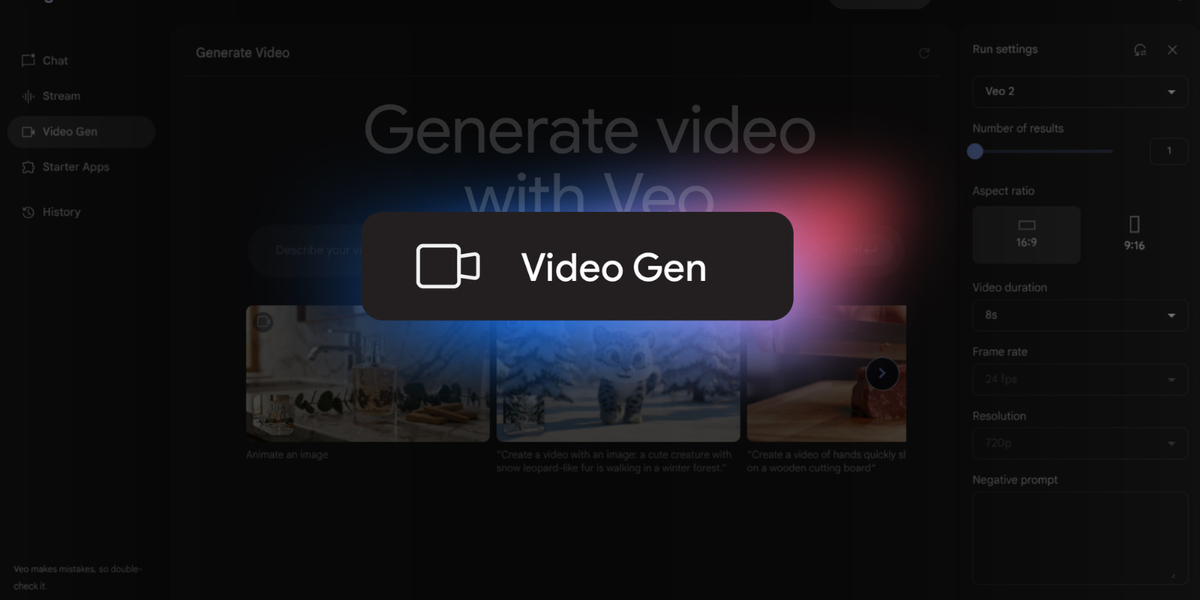
# Bring Your Ideas to Life: Veo 2 Video Generation Available for Developers
Google has announced the general availability of Veo 2, a cutting-edge video generation model, now accessible to developers through Google AI Studio and the Gemini API. Veo 2 is designed to transform text and images into dynamic eight-second video clips, offering developers the ability to create scenes that simulate real-world physics and various cinematic styles.
## Core Capabilities
- **Text-to-Video (t2v):** Transform detailed text descriptions into dynamic video scenes.
- **Image-to-Video (i2v):** Animate images using Veo 2 and optional text prompts for style and motion changes.
## How to Get Started
Users can experiment with Veo 2 in Google AI Studio by manipulating prompts and parameters to view the generated video outcomes immediately. The Gemini API allows for deeper integration into applications, enabling full video generation capabilities.
```python
import time
from google import genai
from google.genai import types
client = genai.Client()
operation = client.models.generate_videos(
model=""veo-2.0-generate-001"",
prompt=""Panning wide shot of a calico kitten sleeping in the sunshine"",
config=types.GenerateVideosConfig(
person_generation=""allow_adult"",
aspect_ratio=""16:9"",
),
)
while not operation.done:
time.sleep(20)
operation = client.operations.get(operation)
for n, generated_video in enumerate(operation.response.generated_videos):
client.files.download(file=generated_video.video)
generated_video.video.save(f""video{n}.mp4"") # save the video
```
## Crafting Effective Prompts
To maximize Veo 2’s potential, developers should craft detailed prompts with specific elements such as subject, action, setting, camera angle, and style. This precision will help in achieving videos that closely match the creative vision.
### Example Prompt
**Effective Prompt:** ""A close-up shot of a modern, faceted crystal perfume bottle with rose gold accents, resting on polished white marble. Soft, diffused light highlights the bottle's angles, creating a subtle shimmer as a delicate hand gently touches the top of the bottle.""
## Real-World Applications
Companies like AlphaWave and Trakto Studio are leveraging Veo 2 for scalable content production, transforming static images and prompts into dynamic marketing videos.
- **AlphaWave**: Utilizes Veo 2 to generate brand-aligned videos from simple prompts or existing images, enabling agile marketing strategies.
- **Trakto Studio**: Uses Veo 2 in their creative automation platform to rapidly create high-quality, editable video commercials.
## Start Building Today!
Veo 2 offers a revolutionary way to create and integrate video content with its advanced features and flexibility. Developers can begin experimenting in Google AI Studio, explore the Colab Notebook from the Gemini Cookbook, and dive into the API documentation to unlock Veo 2’s full potential."



 Sign in with Wallet
Connect another wallet
Sign in with Wallet
Connect another wallet