# AI ASSIGNMENT PROTOTYPES
## Overview
*We want you postulate and protoype the ways in which AI could be mapped onto assignments within the college.* This process may result in AI simply improving and scaling current assignment types OR the creation of entirely new assignment types, based in AI, that perform the same learning functions of currently extant assignments.
### Step One: Brainstorming
To help guide your thinking, here are some schematics used in the Learning Lab to approach assignment re/design. The simplest categorization is below, delineating the two types of assignments the Learning Lab currently works with:
1. traditional assignments (essays, exams, etc.)
2. alternative assignments (podcasts, 3D galleries, etc.)
* this is the Learning Lab's specialty, covering innovative assignment types that align with the traditional rhetorical moves students perform for a given class.
We tend to view all assignments as psuedo-machines.
> Machines being "an apparatus using or applying mechanical power and having several parts, each with a definite function and together performing a particular task."
All assignments, despite their medium, apply "rhetorical" or "intellectual" power to perform a function. There are a multiplicty of these functions that can be structured and understood in a number of ways. However, for the purposes of this prototyping, the functions of the assignments you create should *demonstrate deep understanding of a given topic.*
In pedagogy, there are a number of functions-- that teachers assign and students execute-- to demonstrate this:
* use a Theory to examine a Thing
* use a Thing to test a Theory
* create a Theory or Thing
* critique the Theory or Thing
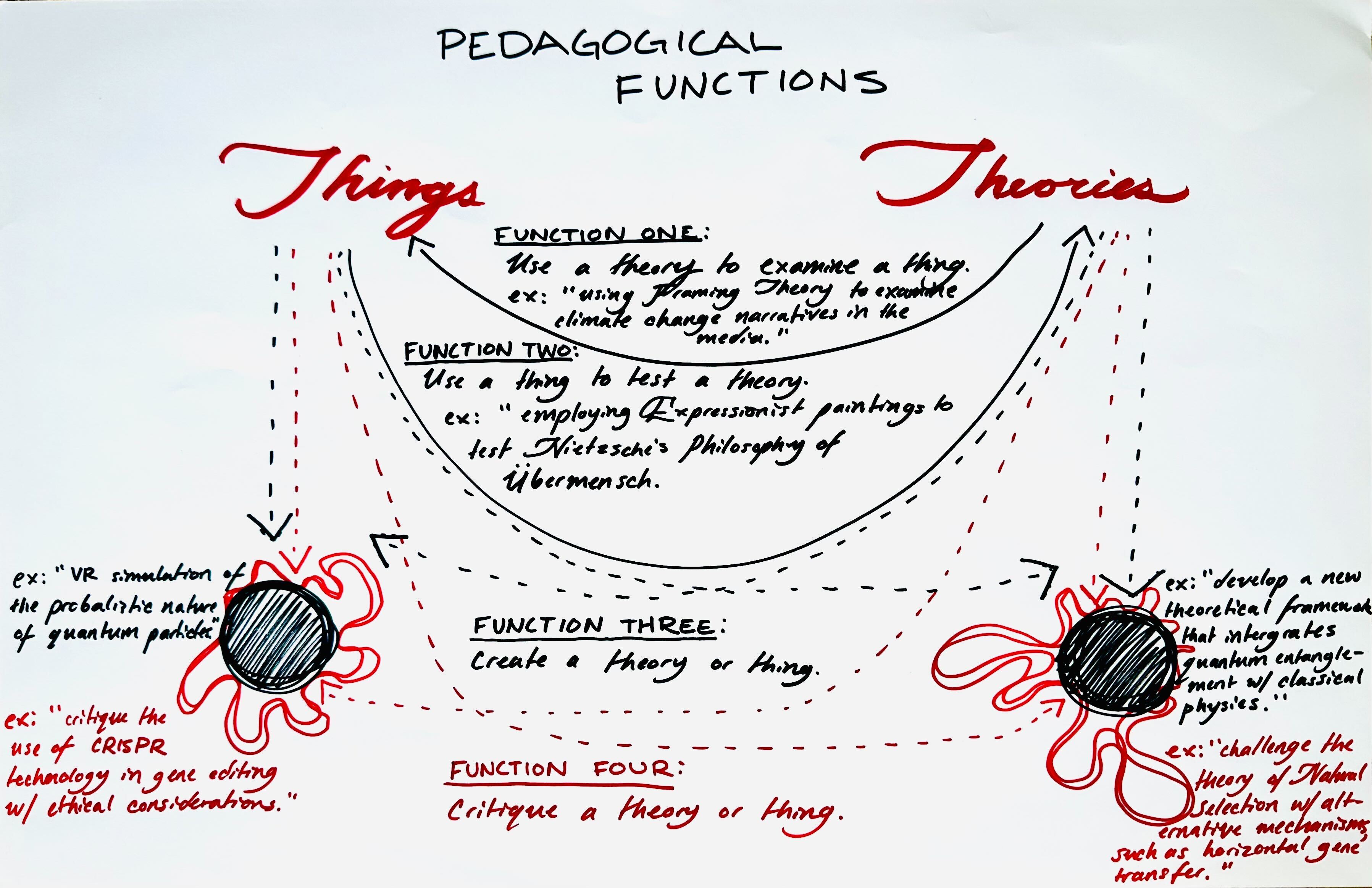
**Things** can be defined as: Tangible or concrete subjects, materials, or media that can be analyzed, critiqued, or used as a basis for creating new knowledge.
Things might include:
* Texts (literature, documents)
* Artifacts (historical objects, artworks)
* Data sets (research data, surveys)
* Digital media (videos, podcasts)
* Technological tools (software, hardware)
The essence of a "Thing," in this framework, is its role as a subject of analysis or a medium through which students can demonstrate their understanding of a given topic. On the other hand...
**Theories** can be defined as: Frameworks, concepts, principles, or hypotheses that guide analysis, interpretation, or creation.
Theories might include:
* Pedagogical theories (e.g., constructivism, behaviorism)
* Critical theories (e.g., feminist theory, Marxist theory)
* Scientific theories (e.g., evolutionary theory, quantum mechanics)
* Conceptual frameworks (in various academic disciplines)
A "Theory" is used to dissect, understand, or contextualize a "Thing." They are abstract constructs through which understanding is articulated.
---
***In summary***: Things are the objects/topics being studied. Theories are the conceptual lenses used to examine those Things.
They interact in "functions" that demonstrate understanding:
* use a Theory to examine a Thing
* use a Thing to test a Theory
* create a Theory or Thing
* critique the Theory or Thing
To perform all of these functions well, you need deep understanding of both "things" and "theories" from a given domain. Thus, the larger pedagogical function (of knowledge transmission and application) is complete.
---
NOTE: your assignments need not be bound by *only one* function. While assignments are often designed to test student's proficiency of a subject via one function, the most complex assignments and submissions often involve multiple.
#### Now, for the completion of this step:
1. select an assignment type
* this could be a medium (essay, podcast, screenplay, animation, etc.)
* and/OR this could be a function (examine, test, create, critique)
2. brainstorm the ways AI could be used within it
* this could be democratizing/making easy formerly difficult tasks
* such as art creation, videos, etc.
* and/OR AI used as the main form of assessment (in which the output is secondary)
* such as submitting finished prompts and code, stable diffusion and controlnet settings, etc.
### Step Two: Prototyping
To present your postulation from Step One, you can create two different prototypes:
1. what a teacher might assign
* assignment prompts, rubrics, etc.
2. what a student might create
* gallery of images, prompt + code reports, etc.
Once you select a form of prototype, move on to the next step.
### Step Three: Reporting/Greenlighting
At this point, once you have selected an assignment type, brainstormed the use of AI, and chosen your prototyping method, please report to Madeleine and Marlon. We'll have a meeting where you will walk us through your thinking, and then we will set clear next steps and goals for the final product.
 Sign in with Wallet
Connect another wallet
Sign in with Wallet
Connect another wallet