# A better form of polling

prompt used: "polling a class"
## description
AI tools can be used to gain insight on student questions, comments, opinions, etc., effectively serving as a polling tool. For instance, in a large lecture course where students are populating a shared Google doc with questions throughout a lecture, a tool like chatGPT can be asked to survey those student questions and tell the instructor which questions are the most common.
## activity
1. Log into chatGPT using the Harvard AI Sandbox
2. From search bar at the bottom of the page, specify that you'd like to use GPT 4 32K, since you'll input a significant amount of text (and GPT 3, 3.5, and 4 have word limits in the Harvard AI Sandbox).
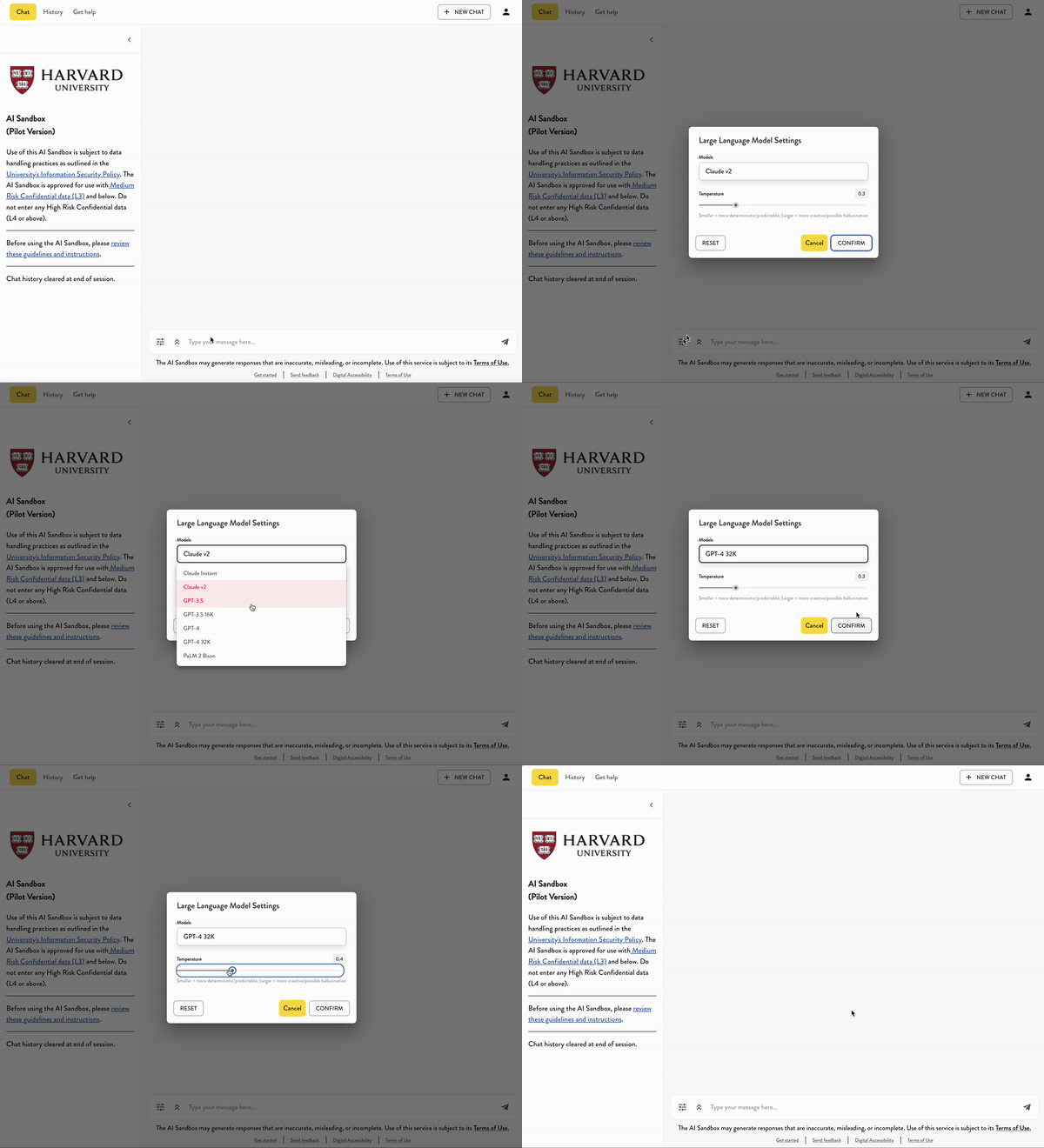
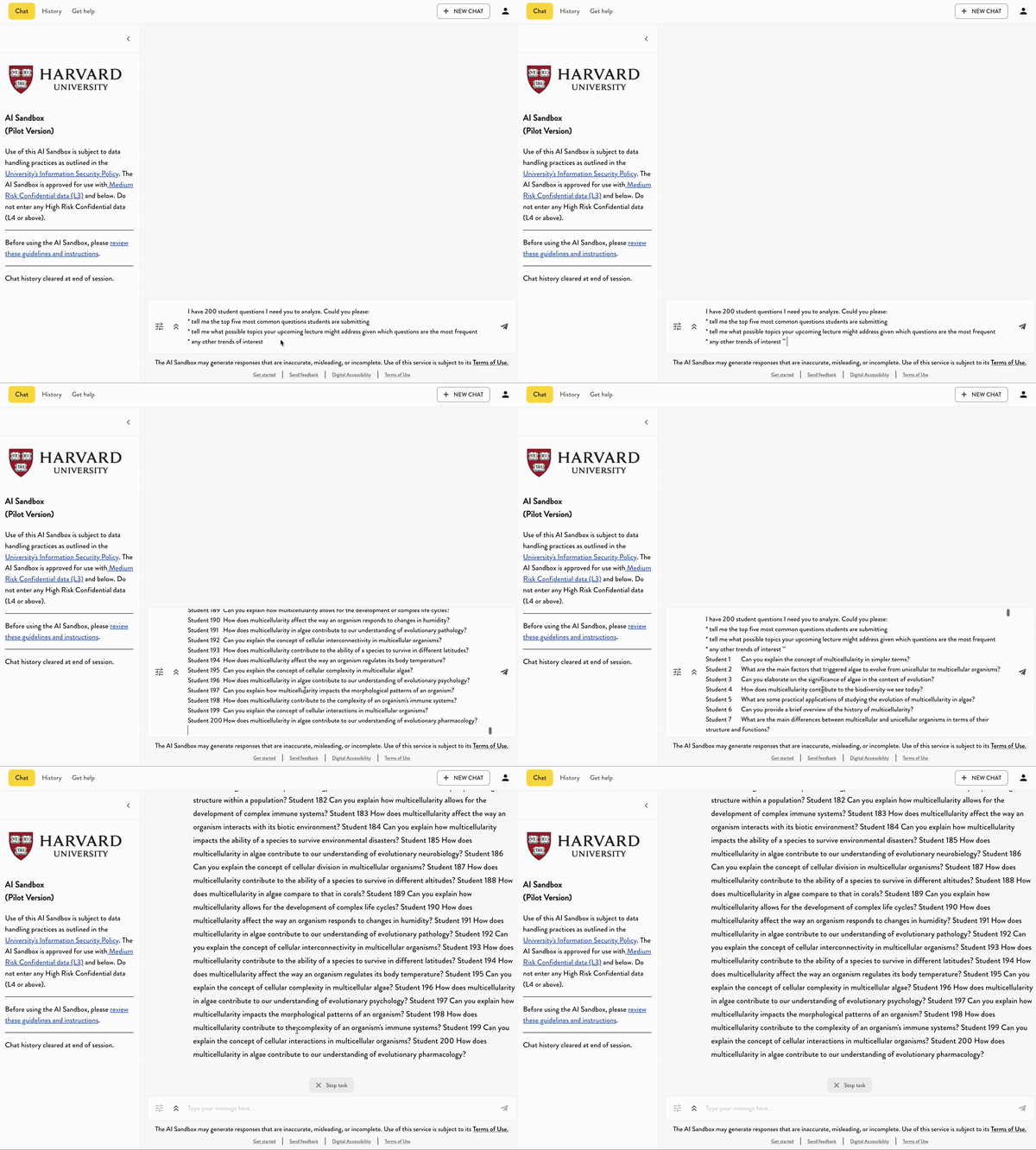
3. First, type your questions and/or your prompt for the AI. Remember:
* If you only hit Enter or Return, this will automatically submit your prompt.
* You can also add three ticks (''') to indicate a paragraph break if you prefer.
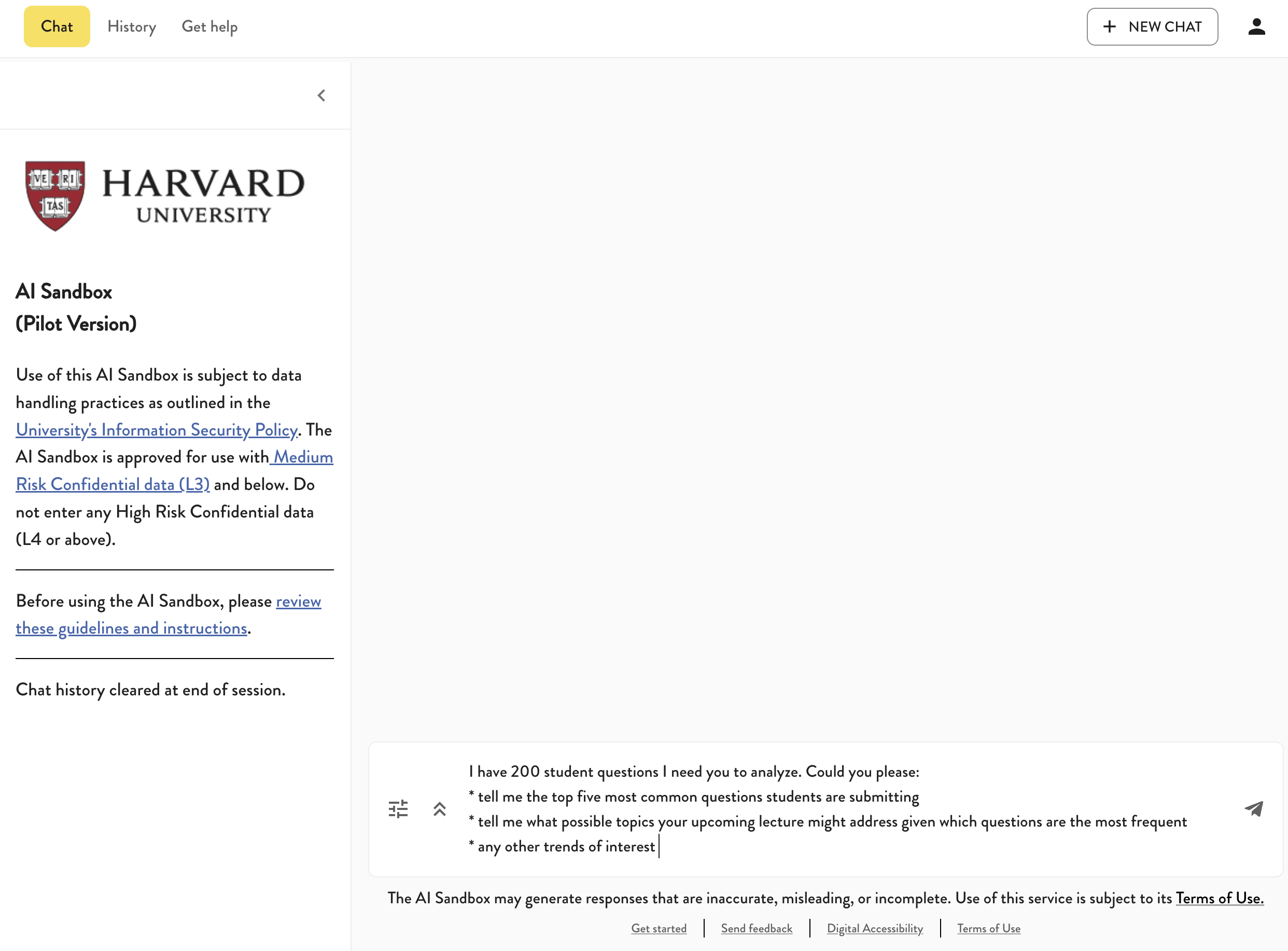
4. For this activity, ask chatGPT to
* tell you the top five most common questions students are submitting
* tell you what possible topics your upcoming lecture might address given which questions are the most frequent
---
## TRANSCRIPT OF ACTIVITY EXAMPLE:
* USER:
* I have 200 student questions I need you to analyze. Could you please:
* tell me the top five most common questions students are submitting
* tell me what possible topics your upcoming lecture might address given which questions are the most frequent
* any other trends of interest
* [polling data - STEM](https://docs.google.com/document/d/1ZSBeSNBJDrePjLLuNI-Oag0r6Yts7FcPmhPv1y_3Bz8/edit)
* AI:
* After analyzing the student questions, here are the top five most common questions:
* Can you explain the concept of multicellularity in simpler terms?
* What are the main factors that triggered algae to evolve from unicellular to multicellular organisms?
* Can you elaborate on the significance of algae in the context of evolution?
* How does multicellularity contribute to the biodiversity we see today?
* What are some practical applications of studying the evolution of multicellularity in algae?
* Given these questions, your upcoming lecture might address the following topics:
* The concept of multicellularity: This includes a simple explanation of multicellularity, the differences between multicellular and unicellular organisms, and the significance of multicellularity in biodiversity.
* The evolution of multicellularity in algae: You could discuss the factors that triggered this evolution, how algae's multicellularity compares to that of other organisms, and the stages in this evolution.
* The implications of multicellularity: This could cover the challenges and advantages of multicellularity, how it affects an organism's lifespan and behavior, and its role in natural selection and evolution.
* The practical applications and significance of studying multicellularity: This might involve discussing how the study of multicellularity in algae contributes to various fields like evolutionary biology, cellular biology, and biochemistry, and its practical applications.
* Other trends of interest include a focus on the role of multicellularity in the survival and proliferation of species, the impact of the environment on the evolution of multicellularity, and the relationship between multicellularity and the complexity of an organism's structure and functions. There's also a recurring interest in the study of algae as a key to understanding multicellularity and evolution.
---
## TRANSCRIPT OF ACTIVITY EXAMPLE: HUMANITIES
* USER:
* I have 200 student questions I need you to analyze. Could you please:
* tell me the top five most common questions students are submitting
* tell me what possible topics your upcoming lecture might address given which questions are the most frequent
* any other trends of interest
* [polling data - humanities](https://docs.google.com/document/d/1d4berRlI1to1AYkOAQKyVFi-L3PsTux4DpRL3SvbWM0/edit)
* AI:
* Analyzing the 200 student questions, the top five most common themes are:
* The influence of Renaissance socio-political climate on sculpture: This theme is prevalent in questions about how the humanist movement, the rise of individual artist celebrities, and changing political ideologies influenced Renaissance sculpture.
* The technical aspects of Renaissance sculpture: Many questions focus on the materials used, the techniques developed, and the challenges faced by sculptors in representing various concepts.
* The role of patronage in shaping Renaissance sculpture: Questions frequently mention the Medici family, the Catholic Church, and the rise of private patronage, indicating a strong interest in how patronage affected the art of the period.
* The representation of the human figure in Renaissance sculpture: There are numerous questions about how sculptors represented the human figure in various states, reflecting changing perceptions of the human body, emotion, motion, and age.
* The intersections between sculpture and other disciplines or practices: Students seem curious about how sculpture intersected with architecture, printmaking, emerging scientific practices, and even modes of transportation.
* Given these common questions, your upcoming lecture might address the following topics:
* The socio-political context of the Renaissance and its impact on sculpture.
* The evolution of sculpting techniques and materials during the Renaissance.
* The role of patronage in Renaissance art, focusing on key patrons like the Medici family and the Catholic Church.
* The representation of the human figure in Renaissance sculpture, including the influence of human anatomy studies and the concept of contrapposto.
* The intersections of sculpture with other disciplines, such as architecture, printmaking, and emerging scientific practices.
* Other trends of interest include the frequent mention of specific artists like Donatello and Michelangelo, indicating a strong interest in the works of these individual artists. There's also a recurring theme of change, with many questions asking about how various aspects of sculpture evolved during the Renaissance, reflecting the period's dynamic nature.
 Sign in with Wallet
Connect another wallet
Sign in with Wallet
Connect another wallet