# Explain or define terms and concepts

prompt used: "Explain or define terms"
## description
AI tools can provide working definitions for key terms and concepts in a given field of study. Students could use AI to help them define unfamiliar terms and then ask follow-up questions to get more clarity or to understand the relationship between a particular term and an overarching concept. This activity would make use of AI's tutor-like capacities and allow students to focus more on asking advanced questions during office hours and lecture.
## activity
1. Log into chatGPT using the Harvard AI Sandbox
2. From search bar at the bottom of the page, specify whichever AI tool you'd like to use.

4. First, type your questions and/or your prompt for the AI. Remember:
* If you only hit Enter or Return, this will automatically submit your prompt.
* You can also add three ticks (''') to indicate a paragraph break if you prefer.
5. For this activity, ask chatGPT (or whichever tool you choose) to define a key term in your particular discipline.
* Ask the AI to provide you with a definition of this term or concept
* Then prompt it with at least two follow-up questions that go into further detail about this term or concept
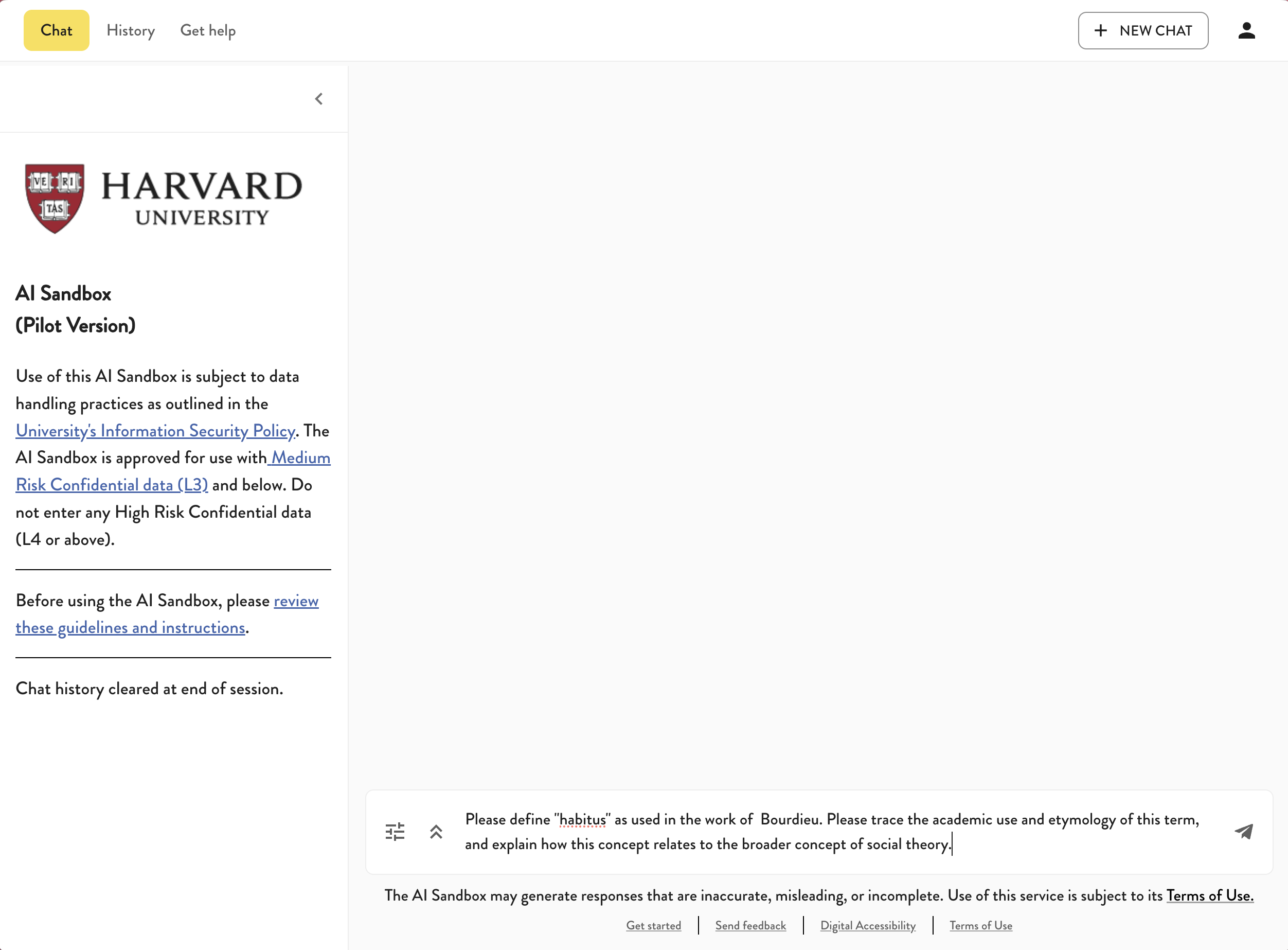
---
## Transcript of activity example:
* USER:
* Please define "habitus" as used in the work of Bourdieu. Please trace the academic use and etymology of this term, and explain how this concept relates to the broader concept of social theory.
* AI:
* "Habitus" is a central concept in the work of French sociologist Pierre Bourdieu. It refers to the deeply ingrained habits, skills, and dispositions that individuals possess due to their life experiences. These dispositions are shaped by past events and structures, and they shape current practices and structures and also the perception and understanding of these practices. In other words, habitus is the way individuals perceive the social world around them and react to it, and these perceptions are shaped by their positions in that world.
The term "habitus" itself has a long history in academic discourse, dating back to Aristotle, who used it to refer to the condition or state of the body. In the Middle Ages, it was used in a similar way to refer to a person's physical and moral characteristics. However, Bourdieu gave the term a new, sociological meaning in his work in the 1970s and 1980s, particularly in his book "Outline of a Theory of Practice" (1972) and "The Logic of Practice" (1980).
In relation to the broader concept of social theory, habitus is a key element in Bourdieu's attempt to bridge the divide between objectivism and subjectivism. Objectivism, in this context, refers to the idea that social structures determine individuals' behaviors, while subjectivism refers to the idea that individuals have free will and make their own choices. Bourdieu's concept of habitus attempts to reconcile these two perspectives by suggesting that individuals' behaviors are shaped by both their personal dispositions (subjectivism) and the social structures in which they exist (objectivism).
Bourdieu's concept of habitus has been influential in many areas of social theory, including cultural studies, education, and sociology. It has been used to explain how social structures are reproduced and how individuals navigate these structures. It has also been criticized for being too deterministic and for not adequately accounting for individual agency. However, it remains a key concept in Bourdieu's work and in social theory more broadly.
 Sign in with Wallet
Connect another wallet
Sign in with Wallet
Connect another wallet